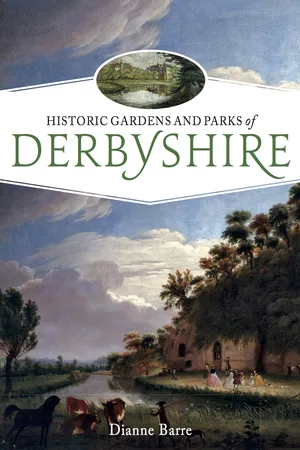
The open hilly terrain of much of Derbyshire has long been a challenge to gardeners and landscapers, but has produced some spectacular walled and terraced gardens. Wealthy aristocrats created important and unusual pleasure gardens including the famous Bess of Hardwick, the Earl of Newcastle and his Venus garden at Bolsover, the Whig Dukes of Devonshire at Chatsworth and their Tory rivals Lords Scarsdale of Kedleston and the Earl of Harrington with his extravagant and secret Elysium garden at Elvaston Castle. Mineral wealth, including ore and coal, produced wealthy manufacturers and businessmen who created their own fashionable and expensive gardens to compete with established county wealth. These included the fabulously wealthy Arkwright family of Willesley Castle and Joseph Whitworth at Stancliffe. In this lavishly illustrated and lively new study Dianne Barre looks not just at such beautifully restored and accessible gardens as Haddon, Melbourne and Renishaw but also lost gardens and parks at Swarkeston, Knowle Hill, Sutton Scarsdale, Wingerworth and Drakelow and considers the importance of gardens at Derbyshire Spa towns. There are many surprises as the author re-examines the fashionable, the quirky, the accessible and the lost and little known.
- 272 pages
- English
- ePUB (mobile friendly)
- Available on iOS & Android
eBook - ePub
About this book
Trusted by 375,005 students
Access to over 1 million titles for a fair monthly price.
Study more efficiently using our study tools.
Information
Subtopic
ArchaeologyIndex
Social SciencesCHAPTER ONE
Introduction: Derbyshire gardens 1570–1920
The Garden maker is striving not for himself alone but for those who are to come after.
From the wide choice of gardens and parks in Derbyshire nearly 100 have been selected including many owned by established families, industrialists and businessmen. Both for the aristocratic Cavendishes and Curzons, and wealthy manufacturers such as the Arkwrights and Strutts, their pleasure grounds played a significant role in their social aspirations and social life. The latter acquired country estates having made their fortunes and became part of the establishment. Derbyshire is rich in minerals, coal, gritstone, alabaster, iron and lead, bringing wealth not only to entrepreneurs but also to established landowning families such as the Hunlokes, Mundys and Sitwells. This provides a very interesting mix of personalities, ambitions and challenges. However we start the story of Derbyshire gardens with a background miscellany.
Many country house gardens were based on a practical and down-to-earth emphasis on attractive productivity. So when Smalley Hall, a modest but attractive newly built country house, was offered to let in April 1764 with ‘Land fitting for a Gentleman’, the advert mentioned two fishponds, orchard and two gardens, ‘wall’d with brick planted with the choicest fruit’: that is ornamental utility.1 In 1799 a property near Ashbourne was on the market and the auctioneer carefully mixed the appeal of the ‘delightful prospect’, with the suggestion that a nearby waterfall, ‘near twenty feet high, and supplied by a fluent brook,’ would be ‘very advantageous to erect a manufactory thereon’.2 When Ashbourne Hall and its parkland were for sale in 1846, to attract the ‘Gentleman of private fortune’ the agent extolled the virtues of its position near the parish church and the romantic scenery of Dove Dale. Then more prosaically he moved to attract the ‘eminent merchant’, noting the proximity of the railway station and that part of land could be adapted for the erection of a manufactory, ‘or any premises of magnitude without obstructing the delightful views from the mansion’.3
The open and often wild hilly terrain of much of Derbyshire produced the obvious response of terraced gardens within protective walls. Indeed the walled garden hardly went out of fashion in the county. A ready supply of local stone, combined with terracing meant that the Italian style garden was at home here. There was no rush to demolish garden walls in the mid-eighteenth century, although fashionable open lawns crept up to larger country houses such as Chatsworth and Kedleston. When, two generations later, terraces and flowerbeds became popular once again nationally, effectively they had never gone out of fashion in Derbyshire. Later the Arts and Crafts gardens, with their walls, terracing and pergolas, meant that many of its smaller gardens were easily very up-to-date. Derbyshire is fortunate in the survival and current restoration of several of these fine walled gardens, although in other ways the twentieth century was not so kind. A number of county house gardens and parks survive as public parks, with or without their house. The result can be a somewhat bland and soul-less landscape, since the focal point, the house, has gone, as at Darley, Markeaton and Shipley. The stunted remains of the halls at Allestree, Alfreton and Ashbourne are hardly any better. Yet even this is preferable to the destruction of Osmaston Hall, Derby, replaced by an industrial estate or Drakelow Hall, demolished for a power station.

FIGURE 1. Holme Hall, Bakewell, terraces summer house and walls 1670s.
COURTESY J. STANSFIELD
COURTESY J. STANSFIELD
For many years Derbyshire was not easily accessible and visitors responded differently over the years, from John Taylor in 1639: ‘most dangerous ways, stony, craggy, with inaccessible hills and mountains,’ to Mrs Thrale in 1774: ‘The Triumphs of Art and Nature are surely all exhibited in Derbyshire’.4 In 1745 the Rev. Nixon was ‘agreeably surprised’ to find that the Peak District had ‘exceeding good roads’, pure air, rich valleys and polite inhabitants.5 Yet in 1747 Lady Sophia Newdigate, travelling towards Buxton, was unenthusiastic:
Through the most uninhabited hill Bleak Country yt can be Conceived for many miles without ye sight of a Tree or even a shrub not a house or anything appeared to convince us we were not the first of all living things that ever ventur’d there.6
In 1755 Resta Patching took four hours to cover the six miles (9.6 km) between Chesterfield and Chatsworth, and his chaise had to be repaired three times on his Derbyshire travels because of the poor condition of the roads.7 Yet tourists were undeterred and even local gentry enjoyed the scenery as when Sir Robert Burdett of Foremark Hall made ‘a jaunt into ye Peake’ in July 1759.8 Visitors were amazed at the wild countryside even before the Picturesque Movement gained momentum, as shown in the 1740s engravings by T. Smith of Derby, where well-dressed viewers admire the wild scenery. Mrs Thrale’s report on her visit to Reynard’s Cave Dovedale (1774) shows that the frissons usually associated with the wild and picturesque scenery of the Wye Valley and the Lakes were just as applicable to Derbyshire:
We were shown another precipe the sight of which so frightened somebody that she fainted at the view, and must have fallen headlong had not a gentleman present caught hold of her suddenly and saved her life.9

FIGURE 2. A View of Reynards Cave in Dovedale, print 1770.
AUTHOR’S COLLECTION
AUTHOR’S COLLECTION
By then Derbyshire was on the tourist route for its wild romantic scenery and fearsome, awesome caves. When Arthur Young published his Tour (1771) he enthused about the wooded precipes of a valley down to the river. His descriptions include ‘gloomy’, ‘picturesque’, ‘beautiful’, ‘striking landscape’, ‘The roar of the falls in the river is fine’.10 A hundred years later travel writers were still extolling the charms of Dovedale with ‘its picturesque beauties ... gorgeous woods, its magnificent rocks, its beautiful river, and the wondrous variety of its scenery.’11
By the late seventeenth century the ‘genteel’ visitor had access to certain of the larger private ...
Table of contents
- Cover
- Title
- Copyright
- Contents
- Preface
- Acknowledgements
- 1. Introduction: Derbyshire gardens 1570–1920
- 2. The Enclosed Garden 1580–1700
- 3. Early Eighteenth Century: From formal garden to ferme ornée
- 4. Capability Brown and William Emes
- 5. Late Eighteenth Century 1760–1800
- 6. Caves, Hermitages and Grottos
- 7. Early Nineteenth Century: Regency to early Victorian gardens
- 8. The Early to Mid-Victorian Period: Reclamation, rockwork, conservatories
- 9. A Victorian Miscellany, Including Designers from Loudon to Sitwell
- 10. The Spas: Matlock Bath, Matlock Bank, Bakewell, Buxton, Derby, Ilkeston
- 11. Edwardian Gardens
- 12. A Miscellany of Gardeners and Nurserymen
- Postscript: Three Modern Gardens
- Bibliography
- Plate section
Frequently asked questions
Yes, you can cancel anytime from the Subscription tab in your account settings on the Perlego website. Your subscription will stay active until the end of your current billing period. Learn how to cancel your subscription
No, books cannot be downloaded as external files, such as PDFs, for use outside of Perlego. However, you can download books within the Perlego app for offline reading on mobile or tablet. Learn how to download books offline
Perlego offers two plans: Essential and Complete
- Essential is ideal for learners and professionals who enjoy exploring a wide range of subjects. Access the Essential Library with 800,000+ trusted titles and best-sellers across business, personal growth, and the humanities. Includes unlimited reading time and Standard Read Aloud voice.
- Complete: Perfect for advanced learners and researchers needing full, unrestricted access. Unlock 1.4M+ books across hundreds of subjects, including academic and specialized titles. The Complete Plan also includes advanced features like Premium Read Aloud and Research Assistant.
We are an online textbook subscription service, where you can get access to an entire online library for less than the price of a single book per month. With over 1 million books across 990+ topics, we’ve got you covered! Learn about our mission
Look out for the read-aloud symbol on your next book to see if you can listen to it. The read-aloud tool reads text aloud for you, highlighting the text as it is being read. You can pause it, speed it up and slow it down. Learn more about Read Aloud
Yes! You can use the Perlego app on both iOS and Android devices to read anytime, anywhere — even offline. Perfect for commutes or when you’re on the go.
Please note we cannot support devices running on iOS 13 and Android 7 or earlier. Learn more about using the app
Please note we cannot support devices running on iOS 13 and Android 7 or earlier. Learn more about using the app
Yes, you can access Historic Gardens and Parks of Derbyshire by Dianne Barre in PDF and/or ePUB format, as well as other popular books in Social Sciences & Archaeology. We have over one million books available in our catalogue for you to explore.