Purple dye is extracted from the glands of the molluscs Hexaplex trunculus, Bolinus Brandaris and Stramonita Haemastoma which, through a chemical reaction of photosynthesis, produces hues ranging from dark red to bluish purple colour. The importance of purple dye since ancient times as a status symbol, a sign of royal and religious power is well documented. Less well known is sea silk, a precious fibre derived from the tufts of the pen shell, Pinna nobilis, a UNESCO protected species, with which the mollusc anchors itself to the seabed. These tufts, once cleaned and bleached, take the aspect of golden thread. Only a handful of artisans on Sardinia still have the knowledge of how to work these fibres, the knowledge having been transmitted orally for generations.
In this new review of latest research, 17 papers concentrate on two marine resources used in ancient textile manufacture: shellfish purple dye and sea silk. Papers include the study of epigraphical and historical sources, practical experiments, as well as, highlighting the presence of purple dye in the Mediterranean area in the archaeological data and in new research contexts; linguistic issues pertaining to terminology, archaeological investigation, the study of the physical and chemical properties of sea silk and the step-by-step practical working of sea silk fibres.
The comprehensive multifaceted overview makes this collection a valuable resource for anyone interested in ancient textiles, dyes and textile technology.
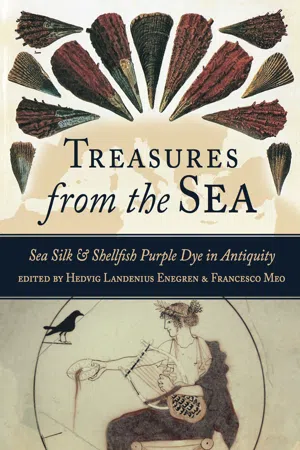
eBook - ePub
Treasures from the Sea
Purple Dye and Sea Silk
- 224 pages
- English
- ePUB (mobile friendly)
- Available on iOS & Android
eBook - ePub
Treasures from the Sea
Purple Dye and Sea Silk
About this book
Information
Subtopic
European HistoryIndex
Social SciencesTable of contents
- Front Cover
- Half-Title Page
- Title Page
- Copyright Page
- Contents
- 1. Introduction
- 2. Byssus and sea silk: a linguistic problem with consequences
- 3. Morphology, Properties and Microscopical Identification of Sea Silk
- 4. Tangled threads. Byssus and sea silk in the Bronze Age: an interdisciplinary approach
- 5. Finds of Pinna nobilis, Hexaplex trunculus and evidence for specialized textile production in Aetolian Chalkis
- 6. Taras and sea silk
- 7. Dal bisso grezzo al filato di bisso/From raw sea silk to byssus thread
- 8. Dyeing wool and sea silk with purple pigment from Hexaplex trunculus
- 9. Recent advances in the understanding of the chemistry of Tyrian purple production from Mediterranean molluscs
- 10. Mari(ne) purple: western textile technology in Middle Bronze Age Syria
- 11. The spread of purple dyeing in the Eastern Mediterranean – a transfer of technological knowledge?
- 12. Sacred colours: purple textiles in Greek sanctuaries in the second half of the 1st millennium BC
- 13. “A Lydian chiton with a purple fringe ...”: The gift of the garment to the Hera of Samos and Hera of Sele
- 14. Purple for the masses? Shellfish purple-dyed textiles from the quarry workers’ cemetery at Strozzacapponi (Perugia/Corciano), Italy
- 15. Historical outline and chromatic properties of purpura rubra Tarentina and its potential identification with purple dye extracted from Bolinus brandaris
- 16. “Purple Wars”: fishing rights and political conflicts concerning the production of marine dyes in Hellenistic Greece
- 17. Purpurarii in the Western Mediterranean
Trusted by 375,005 students
Access to over 1.5 million titles for a fair monthly price.
Study more efficiently using our study tools.
Frequently asked questions
Yes, you can cancel anytime from the Subscription tab in your account settings on the Perlego website. Your subscription will stay active until the end of your current billing period. Learn how to cancel your subscription
No, books cannot be downloaded as external files, such as PDFs, for use outside of Perlego. However, you can download books within the Perlego app for offline reading on mobile or tablet. Learn how to download books offline
Perlego offers two plans: Essential and Complete
- Essential is ideal for learners and professionals who enjoy exploring a wide range of subjects. Access the Essential Library with 800,000+ trusted titles and best-sellers across business, personal growth, and the humanities. Includes unlimited reading time and Standard Read Aloud voice.
- Complete: Perfect for advanced learners and researchers needing full, unrestricted access. Unlock 1.5M+ books across hundreds of subjects, including academic and specialized titles. The Complete Plan also includes advanced features like Premium Read Aloud and Research Assistant.
We are an online textbook subscription service, where you can get access to an entire online library for less than the price of a single book per month. With over 1.5 million books across 990+ topics, we’ve got you covered! Learn about our mission
Look out for the read-aloud symbol on your next book to see if you can listen to it. The read-aloud tool reads text aloud for you, highlighting the text as it is being read. You can pause it, speed it up and slow it down. Learn more about Read Aloud
Yes! You can use the Perlego app on both iOS and Android devices to read anytime, anywhere — even offline. Perfect for commutes or when you’re on the go.
Please note we cannot support devices running on iOS 13 and Android 7 or earlier. Learn more about using the app
Please note we cannot support devices running on iOS 13 and Android 7 or earlier. Learn more about using the app
Yes, you can access Treasures from the Sea by Hedvig Landenius Enegren, Francesco Meo, Hedvig Landenius Enegren,Francesco Meo in PDF and/or ePUB format, as well as other popular books in Social Sciences & European History. We have over 1.5 million books available in our catalogue for you to explore.