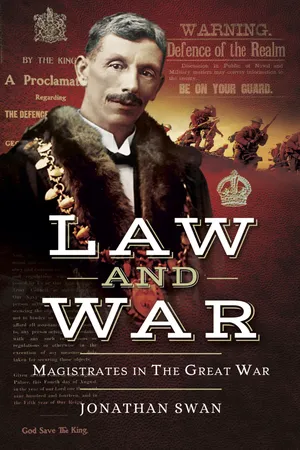
The office of justice of the peace has existed since the twelfth century, when 'good and lawful men' were first appointed to sit in judgment of their peers. Unpaid and untrained, these lay magistrates were the backbone of the English judicial system, dealing with the vast majority of criminal cases in the police courts and the petty sessions. By the start of the twentieth century, social attitudes were changing and the magistrates, drawn from the wealthier classes, were seen as out of touch with the communities they served. The new Liberal Government of 1906 instituted reforms, which allowed the appointment of the working classes.Then came the Great War. Within days of the outbreak of hostilities, the government introduced the Defence of the Realm Act. With several amendments over the years, this all-encompassing legislation resulted in the creation of hundreds of subsidiary regulations, many of which affected the lives of ordinary people in a way they had never expected.Many, including magistrates themselves, fell foul of the myriad orders, covering billeting, licensing, lighting and rationing, which were enforced by the new special constables. At the same time, the conscription of the 'criminal classes' saw a huge fall in the normal workload of the courts, and the closure of many prisons.The magistrates responded as best they could. Some magistrates went to war; some lost their lives. Others served in the many voluntary organizations and committees that appeared across the country, such as the Military Service Tribunals or the Volunteer Corps.The end of the war saw a further change to the old order when the first women magistrates were appointed, marking the birth of modern magistracy.
- 288 pages
- English
- ePUB (mobile friendly)
- Available on iOS & Android
eBook - ePub
About this book
Information
Subtopic
Military & Maritime HistoryIndex
HistoryTable of contents
- Cover
- Title
- Copyright
- Contents
- List of Plates
- Preface by His Honour Richard Seymour QC
- Introduction
- Chapter 1 Summary Justice 1914
- Chapter 2 Fourteen Days, with Hard Labour
- Chapter 3 Transition to War
- Chapter 4 Civil, Military and Martial Law
- Chapter 5 Dear Old DoRA
- Chapter 6 The Enemy Within
- Chapter 7 Down at the Old Bull and Bush
- Chapter 8 How Bright is ‘Bright’
- Chapter 9 What Did You Do in the War, Daddy?
- Chapter 10 And What Did You Do in the War, Mummy?
- Chapter 11 Is Tea a Food?
- Chapter 12 Business as Usual
- Chapter 13 Lessons Learned
- Notes
- Plate section
Trusted by 375,005 students
Access to over 1.5 million titles for a fair monthly price.
Study more efficiently using our study tools.
Frequently asked questions
Yes, you can cancel anytime from the Subscription tab in your account settings on the Perlego website. Your subscription will stay active until the end of your current billing period. Learn how to cancel your subscription
No, books cannot be downloaded as external files, such as PDFs, for use outside of Perlego. However, you can download books within the Perlego app for offline reading on mobile or tablet. Learn how to download books offline
Perlego offers two plans: Essential and Complete
- Essential is ideal for learners and professionals who enjoy exploring a wide range of subjects. Access the Essential Library with 800,000+ trusted titles and best-sellers across business, personal growth, and the humanities. Includes unlimited reading time and Standard Read Aloud voice.
- Complete: Perfect for advanced learners and researchers needing full, unrestricted access. Unlock 1.5M+ books across hundreds of subjects, including academic and specialized titles. The Complete Plan also includes advanced features like Premium Read Aloud and Research Assistant.
We are an online textbook subscription service, where you can get access to an entire online library for less than the price of a single book per month. With over 1.5 million books across 990+ topics, we’ve got you covered! Learn about our mission
Look out for the read-aloud symbol on your next book to see if you can listen to it. The read-aloud tool reads text aloud for you, highlighting the text as it is being read. You can pause it, speed it up and slow it down. Learn more about Read Aloud
Yes! You can use the Perlego app on both iOS and Android devices to read anytime, anywhere — even offline. Perfect for commutes or when you’re on the go.
Please note we cannot support devices running on iOS 13 and Android 7 or earlier. Learn more about using the app
Please note we cannot support devices running on iOS 13 and Android 7 or earlier. Learn more about using the app
Yes, you can access Law and War by Jonathan Swan in PDF and/or ePUB format, as well as other popular books in History & Military & Maritime History. We have over 1.5 million books available in our catalogue for you to explore.