- 248 pages
- English
- ePUB (mobile friendly)
- Available on iOS & Android
eBook - ePub
About this book
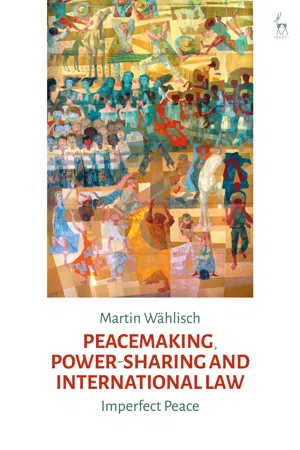
This monograph provides a contemporary analysis of the frictions between peacemaking and international human rights law based on the cases of postconflict power-sharing in Lebanon and Bosnia-Herzegovina. In this context it evaluates the long-standing debate in the United Nations and human rights bodies about the 'imperfect peace'. Written from a practitioner–scholarly viewpoint and drawing from new authentic sources, the book describes the mechanisms used in peace agreements and post-conflict constitutions for managing ethnic or religious diversity, explains their legal limits under international human rights law, and provides a conceptual framework for analysing the nexus between law and peacemaking. The book argues that the relationship between the content of peace agreements and post-conflict constitutions, their negotiation process and the element of time, needs to be untangled to better understand the legal limits of statebuilding in the aftermath of armed conflict. It is a key resource for scholars in human rights law and peace and conflict studies, advisers in peace processes, constitution-makers, and peace mediators.
Information
1
Introduction
I.State Transitions, Power-Sharing and International Law
In 2011, a series of uprisings hit the Middle East and Northern Africa. Like the Balkans in the 1990s, the Arab world has been facing the challenge of transformation, all while trying to manage confessional and ethnic diversity. Issues such as the political participation of minorities, the containment of extremism, as well as sectarian tensions continue to bear the potential of conflict in the region.
In 2012, in a keynote address in Beirut on reform and transition to democracy, the UN Secretary-General responded to the change in the region by calling for ‘a fair share of political power’ to balance interests.1 Yet, decisions by the European Court of Human Rights (ECtHR) and recommendations by the UN human rights monitoring bodies have affirmed that certain power-sharing systems can also infringe upon human rights.2 While consociational constitutions and peace settlements can bring about a pause in civil strife, enhance rights and state stability, they can lay the ground for renewed injustice, which can eventually lead to a relapse into armed conflict.3
In such cases of state transitions, international law is confronted with normative collisions between the right of self-determination, the right to life, the prohibition of discrimination and the prerogative of peace. The result has been described as ‘imperfect peace’, whose legal limits and necessity are the focus of this book.4
A.Peacemaking and Power-Sharing
Aiming to accommodate pluralism, power-sharing is globally a frequent element of peace agreements and constitutional frameworks, creating opportunities but also entailing shortcomings.
In the Balkans, the Dayton Peace Accords introduced a multi-layered state system based on ethnicity that ended one of Europe’s most ruthless civil wars at the end of the twentieth century while regenerating an unresolved cycle of conflict.5 Meanwhile, a secession of the mainly Serb-dominated Republika Srpska from Bosnia and Herzegovina is still under debate.6 A similar situation can be seen in Kosovo, where a split of constitutional power between the Albanian majority, the Serbian minority and other minorities did not fully calm down tension.7
In the Middle East, Lebanon is an example of the success but also the downsides of a consensus-driven democracy. Although the Taif Peace Agreement formally ended 15 years of civil war, the political stability and balance in the country is fragile, and remains to be affected by regional dynamics.8 Over the last years, there have been public demonstrations against the confessionalism system; yet formal and informal entrenched sectarian structures makes it difficult to overcome the conflict-prone past.9 At the same time, Lebanon has been considered as an exemplary model to guarantee some type of rough equity and communal security in the Arab region.10
On the African continent, new political arrangements appear on an ongoing basis, either to prevent or react to coups d’état.11 Power-sharing deals continue to be at the centre of peace talks and post-electoral contestations.12 In parallel, the African Union has responded by outlawing ‘unconstitutional changes of governments’ to counter the legitimization of unconstitutional seizure of power under the pretext of power-sharing.13
In South and Central Asia, a forthcoming endeavour will be a power-sharing pact in Afghanistan, now that there is growing support for negotiations with the Taliban.14 The political and legal modalities have been contested for a long time in this context.15 Eventually, such an agreement could erode what little trust there is in constitutional procedures.16
B.Imperfect Peace
Despite the precious moment of achieving an end to hostilities, peace accords and post-conflict constitutional solutions are frequently inadequate, facing unfulfilled demands and legal implications. Those participating in peace negotiations have characterised this fundamental dilemma in peacemaking as ‘imperfect peace’.
i.The Dayton Peace Agreement and Imperfect Peace
The topos ‘imperfect peace’ has been particularly present in the context of peacemaking and peacebuilding in the former Yugoslavia.17 US Ambassador Richard Holbrooke noted about the Dayton Peace Conference that when it ‘came down to the last few hours’, one ‘had to choose between an imperfect peace and a resumption of the war’.18 Tono Eitel, then Permanent Representative of Germany to the UN, commented that the Dayton Agreement came with ‘painful concessions’ for ‘all sides’, but has nevertheless been ‘a major achievement and an important step forward’.19 ‘Imperfect as it may be’, it represented ‘the best chance in a long time for a durable peace in the region’, he concluded.20 Nobody has been ‘entirely satisfied with the outcome’, but that ‘is a sign that the Agreement as a whole has a realistic basis’, remarked Eitel.21
The same thoughts were shared by other diplomats. The Malaysian Ambassador Razali stated that ‘the international community must stand behind President Izetbegovic and the Bosnians’ in order to ‘give peace, however imperfect or fragile, a chance to take root’.22 The Turkish UN Representative Baykal added later in a General Assembly debate:
Ending conflict and human suffering and then achieving peace without sacrificing justice constitute the most fundamental objective of humankind. Although the signing of the Dayton Peace Agreement and its imperfect implementation brought about peace and ended human suffering in the territory of former Yugoslavia, justice has not prevailed fully.23
In November 1995, Yugoslavia’s then Foreign Minister, Vladislav Jovanović, summarised in a hearing in the UN Security Council the day after the Dayton Peace Agreement was initialled:
This Peace Agreement is not a perfect one, something that can, indeed, be said of a great majority of the peace agreements concluded throughout history. It is a result of necessary and reasonable – although at times painful and difficult – compromises. All parties to the civil war and the Bosnian crisis have come to realize that an imperfect peace is better than a protracted and uncertain war and that only in peace can just goals be best achieved.24
Alija Izetbegović, the first President of Bosnia and Herzegovina, concluded later:
We who signed the Dayton/Paris Peace Agreement to establish peace have always understood it to be imperfect … In Dayton, our priority was to stop the killing, because there had been too much death. We believed that an imperfect peace would be better than a just war and that the natural integration of Bosnia and Herzegovina into the Euro-Atlantic family would help to overcome the shortcomings of such an initially unjust, as well as imperfect, peace.25
Since then, state representatives have increasingly referred to the term ‘imperfect peace’ when describing human rights compromises in peacemaking.
ii.Imperfection and the ‘Culture of Peace’
The matter of imperfection runs as a general theme through UN discussions. In a plenary session of the General Assembly, the President of Honduras, Carlos Roberto Flores Facussé, eloquently stated that:
The world’s age-old desire for a new world order based on peace, cooperation and fraternity between all countries rather than on a balance of arms between powerful and hegemonic States has already come to pass … That is why we must indeed acknowledge that, despite all its imperfections, the world has brought in a new world order at the end of this century and the dawn of the new, an order led by the United Nations …26
The Italian Foreign Minister Lamberto Dini joined in with the chorus by declaring that the Cold War ‘brought a precarious, imperfect peace’.27 In 1999, the UN Secretary-General described times of imperfect peace as a challenge for countries that ‘are caught in the grey and unpredictable zone between peace and war because of protracted conflicts or prolonged transitions to peace’.28 At the UN Millennium Summit in September 2000, Portugal’s Prime Minister António Guterres called on the international community to ‘perfect international law and the means for its implementation in order to protect, ever more effectively, the sovereignty of the individual and to frame properly the right of humanitarian intervention’.29
Similarly, the question of imperfect peace formed part of the discussion in the General Assembly about the ‘culture of peace’.30 In a session of the Security Council on post-conflict peace-building, the Slovenian Ambassador Danilo Türk made the following telling remark:
Making peace usually implies difficult choices, a fact of which the United Nations is intensely aware today … However, we should keep in mind the wisdom of the great European philosopher Erasmus, who explained in 1508 that ‘the most disadvantageous peace is better than the most just war’. This maxim is relevant to many contemporary conflicts and has a specific meaning: peace is a challenge. It can be disadvantageous from the standpoin...
Table of contents
- Cover
- Title Page
- Preface
- Contents
- List of Abbreviations
- Table of Cases
- Table of International Conventions, Treaties, Peace Agreements, Documents and Reports
- List of Figures and Tables
- 1. Introduction
- 2. Power-Sharing in Theory and Practice: Concepts, Mechanisms and Legal Challenges
- 3. Power-Sharing on Trial: Sejdić and Finci v Bosnia and Herzegovina
- 4. Through the Lens of Human Rights Committees: Lebanese Political Confessionalism and Transitional Mechanism
- 5. On the Law of Peace: Parameters, Challenges and Limits
- Appendix
- Bibliography
- Index
- Copyright Page
Trusted by 375,005 students
Access to over 1.5 million titles for a fair monthly price.
Study more efficiently using our study tools.
Frequently asked questions
Yes, you can cancel anytime from the Subscription tab in your account settings on the Perlego website. Your subscription will stay active until the end of your current billing period. Learn how to cancel your subscription
No, books cannot be downloaded as external files, such as PDFs, for use outside of Perlego. However, you can download books within the Perlego app for offline reading on mobile or tablet. Learn how to download books offline
Perlego offers two plans: Essential and Complete
- Essential is ideal for learners and professionals who enjoy exploring a wide range of subjects. Access the Essential Library with 800,000+ trusted titles and best-sellers across business, personal growth, and the humanities. Includes unlimited reading time and Standard Read Aloud voice.
- Complete: Perfect for advanced learners and researchers needing full, unrestricted access. Unlock 1.5M+ books across hundreds of subjects, including academic and specialized titles. The Complete Plan also includes advanced features like Premium Read Aloud and Research Assistant.
We are an online textbook subscription service, where you can get access to an entire online library for less than the price of a single book per month. With over 1.5 million books across 990+ topics, we’ve got you covered! Learn about our mission
Look out for the read-aloud symbol on your next book to see if you can listen to it. The read-aloud tool reads text aloud for you, highlighting the text as it is being read. You can pause it, speed it up and slow it down. Learn more about Read Aloud
Yes! You can use the Perlego app on both iOS and Android devices to read anytime, anywhere — even offline. Perfect for commutes or when you’re on the go.
Please note we cannot support devices running on iOS 13 and Android 7 or earlier. Learn more about using the app
Please note we cannot support devices running on iOS 13 and Android 7 or earlier. Learn more about using the app
Yes, you can access Peacemaking, Power-sharing and International Law by Martin Wählisch in PDF and/or ePUB format, as well as other popular books in Law & International Law. We have over 1.5 million books available in our catalogue for you to explore.