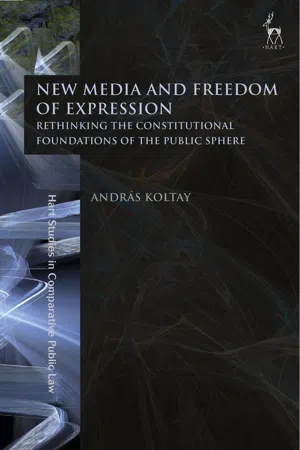
eBook - ePub
New Media and Freedom of Expression
Rethinking the Constitutional Foundations of the Public Sphere
- 224 pages
- English
- ePUB (mobile friendly)
- Available on iOS & Android
eBook - ePub
New Media and Freedom of Expression
Rethinking the Constitutional Foundations of the Public Sphere
About this book
The principles of freedom of expression have been developed over centuries. How are they reserved and passed on? How can large internet gatekeepers be required to respect freedom of expression and to contribute actively to a diverse and plural marketplace of ideas? These are key issues for media regulation, and will remain so for the foreseeable decades. The book starts with the foundations of freedom of expression and freedom of the press, and then goes on to explore the general issues concerning the regulation of the internet as a specific medium. It then turns to analysing the legal issues relating to the three most important gatekeepers whose operations directly affect freedom of expression: ISPs, search engines and social media platforms. Finally it summarises the potential future regulatory and media policy directions. The book takes a comparative legal approach, focusing primarily on English and American regulations, case law and jurisprudential debates, but it also details the relevant international developments (Council of Europe, European Union) as well as the jurisprudence of the European Court of Human Rights.
Information
1
The Foundations of Free Speech and Freedom of the Press
I.FREEDOM OF SPEECH IN THE AGE OF THE INTERNET
The theoretical foundations of free speech can be categorised in a number of ways. Eric Barendt puts these theories into four categories: discovering truth, self-fulfilment, citizen participation in a democracy and suspicion of government.1 A few decades earlier, Thomas Emerson came up with a very similar list, which included participation in decision-making on common matters, self-fulfilment, acquiring knowledge, discovering truth, and maintaining the balance between social stability and change (where debate is suppressed, coercion replaces arguments).2 Another scheme by Russell Weaver identified arguments for the protection of freedom of speech based on the theory of the democratic process, the marketplace of ideas, individual freedom and self-fulfilment, and the safety valve supporting social stability.3 Even when minor differences are taken into account, it is apparent that the various authors typically refer to the same theories when providing possible justifications for the freedom of speech, or to theories that only differ in certain regards, applying these well-entrenched ideas to more recent questions arising in respect of the use of the Internet. An overview of these theories will thus be a useful point of departure for this study.
A.Searching for the Truth
John Milton, the first modern theoretician of free speech, advocated both free speech and a free press, because restricting them might obstruct God’s will and love, preventing the flourishing of the ‘free and knowing spirit’.4 God gave man the freedom to live with this spirit appropriately. Man received the burden of responsibility, but if society restricts his individual freedom and choices, he will not be able to bear the burden. With the help of the gift of reason, everyone must choose independently and by himself from among the available options. ‘And yet, on the other hand, unless wariness be used, as good almost kill a man as kill a good book; who kills a man kills a reasonable creature, God’s image; but he who destroys a good book, kills reason itself, kills the image of God, as it were in the eye.’5
Milton firmly believed in the power of truth and that man, using God’s gifts, has the ability to find the truth in the debate of different views:
Give me the liberty to know, to utter, and to argue freely according to conscience, above all liberties … And though all the winds of doctrine were let loose to play upon the earth, so truth be in the field, we do injuriously by licensing and prohibiting to misdoubt her strength. Let her and falsehood grapple; who ever knew truth put to the worse, in a free and open encounter.6
Before identifying him as a liberal icon, let us not forget that Milton approached freedom of speech from a theological perspective and did not separate the discovery of truth from the intentions of divine providence.7 In line with this, he did not call for unrestricted freedom of the press. He insisted on censorship of the books of ‘Papist bigots’ and required consistent but ex post punishment for any abuse of the press. However, he found suppression of free speech in general to be unacceptable.
John Stuart Mill, the liberal English philosopher, laid down the classic foundations of freedom of speech, which are still cited very frequently today, in his essay On Liberty.8 For Mill, truth is a fundamental value that is recognisable, and its recognition is a prerequisite for social development. Nobody is infallible. We can never be absolutely certain that what we think to be the truth is indeed the truth. Limitation of free speech is therefore impermissible, because a restricted opinion might carry the truth.9 As such, tolerance of varying opinions is necessary, even when they contradict a genuinely true position, because in the absence of constant debate such a view becomes the unchallenged truth, will be accepted only out of habit, and becomes petrified, dead dogma. Moreover, before being recognised, the truth must suffer repeated persecution, and, although it is a ‘pious lie’ that truth prevails despite all persecution, ‘in the course of ages there will generally be found persons to rediscover it … until it has made such head as to withstand all subsequent attempts to suppress it’.10 Hence, free debate also serves the truth that has already been recognised. Beyond this useful function, free speech also belongs to the domain of the individual’s freedom, and, as such, it cannot be restricted unless its practice harms others.11 Mill believes in the individual, whose noble task is to develop his faculties as much as possible. However, even in his strong individualist views, Mill recognises that there is also a place for the interest of the community, the development of which requires the recognition of truth.
Mill’s theory assumes that the publication of a possibly true opinion is of the greatest societal importance in all circumstances. However, there may be a number of situations in which the protection of other interests would seem to be more important than the declaration of the potential truth. Mill probably overvalues the role of public debate in society, since, even if there is complete freedom, only a fraction of the people participate. For the majority, expressing their opinion is not important at all, and they do not necessarily care which opinion prevails in a given debate. They perhaps do not even care what the ‘truth’ is. Even participants in a debate do not necessarily formulate or modify their opinion based on reason or proper consideration of arguments and counter-arguments. Short-term interests, such as, for example, the protection of public peace and public order, may override the aim of discovering the truth, because in most cases that is a long and not necessarily successful process.
Open debate does not necessarily lead to the truth or to better individual or public decisions. While in certain institutions free opinion may generally ensure that correct decisions are taken (for example in universities and research organisations on scientific matters), this cannot be automatically extended to the whole of society. Fortunate is the community in which the means for discussing the truth are freely accessible (free media, democratically elected parliament, etc), but these can be just as effectively employed to prevent the truth from being revealed.12
Further developments of Mill’s theory are discernible in Abrams v the United States, a landmark freedom-of-speech decision of the United States (US) Supreme Court.13 Ironically, it was not the judgment itself but the dissenting opinion of the legendary Supreme Court judge Justice Oliver Wendell Holmes that became a legal classic. According to Holmes, ‘the ultimate good desired is better reached by free trade in ideas – that the best test of truth is the power of the thought to get itself accepted in the competition of the market’.14
The ‘marketplace of ideas’ metaphor, based on Mill’s theory but coined by Justice Holmes and used by the Court in their deliberations, had a great effect on the development of the right to freedom of speech in the US. Later, based on this, the Supreme Court overturned a number of regulations and court decisions that allowed state infringement of freedom of speech, quoting the unrestrictability of the ‘market’. According to this view, the only possible way leading to the truth is through the creation of a free marketplace of ideas, the principal potential enemy of which is the state (the government).
There are also grounds for criticising Holmes’s view, however. In his analysis, the concept of truth is highly relative and the truth is the view that emerges victorious from market competition. In this vision, does objective truth exist at all? The person of today tends to believe in it less and less, but even if objective truth does exist, open debate on public affairs is absolutely necessary to find it. Nevertheless, the theory on searching for the truth has strangely gathered momentum in the so-called ‘Fake News Debate’, which started during the presidential campaign in the US in 2016.15
B.Operation of Democracy
According to Alexander Meiklejohn, the primary objective and purpose of the right to free speech is citizens’ participation in the debate of and decisions on public affairs.16 Hence, the purpose of laws on free speech is to ensure opportunities for democratic self-government and decision-making. Participation must be effective, and this effectiveness can be achieved only with the establishment of certain rules.
We have to differentiate between various opinions based on their content: opinions relating to political debate (here interpreted widely, with ‘politics’ encompassing all public matters) enjoy special protection, while those not necessary for decision-making in public affairs may be more strictly limited. This theory considers freedom of speech primarily as an instrument. The desired objective is not to reach a higher ideal but to ensure the proper operation of society, which, in democratic systems, is impossible without extensive and public decision-making.
The most frequent criticism is that this theory leaves ‘non-political speech’, which does not contribute to the expression of democratic will, defenceless. Meiklejohn soon refined the group of opinions he found worthy of protection. This includes any views connected to education, philosophy, science, literature and the arts, as well as opinions emerging from any debates on public affairs, which are protectable in the name of democratic foundations.17 Reading works of literature, for example, increases the knowledge of the individual who, in turn, will participate more effectively in public debate. The original version of the theory was criticised because it was overly narrow, while its refined version was judged to be limitlessly broad.18
Judge Robert Bork drew stricter limits. He asserts that if we want to assign real and enforceable substance to the right of freedom of speech, it can only and exclusively include ‘political speech’, the purpose of which is to contribute to decisions over public affairs. Although he acknowledges that literature plays an important role in public decision-making, he believes that t...
Table of contents
- Cover
- Title Page
- Acknowledgements
- Table of Contents
- List of Abbreviations
- Table of Cases
- Introduction
- 1. The Foundations of Free Speech and Freedom of the Press
- 2. The Regulation of the Internet and its Gatekeepers in the Context of the Freedom of Speech
- 3. Internet Service Providers
- 4. Search Engines
- 5. Social Media Platforms
- 6. Gatekeepers’ Responsibility for Online Comments
- 7. The Future of Regulating Gatekeepers
- Index
- Copyright Page
Trusted by 375,005 students
Access to over 1.5 million titles for a fair monthly price.
Study more efficiently using our study tools.
Frequently asked questions
Yes, you can cancel anytime from the Subscription tab in your account settings on the Perlego website. Your subscription will stay active until the end of your current billing period. Learn how to cancel your subscription
No, books cannot be downloaded as external files, such as PDFs, for use outside of Perlego. However, you can download books within the Perlego app for offline reading on mobile or tablet. Learn how to download books offline
Perlego offers two plans: Essential and Complete
- Essential is ideal for learners and professionals who enjoy exploring a wide range of subjects. Access the Essential Library with 800,000+ trusted titles and best-sellers across business, personal growth, and the humanities. Includes unlimited reading time and Standard Read Aloud voice.
- Complete: Perfect for advanced learners and researchers needing full, unrestricted access. Unlock 1.5M+ books across hundreds of subjects, including academic and specialized titles. The Complete Plan also includes advanced features like Premium Read Aloud and Research Assistant.
We are an online textbook subscription service, where you can get access to an entire online library for less than the price of a single book per month. With over 1.5 million books across 990+ topics, we’ve got you covered! Learn about our mission
Look out for the read-aloud symbol on your next book to see if you can listen to it. The read-aloud tool reads text aloud for you, highlighting the text as it is being read. You can pause it, speed it up and slow it down. Learn more about Read Aloud
Yes! You can use the Perlego app on both iOS and Android devices to read anytime, anywhere — even offline. Perfect for commutes or when you’re on the go.
Please note we cannot support devices running on iOS 13 and Android 7 or earlier. Learn more about using the app
Please note we cannot support devices running on iOS 13 and Android 7 or earlier. Learn more about using the app
Yes, you can access New Media and Freedom of Expression by András Koltay in PDF and/or ePUB format, as well as other popular books in Law & Comparative Law. We have over 1.5 million books available in our catalogue for you to explore.