eBook - ePub
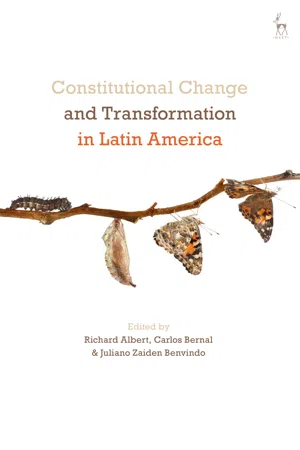
Constitutional Change and Transformation in Latin America
- 304 pages
- English
- ePUB (mobile friendly)
- Available on iOS & Android
eBook - ePub
Constitutional Change and Transformation in Latin America
About this book
Over the past 30 years, Latin America has lived through an intense period of constitutional change. Some reforms have been limited in their design and impact, while others have been far-reaching transformations to basic structural features and fundamental rights. Scholars interested in the law and politics of constitutional change in Latin America are turning increasingly to comparative methodologies to expose the nature and scope of these changes, to uncover the motivations of political actors, to theorise how better to execute the procedures of constitutional reform, and to assess whether there should be any limitations on the power of constitutional amendment. In this collection, leading and emerging voices in Latin American constitutionalism explore the complexity of the vast topography of constitutional developments, experiments and perspectives in the region. This volume offers a deep understanding of modern constitutional change in Latin America and evaluates its implications for constitutionalism, democracy, human rights and the rule of law.
Information
PART I
Popular and Populist Constitutional Democracy
1
Constitution-Making (without Constituent) Power: On the Conceptual Limits of the Power to Replace or Revise the Constitution
CARLOS BERNAL1
I.Introduction
Some scholars and judges claim that people can only make, replace or revise a constitution when they exercise the constituent power, that is, a power that is foundational, legally boundless, and sovereign. They identify the constitution-making power with the constituent power,2 or characterise it as one of its instances.3
This chapter argues against that view. It holds that the theory of the constituent power is only a conception or an understanding of the concept of the constitution-making power,4 and that such conception is incorrect, because of the characterisation of the constitution-making power as unlimited.
To justify this claim, this chapter carries out a conceptual analysis of a core instance of the constitution-making power, namely, the power to replace or revise constitutional texts. For this purpose, while ‘replacement’ will refer to the substitution of a constitutional text by another, ‘revision’ will designate the modification of the basic structure of a constitution by means of constitutional amendment. The analysis of this phenomena shows that the constitution-making power cannot be conceptually unlimited. Therefore, it cannot be understood according to the theory of the constituent power. Instead, this chapter advances an alternative conception of the constitution-making power, as a limited power, one that is based on recent developments in the field of social ontology.
This chapter proceeds in the follow way. Section II narrows down the scope of the analysis as the project to understand the nature of the constitution-making power. Section III accounts for the theory of the constituent power, and its judicial and doctrinal use as an attempt to justify constitutional replacements and revisions, and to ground substantive limitations to constitutional amendments. Then, as Section IV elaborates, a conceptual analysis of the power to replace or revise the Constitution shows that it is conceptually incorrect to conceive this core instance of the constitution-making power as unlimited or boundless. Instead, Section V advances a socio-ontological conception of the power to replace or revise the constitution, which characterises it as a limited deontic power of certain citizens’ political proxy-agents, who are collectively intentionally recognised as having the status of constitution-makers for performing the function of institutionalising constitutionalism. This conception is generalisable as an appropriate understanding of the constitution-making power.
II.On the Nature of the Constitution-Making Power
Written constitutions come into existence by virtue of a foundational act. As Loughlin and Walker explain, that foundational act ‘purports to establish a polity by creating a framework of government and defining the essential form of the political bond between the people (the citizens of the state) and its governing authorities’.5 Constitution-making is instantiated in the enactment of new constitutions by foundational acts of that kind, but also at least in constitutional replacements and revisions.
Scholars study constitution-making from different perspectives. Historians and political scientists account for the intricacies of constitution-making processes in single jurisdictions.6 Political philosophers discuss how to plan and carry out these processes,7 and what outcomes they should produce in order to achieve legitimacy.8 Constitutional designers endeavour to discover the theoretical and empirical relationships between processes of constitution-making and their outputs.9 Finally, comparatists analyse different models of constitution-making, and assess what are the best practices, and how to follow them.10
In contrast, this chapter is about the nature of the constitution-making power. Its approach is conceptual and normative. It undertakes a conceptual analysis of the power to replace or revise a constitution11 – as a core instance of the constitution-making power – with the purpose of accounting for its essential properties.12 This strategy is analogous to the jurisprudential elucidation of the nature of law by stating a set of ‘propositions about the law which are necessarily true’,13 or asserting ‘necessary truths about the law’.14 The reference of those truths is a set of properties conferring to the law its essence,15 its ‘identity’.16 Mutatis mutandi, this chapter asks two questions. First, whether the conception of the constituent power succeeds in explaining the essential properties – the nature of the power – to replace or revise a constitution. If not, secondly, what might be a sound alternative conception?
This conceptual analysis necessarily encompasses normative considerations. Elucidating the nature of the constitution-making power, and whether an act is an instance of it, implies taking a standpoint to justify or criticise that act or its effects.17 For example, analysing whether an extra-constitutional constituent assembly is endowed with constitution-making power, is necessarily connected to the question of whether it is justified to recognise its outputs as a constitution. Also, assessing whether the power to amendment the Constitution encompasses the power to modify its basic structure, necessarily implies taking a stand on the justifiability of undertaking structural constitutional changes by means of amendment procedures. The question on the possibility of normatively neutral conceptual analysis is indeed contested.18 Notwithstanding, the adscription of the constitution-making power to an authority implies a judgement that encompasses not only conceptual and empirical but also normative elements.19 Therefore, Dworkin’s view that the description of any phenomenon central to the law cannot be normatively neutral,20 and that it rather is an ‘interpretation’ grounded in moral judgements and beliefs,21 applies here.
A widespread conception of the nature of the constitution-making power is the theory of the constituent power.22 There are several versions of this theory.23 However, their common element is the thesis that the constitution-making power is foundational, legally boundless, and sovereign.24 I will refer to this conception as the argument from the constituent power.
The constituent power is foundational – it is argued – for it is the primary source of legal authority.25 This characterisation attempts to break the circularity implicit in the foundations of legal authority: an authority is legal if and only if a legal norm empowers it, and a norm is legal if and only if it has been created by a legal authority.26 Assuming the existence of a constituent power as a primary, pre-legal authority, that creates the constitution, breaks that circularity without giving rise to an infinite regress.27 With this aim Carl Schmitt claimed that the foundation of the validity of the Constitution rests upon the constituent power,28 understood as a ‘decision’ or a ‘political will’ defining the ‘type and form’ of the political entity in which the people constitute themselves.29 Moreover, from the foundational character it follows that all constituted powers derive their legal authority from the constituent power, and that they should abide by the legally binding formal and material limitations of their specific empowerments.30
Secondly, as a constituent power, the constitution-making power is boundless.31 Sieyés highlighted this property when he stated that that power ‘is not and cannot be bound by the constitution’,32 for it is the source of all legality. The constituent power can neither be subject to formal nor to material limitations. It is free to create, replace or revise a constitution by means of any procedure and with any content.
Finally, the argument from the constituent power portrays the constitution-making power as sovereign arguing that it holds the ultimate authority to create legal norms.33 No other authority can invalidate its decisions.34 Andreas Kalyvas35 highlighted that this characterisation implied a mutation of the concept of sovereignty as drafted by Jean Bodin as the ‘higher power to command’.36 As a constituent power, the sovereignty of the constitution-making power37 grounds the highest authority to create legal norms.38
III.Constitutional Replacement, Constitutional Revision, and the Argument from the Constituent Power
The argument from the constituent power has often been used to justify constitutional replacements and constitutional revisions. Constitutional replacements and constitutional revisions are special cases of formal structural constitutional changes. A constitutional change is a modification in the set of valid constitutional norms. Constitutional changes can be formal or informal. The difference between constitutional provisions and constitutional norms facilitates the understanding of these modalities.39 Constitutional provisions are the statements of a written constitution. In the case of written constitutions, constitutional norms are the set of meanings expressed by the constitutional provisions. Those meanings can be articulated in prescriptive propositions, which state that something is constitutionally commanded, prohibited or permitted, or that a constitutional power or immunity is granted to someone.
Formal constitutional changes imply a modification in one or more constitutional provisions whose effect is a modification in the set of valid constitutional norms. Constitutional enactment, replacement, revision, amendment, and explicit derogation are kinds of formal constitutional changes. In contrast, an informal constitutional change is a modification in the set of valid constitutional norms that takes place without a modification in the set of constitutional provisions. Constitutional mutation by interpretation,40 infra-constitutional mutation41 and constitutional desuetude,42 are types of informal constitutional change.
Only formal constitutional changes are relevant for the scope of this chapter. The differences and relationships between the concepts related to formal constitutional change, that is, enactment, replacement, revision, and amendment, are subject to debate.43 For instance, for the purposes of their 2009 empirical study, Zachary Elkins, Tom Ginsburg and James Melton endorsed a procedural distinction between amendment and replacement: while in the former ‘the actors claim to follow the amending procedure of the existing constitution’, in the latter ‘they undertake revision without claiming to follow such procedure’.44
In contrast, according to Richard Albert, while ‘an amendment should be understood as an effort to continue the constitution-making project that began at the founding moment’, ‘a revision should be understood as an effort to unmake the Constitution by introducing an extraordinary change that is inconsistent with the fundamental presuppositions of the constitution’.45 The Colombian Constitutional Court follows a similar functionalist approach to the difference between amendment and – in its terminology – ‘substitution’. A clear case of constitutional amendment implies a minor change in one or more non-essential elements of the Constitution. An undisputable instance of constitutional substitution is a modification of ‘great transcendence and magnitude’,46 in one or more essential elements of the state’s architecture47 or the basic structure of the constitution.48 A constitutional amendment preserves the identity and co...
Table of contents
- Cover
- Title Page
- Foreword: The Life and Death of Constitutions in Latin America: Constitutional Amendments, the Role of Courts and Democracy
- Table of Contents
- List of Contributors
- Introduction: Facts and Fictions in Latin American Constitutionalism
- PART I: POPULAR AND POPULIST CONSTITUTIONAL DEMOCRACY
- PART II: JUDICIAL REVIEW OF CONSTITUTIONAL AMENDMENT
- PART III: CONSTITUTIONAL REFORM AND STABILITY
- Index
- Copyright Page
Trusted by 375,005 students
Access to over 1.5 million titles for a fair monthly price.
Study more efficiently using our study tools.
Frequently asked questions
Yes, you can cancel anytime from the Subscription tab in your account settings on the Perlego website. Your subscription will stay active until the end of your current billing period. Learn how to cancel your subscription
No, books cannot be downloaded as external files, such as PDFs, for use outside of Perlego. However, you can download books within the Perlego app for offline reading on mobile or tablet. Learn how to download books offline
Perlego offers two plans: Essential and Complete
- Essential is ideal for learners and professionals who enjoy exploring a wide range of subjects. Access the Essential Library with 800,000+ trusted titles and best-sellers across business, personal growth, and the humanities. Includes unlimited reading time and Standard Read Aloud voice.
- Complete: Perfect for advanced learners and researchers needing full, unrestricted access. Unlock 1.5M+ books across hundreds of subjects, including academic and specialized titles. The Complete Plan also includes advanced features like Premium Read Aloud and Research Assistant.
We are an online textbook subscription service, where you can get access to an entire online library for less than the price of a single book per month. With over 1.5 million books across 990+ topics, we’ve got you covered! Learn about our mission
Look out for the read-aloud symbol on your next book to see if you can listen to it. The read-aloud tool reads text aloud for you, highlighting the text as it is being read. You can pause it, speed it up and slow it down. Learn more about Read Aloud
Yes! You can use the Perlego app on both iOS and Android devices to read anytime, anywhere — even offline. Perfect for commutes or when you’re on the go.
Please note we cannot support devices running on iOS 13 and Android 7 or earlier. Learn more about using the app
Please note we cannot support devices running on iOS 13 and Android 7 or earlier. Learn more about using the app
Yes, you can access Constitutional Change and Transformation in Latin America by Richard Albert, Carlos Bernal, Juliano Zaiden Benvindo, Richard Albert,Carlos Bernal,Juliano Zaiden Benvindo in PDF and/or ePUB format, as well as other popular books in Derecho & Derecho comparado. We have over 1.5 million books available in our catalogue for you to explore.