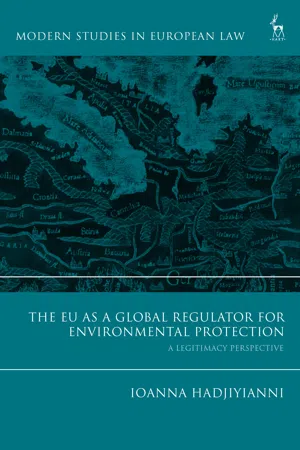
eBook - ePub
The EU as a Global Regulator for Environmental Protection
A Legitimacy Perspective
- 368 pages
- English
- ePUB (mobile friendly)
- Available on iOS & Android
eBook - ePub
The EU as a Global Regulator for Environmental Protection
A Legitimacy Perspective
About this book
This book critically examines the extension of EU environmental legislation beyond EU borders through measures that determine access to the single market on the basis of processes that take place in third countries. It makes a timely contribution to political debates about the relations between EU and non-EU countries, and the Union's role in the global governance of environmental policy, where it has been considered a global leader. The book aims to identify and explain the emerging legal phenomenon of internal environmental measures with extraterritorial implications as an important manifestation of EU global regulatory power, and assesses the extraterritorial reach of EU environmental law from a legitimacy perspective. It examines mechanisms that can bolster its legitimacy, focusing on the legal orders of the EU and the World Trade Organization, which are key legal fora for controlling the EU's global regulatory power.
Information
Part I
IEMEIs as Manifestations of EU Global Regulatory Power
1
Identifying and Mapping the Legal Phenomenon of Internal Environmental Measures with Extraterritorial Implications (IEMEIs)
I.INTRODUCTION
This chapter explores the legal phenomenon of IEMEIs by identifying their legal nature as a mechanism of EU external environmental action and by examining the regulatory techniques they incorporate in extending EU environmental legislation beyond EU borders. The purpose of this chapter is to identify IEMEIs as a manifestation of EU global regulatory power, adopted alongside different types of EU external relations tools. The chapter also seeks to map the legal features of the various examples of IEMEIs examined in this book, providing the foundation for their legal analysis in Parts II and III. In analysing the legal nature of IEMEIs the chapter draws attention to the fact that IEMEIs fit within, but also fall uneasily between, legal regimes in EU, national and international law, including WTO law. In addition to informing the analytical method of the book, the recurring theme of the interplay of multiple legal regimes is identified as critical to the legal understanding of IEMEIs.
The chapter proceeds in the following manner. Section II identifies the legal nature of IEMEIs as an emerging mode of EU external environmental action and explains the prevalence of IEMEIs in terms of the EU’s environmental leadership ambitions. In doing so, it demonstrates how the interplay of governance frames relevant in the operation of IEMEIs informs and partly explains their proliferation. Section III further identifies the legal nature of IEMEIs by exploring features of their legal design and transnational operation. A closer look at these legal features further exemplifies the interplay of multiple legal regimes relevant for the analysis of IEMEIs. This is because IEMEIs make references to international standards and third country law in setting regulatory restrictions on the EU market and often make explicit links to legal developments outside the EU. In light of the legal nature of IEMEIs, Section IV then explains the analytical approach of this book, in examining IEMEIs as a legal phenomenon that operates at the intersection of multiple legal regimes.
II.IEMEIs WITHIN THE BROADER CONTEXT OF EU EXTERNAL ENVIRONMENTAL ACTION
This section situates IEMEIs within the broader context of EU external environmental action. It explores the legal nature of IEMEIs, by identifying IEMEIs as one mode of pursuing external environmental action alongside the EU’s multi-faceted environmental action at the international level (Section II.A), and by considering the motivations of the EU in adopting IEMEIs for pursuing environmental leadership (Section II.B). This discussion demonstrates how multiple legal regimes, particularly in international environmental law and EU external relations law, are a critical part of the story in identifying the legal nature of IEMEIs and explaining their proliferation.
A.Different Modes of EU External Environmental Action and IEMEIs
The external environmental action of the EU is typically associated with different types of external measures regulating the relations of the EU with third countries in the international plane. The EU and its Member States usually promote and influence the development of international environmental law through active participation in Multilateral Environmental Agreements (MEAs).1 This is where EU law ordinarily interacts with public international law in the environmental sphere. The EU, as a strong regulating bloc, usually seeks to gain ‘first mover’ advantages by setting out its position early in the process of multilateral agreements.2 Its global leadership role in this field has thus been usually associated with a preference for multilateralism,3 which is also explicitly embedded in its environmental legal competence.4
In the public international law arena, the EU’s environmental action extends further than the traditional sense of MEAs, encompassing a variety of external relations tools ‘beyond multilateralism’.5 The EU often externalises its own environmental standards to third countries within bilateral and inter-regional agreements. Through ‘environmental conditionality’, the EU promotes its legal standards as a benchmark for development of third country law by providing incentives, usually relating to market integration, for ‘voluntary’ adoption of EU environmental standards.6 Ordinarily these incentives are demarcated in different types of consensual agreements developed in co-operation with third countries,7 unlike IEMEIs, which are unilaterally adopted by the EU. Furthermore, EU practice includes incorporation of environmental integration clauses8 in various types of bilateral or regional agreements,9 as well as in the EU Generalised System of Preferences.10
Also at the level of international law, the EU has been attempting to ‘green’ WTO law.11 On the one hand, the EU has sought through political negotiations to include provisions that would place MEAs and WTO law on an equal footing, in accordance with the principle of mutual supportiveness, albeit with little success.12 On the other hand, the EU has been invoking environmental and other societal concerns in the WTO’s dispute settlement system, including defending its domestic policies in disputes.13
In addition to these modes of EU external action that take place in the realm of public international law, the EU has been pursuing external environmental action through its internal measures. In fact, the EU’s internal environmental policy has always been informed by strong external dimensions such as the international sustainable development agenda14 and international environmental treaties.15 Also, environmental measures have traditionally aimed at protecting the natural environment of the EU as well as the environment beyond EU borders, especially through the implementation of international conventions within the EU.16 Furthermore, the EU would usually adopt internal environmental measures on contentious issues, with the aspiration that by showing the rest of the world what can be achieved internally, the EU policy would then provide an example to be followed internationally. The EU would thus assume a directional leadership role, leading ‘by example’.17 The success of this leadership mode has been called into question, because of challenges for the EU to achieve internal coherence and demonstrate credibility externally.18
Beyond such internal measures with external dimensions, in situations where cooperative regimes fail or are inadequate, the EU increasingly pursues global environmental protection through IEMEIs. IEMEIs involve the unilateral exercise of EU regulatory power in the form of market access requirements adopted in the absence of, or above, existing international standards. IEMEIs more directly and deliberately aim at instigating regulatory changes abroad and influencing third country and international policies. IEMEIs are legally designed to unilaterally extend the territorial remit of EU legislation,19 by making access to the EU market conditional upon the basis of conduct or processes that take place abroad and explicitly linking their application to developments in third countries, or at the international level. The book does not focus on measures that incidentally have extraterritorial implications but rather on measures legally designed to have extraterritorial legal impacts and regulatory effects. The effects of IEMEIs on international trade are key in achieving their regulatory goal by ‘affecting the distribution of costs and benefits accruing from international trade’.20 Notably, through IEMEIs, the EU’s approach is shifting from leadership by example, to structural or power-based leadership,21 which utilises EU market power to prompt regulatory changes in third countries.22 As demonstrated in Section III below, IEMEIs combine features of coercion in the form of conditionality, with the possibility of exclusion from the EU market, as well as persuasion,23 through cooperative elements, thus exhibiting a combination of structural and directional leadership in triggering regulatory changes. In this respect, IEMEIs contribute to transnational processes of policy diffusion24 through regulatory competition among trading partners,25 as well as through different forms of regulatory co-operation.26
Through such processes the EU exercises both normative power27 and market power28 in stimulating regulatory changes abroad in different ways.29 Regulatory standards in IEMEIs often act as ‘norm catalysts’ setting a baseline that creates incentives and affects the costs and benefits of analogous third country and international policies.30 IEMEIs can also influence multilateral regimes, in the form of ‘uploading’ of EU rules to international regimes.31 The ways in which IEMEIs affect third country practices and regulatory behaviour vary, and depend on the EU’s market power, the nature of the issue regulated, the EU’s regulatory capacity and the nature of the standards adopted.32 IEMEIs may thus lead to ‘divergent convergence’33 or mimesis34 in certain areas; provide a ‘source of inspiration’ in others;35 or trigger ‘reflection, debate and reform’.36 This book does not examine the actual impact of EU legislation beyond its borders from an empirical perspective, but rather engages in a doctrinal and normative analysis of how EU legislation is designed to extend beyond EU borders and influence third country policies.
Overall, the EU’s global environmental leadership role is pursued through multiple channels of regulatory action, utilising its legal competences in different ways. In this respect, IEMEIs are identified as a regulatory mechanism through which the EU pursues and influences global environmental governance, alongside other types of trade-related legal mechanisms.37 IEMEIs function as a supplementary mode of EU leadership, used in combination with other external relations tools, to stimulate regulatory changes in third countries and international regimes.38 On the basis of this analysis, the following sub-section seeks to explain why the EU increasingly resorts to IEMEIs in pursuing external action, demonstrating their legal nature as a legally hybrid mode of EU environmental action that simultaneously governs the EU internal market and the EU’s external relations.
B.Explaining the Recourse to IEMEIs
EU unilateral action in environmental matte...
Table of contents
- Cover
- Title Page
- Foreword
- Acknowledgements
- Contents
- Abbreviations
- Table of Cases
- Table of Legislation
- Introduction: Scope and Frame of Inquiry
- PART I: IEMEIs AS MANIFESTATIONS OF EU GLOBAL REGULATORY POWER
- PART II: IEMEIs IN THE EU LEGAL ORDER
- PART III: IEMEIs IN THE WTO LEGAL ORDER
- Conclusion: Combining Legal Orders to Legitimise Global Regulatory Power
- Bibliography
- Index
- Copyright Page
Trusted by 375,005 students
Access to over 1.5 million titles for a fair monthly price.
Study more efficiently using our study tools.
Frequently asked questions
Yes, you can cancel anytime from the Subscription tab in your account settings on the Perlego website. Your subscription will stay active until the end of your current billing period. Learn how to cancel your subscription
No, books cannot be downloaded as external files, such as PDFs, for use outside of Perlego. However, you can download books within the Perlego app for offline reading on mobile or tablet. Learn how to download books offline
Perlego offers two plans: Essential and Complete
- Essential is ideal for learners and professionals who enjoy exploring a wide range of subjects. Access the Essential Library with 800,000+ trusted titles and best-sellers across business, personal growth, and the humanities. Includes unlimited reading time and Standard Read Aloud voice.
- Complete: Perfect for advanced learners and researchers needing full, unrestricted access. Unlock 1.5M+ books across hundreds of subjects, including academic and specialized titles. The Complete Plan also includes advanced features like Premium Read Aloud and Research Assistant.
We are an online textbook subscription service, where you can get access to an entire online library for less than the price of a single book per month. With over 1.5 million books across 990+ topics, we’ve got you covered! Learn about our mission
Look out for the read-aloud symbol on your next book to see if you can listen to it. The read-aloud tool reads text aloud for you, highlighting the text as it is being read. You can pause it, speed it up and slow it down. Learn more about Read Aloud
Yes! You can use the Perlego app on both iOS and Android devices to read anytime, anywhere — even offline. Perfect for commutes or when you’re on the go.
Please note we cannot support devices running on iOS 13 and Android 7 or earlier. Learn more about using the app
Please note we cannot support devices running on iOS 13 and Android 7 or earlier. Learn more about using the app
Yes, you can access The EU as a Global Regulator for Environmental Protection by Ioanna Hadjiyianni in PDF and/or ePUB format, as well as other popular books in Diritto & Diritto ambientale. We have over 1.5 million books available in our catalogue for you to explore.