eBook - ePub
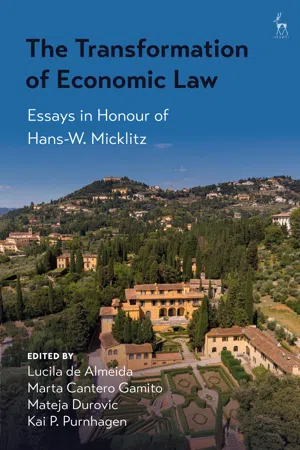
The Transformation of Economic Law
Essays in Honour of Hans-W. Micklitz
- 432 pages
- English
- ePUB (mobile friendly)
- Available on iOS & Android
eBook - ePub
The Transformation of Economic Law
Essays in Honour of Hans-W. Micklitz
About this book
This book is written in honour of Hans-W. Micklitz for his jubilee 70th birthday and the closure of his twelve-year term as the Chair for Economic Law at the European University Institute (EUI). Hans-W. Micklitz has gained international recognition for dedicating his extensive and fruitful career to diverse areas of law: European Economic Law, European Private Law, National and European Consumer Law, Legal Theory, theories of Private Law and Social Justice. This book is a product of the collaborative endeavors of its contributors, who all have a special connection with Hans W. Micklitz as his doctoral supervisees or research assistants. The collection of twenty chapters is to be read as the influence of Hans's dialogues in the early stage of the academic career of thirty-one young legal scholars. The volume is divided into three sections devoted to subjects that have received Hans's attention while at the EUI: EU Consumer Law (part I); European Private Law and Access Justice (part II); the CJEU between the individual citizen and the Member States (part III).
Information
FOREWORD 1
HOMAGE TO HANS-W. MICKLITZ
Academic life has many pleasurable and rewarding dimensions. An academic career usually spans several decades or more. Over the course of time, one encounters many people. I have listened to hundreds of lectures, presentations, seminars, over the course of 30 years as an academic. I have met many extremely interesting and gifted academics. Like everyone, I would imagine, there are only a handful of people who deeply impact one’s own life and work. For me, Hans-W. Micklitz is one of those special people.
When I was interviewed for the Chair in Legal Philosophy and Legal Theory in 2008, I had never been to the European University Institute. Of course, I knew of the existence of the Institute but I had no connection with anyone before I took up my Chair in 2009. When I arrived in Florence in August of 2009, I had no idea what adventures would lie ahead for me. Over the course of the next eight years, I would experience an intellectually rewarding experience like none I have ever had. Hans-W. Micklitz is central to this narrative.
Every year the Institute takes in a new class of researchers. In 2009, the new class of law researchers was hosted by the law department to a one-day event where the researchers and professors would discuss their work and get to know one another. I did not know anyone and, as I rode the bus from Fiesole to a cloister outside Siena, I wondered what my new colleagues would be like. I spent the day listening to the researchers explain their doctoral projects and to my colleagues discussing their work. When Hans spoke about his work I knew I wanted to get to know him better.
The work day in Siena ended with a splendid dinner for the researchers and the professors. As luck would have it, I was seated next to Hans. In the space of less than ten minutes, we established our mutual admiration for a wide variety of philosophers and political theorists. We learned that we both enjoyed economic law and many of the same works of literature. When the meal ended, Hans offered to drive me back to Florence. During the drive, I recall we mainly discussed Marx’s critique of Hegel on law and Kojeve’s role in the reception of Hegel. I went home that night firm in my belief that the next eight years would be like none I had ever experienced before.
Hans and I met regularly during my initial years in Florence. He brought my level of competence in European law – especially economic law – far higher than I would ever achieve on my own. I read everything he suggested to me and I learned an immense amount from him. I recall vividly the day Hans received word of his ERC grant. It was announced at Academic Council (the monthly meeting of all EUI professors) and Hans received thunderous applause. As a result of this grant, Hans was able to add a tremendous amount to the intellectual life of the law department. Speakers, conferences, PhD students and a host of ancillary activities all made for an intellectual feast. It was thrilling.
The law department had a regular practice of having professors present their work. While it was common for people to present completed articles, I always tried to present an idea or an argument and see what I got by way of feedback. I once presented an outline for a review of a book on constitutionalism. My outline was so threadbare that one of my colleagues criticised me for not presenting ‘a paper’. Hans was the commentator for my presentation. In the course of half an hour, Hans tied my presentation to several previous works of mine on globalisation and trade law as well as several of my EUI seminars on topics as diverse as Hardt and Negri’s Empire and transnational legal theory. Hans made connections in my own work that I had never seen before. I was astonished and grateful.
Of course, Hans and I taught seminars together. Two of these stand out for me. One of the many great things about the Institute is the chance to learn languages. When I came to the Institute, I spoke serviceable German but no language other than English. When my Italian developed, I suggested to Hans that we teach a seminar together on Italian Legal Philosophy. Of course, the seminar was to be in Italian. Hans’ Italian was far better than mine but I thought we could pull it off.
Each week, I would send Hans a list of questions we could ask the participants and a key word vocabulary list. These helped me far more than they did Hans: he didn’t need any crutches. Apart from succeeding with the language, Hans always had the most insightful things to say about the texts. Machiavelli, Bobbio and others were the subject of wide-ranging discussions about the nature of law, the role of politics in law and the particular way Italian legal philosophers conceptualise issues in legal theory. Teaching that seminar with Hans was an intellectual delight.
For my last seminar at the Institute, Hans and I decided to invite five leading scholars of transnational law to come and discuss their work with our group. For one week, Hans and I would discuss the seminar material with the researchers and the next we would have the guest speaker come in and defend their positions. By this time, Hans and I were like a well-oiled machine. Our dialogue with the speakers was peppered with interventions by the researchers who were simply extraordinary in their abilities.
For the last session – which represented my last hours teaching as a professor at the EUI – our guest was my dear friend Alexander Somek. To my mind, Somek is the best legal theorist in Europe. That said, we disagree on many things (especially how to read Wittgenstein). But the two hours with Hans and Sascha were the best two hours of my academic life. I may never have another time like it.
The ERC grant enabled Hans to conduct a grand intellectual experiment, one that resulted in the publication of his book, The Politics of Justice in European Private Law. The book is a stunning intellectual achievement. The synthesis of theory, deep knowledge of EU law, and a subtle rendering of economic theory are simply without equal anywhere in the literature. This is a book that will be read widely and will have a major impact on the field.
In the Preface to the book, Hans kindly mentions the fact that I often told him ‘You must write your book’. Hans always had many commitments. He devoted himself to the law department, his supervisees, and his American friend. The present volume is a testament to Hans by the many supervisees whose lives he has touched. He is as selfless as he is brilliant. I have learned so much from him. I shall be forever grateful to the forces that brought us together for what was, for me, the experience of a lifetime.
Dennis Patterson
Professor of Law and Philosophy
Rutgers University
25 January 2019
FOREWORD 2
VORWORT
Ich möchte meinen Freund und Kollegen Hans W Micklitz nicht über den grünen Klee loben, sowas gehört sich einfach nicht. Darüber hinaus wäre ihm eine Hommage auch sehr peinlich, weil man ihr geradezu wehrlos ausgesetzt ist, was er gar nicht gut leiden kann.
‚Wehrlos‘ mag nun ein wenig martialisch klingen – gleichwohl haben wir es in der Wissenschaft immer auch mit dem Kampf um die Wahrheit zu tun.
In unseren Forschungen, also jenen, an denen ich dann und wann beteiligt war, hat er sich nie – und das ist gravierend, auf Theorien und Sekundärdaten verlassen. Er hat sich auch nie in reiner Theorie verloren. Im Gegenteil, soweit ich das miterlebt habe, waren die Ergebnisse anderer Studien oder rechtsphilosophische Grundlagen immer wieder Startpunkte zu neuen Überlegungen und eben auch Forschungen. Wir können also sagen, Plato, Aristoteles, Cato und Caesar saßen genauso am Tisch wie Macchiavelli, Montesquieu und Napoleon.
In Begleitung und Kommentierung der Entwicklung der EWG- und EU-Rechtsgeschichte in den Bereichen des Wirtschafts- und Verbraucherrechts, mehr noch, wie der kürzlich erschienene tiefe Einstieg in The Politics of Justice in European Private Law zeigt, ist ihm nicht Bange, sich an die Wurzeln des europäischen und jeweils nationalen Selbstverständnisses vorzuarbeiten, um sie besser verstehen und explizieren zu können. Sobald wir von Wurzeln (radix) sprechen, drängt sich der Verdacht auf, Micklitz sei ein Radikaler.
Ja, genauso ist es auch. Hans ist ein Radikaler, wiewohl er diese Attribuierung in Bescheidenheit wohl ablehnen würde. Ein Radikaler der Wahrheitsfindung.
Als wir vor vielen, vielen Jahren erstmals zusammengearbeitet haben, ergab sich die Forschungsfrage zwischen ‚law in the books’ und wirklichen Prozeduren, also zwischen ‚Soll-Zuständen‘ und ‚Ist-Zuständen‘ zu unterscheiden.
Also zwischen Normativität und Praxis und eben auch gesellschaftlicher Lebenspraxis, die sich so erstaunlich anders gebärdet, als vorgedacht. Diese sich sanft einschleichende Erkenntnis führte zu weiteren und weiteren Studien.
Das hört sich ziemlich harmlos an, offenbart aber einen Wissenschafts – und Forschergeist, der sich mal eben an die Realität heranwagt, statt dünne Bretter zu bohren.
Da reden wir dann von ‚Krise’, die für Hans Micklitz in meiner soziologischen Betrachtung umstandslos zum allgegenwärtigen ‚normalen’ Forschungsimpetus wird, aber wir reden auch über Struktur, dem feinen Gewebe der gesellschaftlichen Wirklichkeit.
Ich habe erst kürzlich in einem Telephonat erfahren, dass Hans Micklitz seine Annahmen der frühen 90er Jahren heute naiv vorkommen und muss ihm tröstend entgegenhalten, die Annahmen mögen ja vor 30 Jahren naiv gewesen sein, die empirischen Erhebungen und Ergebnisse dieser Zeit aber selbstredend nicht. Die stehen da protokolliert und sind heute noch in Buchform lesbar.
Ist das nicht kurios und wundervoll – die Ergebnisse des Forschenden überholen den Forscher?
Und das ist der Pivot!
Micklitz geht immer wieder das Wagnis ein, sich selbst der Naivität, oder um es konzilianter zu formulieren, sich den eigenen Hypothesen und Prämissen in Enttäuschung zu stellen, ja er fordert diesen Konflikt mit unfertigem Wissen und der Realität geradezu heraus.
Er muss also über eine enorme Enttäuschungsbereitschaft verfügen. Das scheint mir der Kern seiner wissenschaftlichen Tätigkeit überhaupt zu sein.
Im dienenden Hintergrund stehen immer die Befunde Poppers (‚lasst Theorien sterben, aber nicht Menschen’), Thomas Kuhns ‚Paradigmenwechsel‘ in den Naturwissenschaften (ja, selbst dort) und schließlich auch die Ideologiekritik, die Kant, Hegel und Marx systematisch folgt.
Nehmen wir ganz kurz das ERPL-Projekt in den Blick, zu dessen Mitarbeitern Micklitz eine ganze Reihe von begabten und neugierigen PhD-Aspiranten anstiftete.
In meiner Erinnerung waren es mehr als 50 direkt gesprochene und per Audio offene Interviews mit beteiligten Richtern, Gerichtsprotokollen, die stenographisch festgehalten wurden, Beamten, Ärzten und Patienten, Experten des Konsumentenschutzes, selbstbewußten NGO-Aktivisten in Sachen Umwelt, Pressekonferenzen, wissenschaftliche Konferenzen mit Vertretern nationaler Kommunikationsgesellschaften, die oft, audiophon protokolliert über Tage dauerten, über alle sprachlichen Grenzen hinweg.
Wenn man so will, ein Wust von Primärdaten aus der wirklichen Welt. Grob geschätzt waren dies über viele 100 Stunden direkter Wirklichkeitssuche und darüber hinaus, Daten, die erhoben und analysiert werden sollten, von jungen Wissenschaftlern, die gerade deswegen auch begütigt werden sollten, in der Via Palazzine. Vor allem von der bewunderungswürdigen Alexandra, seiner Frau, die couragiert bei Essen und Trinken, Musik, Piano, Gesang und Darstellung dafür sorgte, im Leben zu bleiben.
Ganz im Ernst – das muss alles analysiert werden.
Und wer macht so etwas? Wer arrangiert diesen ‚pädagogischen Eros’. Diese Frage ist schnell beantwortet – Hans Micklitz, der viel gerühmte Experte, knüpft Zusammenhänge wie ein Weber, spinnt Fäden und aus dieser Textur heraus stachelt er seine Studenten und Kollegen auf, an der ‚Sache’ zu bleiben, in Inspiration und Emsigkeit. Das mag nicht jedem gefallen. Ich selbst hatte oft den Eindruck, Hans errichte so ganz im Geheimen eine Gelehrtenrepublik, die aber nicht in Selbstzufriedenheit ‚self-sufficiency‘ stillsteht, sondern fordert, ja auch provokativ fordert.
Eine Antwort, die mich überzeugt, ist das vorliegende Buch, es gibt Wissenschaftler jüngerer Generation, die diesen Faden aufnehmen.
Kleinmütigkeit darf man also dem ‚Anstifter‘ von Empirie nicht vorwerfen, im Gegenteil – das Visier ist immer aufgeklappt, jeder Befund wird geprüft und in endlosen Gesprächen gewichtet und höchstwahrscheinlich (so vermute ich) als Theorem den Überlegungen des Europäischen Rechtsexperiments hinzugefügt.
Das ist das Eine.
Das Andere aber ist, dass aus dieser genuin wissenschaftlichen Disposition, die sich nichts vormachen lassen will, die sich nicht mit Fragen der Demokratisierung von Forschung, nicht mit allfälligen Ideologemen des allgemeinen Betriebs gemein machen will, ein Eros – eine sinnliche Forschungslust resultiert – der so manchen (nicht alle) Aspiranten beflügelt, nun wirklich aus dem schicklichen Leben auszubrechen und zur ‚Sache’ zu kommen:
Ich muß meinem Freund und Kollegen dieserhalb Tribut zollen. Ihm gelang und gelingt es immer wieder nachfolgende Generationen diese Akkuratesse und Delikatesse der Wahrheitssuche nahezubringen, sie zu stimulieren, nicht nachzugeben, die Bürde der Wahrheit oder Wahrheitsähnlichkeit auf sich zu nehmen.
Und unversehens sind wir in der alten ‚Humboldtschen’ Universität des frühen 19. Jahrhunderts, Modell für viele andere aufstrebende Gesellschaften, in der alle Empirie- und Theoriestreitigkeiten produktiv ausgetragen wurden.
Ist also Hans W Micklitz ein Nostalgiker?
Nie im Leben.
Wissenschaft ist die Institution, beständig Kritik zu üben, Wissenschaft ist ein destruktives Geschäft in atemloser Fröhlichkeit – das allein ist ihre Aufgabe.
Niemals Glaube, niemals Überzeugung, nur Überprüfung des Ist-Zustandes in aller Welt.
Wie wir sehen, folgen andere und neue Generationen diesem Gedanken.
Und ich bin froh darum.
Thomas Roethe
Part-time Professor in the Law Department,
European University Institute
CONTENTS
Foreword 1 by Dennis Patterson
Foreword 2 by Thomas Roethe
1.Introduction
Lucila de Almeida, Marta Cantero Gamito, Mateja Durovic, Kai P. Purnhagen
PART I
EU CONSUMER LAW
EU CONSUMER LAW
2.An Average Consumer Concept of Bits and Pieces: Empirical Evidence on the Court of Justice of the European Union’s Concept of the Average Consumer in the UCPD
Hanna Schebesta and Kai P. Purnhagen
3.Private Law Consequences of Unfair Commercial Practices
Mateja Durovic
4.A Consumer Perspective on Algorithms
Peter Rott
5.Technological Totalitarianism: Data, Consumer Profiling, and the Law
Irina Domurath
6.EU Consumer Law and Artificial Intelligence
Agnieszka Jabłonowska and Przemysław Pałka
PART II
EUROPEAN PRIVATE LAW AND ACCESS JUSTICE IN ITS INTERNAL AND EXTERNAL DIMENSIONS
EUROPEAN PRIVATE LAW AND ACCESS JUSTICE IN ITS INTERNAL AND EXTERNAL DIMENSIONS
7.The General Transformations of Private Law Since Léon Duguit: Autonomy, Responsibility and ...
Table of contents
- Cover
- Title Page
- Foreword 1 by Dennis Patterson
- Foreword 2 by Thomas Roethe
- Contents
- 1. Introduction
- PART I: EU CONSUMER LAW
- PART II: EUROPEAN PRIVATE LAW AND ACCESS JUSTICE IN ITS INTERNAL AND EXTERNAL DIMENSIONS
- PART III: THE CJEU BETWEEN THE INDIVIDUAL CITIZEN AND THE MEMBER STATES
- Index
- Copyright Page
Trusted by 375,005 students
Access to over 1.5 million titles for a fair monthly price.
Study more efficiently using our study tools.
Frequently asked questions
Yes, you can cancel anytime from the Subscription tab in your account settings on the Perlego website. Your subscription will stay active until the end of your current billing period. Learn how to cancel your subscription
No, books cannot be downloaded as external files, such as PDFs, for use outside of Perlego. However, you can download books within the Perlego app for offline reading on mobile or tablet. Learn how to download books offline
Perlego offers two plans: Essential and Complete
- Essential is ideal for learners and professionals who enjoy exploring a wide range of subjects. Access the Essential Library with 800,000+ trusted titles and best-sellers across business, personal growth, and the humanities. Includes unlimited reading time and Standard Read Aloud voice.
- Complete: Perfect for advanced learners and researchers needing full, unrestricted access. Unlock 1.5M+ books across hundreds of subjects, including academic and specialized titles. The Complete Plan also includes advanced features like Premium Read Aloud and Research Assistant.
We are an online textbook subscription service, where you can get access to an entire online library for less than the price of a single book per month. With over 1.5 million books across 990+ topics, we’ve got you covered! Learn about our mission
Look out for the read-aloud symbol on your next book to see if you can listen to it. The read-aloud tool reads text aloud for you, highlighting the text as it is being read. You can pause it, speed it up and slow it down. Learn more about Read Aloud
Yes! You can use the Perlego app on both iOS and Android devices to read anytime, anywhere — even offline. Perfect for commutes or when you’re on the go.
Please note we cannot support devices running on iOS 13 and Android 7 or earlier. Learn more about using the app
Please note we cannot support devices running on iOS 13 and Android 7 or earlier. Learn more about using the app
Yes, you can access The Transformation of Economic Law by Lucila de Almeida, Marta Cantero Gamito, Mateja Djurovic, Kai Peter Purnhagen, Lucila de Almeida,Marta Cantero Gamito,Mateja Djurovic,Kai Peter Purnhagen in PDF and/or ePUB format, as well as other popular books in Law & International Law. We have over 1.5 million books available in our catalogue for you to explore.