eBook - ePub
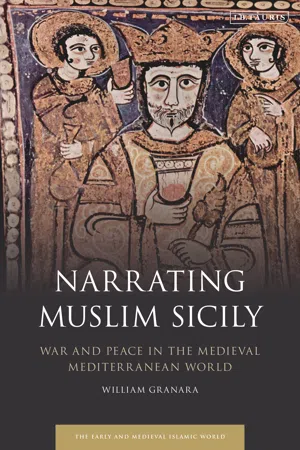
Narrating Muslim Sicily
War and Peace in the Medieval Mediterranean World
- 240 pages
- English
- ePUB (mobile friendly)
- Available on iOS & Android
eBook - ePub
About this book
In 902 the last Byzantine stronghold in Sicily fell, and the island would remain under Muslim control until the arrival of the Normans in the eleventh century. Drawing on a lifetime of translating and linguistic experience, William Granara here focuses on the various ways in which medieval Arab historians, geographers, jurists and philologists imagined and articulated their ever-changing identities in this turbulent period. All of these authors sought to make sense of the island's dramatic twists, including conquest and struggles over political sovereignty, and the painful decline of social and cultural life. Writing about Siqilliya involved drawing from memory, conjecture and then-current theories of why nations and people rose and fell. In so doing, Granara considers and translates, often for the first time, a vast range of primary sources - from the master chronicles of Ibn al-Athir and Ibn Khadun to biographical dictionaries, geographical works, legal treatises and poetry - and modern scholarship not available in English. He charts the shift from Sicily as 'warrior outpost' to vital and productive hub that would transform the medieval Islamic world, and indeed the entire Mediterranean.
Information
1
Sicilian Islamic History as Grand Récit
Looking back: Framing Muslim Sicily’s history in a rise and fall dialectic
The eminently renowned Ibn Khaldun (1332–1406), historian, sociologist and philosopher, bequeathed to human civilization a corpus of writing and ideas on the nature and evolution of human societies. Paramount in his thought was the idea of civilizational decline or, in other words, the study of the rise and fall of nations.
Ibn Khaldun lived in the most interesting of times. His world, spanning the late medieval Islamic West and the Islamic East, was moving at a frenetic pace, and many and much of who and what surrounded him succumbed to wars, rebellions, famine (he lived through the Black Plague), and the political machinations and ambitions of men who make history. His elite classical education and his pursuit of scholarship, on the other hand, allowed him to observe, study, analyse and explicate the problems and complexities of his own times against the lessons of human history.
‘Abd al-Rahman bin Muhammad Ibn Khaldun was born in the city of Tunis in 1332, the scion of an Arab family who had settled in the city of Seville during the early years of the Islamic conquest of Spain (al-Andalus). His family (the generation of his great-grandfather) resettled in North Africa at the onslaught of the Spanish Christian Reconquista, and both great-grandfather and grandfather, religious and legal scholars, became actively involved in the political intrigues of their times. His own father, Muhammad, followed the family’s scholarly traditions but eschewed political life, while the young ‘Abd al-Rahman was destined to follow in his grandfathers’ footsteps.
In thinking about, reflecting on and postulating theories about rises and falls of nations great and small, Ibn Khaldun had much to work with in his own time and place(s). His parents died from the Black Plague when he was just an adolescent, and he witnessed the Marinid invasion of his Hafsid Tunis in the same period of his life. He spent time in prison for being on the wrong side of power, and in 1362 he was warmly received in Granada by its emir, Muhammad ibn Ahmar, and his controversial vizier, Lisan al-Din ibn al-Khatib (1313–1374), with whom Ibn Khaldun enjoyed a long but cautious friendship. Ibn al-Khatib’s many political ups and downs and his ultimate murder while in prison exemplify the mercurial nature of public life at that time. Ibn Khaldun’s diplomatic mission to negotiate with the Christian enemy Pedro the Cruel in 1364 would be replicated later in his life with a similar mission in 1400 to the camp of the Mongol Tamerlane. The many government and teaching posts he occupied from Fez to Damascus made him privy to all that was happening throughout the inner sanctums and corridors of power and provided him with insights, information and perspectives – all the raw material he needed to analyse the processes of history.
As a fully educated scholar in the classical Arab Muslim tradition, Ibn Khaldun had even much more to rely on in his formation as a world historian: literally thousands of pages and centuries of Arabic historiographical writing that bear witness to a long and dynamic process of historical consciousness. From the earliest Bedouin oral narratives of recounting a glorious past (akhbar al-‘arab) to the many references to names, places and events evoked in pre-Islamic poetry, the Arabs succeeded in expanding their historical consciousness by way of understanding and explaining a new Muslim world view as reflected in the genres of sira (biographies of the Prophet), maghazi (accounts of his campaigns) and hadith (records of his saying and deeds). Local and universal chronicles and histories, biographical dictionaries and works of expansive encyclopaedic breadth were penned throughout the Arab Muslim world, addressing questions from the nature of power and the Sunni-Shi‘ite divide to the shift from an Arab, Levantine Ummayad caliphate to a multi-ethnic Mesopotamian Abbasid caliphate. Monumental events and changes, such as the conquest of lands far beyond the borders of the Arabian peninsula, the intellectual interface with classical Greek and Persian learning, the Crusades, the demolition of Baghdad by the Mongol hordes and the emergence of mystical Islamic practices (Sufism) that came to threaten the hold of the old-guard religious elite over large swathes of the populace, were all inscribed in the pages of the many genres of Arabic historiography, contributing in varying ways and degrees to an ever-changing and expansive historical consciousness that forced Arabs to think and rethink their past and present.
In sum, Ibn Khadun’s theories and scholarship were not produced ex nihilo. The combination of his very public and professional life and his erudition in the school of Arab Islamic letters gave him insights and knowledge of historical processes that culminate in his socio-philosophical Muqaddima as well as his opus on positive history, Kitab al-‘Ibar. The history of Islamic Sicily, spanning roughly 827–1060, indeed must have presented to him a discreet and highly illustrative model on which to reflect on rise(s) and fall(s).
Ibn Khaldun’s by now well-known and oft-cited thesis of the five cycles in the life span of a nation (atwar al-dawla) may very well have been shaped, at least in part, by his reading of Islamic Sicily, one that rose and fell many years before. His thesis of cycles includes (i) a period of conquest in which a primitive way of life prevails, based on natural solidarity and religious sentiment; (ii) the years of consolidation of power in the form of a powerful army and a strong government; (iii) a period of financial success, luxury and ease, fortified by a well-developed (urban) infrastructure and civil institutions; (iv) a period of contentment in which luxury is expected, accustomed and constantly pursued; and (v) a final period of waste, deterioration and decline.1
The Islamic conquest of Sicily was launched in the full pageantry of jihad that united various and often-contentious groups under the banner of the Aghlabid prince of the semi-autonomous province of Ifriqiya. The campaign was led by a highly respected Muslim jurist and scholar, Asad ibn al-Furat, and it included a remarkable number from the ‘religious’ establishment. The period of conquest, lasting some seventy years, was followed by a modicum of Aghlabid political consolidation, especially with the development of Palermo as a regional metropolis. By the end of the first century, the Kalbid dynasty, having achieved great success on the military front against Byzantium, came to preside over a royal court that could boast a high culture and a strong and robust economy. Finally, political and social divisions, the result of greed and ambition, led to fragmentation and military defeat at the hands of the Norman militia.
Ibn Khaldun, along with two great master chroniclers who preceded him, Ibn al-Athir (d.1239) and al-Nuwayri (d.1332), is credited, as Michele Amari has observed, with providing the framework for our reconstruction of Muslim Sicily’s political or dynastic history. Each one, as I mentioned above, was not only equipped with a plethora of historical documents but also enjoyed the advantage of hindsight, they all faced nonetheless the challenges of making sense of a messy history from a corpus of fragmented reports and narratives.
The Aghlabid court at Qayrawan in search of an external enemy
The Mediterranean island of Sicily was inhabited by Arabs and Muslims from the early ninth century until the early decades of the thirteenth century. From a broad historical perspective, the Arab invasion and settlement of Sicily in the early ninth century may be read within the long continuum of the Islamic wars of conquest that began shortly after the death of the Prophet Muhammad in 632. As the Arab armies moved beyond the borders of the Arabian Peninsula, they spread in every direction. In their movement westward, beyond the lands of Egypt and into the Maghrib, they eventually covered the whole of the African continent north of the Sahara, and from the farthest point west of the Maghreb, they crossed the Mediterranean and entered, conquered and settled the Iberian Peninsula from the year 711.
Medieval Arab (as well as Latin and Greek) chronicles report sporadic Muslim naval incursions into Sicily as early as the mid-seventh century. As the largest of the Mediterranean islands and the most strategically located, Sicily had long been the target of foreign invaders. Phoenicians, Greeks, Carthaginians, Romans and Byzantines all staked their claims to the vulnerable island, invading, occupying and ultimately inscribing ‘Sicilian’ chapters onto their histories. And so it was natural for the Arab Muslims, in their quest for religious, political, military and commercial sovereignty over the Mediterranean, to cast their sights and carve their name on Sicily as well.
By the beginning of the third Islamic century (ninth century), however, the Islamic Empire had ceased to be a single, monolithic empire with one universally accepted authority. The Islamic ‘nation’ (umma) was politically and religiously divided, and the caliphate in Baghdad was no longer recognized as the sole legitimate authority of all Muslims. The Muslim empire of al-Andalus in the Iberian Peninsula proclaimed its own caliphate in Cordoba, while Sunnis, Shi‘ites and Kharijites acted upon their conflicting visions of legitimate authority and rightful rulership throughout North Africa and the Arabian Peninsula. Additionally, the Muslims of the third Muslim century, now long ensconced in their role as conquerors of nations and cultures, harboured few notions of universal Islam, as their political ideas and treatises began to deal with the more complicated questions of peaceful coexistence and the rights of non-Muslims. In sharp contrast to the Muslim invasion of the Iberian Peninsula a century earlier, the Muslim invasion of Sicily was launched against a background of a divided Muslim world, on the one hand, and a series of negotiated peace treaties with the Byzantine warlords of Sicily, on the other.
More precisely, the history of Muslim Sicily begins somewhere along the corridors and inside the grand chambers of the Aghlabid royal palace in the city of Qayrawan (Tunisia) in the early years of the ninth century. The Aghlabids were a dynasty of Arab princes who ruled the province of Ifriqiya, a region extending from Constantine (Algeria) in the west to Tripoli (Libya) in the east, from 800 until 909. Their founder, Ibrahim I ibn al-Aghlab, was granted autonomy by the Abbasid caliph Harun al-Rashid in 800 in exchange of a yearly tribute tax and pledges of allegiance to the Abbasid Court. By the time of Abu Muhammad Ziyadat-allah (r.817–38), the province was facing a host of domestic problems. Ziyadat-allah had to put down a long and violent insurrection led by a disgruntled military officer, Mansur ibn Nasr al-Tunbudhi, in 824, who, through an alliance with various tribal chieftains, succeeded in seizing control over much of the province for several years. Although the rebellious al-Tunbudhi eventually surrendered and was put to death, residual resentment among the army factions towards the Aghlabid palace continued to fester.
Throughout the rural areas within and beyond Aghlabid rule, the political movement of Kharijism held wide popular appeal, especially among the nomadic Berbers. Kharijism was a sect that began in opposition to both Sunni and Shi‘ite notions of political and religious authority. Meanwhile, many of the Kutama Berbers adhered to Shi‘ism in direct opposition to the Sunni orthodox Aghlabids. Also, tensions between the Arab elite and the Berber masses in the urban centres flared up from time to time, and if this were not enough of a disturbance, the religious scholars (fuqaha’) emerged as popular supporters for the disenfranchised urban poor. Their public and vociferous criticisms of the ruling family and its special interest groups drew attention not only to the economic and social inequities plaguing the realm but also to the licentious and decadent ways that permeated the highest echelons of government.
In the early months of 827, word reached Ziyadat-allah that the Byzantines of Sicily were holding Muslim soldiers as captives. A renegade Byzantine general from Sicily, Euphemius, had contacted the Aghlabid court with this news as well as with other vital military information he offered in exchange for Aghlabid assistance in overthrowing his enemies in Sicily. The military intelligence was extremely valuable to Ziyadat-allah, considering his domestic problems with a restless army, an aggrieved population and a hostile ulema. Sicily, long the target of Muslim raiding expeditions, could easily be reconfigured as enemy territory. At the same time, its strategic location offered exciting prospects for renewed commercial and military ventures. On the domestic front, a war to liberate Muslim captives from enemy lands could redirect the attentions of the masses away from internal problems, and it could provide employment to an idle and troublesome army. However, the question of invading the island was not a simple matter since Ziyadat-allah was bound to a peace treaty with Byzantine Sicily that had been concluded by his successor. In a quandary, the Aghlabid ruler summoned his inner circle for advice.
Two voices emerged during the spirited debates, those of Ziyadat-allah’s two chief judges. Abu Muhriz (d.829), a powerful voice among the Qayrawani religious scholarly community, counselled caution and pleaded for a wait-and-see strategy despite the evidence of a possible Byzantine violation of the treaty. His argument was overwhelmingly supported by his peers. Asad ibn al-Furat, a maverick Hanifi-turned-Maliki scholar of great note as well as an Aghlabid loyalist who was instrumental in Ziyadat-allah’s successful campaign against al-Tunbudhi, took the opposite position. His advice was couched in religious terms as he quoted the Qur’anic verse: ‘So do not become weak-kneed and sue for peace, for you will have the upper hand; as God is with you, and will not overlook your deeds.’2 By standing on solid scriptural ground, whereby appeasing the religious conservatives, Asad pleaded the case that Ziyadat-allah launch an attack.3
The very existence of these debates underscores two important issues at stake at this time. The first issue is the ‘legal’ dimension of a major decision such as waging a war. Despite being something of an absolute potentate, Ziyadat-allah was bound to higher authorities, distant and abstract as they may have been. The caliph in Baghdad was still held as supreme political authority among the urban Qayrawani orthodox masses in spite of the autonomy granted to the Aghlabid ruling family. Any major undertaking on behalf of Dar al-Islam needed at least the nominal blessings of the Baghdad caliphate, or it had to be done in such a way as to not undermine the interests of the larger umma. There was also the authority of Islamic law (al-shari‘a) itself, in both its scriptural precision and in its evolving, elastic and negotiable interpretations. Chapters on jihad in the early manuals of jurisprudence and the emerging genre of siyar literature,4 as will be seen again in Chapter 3, were moving in directions beyond the early treatises, and the nature and role of legitimate rulership was faring more prominently in the manuals for waging war and peace.
The second issue was the virtual power of the religious and legal scholars, not only as guardians of sacred law and legality but as public critics, political dissidents and protectors of the disenfranchised masses. The mere fact that Ziyadat-allah had two chief judges, a non-standard practice in Islam at the time, not to mention his consultations with them on any potential raid on Sicily, points to the sensitivity of the circumstances as well as the reality of power, politics and religion that held significant sway over this issue. Abu Muhriz was a deeply devout and conservative jurist and a disciple of Malik ibn Anas (d.795), the founder of the Sunni school of Islamic law that came to dominate the Islamic Maghreb (North Africa, Spain and Sicily) for centuries. His appointment to the chief judgeship, grudgingly made by Ziyadat-allah’s father, Ibrahim, positioned him among the leadership of the emerging Maliki jurists who engaged in anti-Aghlabid campaigns in an attempt to impose their authority and control over the masses.
Ziyadat-allah broke with tradition and hired a second chief judge for Qayrawan. His choice of Asad ibn al-Furat was a stroke of political genius. Asad was a loyal subject and public servant, a skilled negotiator (he was responsible for convincing the rebellious al-Tunbudhi to surrender to the Aghlabid authorities), and a jurist with outstanding academic credentials. He travelled to Mecca to make his pilgrimage and spent a brief period studying with Malik ibn Anas. He then journeyed to Baghdad where he studied under Muhammad ibn al-Hasan al-Shaybani (d.805), a disciple of Abu Hanifa, and then to Cairo to study with ‘Abd al-Rahman ibn al-Qasim, disciple of Malik. He returned to Qayrawan with his own completed compendium on Islamic law, al-Asadiyya, which gained immediate and widespread popularity throughout Maghribi scholarly circles. In the process, he had become a rival of Abu Muhriz, as both men came to represent opposing factions among the Qayrawani ulema. In their debate on the issue of Sicily, Ziyadat-allah played one faction off the other while paying lip service to all of his potential critics.
On a June morning in the year 827, a fleet was assembled on the orders of Ziyadat-allah at the port city of Susa (eastern coast of modern Tunisia) to set sail towards Sicily. Throngs of people surrounded a cavalry of 700 and an infantry of 10,000, recruited and assembled to board a flotilla of 100 ships. The warriors were Arabs of various tribes, as well as Berbers, Persians, professional soldiers and even members from the scholar/clerical community, many of whom evidently experienced a change of heart in joining the jihad. Asad ibn al-Furat was appointed commander of the fleet, with the royal decree that he maintain his official title as chief judge of Qayrawan. Amid the excitement of the crowds, the neighing of horses, the rolling of drums and the waving of banners, Asad spoke:
There is no god but God alone; he has no partners. O people, neither a father nor grandfather created a state for me nor chose me to rule. No one before me has even seen such a sight, and I have only read about what you now see. Exert your minds and labor your bodies in the search and pursuit of knowledge; increase it and be patient with its intensity, for you will gain with it this world and the next.5
Within three days, the forces of Ziyadat-allah reached Mazara on the southwestern tip of Sicily. A large army, headed by P/Balata, the Byzantine gov...
Table of contents
- Cover
- Halftitle Page
- Title Page
- Contents
- List of Illustrations
- Notes on Transliteration and Translation
- Acknowledgements
- Preface
- 1. Sicilian Islamic History as Grand Récit
- 2. Treason as Historical Anecdote and Literary Trope in Narrating Muslim Sicily
- 3. Land, Law and Jihad: Al-Dawudi’s Anti-Fatimid Polemics
- 4. Of Minarets and Shipwrecks: Ibn Hamdis and the Poetics of Jihad
- 5. In Praise of Norman Kings: Arabic Panegyrics beyond Its Boundaries
- Postscript
- Notes
- Bibliography
- Index
- Imprint
Trusted by 375,005 students
Access to over 1.5 million titles for a fair monthly price.
Study more efficiently using our study tools.
Frequently asked questions
Yes, you can cancel anytime from the Subscription tab in your account settings on the Perlego website. Your subscription will stay active until the end of your current billing period. Learn how to cancel your subscription
No, books cannot be downloaded as external files, such as PDFs, for use outside of Perlego. However, you can download books within the Perlego app for offline reading on mobile or tablet. Learn how to download books offline
Perlego offers two plans: Essential and Complete
- Essential is ideal for learners and professionals who enjoy exploring a wide range of subjects. Access the Essential Library with 800,000+ trusted titles and best-sellers across business, personal growth, and the humanities. Includes unlimited reading time and Standard Read Aloud voice.
- Complete: Perfect for advanced learners and researchers needing full, unrestricted access. Unlock 1.5M+ books across hundreds of subjects, including academic and specialized titles. The Complete Plan also includes advanced features like Premium Read Aloud and Research Assistant.
We are an online textbook subscription service, where you can get access to an entire online library for less than the price of a single book per month. With over 1.5 million books across 990+ topics, we’ve got you covered! Learn about our mission
Look out for the read-aloud symbol on your next book to see if you can listen to it. The read-aloud tool reads text aloud for you, highlighting the text as it is being read. You can pause it, speed it up and slow it down. Learn more about Read Aloud
Yes! You can use the Perlego app on both iOS and Android devices to read anytime, anywhere — even offline. Perfect for commutes or when you’re on the go.
Please note we cannot support devices running on iOS 13 and Android 7 or earlier. Learn more about using the app
Please note we cannot support devices running on iOS 13 and Android 7 or earlier. Learn more about using the app
Yes, you can access Narrating Muslim Sicily by William Granara in PDF and/or ePUB format, as well as other popular books in History & Middle Eastern History. We have over 1.5 million books available in our catalogue for you to explore.