eBook - ePub
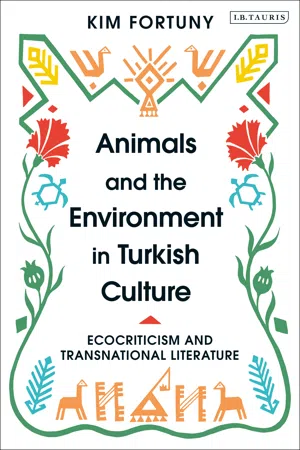
Animals and the Environment in Turkish Culture
Ecocriticism and Transnational Literature
- 200 pages
- English
- ePUB (mobile friendly)
- Available on iOS & Android
eBook - ePub
About this book
Landscape and animals have been fundamental elements of Turkish culture from the Ottomans to the present day. This book examines representations of and attitudes toward land and animals in selected Turkish literary texts and cultural contexts. Informed by global debates in ecocriticism, ecopoetics and animal studies, Kim Fortuny explores literary and arts activism, as well as environmental interventions in the Turkish cultural sphere in light of ongoing ecological degradation in Turkey. Writers from the Turkish canon such as Ahmet Hamdi Tanpinar and Nâzim Hikmet are explored alongside American and English texts to reveal common transnational environmental and ecological concerns across these distinct literary cultures. Analysing works of Turkish literature within the emerging field of ecocriticism, this interdisciplinary work will be of interest to scholars of Turkish and comparative literature and animal studies and ecocriticism across the humanities.
Information
Part One
Land
1
Herman Melville’s Near East Journal and Ahmet Hamdi Tanpınar’s Five Cities: Affinities of Culture, Nature, and Islamic Mysticism in Istanbul
When Herman Melville came to Istanbul in 1856 on an eight-month Old World tour, he recorded his observations in sketches and fragments, extracts of which would be edited by Howard Horsford and published by Princeton University Press one hundred years later under the title Journal of a Visit to the Europe and the Levant October 11, 1856–May 6, 1857. Melville’s “pilgrimage” to the Old World was not an extraordinary undertaking in 1856. The writer’s interest in the Near and Middle East reflected an occidental trend in the late eighteenth and nineteenth centuries on both sides of the Atlantic inspired by, among other things, archeological discoveries in the Near and Middle East and a developing interest in comparative religions and philology. Islamic civilizations that shared geography with ancient Christian cultures were of particular interest in America’s engagement with the region due, in part, to the founding typological narratives that conceived of North America as the chosen land, the New Jerusalem in the popular Christian conscience.1 A surge in American Protestant missionary activity in the Ottoman Empire in the nineteenth century led to an output of narratives by and about Americans in Ottoman lands, narratives that often reflected what Ussama Makdisi calls “the apotheosis of American exceptionalism” (Makdisi 178). It was a moment in mission history, he writes, when “American rationalism, racialism and evangelism fused together” leading to a self-portrait of the United States as an “unproblematic land of liberty,” particularly, it might be added, when compared to the untidy deep history of the eastern Mediterranean (Makdisi 178). Knickerbocker Magazine, one of North America’s most important literary and critical journals of the time, carried articles on the Near East as a subject in nearly every issue starting in January of 1836 (Finkelstein 10, 19).
Although Edward Said suggested in 1978 that “the American experience of the Orient was limited,” compared to the “layer upon layer of interests, official learning, institutional pressure, that covered the Orient as a subject matter and as a territory in the latter half of the nineteenth century” in England and Europe, he nevertheless allowed that “[c]ultural isolatos” like Melville, along with the “ubiquitous” American missionary, took some interest in the Orient (Said 192, 290).2 Travelers east were expected to share their journeys through letters and journals, more famous travelers via public lectures. As Howard Horsford notes in his 1955 introduction to the journals, Melville’s recordings of his impressions tend to be typical of most travel journals of the period: entries are cursory, sometimes merely lists of words: the rough material of more polished narratives to come. But what distinguishes Melville’s journal notes from those of travelers with amateur literary ambitions, or evangelical objectives, not surprisingly, is the power of his writing to inscribe so much with so little rhetorical effort. While many entries recorded during his visit to Istanbul, especially those recorded on his first days, are characterized by the confusion and disdain one often comes across in writing about the city, past and present, the journal becomes simultaneously a series of meditations on the enigmatic nature of reality familiar to readers of Moby-Dick.
Like Ishmael, Melville in Istanbul is never only a witness to empirical phenomena as he wanders the streets and cemeteries, or sails along the Bosporus in a caique, “[c]ushioned like an Ottoman” (Journal 103).3 He too has his eye out for intimations of things inscrutable, an interest that predates his voyage to the Near East, a preoccupation emerging as much from his lifelong conversation and struggle with Christianity, as from his former travels and his deep reading in various world mysticisms. Nathaniel Hawthorne would make the following note of the traveler who began his Old World tour with a visit to his mentor in Liverpool in 1856:
Melville as he always does, began to reason of Providence and futurity, and of everything that lies beyond human ken … It is strange how he persists … in wandering to and fro over these deserts … He can neither believe, nor be comfortable in his disbelief; and he is too honest and courageous not to try to do one or the other.
(Hawthorne 432–433)
While Melville travels to and through Istanbul in the wake of national interest in the region, he also journeys receptive to ways in which Turkey would answer to his impasse with the ineffable.
Approximately one hundred years later the Turkish writer Ahmet Hamdi Tanpınar (1901–1962) would breathe life into the interstices of Melville’s sketchy Istanbul text. As Tanpınar wandered through the backstreets of Istanbul toward the middle of the twentieth century, nearly thirty years after the official end of the Ottoman Empire, he gathered the data and produced a prose that fleshes out Melville’s text in a style that recalls the rhetorical vigor and agility of his American predecessor. Tanpınar’s collection of long essays entitled Five Cities (Beş Şehir), published in Turkish in 1946, and still unpublished in English in full at the time of this writing, looks carefully and artfully at five Turkish cities: Ankara, Erzurum, Konya, Bursa, and Istanbul.4 And while no evidence exists of a direct intertextual relationship between the two Istanbul texts, there are third texts and contexts they share, enough so that remarkable affinities arise in the writing of the mid-nineteenth-century American and the mid-twentieth-century Turk. Both writers are invested in projects of national identity building and their respective representations of this in writing are conflicted; both writers are at odds with Western constructs of progress; both write under the influence of a European Romantic tradition which grew out of the eighteenth-century Enlightenment and was in part a reaction to that century’s enthrallment to the unlimited possibilities of human reason; and both took a particular interest in Islamic mysticism in the form of Sufism in their efforts to account for their distrust of, and dissatisfaction with, modernity.
The 2007 winner of the Nobel Prize for Literature, Orhan Pamuk, in his memoir Istanbul: Memories and the City, acknowledges his debt to an earlier generation of Turkish writers who wrote with particular care about Istanbul’s past, or, rather, the presence of the past in post–Second World War Istanbul. He focuses on two writers in particular, the poet Yahya Kemal and the novelist and essayist Ahmet Hamdi Tanpınar whom he respectfully refers to as his “melancholic” literary predecessors. Pamuk spends much time discussing the difficulties of translating the Turkish word hüzün—suggesting, as it does, a contradictory feeling of pleasant sadness in connection with an unrecoverable past. And in order to demonstrate the nuances of this word in Turkish he turns to Tanpınar’s books which, he says, capture the full spectrum of the word hüzün, from its historical, political, and social depths, to its emotional and psychological reaches. Tanpınar’s books
offer the deepest understanding of what it means to live in a rapidly westernizing country among the ruins of Ottoman culture, and who shows how it is, in the end, the people themselves who, through ignorance and despair, end up severing their every link with the past.
(Pamuk 209)
Yahya Kemal and Tanpınar’s generation of Turkish writers were born Ottoman Turks and lived through the final years of the empire. Both witnessed the War of Independence led by Mustafa Kemal Atatürk (Tanpınar was twenty-two years old when the Turkish Republic was officially founded in 1923) and both writers were involved in the acceleration of the Westernization and nationalization projects and processes that followed. A novelist and a regular contributor to arts and literary publications, Tanpınar was a professor in the Faculty of Letters at Istanbul University, the oldest academic institution in Istanbul. He served as a deputy in the National Assembly from 1942 to 1946 and also for a time in the Ministry of Education. Of the six novels and four collections of non-fiction, Five Cities and the canonical novel Huzur (Peace or A Mind at Peace according to a recent translation) were the only two books published in his lifetime. Five Cities is a remarkably lyrical and polyphonic voyage into contemporary Turkey’s distant past.
If Orhan Pamuk focuses primarily on the elegiac hüzün that permeates the Istanbul chapter of Five Cities, he complicates his own Romantic attachment to his literary forefather by contextualizing the political project behind Tanpınar’s text. Post-Ottoman Turkey, like the United States in Melville’s nineteenth century, was determined to fashion a national identity and cultural production that could supersede former imperial influences: the Ottoman legacy in the case of Turkey, Britain in the case of the United States. The famous reforms introduced by Mustafa Kemal Atatürk that included changing the alphabet from Ottoman script to Latin script led to the desired rapprochement of Turkey to the West, but also served to sever modern Turkey’s relationship to its scriptural past, thus much of its cultural heritage.5 Less dramatic, because so universally practiced, but perhaps even more problematic was the new Republic’s collective project to create an origination myth or genealogy with the new nation as its latest and inevitable manifestation. But a dearth of material on the Steppes of Central Asia and the nomadic and oral traditions that left no written traces of the “original” Turks led to a crisis of identity even before that identity could be fully established. The simultaneous and conflicting nationalist program to cleanse the Turkish language of foreign elements led to a further crisis of letters. Talat Halman notes that the language reforms in post-Republican Turkey would lead to “the most extensive vocabulary change registered in any language in modern times”: “in 1920 the written language consisted of 75% Arabic, Persian, and French words, but by 1970 words of Turkish origin had risen to 80% and borrowals reduced to only 20%” (Halman 3).6 As a writer and a scholar Tanpınar would become directly involved in this vastly complicated project. Lacking other stories to tell, as well as a common language in which to tell it, these writers rewrote Turkey’s cultural past by “rehabilitating” its Ottoman heritage. Thus, Pamuk argues, as Tanpınar and Yahya Kemal wandered through the ruins of Istanbul and wrote about the melancholic beauty of its neighborhoods, their aims were simultaneously aesthetic and political. “They were picking through the ruins looking for signs of a new Turkish State, a new Turkish Nationalism: The Ottoman Empire might have fallen but the Turkish people had made it great” (Pamuk 250).
Pamuk’s assessment of this aesthetic-political quest is certainly correct: the literary result of this search far exceeded the “utilitarian rhetoric” inevitably churned out by state-sponsored literary projects (Pamuk 250). Unlike many of his predecessors and contemporaries who either “praised or condemned the process of westernization,” Tanpınar attempted to remain objective, argues Olgun Gündüz in “Ahmet Hamdi Tanpınar: A Unique Figure in Turkey’s Westernization Quest”: “He endeavored quite openly to understand and articulate the split people went through as an outcome of this phenomenon” (Gündüz 19). His dialectical approach to the representation of cultural transformation partly accounts for the quality of the writing. “Indeed, one of Tanpınar’s literary achievements is his narrative aestheticization of the anxiety of a society on the verge of permanent yet uncertain change,” suggests Erdağ Göknar in “Ottoman Past and Turkish Future: Ambivalence in A. H. Tanpınar’s Those Outside the Scene” (Göknar 5). Focusing on Tanpınar’s third novel that takes place in Istanbul after the First World War, Göknar argues that the “tone of Tanpınar’s novels might be characterized as part lament for the loss of a late-Ottoman cultural past and part anxiety about the future of Turkish national society” (Göknar 3).
Unable to rely on a disintegrating past or on a foreseeable future, the Istanbul society under occupation in Those Outside the Scene can seek deliverance only at the greatest cost: either by forsaking the past for the ‘‘new’’ (in the form of the national) or by accepting the compromise of Western rule in the form of occupation, mandate, or colonial authority.
(Göknar 5–6)
Tanpınar’s aesthetic treatment of this sociocultural ambivalence, his ability to represent in complex terms “the psychological dilemma of a people whose identity has been transformed as a result of rapid sociocultural change” is what marks his fictional and nonfictional prose (Göknar 3). The insipid or hackneyed language of nostalgia that is the hallmark of nationalist propagandas worldwide would give way to a patriotic “poetics of the past” in the subtle hands of Tanpınar (Pamuk 113).
History has criticized both Melville and Tanpınar for various, often conflicting, allegiances. Tanpınar has been accused of being a reactionary, a writer too entrenched in an Ottoman past to serve the future-oriented nationalist project. He has simultaneously been criticized for entertaining Machiavellian nationalist interests, co-opting and then romanticizing an Ottoman legacy in the service of the State. Pamuk suggests he was both and neither: Tanpınar’s “melancholy of the ruins” made him seem to be a nationalist “in a way that suited the oppressive state” (Pamuk 113).7 Tanpınar found a discourse that allowed him to voice criticism of the progressive reforms dictated by the Westernization process with a certain impunity. Hasan Bülent Kahraman, in his article “Yitirilmemiş Zamanın Ardında: Ahmet Hamdi Tanpınar ve Muhafazakar Modernliğin Estetik Düzlemi” [“In Pursuit of Time Not Lost: Ahmet Hamdi Tanpınar and the Aesthetic Dimension of Conservative Modernism”], suggests that Tanpınar’s ambivalence is a studied one.8 He quotes from Tanpınar’s collection of autobiographical essays, published posthumously in 1970 under the title As I Lived, to support this claim: “According to the right, I am opposed to them in favor of a leftist ideology. For the leftists, however, I am a supporter of the right, if not the fascists, because I talk about Turkish music, the call to prayer, and our own history” (Tanpınar qtd. in Kahraman 623). This statement, according to Kahraman, highlights Tanpınar as a “conservative reformist”: he is against the “internationalism or globalism” of the left when it denies Turkish local culture (Kahraman 624). It will also be seen that he, in turn, protests the right by questioning, among other things, his own religious identity as a Muslim (Kahraman 624).
Melville too has been characterized by his critics as both a political reactionary and an iconoclast as he responded in his writing to the effort, ongoing since the revolutionary period, to distinguish and elevate an American narrative above and beyond its European roots. The Pequod is often read as a petri dish for an experiment in American Democracy. More recent criticism reflecting a transnational trajectory in American Studies has reconsidered the rhetoric of Manifest Destiny in Melville’s fiction as a “cosmopolitan vision of national identity,” rather than one of “superiority in isolation,” as noted by earlier critics, however (Marr 140). Timothy Marr, in “Without the Pale: Melville and Ethnic Cosmopolitanism,” notes that although Melville is associated with the Young Americans, a group of New York critics who rallied for a distinct, post-colonial American culture and thus “privileged the United States as the earthly location for a multicultural paradise that drew upon the whole world for an American legacy,” the writer neve...
Table of contents
- Cover
- Halftitle Page
- Title Page
- Dedication Page
- Contents
- Acknowledgments
- Permissions and Grant Acknowledgments
- Introduction
- Part 1: Land
- Part 2: Animals
- Afterword
- Notes
- Bibliography
- Index
- Imprint
Trusted by 375,005 students
Access to over 1.5 million titles for a fair monthly price.
Study more efficiently using our study tools.
Frequently asked questions
Yes, you can cancel anytime from the Subscription tab in your account settings on the Perlego website. Your subscription will stay active until the end of your current billing period. Learn how to cancel your subscription
No, books cannot be downloaded as external files, such as PDFs, for use outside of Perlego. However, you can download books within the Perlego app for offline reading on mobile or tablet. Learn how to download books offline
Perlego offers two plans: Essential and Complete
- Essential is ideal for learners and professionals who enjoy exploring a wide range of subjects. Access the Essential Library with 800,000+ trusted titles and best-sellers across business, personal growth, and the humanities. Includes unlimited reading time and Standard Read Aloud voice.
- Complete: Perfect for advanced learners and researchers needing full, unrestricted access. Unlock 1.5M+ books across hundreds of subjects, including academic and specialized titles. The Complete Plan also includes advanced features like Premium Read Aloud and Research Assistant.
We are an online textbook subscription service, where you can get access to an entire online library for less than the price of a single book per month. With over 1.5 million books across 990+ topics, we’ve got you covered! Learn about our mission
Look out for the read-aloud symbol on your next book to see if you can listen to it. The read-aloud tool reads text aloud for you, highlighting the text as it is being read. You can pause it, speed it up and slow it down. Learn more about Read Aloud
Yes! You can use the Perlego app on both iOS and Android devices to read anytime, anywhere — even offline. Perfect for commutes or when you’re on the go.
Please note we cannot support devices running on iOS 13 and Android 7 or earlier. Learn more about using the app
Please note we cannot support devices running on iOS 13 and Android 7 or earlier. Learn more about using the app
Yes, you can access Animals and the Environment in Turkish Culture by Kim Fortuny in PDF and/or ePUB format, as well as other popular books in Literature & Middle Eastern History. We have over 1.5 million books available in our catalogue for you to explore.