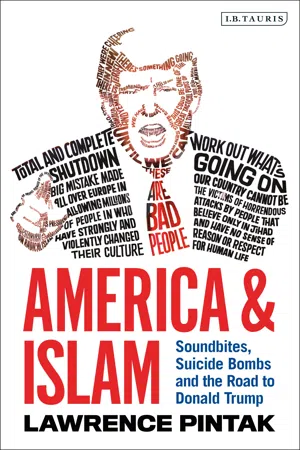
Donald Trump's first term as the 45th President of the United States of America has shocked the world. His attitudes towards Islam became a key point of contention on the campaign trail, and in power Trump has continued his war of divisive words and deeds. Here, acclaimed journalist Lawrence Pintak scrutinizes America's relationship with Islam since its foundation. Casting Donald Trump as a symptom of decades of misunderstanding and demonization of the Islamic world, as well as a cause of future tensions, Pintak shows how and why America's relationship with the world's largest religion has been so fractious, damaging and self-defeating.
Featuring unique interviews with victims and perpetrators of Trump's policies, as well as analysis of the media's role in inflaming debate, America & Islam provides a complete guide to the twin challenges of terrorism and the polarizing rhetoric that fuels it, sketching out a future based on co-operation and the reassertion of democratic values.
- 288 pages
- English
- ePUB (mobile friendly)
- Available on iOS & Android
eBook - ePub
About this book
Information
PART ONE
POLITICS—THE MUSLIM BOGEYMAN
1 MEDIA CODEPENDENCE
[I];f thought corrupts language, language can also corrupt thought.
GEORGE ORWELL
Politics and the English Language
Politics and the English Language
The president of the United States might be a secret Muslim supporting the Islamic State. That was the gist of Donald Trump’s comments to an American television interviewer in June 2016, after the worst mass shooting in American history.
“Look, we’re led by a man that either is not tough, not smart or he’s got something else in mind,” the presumptive Republican nominee told Fox & Friends. “He doesn’t get it, or he gets it better than anybody understands. It’s one or the other.”1
Then he added a four-word rejoinder encapsulating all the anti-Muslim innuendo of the 2016 presidential campaign. “There’s something going on,” Trump said. “It’s inconceivable. There’s something going on.”2 In that loaded phrase lived all the latent fears buried in the DNA of Americans of European descent since our distant ancestors took up swords in the first Crusade.
Something’s Going On
Stoking anger against the external enemy is a tried and true tactic of rulers throughout history. The 2016 presidential campaign proved it also works well for candidates willing to exploit the basest of human emotions. It began early in the GOP primary campaign when Trump lobbed one of his first anti-Muslim bombs: an incendiary and widely discredited claim that he saw “thousands and thousands of people … where you have large Arab populations” cheering as the World Trade Center collapsed.
“Hey, I watched when the World Trade Center came tumbling down. And I watched in Jersey City, N.J., where thousands and thousands of people were cheering as that building was coming down. Thousands of people were cheering. So something’s going on. We’ve got to find out what it is.”3
Something’s going on. We’re not sure exactly, but there’s something. Not saying what it is, not making any accusations . . .
The idea that there was something going on among Muslims and Arabs was the theme to which he kept returning throughout the campaign.
• “We don’t know what’s happening,” Trump said when announcing that he was running for the GOP nomination, referring to Mexican and Middle Eastern immigration.4
• “There’s something going on,” he said in the primary debate after the San Bernardino shootings.5
• “You know, there’s something definitely going on,” he confided to an interviewer, referring to the reaction of Muslims to the Paris attacks in November 2015. “There’s something nasty coming out of there.”6
• “There’s something going on in the mosques,” he told a North Carolina rally in November 2016.7
It was a strategy of innuendo to which it was difficult to respond, casting suspicion without an overt accusation. It left its targets off balance and his political rivals scrambling to show they were even more concerned.
“Radical Islam is on the rise,” Senator Ted Cruz proclaimed in the first Republican primary debate in August of 2015, “Global jihadists” are “an existential threat to our nation.” The next time they met, Ben Carson warned that, “[O];ur children will have no future if we put our heads in the sand.” Wisconsin governor Scott Walker also seized on the next generation card: “We need to live in a world where our children are free, free from the threats of radical Islamic terrorism.” Governor Bobby Jindal said America was being threatened by an “invasion” of Muslims who threatened to “colonize” the U.S., adding that American Muslims “want to use our freedoms to undermine that freedom in the first place.”8
“You feel safe right now?” Trump asked in the September California debate. “I don’t feel so safe.”
When they gathered in Milwaukee in November 2015, former governor Jeb Bush raised the specter of the Muslim enemy within. “We have a caliphate the size of Indiana that gains energy each and every day to recruit Americans in our own country,” he warned, calling “Islamic terrorism” the biggest threat facing the U.S. Yet Bush would be, in relative terms, an outlier as the campaign progressed, occasionally speaking out for Muslims. He gave an early indication of that later in the same debate, pointing out that just as Christians in Syria, Iraq and Lebanon were under threat from the so-called Islamic State, “if you’re a moderate Islamist, you’re not going to be able to survive either,” seemingly conflating the terms “Islamist” and “Muslim.”
Bobby Jindal was more concerned about the threat to his own co-religionists. Asked in the September debate about a fourteen-year-old Muslim boy who had been arrested in Texas for bringing a clock to school, he replied, “I’m glad that police are careful. I’m glad they are worried about security and safety issues. Look, in America we don’t tolerate them. The biggest discrimination that’s going on is against Christian business owners and individuals who believe in traditional forms of marriage.”
That was news to American Muslims, who were experiencing record levels of hate crimes, many of which went unreported by the FBI and thus by the national media.9
Feeding Frenzy
Liberal commentators might have expressed outrage at each new incendiary comment, but controversy meant ratings and so the media—particularly cable TV—eagerly fanned the rhetorical flames. The issue of mosque closings was a vivid example of the synergistic relationship between the candidates and American news organizations. In October, Fox Business anchor Stuart Varney asked Trump whether he would follow the example of Great Britain, which had revoked the passports of suspected militants and closed some mosques. When Trump responded, “I would do that, I think it’s great,” apparently referring to canceling the passports of Americans fighting for ISIS rather than mosque closings, Varney took it another step, seemingly putting words in the candidate’s mouth: “Can you close a mosque? I mean, we do have religious freedom.”
When ISIS killed more than 100 people in a series of suicide bombings and shootings in central Paris the following month, the anti-Muslim tenor of the campaign—and the synergistic media coverage—ratcheted up another notch. On MSNBC’s Morning Joe, host Joe Scarborough trolled for the day’s juiciest sound bite. The French interior minister had called for shutting down mosques in central Paris. What did Trump think of the idea of doing the same in the U.S.? “I would hate to do it, but it would be something that you’re going to have strongly consider,” the future president replied. “Some of the ideas, some of the hatred, absolute hatred, is coming from these areas,” adding, “We’re going to have to watch and study the mosques because a lot of talk is going on at the mosques.”
Over the coming days, the media seemed to egg on the candidates with increasingly provocative questions, eagerly seized on by the political rivals as they battled to bag the most headline-grabbing sound bite. Muslim databases. ID cards listing religion. Watch lists.
“I want surveillance of certain mosques, okay? If that’s okay?” Trump sarcastically asked the cheering crowd at one rally. “I want surveillance. And you know what? We’ve had it before, and we’ll have it again.”10
“We have no idea who’s being sent in here,” he later told ABC’s George Stephanopoulos, referring to Muslim refugees. “This could be the—it’s probably not, but it could be the great Trojan Horse of all time, where they come in.”11
Rubio wasn’t about to let Trump have all the airtime. “It’s not about closing down mosques,” he told Fox. “It’s about closing down any place—whether it’s a cafe, a diner, an internet site—any place where radicals are being inspired.”12 That’s “just wrong,” Jeb Bush responded. But the frenzy of anti-Muslim election rhetoric kept pushing things to the extreme. By the Fox News-moderated debate in January 2016, Bush was also warning of the threat at home. “[I];f we allow this to fester, we’re going to have Islamic terrorism, multi-generations of it all across this country,” he told Chris Wallace.
Co-moderator Megyn Kelly seemed to try to push them even further, pointing out that the Supreme Court had ruled the First Amendment effectively protected hate speech. “In other words,” she provocatively explained to Senator Marco Rubio, “radical Muslims have the right to be radical Muslims, unless they turn to terror.” Rubio readily took the bait. “Megyn, that’s the problem, ‘radical Muslims’ and ‘radical Islam’ is not just hate talk. It’s hate action. They blow people up. Look at what they did in San Bernardino.”
The media fever generated by those serial provocations was nothing compared to the feeding frenzy of the so-called “Muslim ban” as Trump called for “a total and complete shutdown of Muslims entering the United States until our country’s representatives can figure out what the Hell is going on!”13 The ban would stop “the extraordinary influx of hatred and danger coming into our country,” the future president tweeted.14
It was a seminal moment in the campaign, and for the country.
“We don’t have to have refugees come to our country, but all Muslims, seriously?” Bush asked when the candidates gathered a week later, adding that Trump’s comments were “unhinged.” Ted Cruz wanted to split the difference. He had just introduced legislation to ban refugees from nations where ISIS or Al Qaeda “controls significant territory” (He also wanted to “carpet-bomb” Syria to eliminate ISIS).
New Jersey governor Chris Christie was on record as opposing the profiling of Muslims. But it sounded very much like he was advocating exactly that when Kelly asked him about the neighbors of the San Bernardino killers, “They saw Muslims, and they did not think that was enough to call the cops. Do you?”
“I think what people should do is use their common sense,” explained the former prosecutor.
You see something that’s suspicious, you call law enforcement… . What that is, is just common sense. They thought something was wrong.
Kelly then asked Ben Carson, “Do you think the GOP messaging on Muslims has stoked the flames of bias on this as the Democrats suggest?”
“Well, I don’t know about the GOP messaging, but I can tell you about my messaging,” Carson replied in his understated style. “You know, [we] need to stop allowing political correctness to dictate our policies, because it’s going to kill us if we don’t.”
Political correctness. It was quickly becoming code for skirting civil rights in the name of expediency when it came to Muslims.
Carly Fiorina was a case study in the way Islam and American Muslims were used as a political football during the campaign. Shortly after 9/11, Fiorina, then the CEO of Hewlett-Packard, spoke admiringly of Islamic civilization, saying that “we could learn a lesson” from Muslim rulers of the past.15 Fiorina took a very different tone as she prepared to announce her candidacy for the GOP nomination. After a series of ISIS attacks in Paris that claimed seventeen lives, Fiorina appeared on comedian Bill Maher’s HBO program and laid the blame firmly on Is...
Table of contents
- Cover
- Halftitle Page
- Dedication Page
- Other Books by the Author
- Title Page
- Contents
- Reviews
- About the Author
- Author’s Note
- Introduction
- Part One Politics—The Muslim Bogeyman
- Part Two (Mis)Perceptions—Separating Fact from Fiction
- Part Three Policies—Seeing Black and White in a Sea of Gray
- Part Four Prospects—Islam Beyond Trump
- Notes
- Bibliography
- Index
- Copyright Page
Trusted by 375,005 students
Access to over 1.5 million titles for a fair monthly price.
Study more efficiently using our study tools.
Frequently asked questions
Yes, you can cancel anytime from the Subscription tab in your account settings on the Perlego website. Your subscription will stay active until the end of your current billing period. Learn how to cancel your subscription
No, books cannot be downloaded as external files, such as PDFs, for use outside of Perlego. However, you can download books within the Perlego app for offline reading on mobile or tablet. Learn how to download books offline
Perlego offers two plans: Essential and Complete
- Essential is ideal for learners and professionals who enjoy exploring a wide range of subjects. Access the Essential Library with 800,000+ trusted titles and best-sellers across business, personal growth, and the humanities. Includes unlimited reading time and Standard Read Aloud voice.
- Complete: Perfect for advanced learners and researchers needing full, unrestricted access. Unlock 1.5M+ books across hundreds of subjects, including academic and specialized titles. The Complete Plan also includes advanced features like Premium Read Aloud and Research Assistant.
We are an online textbook subscription service, where you can get access to an entire online library for less than the price of a single book per month. With over 1.5 million books across 990+ topics, we’ve got you covered! Learn about our mission
Look out for the read-aloud symbol on your next book to see if you can listen to it. The read-aloud tool reads text aloud for you, highlighting the text as it is being read. You can pause it, speed it up and slow it down. Learn more about Read Aloud
Yes! You can use the Perlego app on both iOS and Android devices to read anytime, anywhere — even offline. Perfect for commutes or when you’re on the go.
Please note we cannot support devices running on iOS 13 and Android 7 or earlier. Learn more about using the app
Please note we cannot support devices running on iOS 13 and Android 7 or earlier. Learn more about using the app
Yes, you can access America & Islam by Lawrence Pintak in PDF and/or ePUB format, as well as other popular books in Politics & International Relations & Politics. We have over 1.5 million books available in our catalogue for you to explore.