More than 700 'utopian' novels are published in Russia every year. These utopias – meaning here fantasy fiction, science fiction, space operas or alternative history – do not set out merely to titillate; instead they express very real Russian anxieties: be they territorial right-sizing, loss of imperial status or turning into a 'colony' of the West.
Contributors to this innovative collection use these narratives to re-examine post-Soviet Russian political culture and identity. Interrogating the intersections of politics, ideologies and fantasies, chapters draw together the highbrow literary mainstream (authors such as Vladimir Sorokin), mass literature for entertainment and individuals who bridge the gap between fiction writers and intellectuals or ideologists (Aleksandr Prokhanov, for example, the editor-in-chief of Russia's far-right newspaper Zavtra). In the process The Post-Soviet Politics of Utopia sheds crucial light onto a variety of debates – including the rise of nationalism, right-wing populism, imperial revanchism, the complicated presence of religion in the public sphere, the function of language – and is important reading for anyone interested in the heightened importance of ideas, myths, alternative histories and conspiracy theories in Russia today.
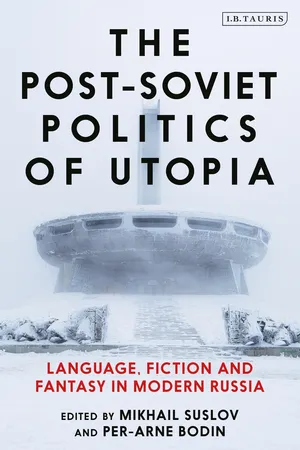
eBook - ePub
The Post-Soviet Politics of Utopia
Language, Fiction and Fantasy in Modern Russia
- 376 pages
- English
- ePUB (mobile friendly)
- Available on iOS & Android
eBook - ePub
The Post-Soviet Politics of Utopia
Language, Fiction and Fantasy in Modern Russia
About this book
Information
Table of contents
- Cover
- Half-Title Page
- Title Page
- Contents
- List of Figures
- List of Contributors
- Acknowledgements
- Introduction
- Part One History
- 1 Alternative Russian Revolution: Viacheslav Rybakov and Kir Bulychev
- 2 Ressentiment and Post-traumatic Syndrome in Russian Post-Soviet Speculative Fiction: Two Trends
- 3 Telluro-Cosmic Imperial Utopia and Contemporary Russian Art
- 4 Lazarus on the Ark: Heterotopias in the Novels of Vladimir Sharov and Evgenii Vodolazkin
- Part Two Ideology
- 5 Conservative Science Fiction in Contemporary Russian Literature and Politics
- 6 Othering Russia: Eduard Limonov’s Retrofuturistic (Anti-) Utopia
- 7 Religio-political Utopia by Iana Zavatskaia Anastasia Mitrofanova
- 8 ‘Respectable Xenophobia’: Science Fiction, Utopia and Conspiracy Victor Shnirelman
- Part Three Language
- 9 Church Slavonic in Russian Dystopias and Utopias Per-Arne Bodin
- 10 Contested Utopias: Language Ideologies in Valerii Votrin’s Logoped Ingunn Lunde
- 11 ‘Londongrad’ as a Linguistic Imaginary: Russophone Migrants in the UK in the Work of Michael Idov and Andrei Ostalsky Lara Ryazanova-Clarke
- Part Four Territory
- 12 Provinces, Piety and Promotional Putinism: Mapping Aleksandr Prokhanov’s Counter-Utopian Russia Edith W. Clowes
- 13 Parameters of Space-Time and Degrees of (Un)Freedom: Dmitry Bykov’s ZhD Sofya Khagi
- 14 The New ‘Norma’: Vladimir Sorokin’s Telluria and Post-Utopian Science Fiction Mark Lipovetsky
- Afterword: Back to the Future, Forward to the Past? Explorations in Russian Science Fiction and Fantasy Kåre Johan Mjør and Sanna Turoma
- Selected Bibliography
- Index
- Copyright
Trusted by 375,005 students
Access to over 1.5 million titles for a fair monthly price.
Study more efficiently using our study tools.
Frequently asked questions
Yes, you can cancel anytime from the Subscription tab in your account settings on the Perlego website. Your subscription will stay active until the end of your current billing period. Learn how to cancel your subscription
No, books cannot be downloaded as external files, such as PDFs, for use outside of Perlego. However, you can download books within the Perlego app for offline reading on mobile or tablet. Learn how to download books offline
Perlego offers two plans: Essential and Complete
- Essential is ideal for learners and professionals who enjoy exploring a wide range of subjects. Access the Essential Library with 800,000+ trusted titles and best-sellers across business, personal growth, and the humanities. Includes unlimited reading time and Standard Read Aloud voice.
- Complete: Perfect for advanced learners and researchers needing full, unrestricted access. Unlock 1.5M+ books across hundreds of subjects, including academic and specialized titles. The Complete Plan also includes advanced features like Premium Read Aloud and Research Assistant.
We are an online textbook subscription service, where you can get access to an entire online library for less than the price of a single book per month. With over 1.5 million books across 990+ topics, we’ve got you covered! Learn about our mission
Look out for the read-aloud symbol on your next book to see if you can listen to it. The read-aloud tool reads text aloud for you, highlighting the text as it is being read. You can pause it, speed it up and slow it down. Learn more about Read Aloud
Yes! You can use the Perlego app on both iOS and Android devices to read anytime, anywhere — even offline. Perfect for commutes or when you’re on the go.
Please note we cannot support devices running on iOS 13 and Android 7 or earlier. Learn more about using the app
Please note we cannot support devices running on iOS 13 and Android 7 or earlier. Learn more about using the app
Yes, you can access The Post-Soviet Politics of Utopia by Mikhail Suslov, Per-Arne Bodin, Mikhail Suslov,Per-Arne Bodin in PDF and/or ePUB format, as well as other popular books in Politics & International Relations & Political History & Theory. We have over 1.5 million books available in our catalogue for you to explore.