In the 'encyclopaedic' fourteenth century, Arabic chronicles produced in Mamluk cities bore textual witness to both recent and bygone history, including that of the Fatimids (969–1171CE). For in two centuries of rule over Egypt and North Africa, the Isma'ili Fatimids had left few self-generated historiographical records. Instead, it fell to Ayyubid and Mamluk historians to represent the dynasty to posterity. This monograph sets out to explain how later historians preserved, interpreted and re-organised earlier textual sources.
Mamluk historians engaged in a sophisticated archival practice within historiography, rather than uncritically reproducing earlier reports. In a new diplomatic edition, translation and analysis of Mamluk historian Ibn al-Furat's account of late Fatimid rule in The History of Dynasties and Kings, a widely known but barely copied universal chronicle of Islamic history, Fozia Bora traces the survival of historiographical narratives from Fatimid Egypt. Through Ibn al-Furat's text, Bora demonstrates archivality as the heuristic key to Mamluk historical writing.
This book is essential for all scholars working on the written culture and history of the medieval Islamic world, and paves the way for a more nuanced reading of pre-modern Arabic chronicles and of the epistemic environment in which they were produced.
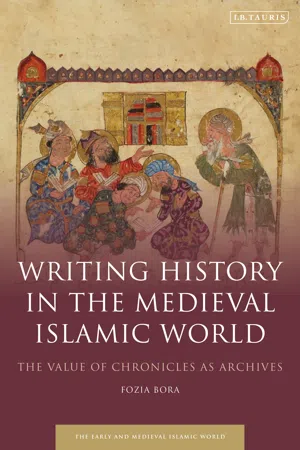
eBook - PDF
Writing History in the Medieval Islamic World
The Value of Chronicles as Archives
- 271 pages
- English
- PDF
- Available on iOS & Android
eBook - PDF
About this book
Information
Table of contents
- Cover
- Half title
- Series page
- Title
- Copyrights
- Dedication
- Contents
- List of Illustrations
- Acknowledgements
- Introduction
- Ibn al-Furāt: A hidden figure of Mamluk historiography
- 1 The Archival Function of Historiography
- 2 An Exemplary Chronicle as Archive: Ibn al-Furāt’s Ta’rīkh al-duwal wa ’l-mulūk
- 3 Fatimid Archivalia: Narratives and Documents in Late Fatimid Egypt
- 4 Mamluk Archivalities: Late Fatimid History in Ibn al-Furāt’s Chronicle
- 5 A Micro-Historical Analysis of Ibn al-Furāt’s Archive (Part 1): Two Fatimid Vizierates
- 6 A Micro-Historical Analysis of Ibn al-Furāt’s Archive (Part 2): Fatimid Caliphs and Viziers to the Rise of Ṣalāḥal-Dīn
- 7 Concluding Remarks: The Value of Chronicles as Archives
- Appendix A: Ibn al-Furāt’s Use of Reports for Late Fatimid Egypt (1094–1166)
- Appendix B: Diplomatic Edition of Selected Extracts from Ibn al-Furāt’s Ta’rīkh al-duwal: Arabic Text
- Appendix C: English Translation of Selected Extracts from Ta’rīkh al-duwal
- Bibliography
- Index
Trusted by 375,005 students
Access to over 1.5 million titles for a fair monthly price.
Study more efficiently using our study tools.
Frequently asked questions
Yes, you can cancel anytime from the Subscription tab in your account settings on the Perlego website. Your subscription will stay active until the end of your current billing period. Learn how to cancel your subscription
No, books cannot be downloaded as external files, such as PDFs, for use outside of Perlego. However, you can download books within the Perlego app for offline reading on mobile or tablet. Learn how to download books offline
Perlego offers two plans: Essential and Complete
- Essential is ideal for learners and professionals who enjoy exploring a wide range of subjects. Access the Essential Library with 800,000+ trusted titles and best-sellers across business, personal growth, and the humanities. Includes unlimited reading time and Standard Read Aloud voice.
- Complete: Perfect for advanced learners and researchers needing full, unrestricted access. Unlock 1.5M+ books across hundreds of subjects, including academic and specialized titles. The Complete Plan also includes advanced features like Premium Read Aloud and Research Assistant.
We are an online textbook subscription service, where you can get access to an entire online library for less than the price of a single book per month. With over 1.5 million books across 990+ topics, we’ve got you covered! Learn about our mission
Look out for the read-aloud symbol on your next book to see if you can listen to it. The read-aloud tool reads text aloud for you, highlighting the text as it is being read. You can pause it, speed it up and slow it down. Learn more about Read Aloud
Yes! You can use the Perlego app on both iOS and Android devices to read anytime, anywhere — even offline. Perfect for commutes or when you’re on the go.
Please note we cannot support devices running on iOS 13 and Android 7 or earlier. Learn more about using the app
Please note we cannot support devices running on iOS 13 and Android 7 or earlier. Learn more about using the app
Yes, you can access Writing History in the Medieval Islamic World by Fozia Bora in PDF and/or ePUB format, as well as other popular books in History & Middle Eastern History. We have over 1.5 million books available in our catalogue for you to explore.