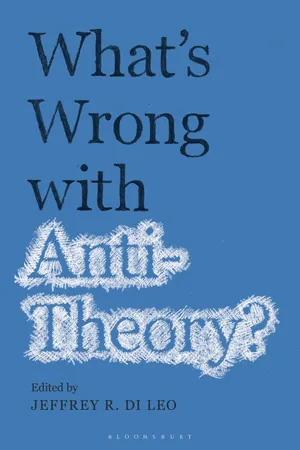
Antitheory has long been a venerable brand of theory and – although seemingly opposite – the two impulses have long been intertwined. Antitheory is the first book to explore this vexed relationship from the 20th century to the present day, examining antitheory both in its historical context and its current state. The book brings together leading scholars from a wide range of Humanities disciplines to ask such questions as:
· What is antitheory?
· What does it mean to be against theory in the new millennium?
· What is the current state of post-theory, the alleged deaths of theory, and the critique of critique?
- 272 pages
- English
- ePUB (mobile friendly)
- Available on iOS & Android
eBook - ePub
What’s Wrong with Antitheory?
About this book
Information
Part One
Antitheory as Theory
1
Antitheory 2.0: The Case of Derrida and the Question of Literature
Antitheory has long been a venerable brand of theory. I recall for example being on a “theory versus cultural studies” panel at the Modern Language Association (MLA) convention in 1994, with Vincent Leitch and Emily Apter—back in the days when theory people used to growl derisively about an antitheory brand of “Madonna studies.” However, I think we came to the conclusion that theory was cultural studies, and vice versa. In any case, literary theory was in those days taking a historicist and social turn (away from the hermeneutic formalism of the text), while cultural studies was from the beginning dedicated to what Stuart Hall called “the detour through theory,” so it may have been not Madonna studies but literary studies that was trending “antitheory” in those days. In any case, the problem was solved that afternoon in San Diego by deploying the old Hegelian trick of finding an opposition to be in fact a form of agreement, if you look at it from a higher level of abstraction. Though of course over the years before and after 1994, there were myriad other conference sessions dedicated to the “antitheory” challenges-from-within posed by Walter Benn Michaels, Eve Sedgwick, Deleuze and Guattari, Badiou, or [fill in the blank]. The session I was in, and many others like it, was a symptom of this venerable antitheory genre of theory itself.
In this chapter, I want to think about how today’s “2.0” antitheory movements are like and unlike prior ones. Which is to ask, are today’s antitheory theories similar to the antitheory challenges posed by—among many other movements—cultural studies, globalization studies, feminism, race and gender studies, queer theory, postcolonialism, Marxism, or new historicism? Or is there something decisively different going on today? To put it bluntly, I argue that the 1980s and 1990s antitheory wars were largely internecine wars concerning interpretive paradigms, and attempts to open up the question of where something like “meaning” comes from when we read a literary work, beyond the strict formalist conception of the text. In other words, the first rounds of “1.0” antitheory wars were largely a series of attempts to open up the question of interpretation beyond a myopic Saussurean focus on the text itself as the only legitimate linchpin for literary hermeneutics.
To recall just the most obvious and banal point concerning Saussure’s thinking, he demonstrates that the signifier-signified relation is a conventional one. In short, Saussure shows us that language is a constructed network of systematic effects, not a list of Adamic names whose meaning is guaranteed by an essential link between the word and the existence its referent in the world. Famously, for Saussure that relation between the signifier and the signified is arbitrary and social, not necessary and essential: as Saussure memorably puts it, “In language, there are only differences, without positive terms.”1 This insight about the workings of language became the linchpin of almost all structuralism and poststructuralism, a loose grab bag of movements also dubbed “the linguistic turn,” which entailed far-reaching revolutions in thinking about everything from the nature of kinship systems (Claude Lévi-Strauss) and historical events (Hayden White) to the workings of political power (Louis Althusser) or sex and gender (Judith Butler), all the way to the workings of African American cultural production (Henry Louis Gates’s “signifyin”), and even the unconscious itself (Jacques Lacan’s famous dictum that the unconscious is structured like a language is specifically scaffolded on Saussure’s relation between the signifier and the signified). The truism that “there are no positive terms, only differences” got translated far beyond Saussure’s insight into the workings of human language, and in the end this linguistic insight found itself exploded into the near-universal claim that there is no meaning in itself (against the “essentialist” position that takes meaning to inhere in an essence within persons and things); rather, on the Saussurean reasoning of the linguistic turn, there is only a series of differential, social (re)productions of meaning—a social (re)production machine that pretends to be based on natural or self-evident truths, but is in reality laden with ideological power plays and hidden political interests that require constant critical demystification. In short, Saussure’s insights into the social nature of meaning in language became the subtending structure or logic animating a series of critical insights into the socially constructed nature of everything.
In doing so, however, the Antitheory 1.0 critique of the signifier largely extended (rather than rejected) that very logic of the signifier—which entailed less a complete rethinking of Saussure’s account of signification than it comprised a shift in emphasis from one Saussurean pole to another, stressing the social construction of signified meaning in the social world rather than a strict attention to the undecidable signifier in the text.
However, precisely because of this linguistic social construction paradigm and its saturation within structuralism and poststructuralism, Saussure’s work has not been well placed to survive the backlash against the linguistic turn that has emerged in the twenty-first century—the various critiques of the linguistic turn’s primary anti-essentialist modus operandi, whereby any given realist or essentialist claim is shown to be constructed in and through the conventions and language of social power. The era of the linguistic turn was simultaneously the era of social constructionism, and its axiomatic sense that any claim to transhistorical truth (any claim to a final signified of guaranteed meaning) was in fact a contextual linguistic power play (a series of socially constructed signifiers) dressing itself up in the language of unassailable objectivism. This wide-ranging unmasking of essentialism was, it seems to me, the primary warrant for critical work in the age of Antitheory 1.0: the hermeneutics of suspicion was exported from the literary text and set loose on the social world of politics, identity formation, race, class, gender, ethnicity, disability, and so on.
Fast-forward to the adolescence of the twenty-first century, though, and the major buzzword in antitheory theory circles these days is “realism”—a rallying cry for myriad movements that only half a generation ago would have been branded naïve or, worse yet, essentialist. (And take it from me, students, there was no label more damning, in the late 1980s or early 1990s, than being called an essentialist.) These new realisms all share a kind of flight from the signifier, from the pivot of language, and from the question of reading or social critique as grounded in a hermeneutics of suspicion. Most obvious here would be the antilinguistic turn in object-oriented philosophy and speculative realism, as well as various forms of vibrant or agential matter (in the work of Jane Bennett and Karen Barad, for example), but one could also look to gender studies, which was ruled a generation ago by the sign- and language-based theories of performativity (say, Judith Butler). However, it’s recently gone in a series of other “new materialist” directions (see, for example, the essays in Stacy Alaimo and Susan Hekman’s Material Feminisms); in literature departments, think of the critique of commentary in Gregg Lambert’s work on Deleuze, or the recent antihermeneutic methodological rise of data analysis, most convincingly thematized as distant reading (Franco Moretti), not to mention emergent methods like surface reading (Stephen Best and Sharon Marcus), descriptive reading (Heather Love), a resurgence of Eve Sedgwick’s reparative reading, or postcritical reading (Rita Felski); likewise, consider various kinds of scientific, neuroscientific, and new media approaches to literature—examining everything from the nonhuman networks in which we act (Bruno Latour) to the brain chemistry of reading or the evolutionary functions of storytelling (Lisa Zunshine). All the way to animal studies and posthumanism, with their stinging critiques of linguistic anthropomorphism (say, Cary Wolfe’s work). In short, if we look closely at the signposts concerning the present, it begins to look like we are postsigns, on the other side of the postmodern linguistic turn.
Language 2.0? Rethinking Derrida on Language
In fact, the driving apparatus of the linguistic turn—the hermeneutics of suspicion and its axiom that any claim can be endlessly recontextualized—becomes the linchpin of Bruno Latour’s critique of deconstruction, taken up by Rita Felski in The Limits of Critique: they share the sense that “context stinks” as a way to think about social determinations of meaning, because sooner or later, you simply have to give up on that endless contextualization, precisely because it’s otherwise an interminable process (akin to the Hegelian “bad infinite”).2 If, as Derrida concisely puts it, “no can be determined out[side] of context, but no context permits saturation,”3 then maybe the larger grid of intelligibility offered by linguistic context has to go, at least in part because that skeptical procedure of endless recontextualization has in the twenty-first century mutated from a tool used primarily by leftist hermeneuts of suspicion, to become the preferred tactic of right-wing climate change deniers and political purveyors of “alternative facts.” In any case, the Antitheory 2.0 critique of contextual meaning is that formerly prized moment of factual conclusion or consensus—scientific, literary, or otherwise—is downgraded to the moment of the process’s arbitrary exhaustion (you have to stop somewhere), arrived at not by satisfactorily completing the contextual deliberative process, but by simply running out of time, throwing up your hands or shrugging your shoulders.
From Derrida’s point of view, however, giving up on endless contextualization is thematized not as a moment of frustrated surrender, but the generative moment of decision—the event where one engages an outcome that’s never guaranteed by the process (in the moment of deliberation, you can’t know if it’s the “right” decision), and (luckily) always open to recontextualization. As Derrida writes in the Afterword to Limited Inc.,
A decision can only come into being in a space that exceeds the calculable program that would destroy all responsibility by transforming it into a programmable effect of determinate causes. There can be no moral or political responsibility without this trial and this passage by way of the undecidable. Even if a decision seems to take only a second and not to be preceded by any deliberation, it is structured by this experience and experiment of the undecidable.4
While there is no theoretical limit to the performative events of iterability and recontextualization (such an iterability of the mark, a gesture’s repetition that nevertheless introduces difference, is the compulsory “real” in Derrida), there certainly is a practical limit to endless recontextualization—the necessity of action and decision without which there would be no ethics or politics. But that ethical decision or political action is based not on the sureties of intentional states and guaranteed outcomes, but on the undecidable calculations of contextual possibilities. Derrida will elsewhere call this iterable contextuality “justice” (the necessity that everything is so calculated that calculation does not have the last word over everything)—so named because any given ethico-political decision is inexorably open to revision in the future (for better or worse): to speak phenomenologically, the “event” that is today is part of a mesh with the retention of yesterday, and the protention of tomorrow. This explains why for Derrida justice is “undeconstructable”: because justice is deconstruction itself.
And thereby any narrow linguistically based example of this deconstructive larger process, like the contextual emergence of meaning or the process of subjective decision making, is necessarily carried along by a structurally more powerful set of disseminating forces that go by many iterable and recontexualized names in Derrida’s work—the aforementioned justice, for example, or iteration, the structure of the remnant, pharmakon, supplement, shibboleth, trace, différance, the performative, hospitality, chora, and so on. The most famous general moniker he gives to those disseminating forces is “writing,” but of course that immediately leads us back to the (still-dominant) thematization of Derrida as a hopelessly “linguistic turn” figure, who suggests that human language—in the form of textuality—is finally what makes the world go round: there is nothing outside the text. On this line of reasoning, deconstruction shows us the embarrassing fact that we used to think the really real was to be found in the intentional metaphysics of presence that animates human speech, but Derrida may seem to teach us the opposite—that the real is (un)grounded in a metaphysics of difference and deferral modeled on human writing practices.
Such a narrowly linguistic understanding of Derrida, however, seriously underestimates the stakes of his notion of writing, which he insists should be taken not as synonymous with human inscription, but in a more general (let’s call it universal, just to be provocative) sense as “the iterability of the mark beyond all human speech acts. Barring any inconsistency, ineptness, or insufficiently rigorous formulation on my part, my statements on this subject should be valid beyond the marks and society called ‘human.’”5 So the trace structure of the iterable mark is open to recontextualization precisely because any given mark or singularity—me, you, the bird, the worm, the orchid, the wasp, the napkin dispenser, the North American power grid, the Earth—is not identical to itself. And that structure of universal nonidentity certainly isn’t caused (or really in any significant way impacted) by humans and their language. Rather, this structure of the mark, the remnant, or iteration is the condition of (im)possibility for the event of being itself—human, animal, plant, planetary.
Which is to say in more prosaic terms that withering and passing away is the condition of possibility for something to come into existence in the first place; so the event that is any given entity—the emergence of everything that’s come into being—necessitates that being is never fully present to itself. Which is why for Derrida, the emergence or life of a being or object is not opposed to its death or disappearance, because finitude is integral to being itself—the ability to pass from the scene inevitably and inexorably marks anything that emerges. And that law applies even to large-scale entities such as the formation of the Earth or the emergence of the human species itself—both of which will pass away eventually, taking the highly circumscribed entity of human logos with them. And such finitude is not merely an avoidable accident that befalls some existents: passing out of existence eventually happens (or at least structurally can happen) to them all; in effect, the eventuality of disappearing is the signature event that marks and prefigures all contextual emergence and presence. In Derrida, that necessity of finitude (the coming into being and passing away of all things, alive or otherwise) constitutes a philosophical “real”—that which far exceeds the human species, much less the arcane intricacies of human linguist...
Table of contents
- Cover
- Halftitle
- Title Page
- Dedication
- Contents
- Notes on Contributors
- Acknowledgments
- Introduction: Antitheory and Its Discontents Jeffrey R. Di Leo
- Part 1 Antitheory as Theory
- Part 2 Reading as Antitheory
- Part 3 Philosophy, Theory, and Antitheory
- Index
- Imprint
Trusted by 375,005 students
Access to over 1.5 million titles for a fair monthly price.
Study more efficiently using our study tools.
Frequently asked questions
Yes, you can cancel anytime from the Subscription tab in your account settings on the Perlego website. Your subscription will stay active until the end of your current billing period. Learn how to cancel your subscription
No, books cannot be downloaded as external files, such as PDFs, for use outside of Perlego. However, you can download books within the Perlego app for offline reading on mobile or tablet. Learn how to download books offline
Perlego offers two plans: Essential and Complete
- Essential is ideal for learners and professionals who enjoy exploring a wide range of subjects. Access the Essential Library with 800,000+ trusted titles and best-sellers across business, personal growth, and the humanities. Includes unlimited reading time and Standard Read Aloud voice.
- Complete: Perfect for advanced learners and researchers needing full, unrestricted access. Unlock 1.5M+ books across hundreds of subjects, including academic and specialized titles. The Complete Plan also includes advanced features like Premium Read Aloud and Research Assistant.
We are an online textbook subscription service, where you can get access to an entire online library for less than the price of a single book per month. With over 1.5 million books across 990+ topics, we’ve got you covered! Learn about our mission
Look out for the read-aloud symbol on your next book to see if you can listen to it. The read-aloud tool reads text aloud for you, highlighting the text as it is being read. You can pause it, speed it up and slow it down. Learn more about Read Aloud
Yes! You can use the Perlego app on both iOS and Android devices to read anytime, anywhere — even offline. Perfect for commutes or when you’re on the go.
Please note we cannot support devices running on iOS 13 and Android 7 or earlier. Learn more about using the app
Please note we cannot support devices running on iOS 13 and Android 7 or earlier. Learn more about using the app
Yes, you can access What’s Wrong with Antitheory? by Jeffrey R. Di Leo in PDF and/or ePUB format, as well as other popular books in Literature & Literary Criticism for Comparative Literature. We have over 1.5 million books available in our catalogue for you to explore.