The Decades of Modern American Drama series provides a comprehensive survey and study of the theatre produced in each decade from the 1930s to 2009 in eight volumes. Each volume equips readers with a detailed understanding of the context from which work emerged: an introduction considers life in the decade with a focus on domestic life and conditions, social changes, culture, media, technology, industry and political events; while a chapter on the theatre of the decade offers a wide-ranging and thorough survey of theatres, companies, dramatists, new movements and developments in response to the economic and political conditions of the day. The work of the four most prominent playwrights from the decade receives in-depth analysis and re-evaluation by a team of experts, together with commentary on their subsequent work and legacy. A final section brings together original documents such as interviews with the playwrights and with directors, drafts of play scenes, and other previously unpublished material.
The major playwrights and their plays to receive in-depth coverage in this volume include:
* Theresa Rebeck: Omnium Gatherum (2003), Mauritius (2007), and The Understudy (2008);
* Sarah Ruhl: Eurydice (2003), Clean House (2004), and In the Next Room (or the Vibrator Play) (2009);
* Lynn Nottage: Intimate Apparel (2003), Fabulation or Re-Education of Undine (2004), and Ruined (2008);
* Charles Mee: Big Love (2000), Wintertime (2005), and Hotel Cassiopeia (2006).
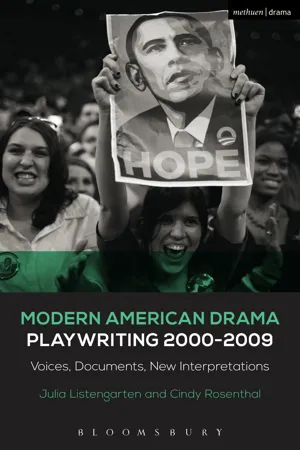
eBook - ePub
Modern American Drama: Playwriting 2000-2009
Voices, Documents, New Interpretations
- 312 pages
- English
- ePUB (mobile friendly)
- Available on iOS & Android
eBook - ePub
Modern American Drama: Playwriting 2000-2009
Voices, Documents, New Interpretations
About this book
Information
1
Introduction: Living in the 2000s
Julia Listengarten
Background
What else could possibly have gone wrong in the first years of the twenty-first century? The country lived through the devastating terrorist attacks of 11 September 2001; major corporate bankruptcies; the collapse of the car industry; the deep economic recession; mass shootings; political and sex scandals. The unemployment rate rose above 10 per cent for the first time since 1983. Surveillance culture grew and intelligence gathering proliferated. Climate change led to environmental catastrophes, such as Hurricane Katrina and its aftermath. While the fear of a massive Y2K computer meltdown did not materialize on midnight of 1 January 2000, other fears soon entered the lives of many Americans: the fear of snipers near Washington, DC, and anthrax attacks, the fear of global terrorism, the fear of losing one’s home, the fear of losing a job, the fear of losing a loved one to the wars in Afghanistan and Iraq.
‘The noughties’, as the British sometimes refer to the decade, was a period of great calamities and inventions. Indeed, this decade of major economic and political upheavals also featured many groundbreaking technological discoveries, including the explosion of Internet-based culture. It was also a decade of great paradoxes: the period of conservative politics in the country coincided with a number of progressive changes toward social equality; globalism and the growth in social networking produced a sense of isolation – both national and personal – and anxiety over the loss of identity and originality. Was it ‘the lost decade’ of massive political and environmental disasters? The ‘digital decade’ of Facebook, Twitter and video games? The decade of the ‘look-at-me generation’, of reality TV and celebrity culture? This chapter explores the decade from these various perspectives and discusses key events and developments in the 2000s which include
•War on a global scale
•The Great Recession
•Changing perspectives on gender and sexual identity
•Racial politics and religious intolerance
•Environmental concerns
•The rise of neoconservatism and the Tea Party
•Evolving definitions of ‘family’
•The emergence of digital and social media
Society
War on Terror
It was, we were soon told, ‘the day that changed everything’, the 21st century’s defining moment, the watershed by which we would forever divide world history: before, and after, 9/11.
Jon Henley, Guardian, 9 September 2011
On 11 September 2001, nineteen Islamic fundamentalists hijacked four US airliners. Two planes were crashed into the World Trade Center in New York City, collapsing the Twin Towers; one was crashed into the Pentagon, seriously damaging the building; and one that was targeted at the White House or the US Capitol instead crashed in a cornfield in Shanksville, Pennsylvania, after passengers tried to stop the hijackers. The al-Qaeda organization, led by Osama bin Laden, was responsible.
Nearly 3,000 people perished as a result of the 9/11 terrorist attacks. The long-term effects included significant physical and mental health issues. In June 2007, New York City commissioned the World Trade Center Medical Group to analyse the short-term health effects of 9/11 and project the long-term care needs of people exposed at ground zero. The report, issued in 2009, found that 15,688 people that year received publicly funded treatment for World Trade Center-related health conditions. Furthermore, over 40,000 first responders and workers were screened or monitored for disease.
In response to the 9/11 attacks, the US launched wars in Afghanistan and Iraq in 2001 and 2003, respectively, with the support of an international coalition. These would become the longest military conflicts in US history. In Iraq, US military fatalities exceeded 4,300 up to 2009. In Afghanistan, US combat deaths numbered 946 up to 2009.
The immediate and long-lasting effects of the wars on the US military personnel deployed in Afghanistan and Iraq included post-traumatic stress disorder (PTSD), traumatic brain injury (TBI), major limb amputations and self-inflicted wounds. In 2003, there were 977 cases of the PTSD diagnosis reported among the deployed personnel; by 2009, the number rose to 13,863. TBI cases reached 28,877 by 2009.1
As the country engaged in the War on Terror, various national security policies emerged, authorizing domestic surveillance as well as detention and interrogation programmes. The establishment of the Department of Homeland Security aimed to unify national security efforts. The National Security Agency (NSA) implemented the Terrorist Surveillance Program (TSP) to intercept al-Qaeda communications, although the programme was later implicated in engaging in widespread domestic surveillance. Blackwater Security Consulting, a private security company, was contracted by the Federal government to conduct risky and at times controversial military operations in the wake of 9/11. During the 16 September 2007 Blackwater operation in Iraq, seventeen Iraqis were killed and twenty-four wounded when Blackwater operators opened fire in a traffic circle in central Baghdad.
BOX 1.1: WAR ON TERROR
The War on Terror, a phrase first used by President Bush on 20 September 2001, is an ideological concept that emerged after the 11 September attacks to fight terrorism. It also refers to the series of international military and diplomatic campaigns aimed at putting an end to international terrorism, largely associated with radical Islamist groups such as al-Qaeda, Hezbollah and Hamas. The War on Terror campaigns were launched by the US, with support from NATO and other allies, in the aftermath of the 11 September terrorist attacks.
In addition to the Bush administration-led wars in Afghanistan and Iraq, the War on Terror also involved covert military operations and new security legislation, as well as efforts to block the financing of terrorist organizations. There was widespread criticism of ‘War on Terror’ as an approach to combating global terrorism and strengthening national security. Critics argued that, instead, this concept promoted an ideology of fear and mistrust, both domestically and internationally.
Economy
The decade’s economy in the US was plagued by a series of crises leading to a major economic decline, also referred to as the Great Recession. The decade began with the dot-com bubble bursting and ended with the meltdown of the financial system caused by the crisis in subprime mortgages.
The development of the global economy prompted the outsourcing of US service and technology, which precipitated what Thomas Friedman called the ‘flattening’ of the world.2 The rise of China and India as world financial powers presented a challenge to the US economy, as the global balance of power began to shift toward the East.
Dot-com bubble burst
The period of the dot-com bubble (also referred to as the Internet bubble or information technology bubble), which began roughly in 1997, achieved its climax on 10 March 2000, when the NASDAQ stock exchan...
Table of contents
- Cover
- Title Page
- Contents
- List of Tables and Boxes
- Acknowledgements
- Biographical Note and Notes on Contributors
- General Preface Brenda Murphy and Julia Listengarten
- 1. Introduction: Living in the 2000s
- 2. Theatre in the 2000s
- 3. Charles Mee
- 4. Lynn Nottage
- 5. Theresa Rebeck
- 6. Sarah Ruhl
- Afterword
- Documents
- Notes
- Bibliography
- Index
- eCopyright
Trusted by 375,005 students
Access to over 1.5 million titles for a fair monthly price.
Study more efficiently using our study tools.
Frequently asked questions
Yes, you can cancel anytime from the Subscription tab in your account settings on the Perlego website. Your subscription will stay active until the end of your current billing period. Learn how to cancel your subscription
No, books cannot be downloaded as external files, such as PDFs, for use outside of Perlego. However, you can download books within the Perlego app for offline reading on mobile or tablet. Learn how to download books offline
Perlego offers two plans: Essential and Complete
- Essential is ideal for learners and professionals who enjoy exploring a wide range of subjects. Access the Essential Library with 800,000+ trusted titles and best-sellers across business, personal growth, and the humanities. Includes unlimited reading time and Standard Read Aloud voice.
- Complete: Perfect for advanced learners and researchers needing full, unrestricted access. Unlock 1.5M+ books across hundreds of subjects, including academic and specialized titles. The Complete Plan also includes advanced features like Premium Read Aloud and Research Assistant.
We are an online textbook subscription service, where you can get access to an entire online library for less than the price of a single book per month. With over 1.5 million books across 990+ topics, we’ve got you covered! Learn about our mission
Look out for the read-aloud symbol on your next book to see if you can listen to it. The read-aloud tool reads text aloud for you, highlighting the text as it is being read. You can pause it, speed it up and slow it down. Learn more about Read Aloud
Yes! You can use the Perlego app on both iOS and Android devices to read anytime, anywhere — even offline. Perfect for commutes or when you’re on the go.
Please note we cannot support devices running on iOS 13 and Android 7 or earlier. Learn more about using the app
Please note we cannot support devices running on iOS 13 and Android 7 or earlier. Learn more about using the app
Yes, you can access Modern American Drama: Playwriting 2000-2009 by Julia Listengarten,Cindy Rosenthal in PDF and/or ePUB format, as well as other popular books in Literature & Literary Criticism in Drama. We have over 1.5 million books available in our catalogue for you to explore.