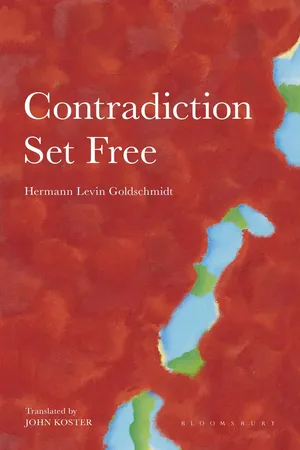
First published in in 1976, Hermann Levin Goldschmidt's Contradiction Set Free, (Freiheit für den Widerspruch), reflects the push to explore new forms of critical thinking that gained momentum in the decade between Theodor Adorno's Negative Dialectics of 1966 and Paul Feyerabend's Against Method in 1975.
The book articulates Goldschmidt's reclamation of an epistemologically critical position that acknowledges the deep underlying link between the modes of production of knowledge and the social and political life they produce. In signalling a breakout from the academic rut and its repressive hold, Goldschmidt pointed beyond the ossified methods of a philosophical discourse whose oppressive consequences could no longer be ignored.Contradiction Set Free makes available for the first time in English a pivotal work by one of the great critical thinkers of the 20th century.
- 168 pages
- English
- ePUB (mobile friendly)
- Available on iOS & Android
eBook - ePub
Contradiction Set Free
About this book
Information
Chapter 1
THE DISCOVERY OF CONTRADICTION
Contradiction from the beginning
Every human being is a whole person or can at least become one. This means the human being is confronted with the universe as something that is, like itself, both singular and whole. If this at once alarmingly weak, and on its own for the most part helpless human creature begins to doubt that it is—all on its own—nonetheless a whole human being (or at least capable of becoming one), it finds itself supported by the singularity and wholeness of the universe, which guarantees by its existence the human being’s as well. Furthermore, the human being is connected to the other humans, each of which is nonetheless, like itself, a whole person all on its own. No matter how intimate their connections with each other or their oneness with the universe may be, humans are, however, never repetitions of each other. The human other, each singular and whole in its own right, is never the same, but always a different person. Humans don’t repeat each other; they contradict each other.
The contradictions that arise between people, in faith and in thought, and between faith and thought, are, from the very beginning, just as fundamental as the individual and collective encounter with the unity of the All. Faced with such contradictoriness, is not this unity merely unified [vereinheitlicht] diversity, that is to say, ultimately only an imagined unity? And is not diversity then here the ultimate: a diversity that, while it can be united [vereinigen], cannot be, cannot ever be, unified? Yet the predominating tendency prefers unity and is full of mistrust in the face of diversity.
It is supposed that the noncontradictory, uniform whole has an advantage over the whole of contradictory diversity, even though the whole accessed through diversity is equally complete and far more emancipatory. Where a contradiction makes itself heard, there, it is often thought, something is wrong—whereas the point is to grasp that it is there, where we encounter no contradiction, that something must be wrong. For unification, which always boils down to enforced conformity [Gleichschaltung], does not safeguard freedom; contradiction does: by virtue of ruling out every unification. Yet deeply engrained prejudices block contradiction’s path to freedom, even though its liberation, and its liberation alone, can lead to freedom’s consummation.
For that singularity and wholeness as which every human being must realize itself also compels it beyond itself towards a unity that embraces the entire universe. This is one of the motives behind the seductive preference for unity in regard to humanity and the universe. The other motive is the no less sublime experience (which makes and leaves an overpowering impression) that, although spirit is perceived by the individual—and by the individual alone—the truth it makes accessible to the individual is nonetheless supra-individual.
That the breakthrough of spirit and to spirit also marks the truth of individuality as its right to contradiction, and that spirit itself represents, from the very beginning, a contradictory breakthrough, has always attracted less attention than the breakthrough to the law, this perception of the universal. The mutually contradictory individuals who grasp the spirit in words, and the contradictory particulars with which they substantiate it, seem less essential than the universality of the spirit that is verified through and because of them.
Nonetheless, in addition to truth’s universality, its contradictoriness has always accompanied it as well, posing a twofold contradiction from the very beginning. This contradiction confronts the truth as a different truth and—within every truth—it confronts the perception of this truth as a different perception of the same truth. In this way, the contradiction that confronts the truth from the outside is founded in the historical event of the simultaneity of two breakthroughs to spirit. Owing to them, this one and only spirit is henceforth faith as well as knowledge: truth by virtue of revelation and truth by virtue of reason.
Yet although this contradictoriness of spirit is from the very beginning, as the opposition of faith and knowledge, an equally important feature of the breakthrough to spirit, it has gone ignored for centuries. The religious awe [Ergriffenheit] of biblical Judaism and the conceptual illumination of ancient Greek philosophy proceeded alongside one another, with revelation beyond reason holding sway on the one side and reason beyond revelation holding sway on the other. The truth of faith prevailed without being challenged by the literally far-fetched truth of reason. And the truth of reason prevailed without any sense of the contradiction posed to it by revelation, because it had only the religiosity of its own Greek populace as a reference point, a piety that was no match for philosophy.
Ever since, after Plato’s death, Aristotle left Athens and encountered a Jew for the first time in Assos in Asia Minor, “who in the intimate converse he maintained with many cultivated persons imparted more than he received,”1 and since the time of his pupil Alexander the Great Greeks and Jews had unavoidably encountered each other without being able to meld. They never had to face the mutual contradiction between faith and knowledge, which they, together, had brought to expression. This predicament would instead determine the fate of the Middle Ages. Yet neither the creators of revealed religion nor the creators of philosophy, who were each able to avoid the mutual contradiction they had ushered into the world, had escaped contradiction as such. They were not spared that contradiction which, within every truth, encounters the perception of this truth as a different perception of the same truth.
Contradiction in thought
Philosophy begins because, in addition to a wealth of knowledge that helps us better master the world and life, there also exists, between the laws of the universe and the reason that reflects them, a perfect consonance called truth. The human being is not just anyone who also knows something, but rather the one whose knowledge perceives the law according to which it itself and the world in its entirety bring about their effects, in spite of the weakness, misery, helplessness, and brevity of every individual human life. Differently, however, than in the sciences, which now also began to develop and for which philosophy also vouches, the truth that is philosophy’s concern never ceases to be called into question. To want to merely complete it is not enough.
That the truth exists and that humans perceive it does not foreclose the possibility of perceiving the truth in the guise of a formal universality from which the particulars dissipate, or as a plethora of characteristics that simply cannot be unified on account of the particulars. Nor does it preclude perceiving the truth as spirit rather than as substance, or as being (if becoming is not presupposed) or even the reverse: as substance instead of spirit, becoming instead of being! Nothing flows, as judged from the being of spirit, and everything flows when one attends to substance and its becoming: both are true.
Philosophy hardly existed before it appeared in the plural, without therefore ceasing to be philosophy in the singular: truth as such. Parmenides and Heraclitus, who during the same decades of the closing sixth and beginning fifth centuries already confronted one another spatially as the west of Lower Italy and the east of Asia Minor, challenged the breakthrough of spirit to philosophy, which had been ushered in by Thales, with the fact of this first fundamental contradiction. They thereby challenged philosophy to take up that search for truth that constitutes its unique mandate. That there is truth, and that human beings perceive it, is not thrown into question by the fact that the perceptions of this truth contradict one another. Neither sophism nor philosophy, whose journeys had just begun and whose paths would soon part for good, is daunted by the contradictoriness of perceiving truth. But the sophist’s path leads to rhetoric, to “persuasion” [Überredung] and that means: ever further away from philosophy. The philosopher’s path, however, leads to the dialectic of “discussion” [Unterredung], and that means: ever deeper into philosophy.
Both the sophist, who lives from the truth, and the philosopher, who lives for it, brought an end to pre-Socratic philosophy. This pre-Socratic philosophy had, in its attempt to press forward to a truth without contradiction, thereby made manifest the contradiction of the perceptions of this truth. For the sophist and the philosopher alike, contradiction is from now on the point of departure—whereby with reference to Plato, and in the formulation of Max Weber, sophism and philosophy are understood to be ideal types. We can thus leave aside the question that arises vis-à-vis its real type, of whether this or that sophist wasn’t also a philosopher, and whether many a philosopher wasn’t also a sophist; Socrates, for instance, maybe even Plato?
The sophist—sophist in the sense of the ideal type—uses the contradictoriness of truth in order to end up being right no matter what, whereas the philosopher—philosopher in the sense of the ideal type—takes the truth for the sake of its contradictoriness upon him- or herself as a goal which, against everything that seems to already be in the right, always still remains to be fought for. Because the truth is contradictorily true, the sophist is prepared, with the best conscience in the world and for a lucrative payoff, to stand up for whichever side employs him or her at any particular moment. The philosopher on the other hand is prepared—because the contradictory truth is true—to stand up for it without demanding any pay. May the philosopher’s “philo-sophia,” which for love of truth builds on truth’s claim and its claim alone, never fully satisfy either side! The philosopher would rather risk his or her life than risk merely achieving success in it.
Contradiction in faith
The same separation that, in view of the contradictoriness of the concept, leads in one direction to philosophy and in the other to sophism also creates a division within revealed religion, owing to the contradictions of its awe: the distinction between true and false prophecy. The true messenger’s concern is the truth, with success being neither here nor there, whereas for the false messenger, the back-and-forth of truth is a means to success.
Still, the contradiction between the truth of religion and that of philosophy went unremarked. But there was also—like the contradiction within philosophizing—already contradiction within religiosity and with it the pressure to choose between the “sophistic” approach of the false prophet and the “philosophical” approach of the true prophet. Instead of the perfect consonance between the laws of the universe and the reason that pursues them in contemplation as conceived on the Greek side of antiquity, Jewry conceives of the human creature’s perfect consonance with the purposes of creation. On the other side of the awakening to the concept, this awakening to awe, which offered certainty rather than knowledge and was thus faith, is also exposed to contradiction. Here as everywhere, its challenge recalls at the very least that in every truth, the perception of this truth encounters other perceptions of the same truth.
It was, to be sure, the human being as such which, as the sole being and only as a whole human being, entered into certainty, so that to it—who is not the creator of the universe, but merely one of its creatures—the purposes of creation from its beginning to its end would be revealed, and so that it, this human in the singular, would able to follow their guidance. But the same thing was also revealed which the Greeks had realized when their individual spirit conceived of itself as the likeness of the supra-individual spirit, capable of thinking the law of its self and that of the universe from their first cause to their final implication: the contradictoriness of the perceptions of the truth! In light of the truth of faith, the biblical human, created in the image of its creator, catches sight of itself in the contradictoriness of the perceptions of man and woman or victim and murderer, and of the multiplicity of languages, despite the one original language of all humans.
“God created man in His image, in the image of God He created him,” it reads without qualification, and in the same sentence continues “male and female He created them” (Gen. 1:27). Or, putting it more radically into contradiction, without for that reason calling into question the wholeness of every individual human being, its individuality in its complete responsibility for itself and creation: “It is not good for man to be alone; I will make a fitting helper, a counterpart [Gegenüber] for him” (2:18, trans. mod.). For animals, these living beings subject to human language, prove to be an insufficient companion for human life. While giving them their names, which are chosen by humans, “no helper suitable to be his counterpart” [keine Hilfe, ihm Gegenpart] (2:20, trans. mod.) is to be found, as Martin Buber’s translation of 2:18 and 2:20 puts it. In addressing animals, only the human monologue unfurled and continues to unfurl, without enabling that enrichment which can only be opened up by dialogue, which humans need in order to be the whole human beings they really are.
It is only when the man is given bone of his bone and flesh of his flesh that he calls out joyfully, “This one at last!” (2:23, trans. mod.). Repeated in this way by another human, the human who is now enabled to carry on a dialogue finds himself facing a human who is different from himself. The other who shares his language with him is capable of contradicting him.
To the same end, the Bible then immediately presents another state of paradise, this time one in which two men’s unclouded brotherhood erupts “in the course of time” (4:3) with the internal contradictoriness of this and every human siblinghood. According to biblical linguistic usage, this is the first time that “sin couches at the door” and that the human is obliged to master it (4:7). Real human life begins with committing the misdeed, its “unacceptable contradiction”; the subjugation of evil, which is as possible as it is necessary, is not thereby weakened so much as crystallized. The evil of the evil person, which is evil always and under all conditions as the good that is “owed,” opens, by virtue of this owing [Schuld], the possibility of Turning [teshuva] from guilt. When Cain asks: “Am I my brother’s keeper?” (4:9), the acceptance of the contradiction he rejects crystallizes into a mandate and a necessity.
The “Tower of Babel” (11:1–9) makes the same point. As in the case of the contradictions that arise between Adam and Eve and Abel and Cain, this story also tries to show, on the basis of the acceptance of a debt, that its consequence—the diversity of human languages—is not a contradictoriness to be overcome, but rather one to be sustained; and that without it, the history that does exist—a historical reality meaningful and creative in equal measure—would not. The different languages of the different peoples, which only the ever-meddling prejudice against contradiction laments as “confusion,” are the flipside of the fact that humans have the power of language and are capable of reaching agreements. The upshot of the contradiction between each language, which excludes all unification, has to be acknowledgment of that original oneness. But insisting upon that oneness does not bring the languages together but has instead brought about a separation by virtue of which they may finally be brought together for real.
Like the paradise lost by Adam and Eve or Abel and Cain, the loss of the peoples’ paradise that existed before the building of Tower of Babel does not cancel the wholeness of humanity that Abraham can only now set forth to gather together (12:1 et seq.). Now and only now can the once cursed earth (3:17) again be included in the blessing of the gathering now commencing upon it. This earth is the very ground and foundation of world history and of the story, which was only just beginning, of the salvation of all peoples and of humankind: “All the families of the earth shall be blessed!” (12:3, trans. mod.).
Plato’s dialectic
But it is philosophy that conceptualizes what biblical awe can only narrate. The contradictoriness of the perceptions of truth, which pre-Socratic philosophy had brought to light, becomes in Plato’s hands a “method,” that is to say a “guide” to the path towards truth. It is contradictoriness itself and as such that will henceforth lead to truth, although—owing to this contradictoriness—one can never proceed from truth. The differing, unavoidably differing claims to truth offer points of departure whose contradictory back-and-forth (called “dialectic” in Greek) can, according to Plato’s teaching, be used by philosophers (although it was merely exploited by the sophists to insist on the correctness of their own or their clients’ positions) to lead towards truth.
Despite the contradictions among their perceptions, truth never stops being true or being the same, sole truth for all human beings. Like the sophist, Socrates boasts of his knowledge, but as the philosopher, who with this insight overcomes sophism, he boasts of knowing that he knows nothing and that he is thus the wisest of all people!2 With this triadic move—which stopped neither at the truth of no knowledge nor at that of not-knowing, and with this first, noteworthy example of how to proceed from the positing, or thesis, of knowledge, by way of the counter-positing, or antithesis, of not-knowing, to the continuation, or synthesis, of wisdom—the guide or method of the dialectic was already complete, even though its long journey of exposing truth by taking contradictions into account had only just begun.
This amounted to a “turning around of the soul” [psyches periagoge],3 as Plato himself understood and elaborated it: a confidence-inspiring turning around of the soul of truly enduring significance, even if this first dialectic (or first-stage dialectic) lacked the dimension of history. Hegel would integrate it into the dialectic only after h...
Table of contents
- Cover
- Halftitle
- Title Page
- Contents
- Translating Goldschmidt: Philosophy and Rhetoric
- Introduction
- Chapter 1 The Discovery of Contradiction
- Chapter 2 Forgotten and Overblown Contradiction
- Chapter 3 Repression of Contradiction
- Chapter 4 Attempted Displacement
- Chapter 5 Attempted Oppression
- Chapter 6 Attempted Eradication
- Chapter 7 The Challenge of Contradiction
- Chapter 8 The Contradictions of Freedom
- Chapter 9 The Unavoidable Contradiction
- Chapter 10 The Unacceptable Contradiction
- Chapter 11 Contradiction Set Free!
- Chapter 12 In Contradiction to the World
- Notes
- Index
- Index of Bible passages
- Imprint
Trusted by 375,005 students
Access to over 1.5 million titles for a fair monthly price.
Study more efficiently using our study tools.
Frequently asked questions
Yes, you can cancel anytime from the Subscription tab in your account settings on the Perlego website. Your subscription will stay active until the end of your current billing period. Learn how to cancel your subscription
No, books cannot be downloaded as external files, such as PDFs, for use outside of Perlego. However, you can download books within the Perlego app for offline reading on mobile or tablet. Learn how to download books offline
Perlego offers two plans: Essential and Complete
- Essential is ideal for learners and professionals who enjoy exploring a wide range of subjects. Access the Essential Library with 800,000+ trusted titles and best-sellers across business, personal growth, and the humanities. Includes unlimited reading time and Standard Read Aloud voice.
- Complete: Perfect for advanced learners and researchers needing full, unrestricted access. Unlock 1.5M+ books across hundreds of subjects, including academic and specialized titles. The Complete Plan also includes advanced features like Premium Read Aloud and Research Assistant.
We are an online textbook subscription service, where you can get access to an entire online library for less than the price of a single book per month. With over 1.5 million books across 990+ topics, we’ve got you covered! Learn about our mission
Look out for the read-aloud symbol on your next book to see if you can listen to it. The read-aloud tool reads text aloud for you, highlighting the text as it is being read. You can pause it, speed it up and slow it down. Learn more about Read Aloud
Yes! You can use the Perlego app on both iOS and Android devices to read anytime, anywhere — even offline. Perfect for commutes or when you’re on the go.
Please note we cannot support devices running on iOS 13 and Android 7 or earlier. Learn more about using the app
Please note we cannot support devices running on iOS 13 and Android 7 or earlier. Learn more about using the app
Yes, you can access Contradiction Set Free by Hermann Levin Goldschmidt, John Koster in PDF and/or ePUB format, as well as other popular books in Philosophy & Critical Theory. We have over 1.5 million books available in our catalogue for you to explore.