Christopher Ben Simpson tells the story of modern Christian theology against the backdrop of the history of modernity itself. The book tells the many ways that theology became modern while seeing how modernity arose in no small part from theology. These intertwined stories progress through four parts.
In Part I, Emerging Modernity, Simpson goes from the beginnings of modernity in the late Middle Ages through the Protestant Reformation and Renaissance Humanism to the creative tension between Enlightenments and Awakenings of the eighteenth-century. Part II, The Long Nineteenth-Century, presents the great movements and figures arising out of these creative tension - from Romanticism and Schleiermacher to Ritschlianism and Vatican I. Part III, Twentieth-Century Crisis and Modernity, proceeds through the revolutionary theologies of period of the World Wars such as that of Karl Barth or novuelle theologie; this part includes a thorough section on modern Eastern Orthodox theology. Finally, Part IV, The Late Modern Supernova, lays out the diverse panoply of recent theologies - from the various liberation theologies to the revisionist, the secular, the postliberal, and the postsecular. Designed for classroom use, this volume includes the following features:
- boxes/chart/diagrams/visual organizations of the information presented included throughout: e.g. lists of key points, visual organizations of systematic ideas in a given thinker, lists of significant works, lists of significant dates, brief outlines of the basic structure of some major theological works
- both a one-page chapter title table of the contents and an expanded(multipage) table of contents
- chapter at-a-glance overview/outline at the beginning of each chapter
- specific references to secondary works and key primary works in Enqlish translation at the end of chapters
- 416 pages
- English
- ePUB (mobile friendly)
- Available on iOS & Android
eBook - ePub
Modern Christian Theology
About this book
Information
Part I
Emerging Modernity
1
The Middle Ages and the Lost World
Chapter Outline
1.1 The Modern and the Pre-Modern
1.2 The Lost World
1.2.1 Characteristics and Practices
1.2.2 The Classical Synthesis
1.2.3 Divine Transcendence and Creation
1.2.4 Paradoxical Harmonies
1.3 The Late Middle Ages
1.3.1 Nominalism and Voluntarism
1.3.2 Nature and Grace
1.3.3 Reform
1.3.4 Disconnections
1.1 The Modern and the Pre-Modern
In the title of this chapter, the ‘Middle Ages’ is plural—there is a distinction between what some people call the High Middle Ages, the Early Middle Ages and the Late Middle Ages. What we want to attend to is a shift that happens within the medieval period such that there is not necessarily a monolithic ‘medieval’ perspective. The title also speaks of the ‘Lost World’. With this we are referring to a unity, a ‘world’—a way that everything holds together and makes sense—which is passing away in the Middle Ages. We will talk about that in terms of the classical synthesis.
Looking at the distinction between the modern and the pre-modern, if we want to understand the present (the modern), we need to begin not just with the Enlightenment (what many see as the beginning of modernity), but also with a much earlier cultural layer—with the Late Middle Ages. Many thinkers even go so far as to write about modernity as if, in some sense, it is a modification of medieval thought. This might be a strange way of looking at things for some people—that modernity is not just a rejection of what came before it, but also a continuation, or a modification, or an appropriation of what came before it. Modernity came from somewhere, and it came from the Middle Ages—it takes up and follows in certain medieval trajectories.
While it is difficult, if not impossible, to locate precisely the shift towards modernity with any one particular thinker or any one particular event, many have pointed to a general constellation of changes and some thinkers who are associated with them. This constellation of shifts brings about the beginnings of Taylor’s first stage of modernity as the emergence of exclusive humanism as a possibility. While nothing like exclusive humanism comes up in the Middle Ages, developments in the Late Middle Ages, Renaissance and the Reformation bring about something that makes the exclusive humanism of the eighteenth century possible.
1.2 The Lost World
1.2.1 Characteristics and Practices
In his book The First Thousand Years, church historian Robert Louis Wilken presents a global history of the first millennium of Christianity. One of Wilken’s key insights is that Christianity in this era is transcultural. One cannot talk about Christianity as simply a modification within Palestinian—Jewish culture because it migrates into different continents, languages, cultures and thought-forms. And so, the question lies with not just trying to find a diverse Christianity, but also how one accounts for this diversity, being an identity called ‘Christianity’. How is what’s going on in Lyon, France, and in northern China, and in Ethiopia the same thing?
| Common elements |
| 1. Canon |
| 2. Creed |
| 3. Bishops |
| 4. Eucharist and Baptism |
| 5. Monasticism |
Wilkens finds five common elements, or points of unity (see above) that describe the transcultural unity of Christianity in its first millennium. They had something like a common canon of Scripture. Christians had a sacred Scripture, and it was more or less the books in the Christian Bible today. They shared certain creeds, especially the Nicene Creed. They had bishops as a common structure of church leadership. There were variations but the same basic Episcopal structure. The Lord’s Supper/Eucharist and Baptism were definitive practices in the lives of Christians. Finally, Christianity, in this period, is marked by the practice and institution of monasticism. It was not that all Christians were monks, but rather that in every place there was Christianity, there was also monasticism, those who had that kind of special role. Without these common, unifying, transcultural elements, Christianity would cease to be an observable unity, or reality. It would be multiple, different religions. And what we will see is that the unity of the first thousand years is going to begin to be redefined by the end of the fourteenth century, and by the time we get to the sixteenth century it is going to be radically challenged.
1.2.2 The Classical Synthesis
In addition to the unity of Christianity, as evident in these characteristics in the early centuries of the church, we can see in the Middle Ages an understanding of the world that has been called (by Dupré) the Classical Synthesis. The ancient view of the world is that it is a cosmos. A cosmos is not simply everything that is. It is an ordered whole. The difference perhaps between a ‘cosmos’ and a ‘universe’ is that while a ‘universe’ is everything, a ‘cosmos’ is also everything, but there is an order to it. There is something normative to the order of the world. In the ancient Greek view, of course, the divine was included in the cosmos: the divine, human and physical were all an ordered part of this world, and all had different parts to play. Here, the cosmos is a very reasonable, intelligible reality.
With the advent of Christianity, there is still a cosmos, but there is a significant change in the understanding of God. In the Christian understanding, God is not a part of the cosmos. He is not the highest, best and/or first part of the world. (Which God was with, for example, Aristotle. The Greek pantheon saw deity in this way as well. The Greek gods, of everything in the world, were the best of beings.) Because of this, in the Christian view of the world, God and the world will have a different relation. Paradoxically, God’s relationship to the cosmos is more intimate. God is not a high, distant, especially awesome part of the cosmos. He can then be immediately present to everything in a different way.
The order of the cosmos in the Christian pre-modern view of things marks the presence of God. When you look at the world, the world declares the glory of the Lord. It does not declare its own glory alone, but makes one mindful of God. These marks, however, are less scientific than enigmatic/strange indicators.
The classical synthesis is usually organized around three terms: God (theos), humanity (anthropos) and nature (kosmos). The classical synthesis has to do with the deep interrelation between these three distinct and yet related domains. The human is not merely the natural, simply a part of the natural world, but it is related to the natural world. God is related to the world, but God is not the world. Humans are related to God, but God and humans are not the same thing.
In the classical synthesis there is a relationship between God and humanity. Humanity is specially created in the image of God, the imago Dei (God → Humanity). Humans are in some sense an image of God. Humans are also internally oriented towards God as our end, as the ultimate object of our desire. ‘Our hearts are restless until they find their rest in Thee,’ as Augustine wrote (Humanity → God). Humanity is also the height of God’s creation. As God creates the natural world, the height of that natural world is the human (God → Nature → Humanity). So people will talk about humanity in this period as a microcosmos—in that in our humanity we somehow sum up the rest of reality, bringing together the divine and the natural (as the image of God and the height of Nature). Humanity can also come to know of God through nature because of the mark or signs of God in the world (Humanity → Nature → God).
When it comes to the relationship between God and nature, the latter is seen as being created by God, and, therefore, as being good (God → Nature). The material world is not evil or something that stands in opposition to the spiritual world in a Gnostic sense. The classical Christian perspective sees nature as created by God, and as, thus, reflecting the wisdom and goodness of God. It’s not only that God created nature, but also that nature has signs of God’s goodness and wisdom within it. So, the order of nature is significant. It can help tell us something about its origin (Nature → God).
Finally, the classical synthesis presents a relationship between humanity and nature. Nature in the ancient world is hospitable to humanity. We live and dwell within the natural world as something that sustains our lives, and not merely as something deathly to be escaped (Nature → Humanity). Nature is also intelligible; we can understand the world (Humanity → Nature). The order and wisdom that we have within us—that we received from God—matches up somehow with the way that world is structured, and therefore we can understand the way the world is (God → Humanity → Nature). In some of the earlier understandings of humanity, you have the entire natural world reaching towards God, that in human salvation you have the salvation of the entire created order summing up everything that came before it (Nature → Humanity → God).
1.2.3 Divine Transcendence and Creation
To understand the distinctively Christian understanding of this classical synthesis, we should think a bit about the relationship between divine transcendence and creation. As mentioned above, one of the particular differences of the Christian view of the world (as represented in such pre-modern thinkers such as Augustine, Anselm and Aquinas) over against the pagan view of the world is a different understanding of God. God has a different kind of transcendence, or maybe God is truly transcendent in the Christian view. William Desmond refers to this as an asymmetry. There is a fundamental asymmetry between God and the world—God is ‘the unequal’ itself. Because of this there is a common understanding that God is ultimately unimaginable, ultimately shrouded in mystery and ultimately incomprehensible. God is not one among many things in the world that we can understand, but God is distinct in such a way that we cannot get a position of mastery over Him. Nevertheless, this is not to say that God is utterly unthinkable. There is still some intelligible relation between God and God’s creation—humanity and nature.
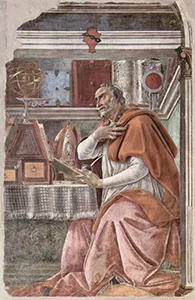
Figure 1.1 Augustine.
‘Sandro Botticelli 050’ by Sandro Botticelli: The Yorck Project: 10.000 Meisterwerke der Malerei. DVD-ROM, 2002. ISBN 3936122202. Distributed by DIRECTMEDIA Publishing GmbH. Licensed under Public Domain via Wikimedia Commons.
So, God in this perspective is not the highest and best and most powerful entity in the collection of all of the entities. It is not as if the universe is an aggregate of beings, and God is the biggest (or best) of those beings. God is, instead, radically distinct from the universe as a whole. God is not one more being, not one more thing. David Bentley Hart, in his book The Experience of God, says that this more traditional perspective is against the view that ‘God is a very large object or agency within the universe, or perhaps alongside the universe. A being among other beings, He differs from all other beings in magnitude, power and duration. But not ontologically’ (p. 32). This is to say that the traditional view of God is that He is of a different order of being than us. We, and everything we know in the world is created, and God is not—this difference is not quantitative but qualitative.
In order to name this difference that distinguishes God in the Judeo—Christian perspective from the pagan gods (who were the divine, best and even governing parts of nature), Robert Sokolowski and David Burrell (twentieth-century Catholic philosophers and theologians) use the term: ‘the distinction’—the distinction between ‘God and all things.’ ‘The distinction’—the difference—between God and everything else is unlike any other distinction that is made within the world. We cannot say that just as I distinguish between a human and a desk, so will I distinguish between God and the world. There is another order of distinction.
This distinction or difference is implied in the doctrine of creation. If we believe in creation, we have to believe that God is something fundamentally different, although not unrelated, to everything else. The beginning of all things cannot be contained within the set of all things. Interestingly, as we’ll see, being fundamentally different can be mor...
Table of contents
- Cover
- Halftitle Page
- Title Page
- Contents
- Acknowledgements
- List of Illustrations
- Introduction
- Part I Emerging Modernity
- Part II The Long Nineteenth Century
- Part III Twentieth-Century Crisis and Modernity
- Part IV The Late Modern Supernova
- Index
- Imprint
Trusted by 375,005 students
Access to over 1.5 million titles for a fair monthly price.
Study more efficiently using our study tools.
Frequently asked questions
Yes, you can cancel anytime from the Subscription tab in your account settings on the Perlego website. Your subscription will stay active until the end of your current billing period. Learn how to cancel your subscription
No, books cannot be downloaded as external files, such as PDFs, for use outside of Perlego. However, you can download books within the Perlego app for offline reading on mobile or tablet. Learn how to download books offline
Perlego offers two plans: Essential and Complete
- Essential is ideal for learners and professionals who enjoy exploring a wide range of subjects. Access the Essential Library with 800,000+ trusted titles and best-sellers across business, personal growth, and the humanities. Includes unlimited reading time and Standard Read Aloud voice.
- Complete: Perfect for advanced learners and researchers needing full, unrestricted access. Unlock 1.5M+ books across hundreds of subjects, including academic and specialized titles. The Complete Plan also includes advanced features like Premium Read Aloud and Research Assistant.
We are an online textbook subscription service, where you can get access to an entire online library for less than the price of a single book per month. With over 1.5 million books across 990+ topics, we’ve got you covered! Learn about our mission
Look out for the read-aloud symbol on your next book to see if you can listen to it. The read-aloud tool reads text aloud for you, highlighting the text as it is being read. You can pause it, speed it up and slow it down. Learn more about Read Aloud
Yes! You can use the Perlego app on both iOS and Android devices to read anytime, anywhere — even offline. Perfect for commutes or when you’re on the go.
Please note we cannot support devices running on iOS 13 and Android 7 or earlier. Learn more about using the app
Please note we cannot support devices running on iOS 13 and Android 7 or earlier. Learn more about using the app
Yes, you can access Modern Christian Theology by Christopher Ben Simpson in PDF and/or ePUB format, as well as other popular books in Theology & Religion & Christian Theology. We have over 1.5 million books available in our catalogue for you to explore.