In this book, Marek Sullivan challenges a widespread consensus linking secularization to rationalization, and argues for a more sensual genealogy of secularity connected to affect, race and power. While existing works of secular intellectual history, especially Charles Taylor's A Secular Age (2007), tend to rely on rationalistic conceptions of Enlightenment thought, Sullivan offers an alternative perspective on key thinkers such as Descartes, Montesquieu and Diderot, asserting that these figures sought to reinstate emotion against the rationalistic tendencies of the past. From Descartes's last work Les Passions de l'Âme (1649) to Baron d'Holbach's System of Nature (1770), the French Enlightenment demonstrated an acute understanding of the limits of reason, with crucial implications for our current 'postsecular' and 'postliberal' moment.
Sullivan also emphasizes the importance of Western constructions of Oriental religions for the history of the secular, identifying a distinctively secular-yet impassioned-form of Orientalism that emerged in the 18th century. Mahomet's racial profile in Voltaire's Le Fanatisme, ou Mahomet (1741), for example, functioned as a polemic device calibrated for emotional impact, in line with Enlightenment efforts to generate an affective body of anti-Catholic propaganda that simultaneously shored up people's sense of national belonging. By exposing the Enlightenment as a nationalistic and affective movement that resorted to racist, Orientalist and emotional tropes from the outset, Sullivan ultimately undermines modern nationalist appeals to the Enlightenment as a mark of European distinction.
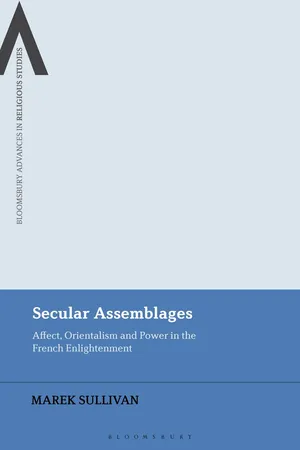
eBook - ePub
Secular Assemblages
Affect, Orientalism and Power in the French Enlightenment
- 264 pages
- English
- ePUB (mobile friendly)
- Available on iOS & Android
eBook - ePub
About this book
Information
1
Cartesian secularity: ‘Disengaged reason’, the passions and the public sphere beyond Charles Taylor’s A Secular Age (2007)
Though love is but a passion of our soul, it has this advantage in common with divinity: that it is as secret as it is public, and that there is nothing in nature more evident yet more hidden … our hopes divulge it and all our passions discover it, yet it is retreated in the bottom of our hearts, and all the traces that reveal its presence are as so many clouds, concealing it from our understandings.
Jean-François Senault, De l’Usage des Passions (1641: 214–15)
Introduction
Talal Asad has criticized Charles Taylor’s A Secular Age (2007) for privileging belief as the pivot between pre-secularity and secularity. Against Taylor’s primary interest in the emergence of ubiquitously optional belief (what he calls ‘secularity 3’), Asad argues for ‘the importance of studying the senses in order to identify ways they can build sensibilities and attitudes that are distinct from beliefs’ (2011: 37). This alternative approach sidesteps a Christo- or ratiocentric tendency to take faith, doctrine, propositional truth or even ‘enchantment’ as the essence of religion, and it clears the way for an analysis of the modern subject that crosses the secular/religious divide. If ‘belief’ and its accompanying term ‘religion’ are today better understood as performative elements in a language game that facilitates rule by liberal democratic government, ‘studying the senses’ promises an avenue into both religious and secular subjectivity that is not already interpreted.1 Asad’s counter-Taylorian emphasis on the pre-interpreted, sensual and disciplinary dimensions of secularism extends his earlier project, first outlined in Formations of the Secular, to develop an ‘anthropology of secularism’ (2003: 1).
This chapter agrees with Asad but goes further in questioning the ‘disenchantment’ narrative at the heart of A Secular Age. Indeed, it suggests that Taylor’s focus on belief not only presents a methodological problem vis-à-vis the genealogy secularity, but leads to a distorted factual understanding of this genealogy, by overemphasizing the importance of a historical break between belief and practice, reason and emotion, and mind and body in the intellectual history of Europe – a tendency that is particularly clear in Taylor’s treatment of the historical ‘Enlightenment’. While explicitly challenging over-simplistic dichotomies between secular reason and religious affect, I argue Taylor overstates the division of reason and emotion in the thought of certain secularizing thinkers, especially Descartes, and thus unjustifiably associates secularization or Enlightenment with an epistemological and ethical disengagement from the body. To take this position is to grant the Enlightenment both too much and too little. It grants the Enlightenment too much, because it allows it to step outside of politics and power and assume the voice of an idealized pure reason. It grants the Enlightenment too little, because it does not recognize the sophistication of its engagement with the question of human subjectivity and the importance of its legacy for modern psychology, especially theories of mass manipulation by manufactured consent. Against such idealistic conceptions, I show that Enlightenment thought – beginning with Descartes – is indissociable from the body, politics and power.
Why Descartes? According to Taylor, Descartes marks a key moment in the simultaneous transition from theism to ‘exclusive humanism’, and from the ‘porous’ to the ‘punctual’ (1989) or ‘buffered self’ (2007) of secular modernity. The sixteenth- to seventeenth-century shift from medieval practices of piety and devotion rooted in the body, to the mind-based, ‘rational-critical’ world of the eighteenth-century Enlightenment situates Descartes in a pivotal position for the erasure of bodily experience, and eventual hegemony of autonomous, ‘disengaged reason’ (1989, 2007, 2012). This in turn feeds into a disembodied conception of a ‘public sphere’ founded on the dialogical unfolding of pure reason exempt from social conflict and the distortive influence of power (2007: 185–96). Within this broad historical context, Taylor reads Descartes with a clear anti-corporeal or anti-emotional inflection: he opened the way for the ‘cold rationalism’ of the Enlightenment and its distrust of religious sentiments or ‘enthusiasm’ later epitomized by Gibbon and Hume; and he helped lay the ground for an effective ‘immanentization’ of ethics, by drawing previously external sources of moral authority (e.g. God or Nature’s order) under the judgement of autonomous reason, an internalizing movement partially revoked by the subsequent rise to dominance of communicative rationality in the public sphere.
The assumption that Descartes sought to downgrade or dominate the passions by force of reason is so engrained that even researchers more sensitive to the presence of the body in the Enlightenment still associate Descartes with an antithetical stance towards the body and emotions. According to Jessica Riskin, whose work on the Enlightenment body is central to the following chapter, Descartes ‘treated the passions as innate tendencies of the human constitution, the antithesis of the rational faculty, and inherently destructive’ (2002: 49). This is false, even by Taylor’s account. Descartes’s last major work Les Passions de l’Âme (1649) – according to Philip Fisher, ‘the most significant modern work on the passions’ (1998: 16) – testifies to an acute awareness of the limits of internal, autonomous reason, emphasizing the entanglement of reason in the workings of the body; the importance of external, environmental factors for the shaping of human experience and response; and the centrality of ‘habit’ or ‘habits’ to the cultivation of virtue. In this respect, Descartes’s theories share more in common with Aristotelian virtue ethics than a reason-based framework of moral decisions, or a neo-Stoic ‘honour ethic’ founded on coercive acts of sovereign will meted out to subjugated and immediately accessible passions or acts. Although Taylor accepts that Descartes adopted an instrumentalist approach to the passions that allowed for a positive reassessment of the latter, he still reads Descartes in terms of a rationalistic, ‘disengaged stance’ towards the body that, among other things, elides his theory of the habit entirely. This chapter redresses the record.
Given the depth and complexity of Taylor’s analysis, I begin with a detailed summary of the intellectual history leading up to Descartes, as outlined in A Secular Age, then summarize Taylor’s reading of Descartes, both in A Secular Age and Sources of the Self. I briefly compare the chief arguments of the Passions, as read by Taylor, to the arguments of an earlier, lesser-known treatise, De l’Usage des Passions (1641), by the Augustinian philosopher Jean-François Senault, in order to draw out the distinctiveness of Descartes’s contribution. My own close reading of the Passions suggests that, if Descartes played a pivotal role in the genealogy of the secular, it is not because he rationalized the ideal thinking, feeling, acting subject (a feature of De l’Usage) but, on the contrary, because he provided a striking anticipation of postrationalist scepticism, articulated through his theory of the associational habit. Excavating Descartes’s sceptic side will later serve as a basis for deconstructing two key premises of A Secular Age: that the ‘Counter-Enlightenment’ marked a recovery of affect or the unconscious, following the failures of the rational Enlightenment; and that modern secularity is conditioned by a moment of pure rationality at the foundation of the nation-state.
In the broader scheme of secular history, a careful re-evaluation of Descartes problematizes Taylor’s narrative arc casting the eighteenth-century Enlightenment as the culmination of a gradual suppression of sentiment, and rise to hegemony of affectless, disengaged reason. As I will argue later, this culmination narrative is both inaccurate, since it relies on an illegitimate reification of pure or disengaged reason that in fact never existed, and masks important ways in which the ‘radical Enlightenment’ (Taylor 2007: 149) of the eighteenth century combined ‘rational-critical’ (Habermas 1989 [1962]) elaboration with nationalistic propaganda. This propaganda played heavily on sentiments and passions to manipulate an emergent public opinion and build up a secular-nationalist structure of affect with revolutionary and long-lasting consequences.
From porous to buffered selves: Questions and categories
Taylor begins Part I of A Secular Age with a thematic question tying the whole of the book’s almost 800 pages together: ‘why was it virtually impossible not to believe in God in, say 1500 in our Western society, while in 2000 many of us find this not only easy, but even inescapable?’ (25). This simple question, laying out two poles on a temporal continuum stretching over 500 years, establishes a binary narrative structure based on the historical progression from one state of affairs to another. State 1 is characterized by three principal features:
(1) People’s ‘natural world’, including both the world of daily experience and the imagined cosmos in which this world was situated ‘testified to divine purpose and action’.
(2) God was implicated in ‘the very existence of society’.
(3) People lived in an ‘enchanted world’, that is, a world inhabited by visible and invisible spirits that interacted with fleshly humans in ways we now find difficult to imagine (e.g. ‘possession’ by a spirit could take the form of a physical substance, e.g. black bile). (25)
State 2 (our ‘secular age’) is characterized by the overwhelming absence of these features. Taylor devotes the bulk of A Secular Age to fleshing out the gap between states 1 and 2.
To this end, Taylor develops several conceptual categories based upon challenges to the above features. (1), (2) and (3) all suggest a pre-modern openness to transcendence that is gradually ‘fragilized’ by encounters with alternative (e.g. materialist) construals of the natural order, society or the good, leading to the eventual establishment of ‘the immanent frame’: a metaphysical outlook that tends to elide (indeed, make impossible) all appeals to transcendence. The subject position most closely linked to this closure of transcendence is what he calls the ‘buffered self’ in contradistinction to the ‘porous self’ of the enchanted Middle Ages. Whereas the porous self lived in a universe crossed through with invisible forces and beings, and was constantly threatened by forms of divine and/or malign agency that may enter, possess or destroy human bodies and ecologies, the buffered self is characterized by its confidence in the invulnerability of the self to forces beyond the immanent (or empirically accessible) realm.
Crucially, whereas the porous self typically derived its conception of the good from transcendental sources of moral authority (e.g. Platonic forms, divine commandments and fear of retribution), the buffered self has, through a number of intermediary stages, brought moral judgement into the exclusive realm of an immanent Natural Law or secular ethics (e.g. utilitarianism) determinable (if not determined) by human powers. In this sense, the modern self is not only buffered against forces we would now consider imaginary (e.g. divine or satanic possession) but against the arbitrary judgement of a divine legislator or a priori world of pure forms not answerable to, yet determinative of, rational principles. Immanent ethics emerge through an individual process of rational deliberation or inward reflection accessible to anyone endowed with the capacity to think; the outcome may or may not reflect God’s will. The tendency was in fact to move from the first to the second possibility: from rationally inferred Natural Law as the disclosure of God’s blueprint for creation (e.g. Hugo Grotius), to rationally inferred ethics established in independence from the legitimating force of divine sanction (e.g. Holbach). Bufferedness is thus as much an ethical as an ontological or physical condition – indeed, Taylor’s thesis can be seen as an attempt to shift weight from the latter onto the former, since pre-A Secular Age genealogies of the secular tended to overemphasize the power of empiricism to debunk theological imaginings on physical grounds alone.
The buffered self therefore involves at least two interrelated shifts, both of which reflect a broader shift from an enchanted to a disenchanted universe: (1) the gradual disappearance of supernatural forces and spirits inaccessible to empirical verification; and (2) the internalization of sources of moral authority, as guidance no longer issues from a tension between our falling short of an objective standard set by Platonic forms existing ‘out there’, or divine commandments disclosed via the intermediary of an external arbitrator, e.g. the Church or Prince, but from the internal domain of the reasoning self. The ‘aura’ surrounding traditional, external sources of moral authority has disappeared.
According to Taylor, however, bufferedness also entails a third, less explicit shift in subjectivity: it calls for a negative, objectifying or instrumental stance towards the body and affective registers of experience, morality and agency – a stance Taylor associates especially with Descartes’s ‘disengaged reason’ (1989, 2007, 2012), and later with the eighteenth-century Enlightenment. This aspect of his analysis demands careful attention. For in his effort to track a coherent thread running through Western intellectual history, Taylor tends to underplay Descartes’s more positive assessments of the body and its entanglement with the mind. Since Taylor links Descartes strongly to the ‘neo-Stoic’ tradition of sixteenth-century reformism, I will begin by outlining the neo-Stoic background to Descartes’s thinking, as presented in A Secular Age.
The neo-Stoic backdrop
A Secular Age situates a key moment for the genealogy of the buffered self in the sixteenth-century neo-Stoic reformer Justus Lipsius. Like the Stoics, Lipsius broke from existing ethical frameworks based on divine command, empathy or virtue by formulating an ethical theory rooted exclusively in the reasoning mind. Where Christian ethics might emphasize the power and necessity of agape, love for our neighbour, or miseratio and misericordia (the ‘compassion of feeling’ embodied in the figure of Christ), Lipsius rejected all these in favour of the Stoic goal of apatheia, ‘a condition beyond passion’ (2007: 115). His ‘Christianized Stoicism’ had no place for the body or emotions but rather sought moral perfection ‘on the basis of a full inner detachment’ (115). This did not mean detachment from God, however; Lipsius was not what Taylor calls an ‘exclusive humanist’. Rather, the use of reason was itself a crucial element of God’s plan, since ‘God is the source of the ratio on which we base our lives’ (115), an idea later systematized in Grotius’s formulation of Natural Law – one both rationally inferable and ‘God given’ (129). For Lipsius and Grotius, to be rational was to exercise one’s faith, and vice versa. Reason was a route into the mystery of divine order. Indeed, it was its fundamental principle, for unlike ‘opinion, which comes from the earth and the body’, or ‘external calamities’, ‘Reason tells us to hang on to what is unchanging’ (115–16). The focus on eternal truth naturally tended to downgrade Christological emphases on the temporality and embodied suffering of Christ, and from there to downgrade the body in general. As Lipsius’s predecessor Erasmus put it: ‘Transfer your love to something permanent, something celestial, something incorruptible, and you will love more coolly this transitory and fleeting form of the body’ (Taylor 2007: 116).
Along with the rationalization and internalization of morality came a new-found confidence in man’s ability to manipulate both himself and his environment. Lipsius ‘set the tone’ for the reformers of the following century, that is high civil servants, administrators and generals who sought to ‘reconstruct various dimensions of society’ (118). A new optimism took over during this period, grounded in self-discipline and the training of the subordinate masses, so that eventually the belief emerged that ‘nothing in principle stood in the way of … social engineering’ (121). Whereas the Middle Ages were still ‘steeped in the view … that there are severe limits to the degree in which sin and disorder can be done away with in this world’ (119), the new ‘protestant work ethic’ and ‘inner worldly asceticism’ propagated by Calvinism and Pietism tended to remove limits on human improvement and bring other-worldly utopianism into the present. The thrust of this new optimism was an unprecedented faith in the powers of human reason. The eventual hegemony of reason, still understood as the ultimate expression divine order, would allow humans to reach maximal control (and hence happiness) in this life, not just the next. In other words, the body was not just relegated to a subordinate position in the hierarchy of human flourishing; it was to be subordinated by force of will and reason.
Cartesian reason
It is in this context that Taylor presents Descartes, as a transitional figure for the closure of self at the onset of early modernity. According to Taylor, Descartes ‘clearly [stood] in the neo-Stoic stream of thought’ (130), yet departed from traditional neo-Stoicism in important ways. He retained and intensified the neo-Stoic emphasis on disengagement from the body and, ...
Table of contents
- Cover
- Halftitle Page
- Title Page
- Contents
- Preface
- Acknowledgements
- Note on translations
- Introduction
- 1. Cartesian secularity: ‘Disengaged reason’, the passions and the public sphere beyond Charles Taylor’s A Secular Age (2007)
- 2. Enlightened bodies I: Secular passions, empiricism and civic virtue in the ‘radical enlightenment’
- 3. Enlightened bodies II: The crafting of a secular-national subject
- 4. The ritual mask of oriental despotism: Wonder and superimposition in Montesquieu’s Lettres Persanes (1721) and De l’Esprit des Lois (1748)
- 5. ‘A morbid impression’: Race, religion and metaphor in Le Fanatisme, ou Mahomet (1741)
- Conclusion
- Notes
- Bibliography
- Index
- Imprint
Trusted by 375,005 students
Access to over 1.5 million titles for a fair monthly price.
Study more efficiently using our study tools.
Frequently asked questions
Yes, you can cancel anytime from the Subscription tab in your account settings on the Perlego website. Your subscription will stay active until the end of your current billing period. Learn how to cancel your subscription
No, books cannot be downloaded as external files, such as PDFs, for use outside of Perlego. However, you can download books within the Perlego app for offline reading on mobile or tablet. Learn how to download books offline
Perlego offers two plans: Essential and Complete
- Essential is ideal for learners and professionals who enjoy exploring a wide range of subjects. Access the Essential Library with 800,000+ trusted titles and best-sellers across business, personal growth, and the humanities. Includes unlimited reading time and Standard Read Aloud voice.
- Complete: Perfect for advanced learners and researchers needing full, unrestricted access. Unlock 1.5M+ books across hundreds of subjects, including academic and specialized titles. The Complete Plan also includes advanced features like Premium Read Aloud and Research Assistant.
We are an online textbook subscription service, where you can get access to an entire online library for less than the price of a single book per month. With over 1.5 million books across 990+ topics, we’ve got you covered! Learn about our mission
Look out for the read-aloud symbol on your next book to see if you can listen to it. The read-aloud tool reads text aloud for you, highlighting the text as it is being read. You can pause it, speed it up and slow it down. Learn more about Read Aloud
Yes! You can use the Perlego app on both iOS and Android devices to read anytime, anywhere — even offline. Perfect for commutes or when you’re on the go.
Please note we cannot support devices running on iOS 13 and Android 7 or earlier. Learn more about using the app
Please note we cannot support devices running on iOS 13 and Android 7 or earlier. Learn more about using the app
Yes, you can access Secular Assemblages by Marek Sullivan in PDF and/or ePUB format, as well as other popular books in Social Sciences & History of Religion. We have over 1.5 million books available in our catalogue for you to explore.