The first comprehensive treatment in English of the rich and varied afterlife of classical drama across Latin America, this volume explores the myriad ways in which ancient Greek and Roman texts have been adapted, invoked and re-worked in notable modern theatrical works across North and South America and the Caribbean, while also paying particular attention to the national and local context of each play.
A comprehensive introduction provides a critical overview of the varying issues and complexities that arise when studying the afterlife of the European classics in the theatrical stages across this diverse and vast region. Fourteen chapters, divided into three general geographical sub-regions (Southern Cone, Brazil and the Caribbean and North America) present a strong connection to an ancient dramatic source text as well as comment upon important socio-political crises in the modern history of Latin America. The diversity and expertise of the voices in this volume translate into a multi-ranging approach to the topic that encompasses a variety of theoretical and interdisciplinary perspectives from classics, Latin American studies and theatre and performance studies.
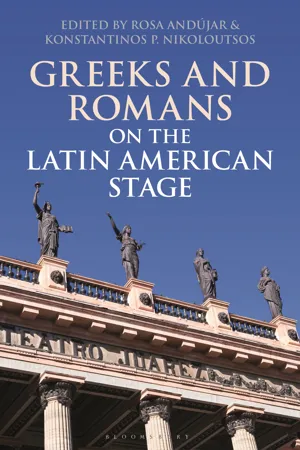
eBook - ePub
Greeks and Romans on the Latin American Stage
- 312 pages
- English
- ePUB (mobile friendly)
- Available on iOS & Android
eBook - ePub
Greeks and Romans on the Latin American Stage
About this book
Information
CHAPTER 1
STAGING THE EUROPEAN CLASSICAL IN ‘LATIN’ AMERICA: AN INTRODUCTION
Rosa Andújar and Konstantinos P. Nikoloutsos
This volume explores the rich and varied afterlife of Greek and Roman tragedies and comedies in Latin America, offering nuanced examinations of notable theatrical adaptations of ancient drama from ten countries across this diverse region. Though scholars have now examined the afterlife of the genre in various continents,1 and in a variety of colonial and postcolonial contexts,2 Latin America remains a relatively unexplored territory for scholars of classical reception and drama,3 despite the fact that Latin American playwrights have repeatedly engaged with their Greek and Roman forebears. Especially in the past few decades, the region has seen a number of pioneering theatrical adaptations of ancient drama that address the turbulence of the twentieth century and the dilemmas of present-day realities. These adaptations, unknown even as titles to many in the Global North, are analysed as a body of literature in English for the first time in the present volume.
Since many of our readers might not be familiar with Latin American material, our introduction is structured in four parts, which, besides explaining the aims and scope of our project, summarizes the particular issues and complexities involved in examining receptions from the region. The first and second sections outline critical issues involved in employing the terms ‘Latin American’ and ‘postcolonial’, respectively, labels which, though useful for enabling a study on a large-scale and wider level, nevertheless mask a series of particular problems unique to the region which continue to resonate today. These problems are furthermore compounded in an examination of what is essentially an ‘inherited’ classical tradition from European colonizers. The third section addresses the specific complexities (and ultimately the impossibility) of developing appropriate models of classical reception for this vast and ‘hybrid’ region, especially in light of the issues raised in the first two parts. The fourth provides a justification of the volume’s specific focus on engagements with ancient drama: we provide not only a brief sketch of the history of drama in the region, but also a summary of the larger themes which have emerged from the specific case studies selected for inclusion in the volume. This introduction should moreover be of use to scholars in Spanish, Portuguese and Latin American Studies Departments. The volume supplements the relatively few studies on the topic conducted by scholars in these fields by emphasizing throughout the complex transhistorical and transnational routes and frameworks for the transmission and understanding of Graeco-Roman texts, myths and ideas in modern Latin America.4 We believe that this broader picture, which charts both the movement and the use of the ‘classical’,5 allows for a better insight of the changing value of these dramatic texts in various local contexts across the region.
‘Latin’ America?
In this volume we use ‘Latin America’ to cover the large and diverse area south of the US–Mexico border. The problematic nature of the term, which crucially includes the word Latin, must be acknowledged at the outset, given its associations with the long and convoluted histories of European and North American imperialisms in the region. There is currently no scholarly consensus on the term’s origins: some historians, for example, argue that the French coined it to justify neo-imperialist interventions, most notably their notorious installation of the Habsburg Emperor Maximilian in Mexico during the 1860s.6 Others have pointed out its earlier use by Central and South Americans as a rallying point for unity against the rising threat of the United States.7 Despite a lack of clarity on the precise emergence of ‘Latin America’ as a concept, what is clear is the term’s direct connection to various foreign imperialist missions in the nineteenth century.
The fact that the nineteenth century is the specific setting for the construction of this new regional term adds further complications to its use in a study of engagements with the European classical in the region. This is the century in which various independence and revolutionary movements emerged, movements that not only led to the establishment of the nations which exist today, but also ones which themselves were motivated by notions of Graeco-Roman antiquity.8 This is also when some of the most visible forms of engagement with European antiquity emerge across the region, as is suggested, for example, in the erection of prominent monuments and statues in a neoclassical style in various cities.9 In other words, this is the time when these newly independent nations constructed national identities visibly aligned with Europe, which furthermore obfuscated indigenous and African histories.10 Using the term ‘Latin America’ in the context of examining classical receptions arguably continues propagating these carefully constructed identities that privilege Europe.
In addition to presenting a whitewashed European picture of the region, its use as a single category might furthermore advance North American interests. In the mid-twentieth century, US federal agencies created the category of ‘Hispanic’ to represent the various groups with ties to places south of the US–Mexico border, uniting in a broad-brush diverse and distinct peoples.11 Despite its common and wide usage, it is crucial to recognize that employing this and other panethnic categories effectively advances the wishes of a particular country to lump all of its southern neighbours (and the majority of the Western Hemisphere) into one group.
Though we acknowledge the various problems associated with this term, we are retaining it not to endorse it, but precisely because of the problems that we have highlighted above. It also allows discussion on a macro-level, illuminating that the manner in which the region’s engagements with Graeco-Roman source texts tends to differ from those of other areas. Though grouped under the term ‘Latin American’, our volume showcases the wide range of receptions that are possible across this region, ultimately reflecting their intense and varied complexities. Each case study nevertheless provides essential contextual information regarding the national and local context of each play, which in all cases is more important than a perceived – and artificial – ‘Latin American’ context.
Latin America and the postcolonial
Nearly all plays featured in this volume were written, produced and performed across the region after independence from their European colonizers.12 This, however, does not mean that we are dealing with a ‘postcolonial’ region. Various scholars have pointed out the limitations and inadequacies of applying this particular term, which initially emerged from studies of former British and French colonies, to Latin America. Most notably, anthropologist J. Klor de Alva declared that the concepts of colonialism and postcolonialism are ‘mirages’ for the region.13 His main argument hinges on the fact that the region’s complex historical experience and hybrid identities led to relationships with Europe that cannot be reduced to binaries of oppressor (colonizer)/oppressed (colonized), which are typically associated with the colonial condition in places such as India, South Africa and Algeria. Since then there have been several attempts to articulate the region’s ‘postcoloniality’ in more refined theoretical terms that address its unique specificities, such as America’s conception as an extension of Europe,14 the exact time of the postcolonial in the region (Peter Hulme asks, ‘Just when is postcolonialism?’),15 and the region’s peripheral status.16
Previous work examining classical receptions in specifically postcolonial contexts has focused mostly on Asia and Africa, in keeping with the development of postcolonial theory,17 a large majority of which formed part of the British Empire.18 In the former British colonies, Graeco-Roman classical texts were typically part of what Goff and Simpson call ‘the apparatus of colonialism’, often embedded in educational curricula.19 This means that many postcolonial engagements with the Graeco-Roman Classics in these contexts have been subversive, a case of what Salman Rushdie described as ‘the empire writes back with a vengeance’.20 The long tradition and presence of Graeco-Roman ideas, texts and motifs in these contexts facilitates a general awareness of the cultural capital of the European classical.
In Latin America, the Graeco-Roman Classics were not embedded in the colonial curriculum or experience in the same way. Instead, European antiquity was transmitted and mediated by diverse means, from various Catholic missionaries in the sixteenth and seventeenth centuries to twentieth-century artists undertaking visits to North America and Europe, via nineteenth-century engagements with French and Italian literature around the time of independence from Spain. To consider Latin America a straightforwardly ‘postcolonial’ region in terms of classical reception would be a mistake, as it requires a new framework which would need to account for multiple and varied transmitters of the classical, which crucially include religion as well as encounters with foreign ideas.
As a result, sub-regional and local histories matter enormously. For this reason, our volume groups case studies across three general areas: (1) Southern Cone, (2) Brazil, and (3) the Caribbean and North America. This division allows us to examine some of the most prominent sub-geographical contexts within Latin America, facilitating the analysis of themes and issues beyond specific national borders. We do not offer a comprehensive survey, which would be impossible in a single volume given the extraordinary diversity of responses to ancient drama across Latin America. Instead, we provide a broad cross-section of notable case studies from ten different countries which suggest specific histories. This division furthermore aims to address the fact that Graeco-Roman legacies throughout Latin America are largely muddled and indirect, in addition to being varied and inconsistent throughout the centuries, depending on the location in question and the European nation by which it was colonized. There is a great deal that we still do not know about how classical texts, motifs and ideas have circulated throughout the short history of the region; part of this uncovering will also involve deep engagement with the way in which these texts have circulated and been understood in the Iberian peninsula since antiquity. Certainly, there will be other intermediaries and ‘fuzzy connections’, to quote Lorna Hardwick,21 emerging from this much-needed work. Nevertheless, it is possible to propose some general observations about the ways in which the European Classics circulated across the some of the general blocks that make up ‘Latin America’, which roughly correspond to our division:
1.In Spanish Latin America, the Graeco-Roman Classics have a fragmentary afterlife, one that is incredibly difficult to piece together. Though the Spanish used the ancient past as a way to frame and justify their conquest of the Americas,22 and despite the presence of a few neo-Latin epics composed in the New World (which were written by Spanish- or Italian-born Jesuit missionaries rather than any native-born men),23 Spanish-American colonial classicisms tend to be overwhelmingly Latin, and generally connected to or mediated through the Cathol...
Table of contents
- Cover
- Half-Title Page
- Series Text
- Title Page
- Contents
- List of Illustrations
- Notes on Contributors
- Acknowledgements
- 1 Staging the European Classical in ‘Latin’ America: An Introduction
- Part I Southern Cone
- 2 From Epic to Tragedy: Theatre and Politics in Juan Cruz Varela’s Dido
- 3 Leopoldo Marechal’s Antígona Vélez: Rewriting Greek Tragedy as a Foundation Myth in Peronist Argentina
- 4 Juan Radrigán’s Medea Mapuche: Recreating Euripides’ Revenge Tragedy in an Indigenous Chilean Context
- 5 Philoctetes and Medea in Contemporary Chilean Theatre
- Part II Brazil
- 6 A God Slept Here by Guilherme Figueiredo: A Radical Modernist Amphitruo from Brazil
- 7 Guilherme Figueiredo, Amphitryon and the Widow of Ephesus: Linking Plautus and Petronius
- 8 Electra’s Turn to the Dark Side: Nelson Rodrigues’ Senhora dos Afogados
- 9 Becoming Antigone: The Classics as a Model of Resistance in Jorge Andrade’s Pedreira das Almas
- Part III The Caribbean and North America
- 10 Distorting the Lysistrata Paradigm in Puerto Rico: Francisco Arriví’s Club de Solteros
- 11 Challenging the Canon in the Dominican Republic: Lisístrata odia la política by Franklin Domínguez
- 12 Aeschylus and the Cuban Counter-Revolution
- 13 The Contest between Créolité and Classics in Patrick Chamoiseau’s Stage Plays
- 14 Dismantling the Anthropological Machine: Feliks Moriso-Lewa’s Antigòn and Luis Alfaro’s Electricidad
- 15 Antigone Undead: Tragedy and Biopolitics in Perla de la Rosa’s Antígona: las voces que incendian el desierto
- Notes
- Bibliography
- Index
- Copyright
Trusted by 375,005 students
Access to over 1.5 million titles for a fair monthly price.
Study more efficiently using our study tools.
Frequently asked questions
Yes, you can cancel anytime from the Subscription tab in your account settings on the Perlego website. Your subscription will stay active until the end of your current billing period. Learn how to cancel your subscription
No, books cannot be downloaded as external files, such as PDFs, for use outside of Perlego. However, you can download books within the Perlego app for offline reading on mobile or tablet. Learn how to download books offline
Perlego offers two plans: Essential and Complete
- Essential is ideal for learners and professionals who enjoy exploring a wide range of subjects. Access the Essential Library with 800,000+ trusted titles and best-sellers across business, personal growth, and the humanities. Includes unlimited reading time and Standard Read Aloud voice.
- Complete: Perfect for advanced learners and researchers needing full, unrestricted access. Unlock 1.5M+ books across hundreds of subjects, including academic and specialized titles. The Complete Plan also includes advanced features like Premium Read Aloud and Research Assistant.
We are an online textbook subscription service, where you can get access to an entire online library for less than the price of a single book per month. With over 1.5 million books across 990+ topics, we’ve got you covered! Learn about our mission
Look out for the read-aloud symbol on your next book to see if you can listen to it. The read-aloud tool reads text aloud for you, highlighting the text as it is being read. You can pause it, speed it up and slow it down. Learn more about Read Aloud
Yes! You can use the Perlego app on both iOS and Android devices to read anytime, anywhere — even offline. Perfect for commutes or when you’re on the go.
Please note we cannot support devices running on iOS 13 and Android 7 or earlier. Learn more about using the app
Please note we cannot support devices running on iOS 13 and Android 7 or earlier. Learn more about using the app
Yes, you can access Greeks and Romans on the Latin American Stage by Rosa Andújar, Konstantinos P. Nikoloutsos, Rosa Andújar,Konstantinos P. Nikoloutsos in PDF and/or ePUB format, as well as other popular books in Literature & Drama. We have over 1.5 million books available in our catalogue for you to explore.