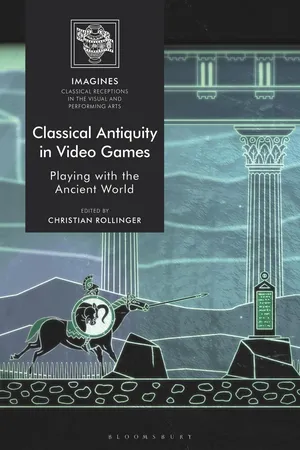
From gaming consoles to smartphones, video games are everywhere today, including those set in historical times and particularly in the ancient world. This volume explores the varied depictions of the ancient world in video games and demonstrates the potential challenges of games for scholars as well as the applications of game engines for educational and academic purposes. With successful series such as "Assassin's Creed" or "Civilization" selling millions of copies, video games rival even television and cinema in their role in shaping younger audiences' perceptions of the past. Yet classical scholarship, though embracing other popular media as areas of research, has so far largely ignored video games as a vehicle of classical reception.
This collection of essays fills this gap with a dedicated study of receptions, remediations and representations of Classical Antiquity across all electronic gaming platforms and genres. It presents cutting-edge research in classics and classical receptions, game studies and archaeogaming, adopting different perspectives and combining papers from scholars, gamers, game developers and historical consultants. In doing so, it delivers the first state-of-the-art account of both the wide array of 'ancient' video games, as well as the challenges and rewards of this new and exciting field.
- 312 pages
- English
- ePUB (mobile friendly)
- Available on iOS & Android
eBook - ePub
About this book
Information
1
An Archaeology of Ancient Historical Video Games
Christian Rollinger
In most accounts of the history of video games and of history in video games, the credit for creating the first historical video game (by which I mean a game with a specifically historical setting) goes to educators and computer aficionados Don Rawitsch, Bill Heinemann and Paul Dillenberger at Carleton College in Northfield, Minnesota. In 1971, they developed the first version of The Oregon Trail, though, as we shall see, The Oregon Trail was not, in fact, the first historical video game. To play, users of the first version of the game had to input text on a mainframe computer on the college campus; the player interacted with the software purely via manual text input and printouts; it was only the later (1978) versions and the commercial edition (1985) ported to Apple and Commodore systems that would introduce a rudimentary graphic interface. Players found themselves in the role of a wagon leader travelling from Missouri to Oregon in 1848. Their mission was to ensure the survival of their party in the face of natural obstacles such as rivers or mountain ranges, weather, sickness, thieves, Indian raids and bandits. Designed as an educational tool for teaching nineteenth-century US history, specifically the story of the American western expansion, the game was rather text-heavy and has been described as an ancestor of the modern serious game subgenre.1 It was published by the Minnesota Educational Computing Consortium (MECC) and pioneered computer teaching by attempting to present a realistic experience of nineteenth-century settlers for the benefit of pupils and students.2 The game itself, and especially some individual aspects of gameplay have acquired cult status among its modern fans, particularly the announcement that the player or members of their party have contracted or died of dysentery (an unnervingly frequent occurrence; see Fig. 1.1).
As early computers had limited to no graphic display options, the first historical games were ipso facto text-based and this significantly limited the options of both game developers and gamers. As we shall see, hardware developments are not inconsequential for the ways in which (ancient) history and culture is presented in video games. As computers slowly evolved from house-, then room-sized apparatuses into compact, desk-fitting machines, video games underwent a cultural sea change and began their transformation into a mass medium.

Fig. 1.1 The Oregon Trail screen announcement (1971/1974 © MECC).3
Hardware and genre
Games of the early 1970s were thus predominantly text-based adventures, with William Crowther’s Colossal Cave Adventure (1975) being the first entry in a genre later known as ‘adventure games’ (‘adventures’). Programmed for the PDP-10 minicomputer, Colossal Cave Adventure ‘simulates’ its gamescape – a term coined in 2006 by Shoshana Magnet to denote the virtual landscape of a video game4 – not by depicting a bitmap-based graphic or rendering it in real-time, but rather by describing it in text form. The player, whose ‘mission’ is to explore a mysterious cave system, in turn, entered simple commands such as ‘yes/no’ or ‘go south/north’, which were parsed by the software and prompted in-game developments (such as the player falling into a pit and breaking his bones). The game was recognizably a computerized version of classic role-playing games of the ‘pen-and-paper’ genre (e.g. Dungeons & Dragons).5
During the 1970s, arcade games and home video game consoles became capable of displaying adequate bitmap or vector graphics and with the addition of graphical interfaces, video games changed immeasurably. Thanks to titles such as Pong, they ceased to be the exclusive domain of 1970s and 1980s college campus hacker culture. Coin-operated arcade games (‘coin-ops’) appeared in bars and amusement arcades and were the motor behind the first video game surge. Even with relatively simple, not to say archaic, vector graphics, they allowed for a completely new experience, for example in piloting spaceships and destroying Asteroids or, in a game rather glumly inspired by Cold War reality, attempting to intercept enemy nuclear missiles, for instance Missile Command. As arcade consoles progressed technologically, graphics likewise improved, gaining both in colour and in complexity. The same, however, cannot be said for the games themselves, which, despite the addition of new genres such as fighting and racing games, as well as vertically or horizontally scrolling action games (jump-and-runs, for example Donkey Kong), remained tied to ‘the purest, most elemental videogame pleasure’: the ‘heathen joy of destruction’.6 While arcade games survived into the 1990s and, in one form or another, survive to this day, they, together with their home-based equivalents in early gaming consoles (perhaps the most famous of which was the second-generation Atari 2600 VCS, or video computer system, released in 1977), were inevitably supplanted by Personal Computers (PCs).
Personal computers, as well as third-generation consoles, changed gaming forever, by introducing first 8- and 16-bit, then VGA/SVGA, and, finally, the high-resolution, quasi-photorealistic graphics that are now de rigueur. The level of technological advancement in computer processing power naturally had a significant impact on the development of video games in general, an impact that went far beyond the superficial aspect of graphics quality. Although the impact of technological innovation is unfortunately often ignored in the analysis of historical video games, it was only through such innovation that historical video games found a market and a hitherto unsuspected mass appeal. The prime example of this is the advent of a seemingly inconspicuous instrument that, nevertheless, had a tremendous impact on gaming: the computer mouse.
The first computer mouse prototype was built as early as 1964 and mentioned in a 1965 report from the Stanford Research Institute in Menlo Park, California, but it was only popularized by the appearance of the Apple Macintosh 128K computer in 1984, which was sold with a Macintosh Mouse included.7 The importance of the mouse for computer game development (and for the domestic and business applications of personal computers, in general) can hardly be overstated. As an integral part of graphical user interfaces (GUIs) since the mid-1980s, the mouse has facilitated easy-to-use computing and software. Transforming movements on a lateral physical plane into mo...
Table of contents
- Cover
- Half-Title Page
- Series Text
- Title Page
- Contents
- List of Illustrations
- Notes on Contributors
- Preface
- Prologue: Playing with the Ancient World: An Introduction to Classical Antiquity in Video Games Christian Rollinger
- 1 An Archaeology of Ancient Historical Video Games Christian Rollinger
- Part One A Brave Old World: Re-Figurations of Ancient Cultures
- 2 Ludus (Not) Over: Video Games and the Popular Perception of Ancient Past Reshaping David Serrano Lozano
- 3 Playing in a ‘Real’ Past: Classical Action Games and Authenticity Tristan French and Andrew Gardner
- 4 The Representation of Women in Ryse: Son of Rome Sian Beavers
- Part Two A World at War: Martial Re-Presentations of the Ancient World
- 5 Battle Narratives from Ancient Historiography to Total War: Rome II Dominic Machado
- 6 Digital Legionaries: Video Game Simulations of the Face of Battle in the Roman Republic Jeremiah McCall
- Part Three Digital Epics: Role-Playing in the Ancient World
- 7 The Bethesda Style: The Open-World Role-Playing Game as Formulaic Epic Roger Travis
- 8 Postcolonial Play in Ancient World Computer Role-Playing Games Ross Clare
- 9 Playing with an Ancient Veil: Commemorative Culture and the Staging of Ancient History within the Playful Experience of the MMORPG, The Secret World Nico Nolden
- Part Four Building an Ancient World: Re-Imagining Antiquity
- 10 Choose Your Own Counterfactual: The Melian Dialogue as Text-Based Adventure Neville Morley
- 11 Mortal Immortals: Deicide of Greek Gods in Apotheon and Its Role in the Greek Mythic Storyworld Maciej Paprocki
- 12 The Complexities and Nuances of Portraying History in Age of Empires Alexander Flegler
- 13 Simulating the Ancient World: Pitfalls and Opportunities of Using Game Engines for Archaeological and Historical Research Erika Holter, Una Ulrike Schäfer and Sebastian Schwesinger
- 14 Quo Vadis Historical Game Studies and Classical Receptions? Moving Two Fields Forward Together Adam Chapman
- Glossary of Video Game Terms
- Bibliography
- Mediography
- Ludography
- Index
- Copyright
Trusted by 375,005 students
Access to over 1.5 million titles for a fair monthly price.
Study more efficiently using our study tools.
Frequently asked questions
Yes, you can cancel anytime from the Subscription tab in your account settings on the Perlego website. Your subscription will stay active until the end of your current billing period. Learn how to cancel your subscription
No, books cannot be downloaded as external files, such as PDFs, for use outside of Perlego. However, you can download books within the Perlego app for offline reading on mobile or tablet. Learn how to download books offline
We are an online textbook subscription service, where you can get access to an entire online library for less than the price of a single book per month. With over 1.5 million books across 990+ topics, we’ve got you covered! Learn about our mission
Look out for the read-aloud symbol on your next book to see if you can listen to it. The read-aloud tool reads text aloud for you, highlighting the text as it is being read. You can pause it, speed it up and slow it down. Learn more about Read Aloud
Yes! You can use the Perlego app on both iOS and Android devices to read anytime, anywhere — even offline. Perfect for commutes or when you’re on the go.
Please note we cannot support devices running on iOS 13 and Android 7 or earlier. Learn more about using the app
Please note we cannot support devices running on iOS 13 and Android 7 or earlier. Learn more about using the app
Yes, you can access Classical Antiquity in Video Games by Christian Rollinger in PDF and/or ePUB format, as well as other popular books in Arte & Historia antigua. We have over 1.5 million books available in our catalogue for you to explore.