![]()
CHAPTER ONE
BEYOND THE HIGHWAY OF HEROES
FROM REVERENTIAL SILENCE TOWARD A PERIPHERAL POETICS OF LAMENT1
20 February 2011
Christie Pits Park, Toronto
falls 23,400–23,5002
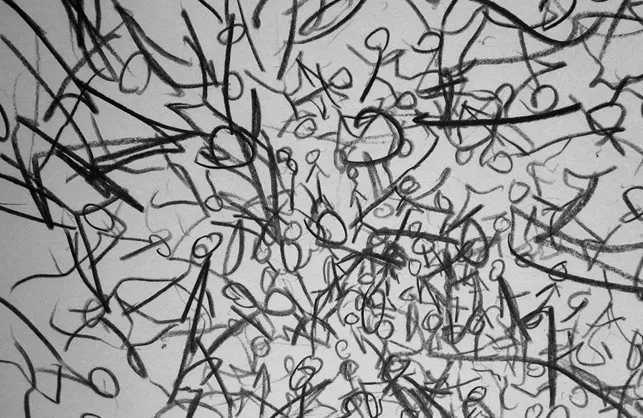
I drew a picture after falling today of one hundred fallen stick-figure bodies (Figure 2). In some ways it’s easier to fall one hundred times than to draw one hundred fallen stick figures. When falling, each fall is intact unto itself. Each fall comes before or after another. Like language. Like words on the page—meaning falsely ordered through linear progression. But as the number of fallen stick figures multiplied on the page, they began to fall on top of one another until the distinction between bodies became obscured. By the time I reached one hundred they were not only no longer recognizable as individual bodies, their very recognizability as bodies had become obliterated—they had been rendered an unknowable mass.
Who do we mourn? Who do we remember? Who do we forget? Which bodies and populations do our national mourning practices make knowable to us? Which bodies and populations are rendered unknowable, unrecognizable? The politics of social memory—intricately entwined with the politics of social forgetting—is about who and what we remember. It is also about how we remember and how we forget. What are the mechanisms through which Canada’s privileged national subjects are placed at the top of the nation’s hierarchy of grievability, while entire populations of unknowable “others” are cast beyond the horizon of our collective grief? How are some historical narratives rehearsed and reiterated until they become fixed in collective memory, while others are qualified, contained, or allocated to the distant forgetful peripheries of national memory?
Figure 2. Drawing of fallen stick-figure bodies.
With the return of Canada’s first combat fatalities from the war in Afghanistan in spring 2002, Canadians began to gather along the 172-kilometre repatriation route between the military base in Trenton, Ontario, and the Toronto coroner’s office. As each new casualty returned home, the crowds on the roadsides and freeway overpasses of Ontario’s Highway 401 grew. Veterans, police officers, firefighters, and residents waited—sometimes for hours—in heat and rain, in cold and snow, to pay tribute to the soldiers whose bodies were being transported in the passing motorcades. The phenomenon garnered positive media attention across Canada (as well as in the United States), led to the official renaming of sections of the repatriation route as the “Highway of Heroes” (2007) and “Route of Heroes” (2010), and inspired a host of songs, YouTube video tributes, books, and other institutional and popular cultural representations.
I learned of the Highway of Heroes memorials in 2009 when I returned to Canada after living for twenty years in the United States. I was immediately struck by the contrast between Canada’s popular and widely publicized roadside mourning rituals and the U.S. government’s (then) ban on media coverage that displayed images of caskets of repatriated U.S. soldiers. Initially, I was profoundly moved by the public display of mourning for Canada’s military casualties. But as I witnessed the Highway of Heroes memorials through their prolific reiteration via Canadian mainstream and social media venues, two things stood out: first, the absence of any acknowledgement of Afghan deaths; and second, the extent to which the Highway of Heroes—though framed as a “spontaneous” and “grassroots” movement—resembled a host of other Canadian military commemoration ceremonies.
At first, I imagined the Highway of Heroes memorials to be a gesture of resistance to militarism and opposition to the war in Afghanistan (an assumption I attribute to my time in the United States, where military casualties are more commonly invoked in anti-war protests). But my imagined Highway of Heroes bore little resemblance to the roadside memorials. Like Remembrance Day and other government-sponsored ceremonies of military mourning, Highways of Heroes memorials embrace a militaristic and nationalist poetics of mourning that contributes to the production and dissemination of very distinct narratives of Canadian militarism and nationalism. These ceremonies act as public stages onto which Canada’s military dead are cast as “just warriors” who heroically sacrifice their lives in acts of enlightened military intervention and selfless national loyalty. Where, I wondered, were the voices of lament of the mothers, fathers, children, lovers, friends, and civilians who dissent from the Canadian narrative of selfless sacrifice and humanitarian militarism? Where were the voices questioning the geopolitical conditions that resulted in the loss of those being mourned? And where were the voices of lament for the Afghan dead?
I did not attend any Highway of Heroes memorials. It was not an easy decision. I struggled with the tension between my desire to take part in a collective act of mourning for war’s dead and my concern that participation would implicate me in a form of nationalist and militarist display. Instead, I began Impact Afghanistan War, a counter-memorial project in which I fell one hundred times a day in a public space for one year—each fall in recognition of a death in the Afghan war. Over the course of the year—from Canada Day 2010 through Canada Day 2011—I fell in parks and on campuses, in courtyards and public squares, in front of churches and political institutions, at festivals and conferences, in cities throughout Canada, the United States, and Europe.
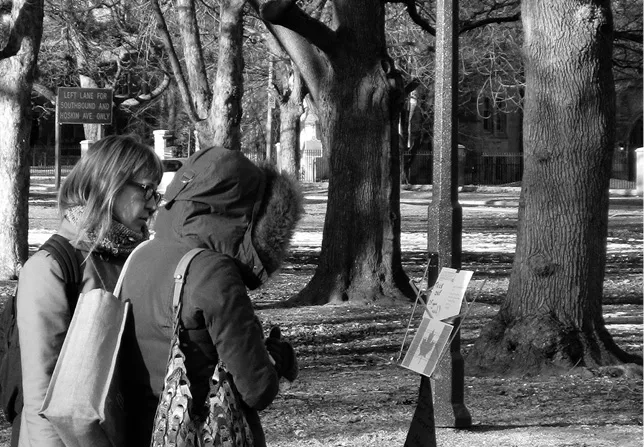
Figure 3. Witnesses looking at Impact display stand.
Each time I fell, I set up a small music stand onto which I attached a cloth flag and placed information flag-postcards. In addition to being signifiers of the nation, the flag and informational postcards (Figure 3) served a more didactic purpose as they bore the following message:
An investigation of the space between “us” and “other,” between individual and social mourning, between personal ritual and public protest, Impact was an attempt to register, in and through the body, the impact of “our” (Canada’s) engagement in Afghanistan. Impact was also a way for me to engage the Highway of Heroes in an embodied dialogue that though not proximal (or on-site), through its gestures (standing at attention before and after each fall) and its signifying symbol (the Canadian flag) had a recognizable association with the popular memorial. With its inscribed-upon flag as an unbecoming signifier of the nation and through its daily insinuation into the everyday present of the public sphere, Impact sought to question the confinement of social grief within national boundaries.
4 February 2011
Christie Pits Park, Toronto
falls 21,800–21,900
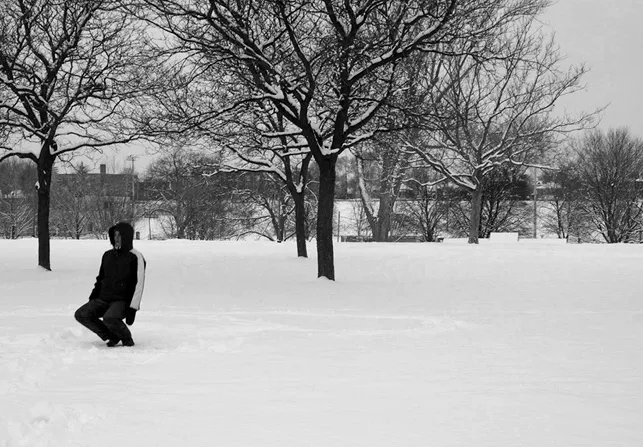
Stand. Fall. Stand. Fall. Stand. Fall. The impact of body with ground. The surprising accommodation of surfaces. The season’s first snow was soft and embracing, but now, as winter wears on the ground has taken on the topography of a moonscape. Falling is the easy part—the curious architecture of body and limbs. It’s standing, rising, that’s difficult. Stand. Fall. Breathe. Traffic, birdsong, distant or passing voices, circling hawk, tree limbs, plane slicing sky, snow. Falling. The ground becomes a between-space where I experience both the vastness of my distance from, and a closeness to, all those who have fallen, are falling, in Afghanistan. Distance, because I am acutely aware of the inadequacy of my gesture. I fall of my own accord. I have not been struck down. I am not injured. I can rise. Do rise. But it is precisely this awareness of distance that connects me. Each fall becomes an embodied meditation on the unequal distribution of vulnerability in our geopolitical landscape. With each fall I recognize—it “could” be me, it isn’t me, and, the reasons it’s not.
Figure 4. Falling in Christie Pits.
In Frames of War, Judith Butler extends Louis Althusser’s notion of “modalities of materiality” to argue that the mechanisms through which war is framed need to be understood as “material instrumentalities of violence” that function as more than simple precursors to or commentaries on war, but as acts of war in and of themselves.4 These frames function not only by legitimizing particular agendas and geopolitical world views through the selective placement of images and narratives within the frame but also through the “de-realization” of “enemy” populations by casting them outside of what is considered the normal realm of human values into an otherness that is consequently outside of the range of our compassion.5
While de-realization at its most overt is evident in the demonization of the “enemy,” it also functions more subtly by placing entire populations outside of the range of our collective grief, thereby facilitating a large-scale empathetic detachment from the consequences of our nati...