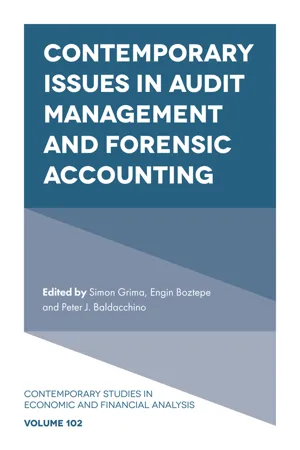
It is not possible to take measures against and fight financial crimes by using old traditional methods. Instead, the field of Forensic Accounting has arisen to directly tackle these issues. In the 18 chapters in this volume of Contemporary Studies in Economic and Financial Analysis, expert contributors gather together to examine the extent and characteristics of forensic accounting, a field which has been practiced for many years, but is still not internationally regulated yet.
eBook - ePub
Contemporary Issues in Audit Management and Forensic Accounting
- 487 pages
- English
- ePUB (mobile friendly)
- Available on iOS & Android
eBook - ePub
Contemporary Issues in Audit Management and Forensic Accounting
About this book
Recently, financial crimes have increased exponentially in many regions of the world. Considering that these crimes are usually due to accounting fraud, more sensitive and effective approaches to accounting fraud and corruption have started developing. In this context, regulations have been put into practice in many countries for measures to be taken against fraud and corruption.
Information
CHAPTER 1
AN EMPIRICAL ANALYSIS ON STUDENTS’ CHEATING BEHAVIOR AND PERSONALITY TRAITS IN THE CONTEXT OF FRAUD TRIANGLE FACTORS
ABSTRACT
The aim of this study is to analyze the relationship between personality traits and students’ cheating behavior using the five-factor personality model and the fraud triangle factors. This chapter develops an evidential study that has the goal to determine the relationship between the students’ cheating behavior and personality traits by using fraud triangle factors. In this context, 251 surveys have been conducted on students of a foundation university located in Istanbul. As means of data collection, NEO – Five Factor Inventory and Academic Fraud Risk Factors have been used. Data have been analyzed by regression tree analysis. Risk and classification tables have been created before starting the study with a decision tree in which classification and regression trees algorithms were implemented. The results reveal that rationalization behind the cheating is the most important reason for students to copy and people who believed that they were extremely appropriate to copy were responsible ones when analyzed in terms of their personality traits. The results of this study contribute to the literature by discovering the characteristics of those who admit academic dishonesty and underlie the factors or predispositions for engaging in this behavior. For sure, three factors of the fraud triangle may have different levels of significance in this study; in addition, pressure is not associated with the cheating behavior.
Keywords: Fraud triangle; academic cheating; academic dishonesty; regression tree; personality traits; auditing
JEL classifications: M49; C14; C35
INTRODUCTION
Copying from others, using cell phones, plagiarizing from the internet, using signals during an exam, and using prohibited reference materials; the ways students resort to engage in academic dishonesty are numerous. Academic dishonesty, cheating/misconduct signifies to conditions in which a student claims credit for others’ work or efforts without authorization or citation (Becker, Connolly, Lentz, & Morrison, 2006). Academic dishonesty is perhaps as old as education itself. Many students today do not even consider the acts like plagiarism and cooperating with others on tests as cheating at all; thus, cheating has become an ordinary part of academic life. This cheating behavior can also be described/explained by economic models (Bunn, Caudill, & Gropper, 1992). According to a study including approximately 50,000 undergraduate students on more than 60 different campuses in the United States, 70% of these students admits that they have been involved in cheating. One fourth of the students admitted to serious test cheating in the past year and half attempted to cheat on one or more written assignments. Academic fraud is a significant, recognized threat to the core value of higher education (Burnett, Rudolph, & Clifford, 1998; McCabe, Trevino, & Butterfield, 2001; Whitley & Keith-Spiegel, 2002). Traditionally, instructors have used controls to limit opportunities to cheat or reduce incentives to cheat (MacGregor et al., 2012).
Cheating and academic fraud continue to become more and more prevalent especially among business students (Klein, Levenburg, McKendall, & Mothersell, 2007). The opportunities and pressures to cheat seem to have increased dramatically today. Advances in the technology, worldwide usage of internet, and easy access to information have increased the opportunities for academic cheating and fraud. The pressure to get better grades, succeed, and advance academically has increased as the importance obtaining a higher academic degree in today’s economy. We assume that the critical piece standing between these opportunities and incentives and academic fraud are a student’s ability to rationalize his/her inappropriate academic behavior (MacGregor et al., 2012).
This study tests student’s cheating behavior that is obtained from a model of dishonest behavior related to business life, the fraud triangle, which is the main tool used by auditors and is generally accepted by auditing standards to assess fraud risk.
The fraud triangle (Cressey, 1953) is an established framework for analyzing fraudulent behavior, like cheating, which is a model originally evolved by a criminologist, Donald R. Cressey. It is one of the oldest and basic concepts in fraud deterrence and detection. A fraud, or a “trust violation” as Cressey’s terminology, involves three factors – incentives pressures, opportunities, and attitudes/rationalization – that together give notice of any probability of fraud within an economy. The causal factors that should be removed to deter fraud are best described in the fraud triangle. According to this theory, fraud occurs where the conditions are right for it to occur. The concept of a fraud triangle is introduced to the professional literature in Statement of Auditing Standards (SAS) No. 99 Consideration of Fraud in a Financial Statement Audit. As part of the SAS 99 the fraud triangle consists of the following three factors are generally present when fraud occurs (Murphy & Tina, 2011). These factors are also mentioned as fraud risk factors in International Standards on Auditing 240 The Auditor’s Responsibilities Relating to Fraud in an Audit of Financial Statements. First, being under pressure or having an incentive provides a reason to commit fraud regardless of being a manager or an employee. Second, current circumstances, such as ineffective controls or absence of controls, and management’s ability to override mentioned controls provide the opportunity to perpetrator to commit fraud. In addition, for the last, rationalization is necessary for those committing a fraudulent act. Even though some individuals’ character, attitude, or ethical values enables them to intentionally and easily commit a fraudulent act, honest individuals can also commit fraud when exposed to sufficient pressure. The greater incentive or pressure, the more likely an individual will be able to rationalize the acceptability of committing fraud (Public Company Accounting Oversight Board PCAOB, 2005). As a result, fraud involves pressure for commitment, a case perceived as an opportunity to do so and some rationalization of the act.
SCOPE AND LIMITATION OF THE STUDY
In an academic environment, uncertainty and information asymmetries, combined with ineffective monitoring and control mechanisms, create opportunities for academic fraud. Students’ incentives to cheat are generally economic or social. The final fraud triangle factor, rationalization, involves the individual’s internal response to external opportunities and incentives. Rationalization is a mechanism that allows people to eliminate the inconsistency of what they do from what they know they should do, and is used by students to justify aggressive academic behaviors (MacGregor et al., 2012).
The purpose of developing the model is twofold: (1) to underline the perspective of students cheating behavior; and (2) to gain an understanding of the psychology of the students committing academic dishonesty. Participants of the study were 251 students. The study showed that two elements of the fraud triangle – opportunity and rationalization – are significant determinants of student’s cheating behavior.
In addition, even though the survey was based on volunteering, it was completed within the lecture hall. Thus, students may have declared less academic dishonesty due to the physical affinity of others in the class and the precise nature of the information asked in the survey. Against the possibility of the respondents underreporting their neutralizing propensities, actual cheating behaviors, and tendencies, before the survey participation, the nature of the data collection process and how the confidentiality and anonymity of the participants will be secured were explained.
The interdisciplinary approach chosen for this study is a criminological-business perspective based on the fraud triangle model, which is extensively used and is highly defended by fraud examiners and auditing professionals. For example, Biegelman and Bartow (2006, p. 33) wrote, “Every corporate executive needs to understand the fraud triangle and why employees commit various kinds of fraud.” The fraud triangle tends to emphasize three different factors and instead of focusing on the characteristics of the organization and its environment, it focuses on the individuals with the opportunity to misappropriate assets. Alias, books and records do not commit fraud; people do. Thus, the fraud triangle recommends focusing on individuals who could commit fraud alongside focusing on the organization and its records (LaSalle, 2007).
Personality traits appear to be major fraud risk factors for the students’ attitude toward cheating behavior. This study focused on the relations between university students’ self-reported cheating behavior and their personality traits via fraud triangle. It was hypothesized that students’ personality traits would predict cheating. Five dimensions of personality traits – agreeableness, extraversion, neuroticism, conscientiousness, and openness – were measured.
A substantial limitation of this research is the self-report nature of the data and their collection. Even though students’ names were not asked in the study, students were aware that they had been uncovered.
Method
Decision trees and decision rules are data mining methodologies applied in many real-world applications as a powerful solution to classification problems (Kantardzic, 2002). Berry and Linoff (2004) describe decision trees as a structure that can be used to divide a large collection of records into successively smaller sets by applying a sequence of simple decision rules.
Decision trees have four commonly algorithms: Chi-squared Automatic Interaction Detection (CHAID), the Exhaustive CHAID, Classification and Regression Trees (CRT), and Quick, Unbiased, Efficient Statistical Trees (QUEST).
The CHAID algorithm was originally proposed by Kass (1980) and the Exhaustive CHAID by Biggs et al. (1991). CHAID and Exhaustive CHAID algorithm allow multiple splits of a node. CRT algorithm was developed by Breiman, Friedman, Olshen, and Stone (1984). CRT splits the data into segments that are as homogenous as possible with respect to the dependent variable. QUEST was developed by Loh and Shih (1997). This method can be specified only if the dependent variable is nominal. A decision tree consists of “nodes” where attributes are tested. The outgoing “branches” of a node correspond to all the possible consequences of the test at the node (Kantardzic, 2002).
Sample
The purpose of the study is to explain the impact of the personality traits on the cheating behaviors of the university students through the fraud triangle. For this purpose, one foundation university located in Istanbul (2018) was examined and the selection of the students was done by using the stratified sampling method. In order to include different type...
Table of contents
- Cover
- Title
- Chapter 1. An Empirical Analysis on Students’ Cheating Behavior and Personality Traits in the Context of Fraud Triangle Factors
- Chapter 2. The Effects of Big Data on Forensic Accounting Practices and Education
- Chapter 3. Forensic Accounting Education: An Evaluation of Perception of Students and Certified Public Accountants
- Chapter 4. Financial Information Manipulation and Its Effects on Investor Demands: The Case of BIST BANK
- Chapter 5. The Current Situation and Prospects of the Profession of Judicial Advisory in Turkey: A Research on Lawyers
- Chapter 6. Insurance Fraud: The Case in Turkey
- Chapter 7. Rationality in Decision-Making and Deterring Corporate Fraud
- Chapter 8. Explaining Heterogeneity in Risk Appetite and Tolerance: The Turkish Case
- Chapter 9. An Analysis of Fraudulent Financial Reporting Using the Fraud Diamond Theory Perspective: An Empirical Study on the Manufacturing Sector Companies Listed on the Borsa Istanbul
- Chapter 10. Detection of Accounting Frauds Using the Rule-Based Expert Systems within the Scope of Forensic Accounting
- Chapter 11. Financial Statement Manipulation: A Beneish Model Application
- Chapter 12. The Evaluation of the Criteria for the Selection and Change of the Independent Audit Firm Using the AHP Method
- Chapter 13. The Forensic Accounting Profession and the Process of Its Development in the World
- Chapter 14. Forensic Accounting and Fraud Audit in Turkey (2008–2018): An Academic Literature Review and Classification
- Chapter 15. The Views of Turkish Accounting Academics about the Skills of the Forensic Accountant
- Chapter 16. Financial Crime: A Review of Literature
- Chapter 17. Social Auditing and Its Applicability to Maltese Co-Operatives
- Chapter 18. Challenging the Adequacy of the Conventional ‘Three Lines of Defence’ Model: A Case Study on Maltese Credit Institutions
- About the Contributors
- Index
Trusted by 375,005 students
Access to over 1.5 million titles for a fair monthly price.
Study more efficiently using our study tools.
Frequently asked questions
Yes, you can cancel anytime from the Subscription tab in your account settings on the Perlego website. Your subscription will stay active until the end of your current billing period. Learn how to cancel your subscription
No, books cannot be downloaded as external files, such as PDFs, for use outside of Perlego. However, you can download books within the Perlego app for offline reading on mobile or tablet. Learn how to download books offline
Perlego offers two plans: Essential and Complete
- Essential is ideal for learners and professionals who enjoy exploring a wide range of subjects. Access the Essential Library with 800,000+ trusted titles and best-sellers across business, personal growth, and the humanities. Includes unlimited reading time and Standard Read Aloud voice.
- Complete: Perfect for advanced learners and researchers needing full, unrestricted access. Unlock 1.5M+ books across hundreds of subjects, including academic and specialized titles. The Complete Plan also includes advanced features like Premium Read Aloud and Research Assistant.
We are an online textbook subscription service, where you can get access to an entire online library for less than the price of a single book per month. With over 1.5 million books across 990+ topics, we’ve got you covered! Learn about our mission
Look out for the read-aloud symbol on your next book to see if you can listen to it. The read-aloud tool reads text aloud for you, highlighting the text as it is being read. You can pause it, speed it up and slow it down. Learn more about Read Aloud
Yes! You can use the Perlego app on both iOS and Android devices to read anytime, anywhere — even offline. Perfect for commutes or when you’re on the go.
Please note we cannot support devices running on iOS 13 and Android 7 or earlier. Learn more about using the app
Please note we cannot support devices running on iOS 13 and Android 7 or earlier. Learn more about using the app
Yes, you can access Contemporary Issues in Audit Management and Forensic Accounting by Simon Grima,Engin Boztepe,Peter J. Baldacchino in PDF and/or ePUB format, as well as other popular books in Business & Accounting. We have over 1.5 million books available in our catalogue for you to explore.