![]()
SECTION 1
ASSESSMENT FUNDAMENTALS
![]()
1
ASSESSMENT FOR ORGANIZATIONS
CHAPTER SUMMARY
Chapter 1 presents a general definition of assessment and describes how it is commonly used in organizations. This chapter also considers why organizations assess. This chapter also explains how assessment has changed from the industrial economy to the knowledge economy. This chapter also describes the current state of assessment in knowledge management. This chapter explains that to discover the rich body of knowledge of assessment, we must expand our search to include examples that are embedded in other sources and examples that are defined by their tactics.
WHAT IS ASSESSMENT?
What do we mean by assessment? Assessment is a general term which can be applied to anything or any activity. Assessment is often associated with other terms such as analysis, examination, estimation, prediction, comparison, validation, and compliance. In the common dictionary sense, assessment tends to focus on analysis, appraisal, or evaluation. Assessment is often defined by the nature of its domain and application – curriculum assessment, student assessment, program assessment, requirements assessment, productivity assessment, efficiency assessment, patient care assessments – the adjective defines the nature of the assessment. For example, in the field of education, assessment is defined as the process of gathering and discussing information from multiple and diverse sources in order to develop a deep understanding of what students know, understand, and can do with their knowledge as a result of their educational experiences. Assessment results are used to improve subsequent learning. The term “assessment” is used quite generically it is only given a true definition when it’s used in a context. Definitions of assessment tend to focus on evaluation or judgment when, in fact, these definitions pertain to how the results are used and what actions are taken.
We define assessment in a generic dictionary sense - the systematic collection, review, and use of information about an entity or activity undertaken for the purpose of improvement. What we learn from all of these definitions is that Assessment is a verb – a process. The definition depends on the activity or entity the process is applied to.
Every organization has an assessment strategy and an assessment culture, whether it is explicitly documented or part of the everyday behavior of the organization. Most organizations today will have some form of assessment methods and models in place. These might include performance assessment, personnel appraisals, budget reviews and budget analysis, customer assessments in the form of feedback, after-action reviews, or requirement analysis. There is much we can learn from current practices. And when we’re introducing a new approach, we always want to align that approach with what exists.
WHY DO WE CARE ABOUT ASSESSMENT?
Why do people conduct an assessment? The goal of assessment is almost always to learn, understand, describe, and interpret. We want to learn how things changed. We want to know what works and what doesn’t work. We want to understand why it works and why it doesn’t work. We want to understand how to interpret the change in different context. In order to gain these insights, we need to focus on all aspects of the assessment process – the initial state, the change process, and the final or end state. We conduct an assessment because we want to understand the initial state of something – the status quo or the current state or its characterization before we implement a change. We also might assess because we want to understand what happens during the change process. We might assess the behavior of a new feature, the application of a material or the integration of a new chemical in the creation of a product. We can assess the end result, but we need to understand how the change affected the product. We might want to assess a new manufacturing method while we’re testing it. We might assess a new software product during its development phase.
ASSESSMENT IN THE INDUSTRIAL ECONOMY
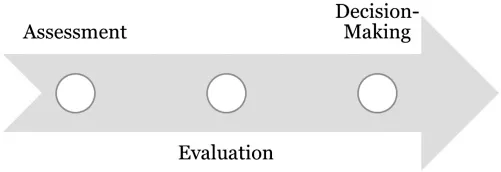
In the industrial economy, assessment has been focused on evaluation and decision making (Fig. 1.1). Assessment is the first step in a process that positions us for evaluation and leads to decision making. Assessment in most organizations will tend to focus on outcomes or outputs, on judging or evaluating those results against expected levels of performance or production. The expected levels may be internally defined at the business unit level, they may be organizational level goals, or they may be industry standards. Assessment in the industrial economy is often limited to determining whether we have achieved expectations, a goal, or a benchmark.
Fig. 1. Traditional Characterization of the Assessment Process.
Perhaps, the reason we see outcome- and output-focused assessment more frequently in the industrial economy is because we expect little change. We can more easily assess whether something is efficient or effective because we have established expectations for what the end state will be. For this reason, it’s very important to focus on beginning state, the process aspect of assessment, and then to learn what the end state might be rather than to be able to assess whether we have achieved the desired end state.
In the industrial economy, we design processes to reduce variation, improve quality, reduce costs, or increase profit and revenue. The goal of assessment therefore is to standardize processs to increase predictability and control. We assess process when the end state does not align with our expectations, the desired or predicted state. We undertake an assessment when we are considering a change or have been affected by a change – we need to understand how change might impact our expectations. This makes sense in the industrial economy.
In the traditional assessment model (Fig. 1), we note that assessment is not broken down into a process. Assessment is often associated with tactics – a specific set of procedures or methods that support evaluation and decision making in a context such as human resource management or project management. Additionally, assessment is focused on the final stage – analyzing and synthesizing information to use for evaluation.
ASSESSMENT IN THE KNOWLEDGE ECONOMY
In this text, we’re interested in understanding what assessment means for knowledge organizations and the field of knowledge management. We’ve said that assessment will depend upon what we’re assessing and why. What is the nature of the change in the knowledge economy? The knowledge economy is changing the nature of our work, how we work, where and when we work, and who works. The impact to organizations is significant. The changes mean that the landscape of assessment – methods, areas of application, and expectations – is expanding. At a minimum, we need to assess how we are leveraging our knowledge capacity in the everyday operations of the organization, how we are leveraging our knowledge capital assets, and how we are leveraging our knowledge capabilities and processes. Why we assess is also expanding. We assess in order to learn and understand. Because change is continuous and unpredictable in a knowledge economy, we may not always have an expected or desired state. We may use assessment to determine what that state might be. Because the nature of change is sometimes disruptive and unfamiliar, we may use assessment to better understand what works, what doesn’t work, and why.
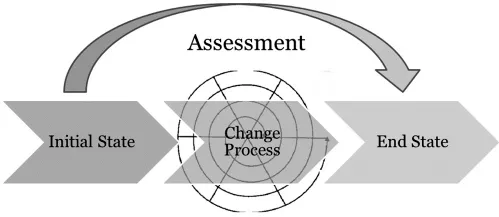
A significant difference between assessment in the industrial economy and assessment in the knowledge economy is that we assume predictability and static processes in the former and a world of continuous change in the latter (Fig. 2). Assessment is a more critical tool for managing and driving change in the knowledge economy than it has been in the industrial economy. Assessment may be a tool that is more frequently used in the knowledge economy simply because we need to understand the nature of change in every activity and at every level. Assessment in the knowledge economy begins with the traditional assessment model but breaks it down into initial state, process state, and end state. And it changes the nature of the assessment process from simple evaluation and judgment to include learning, innovation, creativity, ideation, and unlearning. This means that the process stage of assessment becomes much more interesting. Assessment begins to look more like a continuous improvement and spiral model than a simple linear step in a predictable process.
In a knowledge organization, assessment focuses on all three components of the model – initial state, process, and final state. Most of the literature on traditional assessment assumes a predictable end state. In fact, much of the literature suggests that if you cannot explain or describe the end state you probably cannot do an effective assessment. In an economy where change is continuous and unpredictable, we assess to learn how to better manage change. This means that our assessment tool kit should increase, and it should have more methods at hand to use to assess processes.
Fig. 2. Assessment Model for Knowledge Organizations.
The process focus is particularly relevant to knowledge functions and knowledge assets. The economic properties of knowledge are different from other types of assets – there is no end state for knowledge. The more knowledge is in use, the more knowledge is in circulation, the greater the variation we expect. Knowledge is tied to people, and knowledge processes are inherently human. Knowledge is also inherent to those processes that are core to the knowledge economy – innovation, experimentation, texting, and ideation. The nature of knowledge functions and capabilities are evolving – we are still learning what works and what doesn’t. We are continually assessing our own processes to understand how to grow them. Additionally, today, the knowledge capacity of traditional business processes is undervalued, uneven, and not systematically managed. It is essential for organizations to understand and manage knowledge assets, knowledge functions, and knowledge capacity if they expect to succeed in the knowledge economy.
CURRENT STATE ASSESSMENT – KNOWLEDGE ORGANIZATIONS
The assessment literature in the field of knowledge management is scattered, fragmented, and challenging to discover. The formal peer-reviewed literature on assessment tends to focus on knowledge management maturity modeling and knowledge audits. Maturity models tend to focus on the initial state of assessment – to tell us what is. And maturity models tend to focus on measurement – the end state of the assessment process. Audits should tell us how we vary from expected practice or standards. These treatments are important, but they are not significantly different from the traditional industrial economy assessment model. They generally do not focus on the assessment process. Does this mean that there is little or no treatment of assessment processes in the field? Definitely, not. In fact, both the peer-reviewed and the gray literature are rich with discussions of assessment as a process. And with references to assessment as a form of learning, innovation, ideation, testing, and experimentation, where is this literature and how can we find it?
The authors spent considerable time searching and reviewing the knowledge manag...