INTRODUCTION
In this chapter, an analytical model for understanding philosophy of science for Knowledge Management will be developed. In addition, we will create three conceptual models to understand the analytical model. We will also create a postulate system for philosophy of science for Knowledge Management. “Postulate system” as it is used here refers to a set of premises from which all the propositions in a theory follow (Bunge, 1999, p. 218). “Theory” as it is used here refers to a system of propositions (Bunge, 1999, p. 295).
Language, history, tradition and the epistemological hierarchy here belong to what we choose to denote as feed-pre. The epistemological hierarchy is here understood to be a hierarchical, logical structuring of meta-theory (Weltanschauung), theory, model and method, respectively.
The concept feed-pre is related to the cybernetic feedback concept. Feed-pre is nourished by the observers’ previous experiences, while feedback is oriented towards the correction of procedures to avoid error deviation, and this is what creates the distinction between the two concepts. Feed-pre, on the one hand, is instrumental in the interpretation of information of feedback processes and thus instrumental in constituting these. On the other hand, feedback processes are necessary conditions for feed-pre. Without feedback processes feed-pre could not be constituted. In this way, feed-pre and feedback are mutually dependent entities.
Pre-understanding indicates the distinction between the description and the described (the object system). The description and the described are related entities, in the same manner as a word is related to its referent. The described is subject to a definition process, which among other things is coupled to feed-pre. When an observer evaluates, to a major extent it is the description which is subject to evaluation and not the described. If this is correct, it is not empirical truths that are subject to scientific evaluation but one’s own descriptions of the described. In order to make the distinction towards the descriptive statement about the described unambiguous, the observed system is here referred to as the described.
The main question asked in this chapter is: what constitutes philosophy of science for Knowledge Management?
The questions contributing to the understanding of the main question are as follows:
How does feed-pre contribute to the understanding of philosophy of science for Knowledge Management?
How does pre-understanding contribute to the understanding of philosophy of science for Knowledge Management?
How does the described system contribute to the understanding of philosophy of science for Knowledge Management?
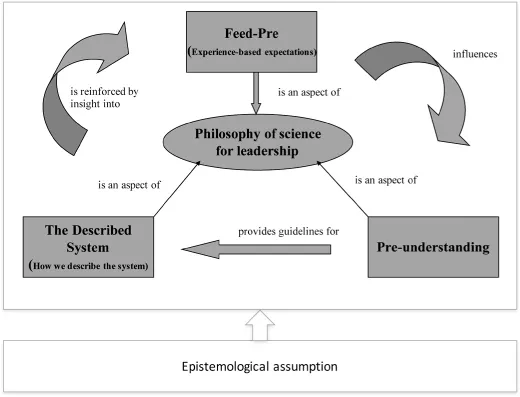
In this way, feed-pre, pre-understanding, the described and philosophy of science for Knowledge Management become interrelated entities in the model (Fig. 1). Fig. 1 also shows how the chapter is organised. The epistemological foundation for philosophy of science for Knowledge Management in Fig. 1 is elaborated in Appendix 1. This is done for educational reasons.
Fig. 1. Philosophy of Science for Knowledge Management.
Feed-pre
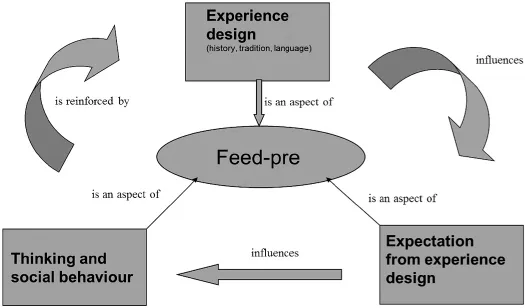
Feed-pre is connected to experience design and experience-based expectation. It is in this connection language, history, tradition and the epistemological hierarchy (Appendix 1) come into operation for interpretation and social behaviour.
Feed-pre is contrasted to the idea of free reflexive thinking, as thinking is constituted by the observer’s feed-pre and pre-understanding. Gadamer (1975, p. 145) makes the following statement: ‘The prejudice of the individual far more than his judgements, constitutes the historical reality of his being’. We hold this to be in support of the statement: Feed-pre constitutes reflection. This is not something we can free ourselves from, only something that we can become conscious of.
Dilthey (1976) is accredited with viewing history as an interpretation subject and underlined its importance for interpretation contexts. He emphasised the importance of history’s influence on our interpretations and social behaviour.
In relation to philosophy of science for Knowledge Management, a very important point is to make the history of the system transparent because feed-pre directs human behaviour and how we think and act. The relationship between history, language and tradition is here regarded as an explicit here-and-now creation by the interpretative subject, which shapes how we think, what we think and how we act.
The notion of the tradition concept we use in feed-pre finds support in Gadamer (1975, p. 249) who writes “tradition has a justification that is outside the argument of reason and in large measure determines our attitude and behaviour”. Gadamer also reminds us that we belong to tradition, history and language before they belong to us, according to Bernstein (1985). This we think underlines the importance of making these elementary interpretation processes explicit, to make an explicit critique and reflection possible. Otherwise our thoughts and social behaviour drift like leaves in the wind.
Postulate: History, language and tradition shape how we think, what we think and how we act.
Part-conclusion
How thinking was established through our history, our traditions and our language is vital to what we think, how we think and what we do.
The presuppositions of philosophy of science for Knowledge Management are evident in the following statements:
Fig. 2. Feed-pre.
Reflexive awareness is not possible until:
The categories in feed-pre have been made authentic to the individual.
The relationship to “the other one” has been clarified.
The individual is aware of the resonance between feed-pre, pre-understanding and the described.
Feed-pre may be conceptualised as we have shown in Fig. 2.
Pre-understanding
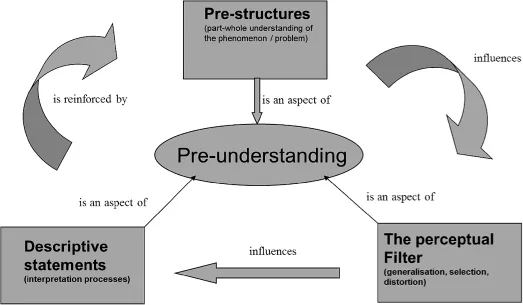
Pre-understanding, as it is used here, consists of three elements that are reciprocally influential:
Pre-structures: There exist three pre-structures according to Caputo (1987, p. 70):
Fore-having: This means that one has an understanding of the totality in the subject matter.
Fore-sight: This means an initial understanding of what type of phenomenon we are confronted with.
Fore-grasping: This means that we have pre-concepts concerning the phenomenon.
The perceptual filter: the perceptual filter consists of three elements1:
Generalisation: the abstraction ‘leaps’, that is, the process of abstraction we make from the data in the problem area.
Selection: selective process that makes us aware of the various dimensions in our experience and de-select others.
Distortion: the process of bringing about the selection of various dimensions in the object field while disregarding others.
Descriptive statements: About the object system, problem area, object field, etc. Descriptive statements about the object field are always subject to interpretation and change. Descriptive statements can be regarded as a structuring process. Structuring process here means when we attach qualities to an object, object field, etc., they are not the qualities the object embodies but the qualities we have attached to it and that have been agreed upon by a community of practice.
Postulate: Pre-understanding is constituted by pre-structures, the perceptual filter and descriptive statements about the object system.
Part-conclusion
Through communicative processes based on communicative awareness, it is possible to make knowledge explicit that is not explicitly accessible to the individual observer, and which is based on the structuring processes (Chapter 3). In this way this knowledge may be made accessible to leaders and all the parties involved in a community of practice.
Fig. 3. Pre-understanding.
In philosophy of science for Knowledge Management the acquisition of knowledge (regardless of method) is shaped by the interaction between:
Tradition, history, and language.
Our pre-understanding.
Our descriptive statements about the object system.
Our relationship to others.
The situation context.
Pre-understanding may be conceptualised as we have shown i...