![]()
1
Change in the Digital Age
The world seems to be moving at a greater speed than ever before. Change is a constant in the twenty-first century due to technological disruptions that are happening at an accelerated pace. In this age, change management will have to take on a different meaning as companies reinvent and adapt their organisational strategies to cope with this digital revolution. Changes in this digital age will include looking at digital talent, digital leadership, and digital transformation.
Among all, digital transformation is probably the most important and disruptive organisational change to happen in recent times. It is the process of integrating digital technology into all areas of businesses and its processes, thus changing how you operate and deliver value to customers. One of the key critical elements in this process is culture change, which requires an organisation to continually innovate and transform the mindsets of employees to cope with Industry 4.0.
1.1 Importance of Culture in Digital Transformation
Many organisational leaders I have met opined that technological barriers were far easier to overcome than barriers relating to organisational culture. However, for those organisations that were successful in digital transformation, they were also able to transform their culture and help their employees align to the organisation's realigned values and purposes throughout the transformation journey. Culture is, thus, a vital component in the facilitation of organisational transformation. Leaders will need to help their workers change mindsets so they are ready for the future of work. Professor Namgyoo K. Park (2019), in his article on the cultural impact of automation, shares that the impact on corporate culture brought on by Industry 4.0 are great. They include looking at corporate governance, company communications, organisational structure, working conditions, and HR practices. In another article by Josh Bersin, entitled, “The New Organisation: Different by Design” (Bersin, 2016), he states, “One of the biggest drivers and facilitators of the ‘new organisation’ is the need to drive culture, employee engagement, learning and feedback throughout the company. Millennials are looking for mission and values at work, and when they work in small teams, they need a shared culture to ensure that strategies, programs, and compliance takes place in a consistent way.”
In yet another study, “Culture for a Digital Age 1 ” (Goran, LaBerge, & Srinivasan, 2017), the authors share that shortcomings in organisational culture are one of the main barriers to a company's success in the digital age. The survey emphasized three digital culture deficiencies present today. These three deficiencies are:
- Functional and departmental silos;
- Fear of taking risks;
- Difficulty forming and acting on a single view of the customer.
The research also shows that cultural obstacles correlate with negative economic performance. In view of this, executives will need to be proactive in shaping and measuring culture, and approach it with the same rigor with which they tackle operational transformations. Alyson Clarke (2018) shares that digital transformation will demand changes to strategy, technology, processes, and structure – and culture is the glue that brings it all together. Cultural transformation is one of the biggest barriers to digital transformation, and digital leaders must seed cultural changes to start shifting their organisation toward a digital culture that is customer focused, empathetic, agile, experimental, and collaborative. 2
In view of the need to accelerate culture transformation, Park (2019) says that collaboration platforms for brainstorming, idea generation, and open communication in which ideas can be shared in real-time are vital components of success. They allow for faster and more efficient collaboration – one of the key ingredients to successful culture transformations.
1.2 My Research Work in the Area of Digital Tools for Culture Change
In moving organisation culture in today's world, digital tools are a great way to facilitate change and a means of bringing communities together. Innovative and low-cost platforms can be easily integrated to start building a digital culture in a non-threatening manner. This book is a culmination of my research in the area of developing digital tools for culture transformation through a robust design methodology.
In my earlier days of working as a Human Resources Leader, I often had to lead culture transformation projects with thousands of employees. These change projects took a long time as we often had to conduct communication and feedback sessions manually. In addition, not everyone had the chance to voice their opinions or views as there was limited time. The sessions were also subject to process losses due to group dynamics which compromised the integrity of the change project.
I began to look for ways in which I could work on culture transformation projects using digital tools that can speed up the change process and improve its effectiveness in an objective manner. In 2009, I started working as Director of HR in the Singapore University of Technology and Design (SUTD), a new university set up by the Singapore government, to develop technically grounded leaders who will make a difference to the world through Design. While there, I had the opportunity to work with the senior leadership team to build and develop an innovative culture necessary for the success of SUTD. I began to explore the idea of using technology for culture transformation. This began my PhD work in developing digital tools and its associated methodology for change in a new university. In conjunction with a commercial company in the Netherlands who sponsored their software platform for the project, and through the use of an openly available culture tool, I developed the architecture and platform for the digital tool and tested it with the university population of faculty, staff, and students to validate the methodology and the results. Many positive outcomes came out of the tool, which continues to help facilitate the success of SUTD today. In this book, I will share the developmental process and methodology of the digital tool, called the “Culture Acceleration Tool and Methodology (CATM),” and its successful outcomes through the case study of two organisations. There will be explanations of the concepts underpinning the design and configuration of CATM and its associated culture tool. We will also discuss, in detail, the use of group decision support systems as a platform in which CATM was built.
Before we move on to the topic of CATM, we will talk about Industry 4.0, the future of jobs, workforce planning, and digital leadership. These are necessary preambles to the topic of culture transformation. Next, we will touch on the theoretical concepts underpinning organisation culture and change management before moving on to the use of digital tools for culture acceleration.
1.3 Rapid Digitization and Advent of Industry 4.0
Industry 4.0 is here, today. When we trace through history, starting with the development of the steam engine in the 1800s to where we are now, in 2019, we have actually moved from the “First Industrial Revolution” to what is now called the “Fourth Industrial Revolution.” This is a period ushered by rapid digital transformation where end-to-end digital and intelligent systems, artificial intelligence (AI), internet of things (IoT), robotics, and data analytics dominate the world. We have shifted from what we call “mechanization” to what is now deemed the period of “autonomy.”
As depicted by Hawksworth, Berriman, and Goel (2018), the three waves of digital automation are described as the Algorithm Wave, Augmentation Wave, and Autonomy Wave (see Table 1.1).
Table 1.1. Algorithm Wave, Augmentation Wave, and Autonomy Wave.
| Phase | Description | Tasks Affected | Industries Affected |
| Algorithm wave | Automation of simple computational tasks and analysis of structured data, affecting data-driven sectors (e.g., financial services) | Manually conducting mathematical calculations or using basic software packages and Internet searches. Despite increasingly sophisticated machine learning algorithms becoming available and commoditized, more fundamental computational job tasks will be most affected first | Data-driven sectors (e.g., financial and insurance, information and communication and professional, scientific and technical services) |
| Augmentation wave | Dynamic interaction with technology for clerical support and decision making, including robotic tasks in semi-controlled environments (e.g., moving objects in warehouses) | Routine tasks that include the physical transfer of information (e.g., filling out forms and exchanging information). A decreased need for many programming languages is also likely, as repeatable programmable tasks are increasingly automated and machines themselves build and redesign learning algorithms | Financial and insurance sectors, along with other sectors with a higher proportion of clerical support (e.g., public and administration, manufacturing and transport and storage) |
| Autonomy wave | Automation of physical labor and manual dexterity and of problem solving in dynamic real-world situations that require responsive actions (e.g., transport and manufacturing) | Artificial intelligence and robotics will further automate routine tasks and tasks that involve physical labor or manual dexterity, including the simulation of adaptive behavior by autonomous agents | Construction, water, sewage and waste management and, with the advent of fully autonomous vehicles and robots, transportation and storage |
Following this autonomy wave, we see six megatrends taking place today. 3 These megatrends are as follows:
- People and the Internet. This is where wearable and implantable technologies are changing how people connect and interact with the world around them.
- AI and Big Data. This is the ability of software to learn and evolve, thus building on big data for effective decision making.
- Sharing Economy and Distributed Trust. This is where disruptive technologies that can enable new efficiencies and business models arise. In this ecosystem, assets can be shared, replacing third-party suppliers to provide trust for financial, contract, and service activities.
- Computing, Communications, and Storage Everywhere. There will be a rapid decline in the size, power, and cost of technology, which will lead to ubiquitous computing and connectivity anywhere and anytime
- Digitization of Matter. In this scenario, 3D printing will revolutionalize industries, ranging from manufacturing to human health, as well as transplantable organs in the future
- IoT. This is where smaller, cheaper, and smarter sensors are becoming commonplace in homes, clothing, cities, transport, energy networks, manufacturing processes, transportation, and more.
The impact of digital transformation in the fourth industry revolution is seeing a major shift in work as jobs are gradually being replaced by advanced robotics and machine intelligence at a faster rate than is being created. The innovation economy will result in a new currency called information and data, a new form of human capital that lies in creative talents and multi-disciplinary capabilities, and new skills in the area of AI, data analytics, and 3D printing. The ability to work across disciplines is critical, as the workplace needs to have the means to assemble multi-disciplinary teams to develop eco-systems to support the future of work. Mr Elon Musk, the famous technopreneur, is an expert generalist, as he is able to integrate concepts from different fields, thus transferring knowledge across different domain areas.
1.4 Future of Jobs
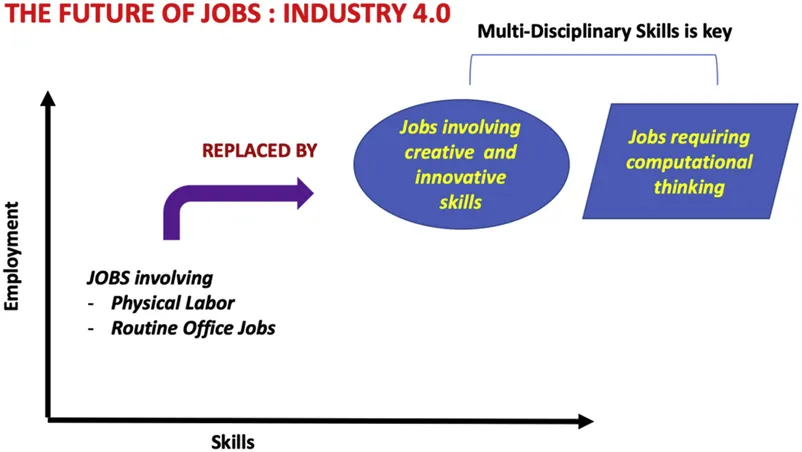
In the future of jobs, more jobs will move from physical manual labor to work that is creative and innovative. The new skills that will be in demand will be the ability to work across disciplines, being creative and innovative, and possessing good communication and people skills. In this digital age, knowing how to work on different media platforms and leveraging them for persuasive communication will be a key strength for individuals and companies. Virtual collaboration and social intelligence both become critical as we harness the ability to not only work virtually across boundaries, but also having the ability to assemble a virtual team together through technology to develop deep collaborations. Lastly, having innovative and adaptive thinking to be able to derive solutions beyond which is routine will become more and more important (Fig. 1.1). Design Thinking is one of those skill sets gaining popularity today, as new innovations in products and services goes through design cycles and iterations before they are launched.
Fig. 1.1. The Future of Jobs.
In view of the sweeping chan...