eBook - ePub
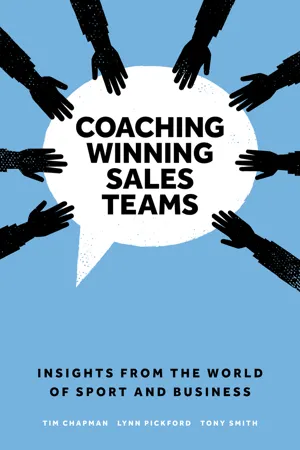
Coaching Winning Sales Teams
Insights from the World of Sport and Business
- 285 pages
- English
- ePUB (mobile friendly)
- Available on iOS & Android
eBook - ePub
Coaching Winning Sales Teams
Insights from the World of Sport and Business
About this book
Great sales coaching positively impacts individual, team and organisational sales performance. However, in today's results-driven and time-poor business world, the embedding of sales coaching into everyday practice is often overlooked. This guide utilises the authors' own experiences of helping companies and individuals turn average, static and infrequent sales coaching regimes into successful business strategies for winning sales teams. Looking at the reality of sales coaching today, the book explores the how, what and why of sales coaching. Through extensive research into elite coaches in the world of business and sports the authors explore the mindset, skills and behaviours required to be a top sales coach. They also consider how to be coached. How the sales person can overcome any natural shyness, fear of performance critique and seek out specific, timely and actionable coaching feedback. Using the latest thinking in neuroleadership and psychology, the book outlines the nine key behaviours of a great coach and provides a range of practical sales coaching models, tools and techniques which can be easily integrated into a sales leaders every-day pressurised role. Coaching Winning Sales Teams is an essential read for sales leaders and professionals, alongside researchers and practitioners working in HR, Learning and Development and Sales Effectiveness.
Information
1
Introduction
Great sales coaching positively impacts individual, team and organisational sales performance. As experienced sales professionals, this is a statement we could probably all agree on, and then find plenty of research to provide empirical evidence, but what our experience and research suggests is that sales coaching is not great.
Our experience of being coached, coaching and working with organisations to improve sales performance is that the reality of sales coaching can be average or poor, programmatic, not cultural, and infrequent in today's results-driven and time-poor business world. As a result, the impact of coaching on performance can be marginal or in some cases negative. You can probably point to a time where you received some poor coaching that destroyed your motivation and confidence or when your boss returned from a development programme and said ‘let's do some coaching’!
The reality of sales coaching today grated, so we set out to dig into the how, what and why of sales coaching to help sales professionals. We didn't want to just talk superlatives about how great coaching can be and its benefits for individuals and organisations, but really get under the lid of what's going on and how could we add some insight to make great sales coaching the ‘everyday’. After all, organisations, like sports teams, invest heavily in their teams with recruitment, salaries, bonuses and training. The one difference perhaps is that the owner of a sports team would not invest heavily on the team in isolation, and then not invest in coaching. We wanted to explore not only the mindset, skills and behaviours required to be a top sales coach, but also the perspective of the person being coached. Coaching is a two-way street and both parties need to believe in the merits and be open to the process; you know the old saying ‘you can lead a horse to water but you can't make him drink’. We're not saying salespeople are horses, but there is something in the psyche of the salesperson that means they are not always coachable but rather, resistant to change, thinking they know best or not willing to admit they need some help.
So, we set out to address these issues through the idea of exploring how coaching is used to improve performance in other industries, in order to share our findings, blended with our experience. To write a down-to-earth book that will help sales professionals see the value in coaching, reflect on their own current practices and help, with practical coaching techniques, integrate better ways of coaching into their everyday pressurised roles.
We wanted a to write a book that will speak to the sales leader and sales professional, in other words, how to coach and how to be coached.
That's when we started to think about sport.
What's Sports Got to Do with Sales Coaching?
One of the early questions we bounced around was how is it that in the world of sports, feedback and continual improvement is the norm, for both the coach and player. Feedback is proactively sought by many, and yet we know this not to be true in the world of sales? Sports struck a chord in us in that there is an innate desire in those who enter this world to be better than their competitors: win more, be faster, open themselves up to criticism, operate in a culture of public judgement and continuous improvement. Even if a world record is broken there is a new target to achieve. In sports you are never the finished article, whereas in sales we have recognised this isn't always the case.
We realised very early on that we could learn many lessons, coaching approaches and best practices from sports professionals and translate this into sales coaching. Sports and sales have much in common; an individual and team dynamic, competitive and results driven and many of the beliefs and behaviours of high-performing salespeople mirror those of sports.
And we knew that the book would be a lot richer with the sage and expert contribution of a seasoned professional who has coached for many years at elite sports level, both internationally and in the UK. Prevailing over the coaching challenges of the coach and the person being coached, not just from a physical perspective but a psychological one too. Someone who comprehends this world with their valuable insights into the human side of coaching, adopting a holistic style that embraces both the person and the driven athlete, to enable us to better translate what we learnt into business.
We followed our personal networks and they led us to the perfect fit, Tony Smith. Tony has experience in both the business world, working in sales in the finance sector, and as an elite Rugby League coach leading England, Leeds Rhinos and Warrington Wolves to multiple titles and trophies. He is currently Head Coach at Hull Kingston Rovers, a premiership Rugby League team.
When we met Tony, we instantly knew that all three of us were connected by a passion for helping others, coupled with a fascination of how coaching can enable this. Tony has this in abundance; we spent many an hour listening to stories of his time as a Rugby League coach; what motivated him, how he gets personal satisfaction from getting to know individuals, finding out what makes them tick and how they want to be led, and then seeing them flourish – the journeys with his teams, with all the bumps, obstacles and challenges along the way being the best bit. For Tony, success is seeing his team play above their weight, achieving what they should, or above, knowing that he has had a hand in improving each individual's performance. In common with the successful coaches and sales leaders we went on to interview, reflection on his own methods and decisions, if the team didn't play as they should, was always his first thought and action.
There were two other things that prompted us to connect sports to sales coaching. For Tim it was his long-standing love of sports, his own experience of junior sports coaching and the inspiration of his Great Uncle Herbert, a legendary figure in the world of football. Herbert Chapman was an English Association football player and manager. Though he had an undistinguished playing career, he went on to become one of the most successful and influential managers in early twentieth-century football.
Unlike his managerial predecessors and contemporaries, who were under the thumb of the club chairman and directors, Chapman ruled over his creations like an autocrat, and came to be called, aptly enough, the Napoleon of the game. But his regime was not tyrannical – it was based on a deep understanding of his players' individual abilities and problems.1
In the words of one of his players…
Alex Jackson (former player at Huddersfield): ‘Chapman knew when to blow you up and when to blow you down, when to be the big boss and when to be the family friend. He was a genius and that's the fact of it.’
Herbert led Huddersfield Town, winning an FA cup and two First Division titles in the period of four years before joining Arsenal. His work at Arsenal resulted in them becoming the dominant team of the 1930s, leading the club to its first FA Cup success and two First Division Titles. Uncle Herbert is regarded as one of the game's first modernisers, introducing new tactics, coaching and training techniques.
It wasn't the cups and championships that fascinated Tim from an early age, but what made him a great manager and was there anything to learn from it? Why was he such a great coach, when he was a very average journeyman player? How had his successful managerial career in the Mining Industry influenced him as a coach and a manager? What motivated him? Answering these questions and many others has allowed Tim to link Herbert's philosophy and approaches to his own world of sales coaching and consulting.
For Lynn the connection between sports and business coaching was sparked by a 2017 TED talk by American surgeon Atul Gawande,2 ‘Want to get great at something – get a coach’. Atul said ‘it's how good you're going to be that really matters.’ He talked of the difference between sports and professionals. A professional generally goes through the journey of study, practice, learning, graduation and from then on into work. From then onwards, a professional is more or less capable of managing their own improvement. Sports has a different philosophy and practice; you are never done, everyone needs a coach. He cited a pinnacle moment in American sporting history when Yale hired a head coach, something that hadn't happened before in their years of rivalry with Harvard. Yale won; Harvard then went on to hire their own coach. Atul applied coaching to his own role as a surgeon, asking a fellow surgeon to observe him and give him feedback. He did go on to make small changes and improved his clinical outcomes. As Atul says, ‘Great coaches are your external eyes and ears, break down your actions then build you back up again’.
This really resonated with Lynn. a penny dropped, linking the expectation of coaching in sport and yet in business, other than the obligatory training which to be fair many companies are generous with, it is down to the individual to seek coaching, or be lucky enough to have an enlightened boss, who either coaches naturally, or purposefully.
So, with sport in mind, along with the challenges for sales professionals we discussed earlier, we defined our question. ‘How is it that coaching is the norm in the world of sport and not in business? – sportspeople expect to have a coach, be coached and embrace coaching (for the most part) and yet if we contrast this with the world of professional sales, from our experience and research, coaching isn't the norm. More than 76% of companies say the amount of coaching provided by their managers is too little according to The Sales Management Association.3 And yet, a small fortune is invested globally each year in sales training programmes. Companies in the US alone spent $2.6B (USD) in 2018, hoping that these ‘programmes’ set people up and miraculously they will come back to work adopting all of these new habits.4 It's not only the overload of new concepts, methods and skills that are unfeasible, it's the ongoing sales coaching that helps each individual to embed these new ways of working in their own timescales and styles. At this point it's worth clarifying that, we are not anti-sales training, in fact, we love it. We have all benefited enormously from the various courses we've been sent on over the years, picking up new approaches and skills along the way, but the truth is it was and is very much down to the individual to choose to embrace, adopt and experiment with these new skills. To Atul's point, people in business are very much left to manage their own improvement.
Some companies do set up ‘sales coaching programmes’, and some salespeople are hungry for knowledge and continual improvement, and so seek out their own coaches – but for many salespeople and leaders, coaching is not a natural default position or expectation, as it is in sports. Perhaps it is something in the sales psyche around confidence, not wanting to admit failure or the ‘lone wolf’, ‘I can sort this for myself’ mindset. Or perhaps it is that, from our standpoint, sales managers can be shy of giving critical feedback for fear of upsetting someone, particularly a salesperson who is already doing OK, but has much more that could be developed. We've all had those times when your manager asks ‘can I give you some feedback’ and your mouth is saying ‘yes of course’, your face is open, ready for the message you know is intended to help you; but inside your brain is yelling ‘attack, attack, attack’, sirens going off heart beating that little bit faster, dry mouth perhaps. Oh, the relief when it's positive. Although, have you noticed positive feedback usually doesn't have a permission request in advance, it's usually just given? Critical feedback usually has someone setting the stage and seeking permission in some way.
This approach doesn't always transpire to be positive or useful for the salesperson. Tim tells a story of when he had just joined a global technology organisation, full of pride at landing a role in such a well-respected and forward-thinking company. His first time out with his new manager, shall we say, popped his bubble of enthusiasm slightly. The manager joined Tim on a joint sales call, equipped with an observation sheet, like a checklist, to critically and objectively observe Tim's sales skills. There's nothing wrong with that, of course, except the manager hadn't prepared well in advance and was just relying on the checklist – which was visible to the customer and created an awkward atmosphere in the meeting, throwing the desired outcomes of the meeting off course. It was obvious to both Tim and the customer that the manager was watching Tim and marking his work. Afterwards, the manager gave Tim his feedback, with Tim feeling like he was in the headmaster's office. Certainly not the best start to a new job.
Anonymous feedback can be just as painful, if not more so, because of our brain's need for knowing and certainty. We can spend needless energy and anxiety trying to figure out who that one person was that gave you the negative comment in the free text field.
This happened to Lynn in a routine annual 360 appraisal; this may resonate with some of you. The report lands and you open it, glance at the top line scores on the dashboard- phew, all satisfactory, then go straight to the back to the free text comment section which is feedback from colleagues (paralleled to the moment when the sales quotation is finally picked up by the buyer, whose perfunctory interest ignores the patient hours of careful responses and wording in the bulk of the document, straight to the prices at the back). This section was good. Eyes now quickly skipping down, vigilant for the one comment that if not processed quickly can stay with you for days. There it was. It wasn't a particularly harsh comment, and with hindsight, there was some truth in it. But it did sting, and a more personal, positive, balanced frame would have been received much better.
These two stories illustrate how awkward, de-motivating and performance impacting poor coaching and a lack of openness in receiving the messaging can be, for both the coach and the salesperson. In contrast, in sports, the coaching relationship and feedback is part of the norm. The player seeks and processes feedback with the intention of improving their performance. Yes, we are sure there are still the human moments of ‘don't agree with that’ and some other more ‘choice’ language, but this quote from the former England international footballer and coach, Stuart Pearce MBE, Former Premiership Football Player and Manager, illustrates perfectly that ‘feedback is a gift and embrace it’:
‘For me the big learning lessons in life come from adversity. I am making my debut for England and a Brazilian winger cuts inside me, he spins in behind crosses it and they score a goal. At half time you walk in, the manager turns around and he says “he done you didn't he” and you think it's your last international cap and I said “yeah” and then the words come out “don't let that happen again”. Lesson learned – exactly that embrace the pain, that's what I would say. If you never make a mistake in your career you can never get better, that is the key to the pain and the critical feedback. The critical feedback is coaches taking the time and effort to outline something. Why do they do it? They do it because they know it can improve you as an individual. That's why I would embrace critical feedback, whether you're a coach whether you're a player someone has actually taken the time to sit and give you critical feedback. Why? Because, if you feel someone's not going to improve with critical feedback, you don't do it, you don't deliver it. It's a real plus, embrace it is the word I'd use.’
We know though from our own experiences, and the coaches that we've spoken with, personal and professional growth generally comes through a mixture of hard work, boldness, open-mindedness, correction and adversity. What doesn't kill us makes us stronger, and all that.
For sportspeople coaching is part of the way they do things, in sales less so. So what other parallels should we draw between these two worlds? Well let's start with the obvious: it's competitive and there are winners and losers who experience moments of great euphoria and moments of utter emptiness. There are individual and team dynamics to consider; how do I balance different abilities, motivations and egos, individual goals with the team and that transition from sole contributor to manager or player, then to being the coach? There is a lot of psychology involved in both sales and sport reflected in this quote from Craig McNaughton, Corporate Director at Lex AutoLease (part of the Lloyds Banking Group), ‘I watch the psychology of sport a lot and I think that the psychology element is extremely relevant in business. It's that attitude, willingness and desire to adapt and change that is of critical importance in business.’ I am sure you can see the parallels and of course we are not the first people to link sports with business.
We have found though, through our research, there are more similarities than we originally perceived. As Tony says, sportsmen and women have the same emotions, self-doubt, low dips of motivati...
Table of contents
- Cover
- Title
- Copyright
- Dedication
- Contents
- Foreword – Damian Hughes
- Foreword – Andrew Hough
- Acknowledgements
- 1. Introduction
- 2. You as Coach, Your Inner Coach
- 3. The Outer Coach: The Skills and Behaviours of Great Coaches
- 4. Being Coached
- 5. Structure, Process and Models
- 6. Preparing to Coach
- 7. Coaching Winning Sales Teams in Action
- 8. Coaching Winning Sales Teams, The How
- 9. Final Thoughts
- 10. Meet Our Coaches
- References
- Index
Trusted by 375,005 students
Access to over 1.5 million titles for a fair monthly price.
Study more efficiently using our study tools.
Frequently asked questions
Yes, you can cancel anytime from the Subscription tab in your account settings on the Perlego website. Your subscription will stay active until the end of your current billing period. Learn how to cancel your subscription
No, books cannot be downloaded as external files, such as PDFs, for use outside of Perlego. However, you can download books within the Perlego app for offline reading on mobile or tablet. Learn how to download books offline
Perlego offers two plans: Essential and Complete
- Essential is ideal for learners and professionals who enjoy exploring a wide range of subjects. Access the Essential Library with 800,000+ trusted titles and best-sellers across business, personal growth, and the humanities. Includes unlimited reading time and Standard Read Aloud voice.
- Complete: Perfect for advanced learners and researchers needing full, unrestricted access. Unlock 1.5M+ books across hundreds of subjects, including academic and specialized titles. The Complete Plan also includes advanced features like Premium Read Aloud and Research Assistant.
We are an online textbook subscription service, where you can get access to an entire online library for less than the price of a single book per month. With over 1.5 million books across 990+ topics, we’ve got you covered! Learn about our mission
Look out for the read-aloud symbol on your next book to see if you can listen to it. The read-aloud tool reads text aloud for you, highlighting the text as it is being read. You can pause it, speed it up and slow it down. Learn more about Read Aloud
Yes! You can use the Perlego app on both iOS and Android devices to read anytime, anywhere — even offline. Perfect for commutes or when you’re on the go.
Please note we cannot support devices running on iOS 13 and Android 7 or earlier. Learn more about using the app
Please note we cannot support devices running on iOS 13 and Android 7 or earlier. Learn more about using the app
Yes, you can access Coaching Winning Sales Teams by Tim Chapman,Lynn Pickford,Tony Smith in PDF and/or ePUB format, as well as other popular books in Business & Mentoring & Coaching. We have over 1.5 million books available in our catalogue for you to explore.