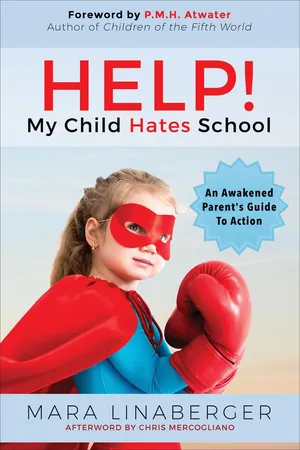
A veteran educator tackles the many difficulties kids face in school—from bullying to lack of motivation—with strategies to help your child love learning.
Is your child depressed, unmotivated, resentful, or angry when it's time to go to school each morning? Does your child come home with stories of being bullied or made fun of? Does your child possess unusual talents that go unrecognized at school?or, worse, is he or she seen as strange by teachers or peers?
If you answered yes to any of these questions, help has arrived.
HELP
! My Child Hates School cuts to the root of your child's school issues and shows you practical ways to turn the situation around, getting your child out of misery and back to thriving. Along the way, Mara Linaberger, an educational innovator with more than twenty-five years of experience, will share stories, tips, and tricks to help instill a love for learning in your child!
If your child can't last another day in school, and you've had it with the fighting, crying, and coercing,
HELP! My Child Hates School is for you.
- 163 pages
- English
- ePUB (mobile friendly)
- Available on iOS & Android
eBook - ePub
About this book
Information
Subtopic
Education Theory & PracticeChapter 1
Where’s the Magic?
“And above all, watch with glittering eyes the whole world around you because the greatest secrets are always hidden in the most unlikely places. Those who don’t believe in magic will never find it.”
As I began writing this book, I thought back to my days in school to see if there was some connection between my passion for educational alternatives and the trajectory of my career path. I’ve learned lots about myself and following the magic, choosing to do what feels good versus what is expected. I found that I’ve actually been preparing to write this book for a very long time. I wondered if there was some additional deep reason I feel called to help parents navigate school issues with their children at this particular point in my life. Indeed there is a pattern.
My story is pretty typical, as far as an idyllic childhood in the 70s and 80s is concerned. I was born to two parents who had both attended college. I lived with them, my two sisters, and my maternal grandmother in her house. It was a traditional, colonial brick home on one acre of land where we had gardens, fruit trees, and lots of freedom. We also had extended family living next door and the other set of grandparents living close by.
I was a decent student, earning mostly As and Bs with the occasional C, usually in math or social studies. I played Suzuki violin, sang in the church choir from second grade onward, rode bikes, played in the sandbox or on the tire swing, and chose Legos or Play-Doh when I had to be inside. Recently I dug out the report cards my mother had saved for me, wondering if they’d shed any light upon my experiences at school. In the margins I noticed a lot of absences, and scattered comments about my need for improvement in the areas of taking constructive criticism and following directions. This was my first reminder of my own challenges with school.
I was fascinated to note that the other mementos of childhood school years my mother kept for me had less to do with school and more to do with extracurricular activities. There were programs from various church productions and from Suzuki violin recitals. And there were handmade playbills from the original dramatic productions my sisters and I put on for family on the Fourth of July with our cousins from Chicago.
This trip back in time clarified for me that when it came to school, I didn’t always apply myself deeply in mastering the content teachers presented. I was often bored, engaging in my own fun by chatting with the other students nearby. As a handwritten comment on my report card pointed out in fifth grade, “Your work is good, but it could be so much better if you focused. Pay attention!” At the time I found these remarks confusing. Having been seated in groups, I found it difficult to limit my conversations with classmates to only those times deemed appropriate by the teacher.
Does this sound familiar? Are there any similarities to the comments made about you as a child or to your child?
As a kid I knew that I wanted to do what I wanted to do, when I wanted to do it. I’m pretty much the same gal today. Back then, when I voiced my desires with that simple clarity, most adults responded with something like, “Don’t be silly, that’s selfish.” Others said, “You’re too strong-willed, you need to learn to fit in.” And I listened. Sigh. I tried my best to conform, but it was hard and I often fought back unconsciously. I ended up having lots of anxiety about complying with what I was being asked to do while trying to remain true to myself. At some point I gave up, as so many of us do, and conformed as often as I could to get through childhood and adolescence. It wasn’t until college that I began to reawaken, exploring my own inner urgings, creating a path I loved.
When you think back, what do you remember about school? Is there a pattern to your memories? I recall very little of the specifics around school days, and almost nothing about what I was directly taught. Most of my memories revolve around things that felt good, magical. For instance, I remember my third-grade teacher who read The Last of the Really Great Whangdoodles after lunch every day, and the fifth-grade teacher who helped us put on two plays: “Mr. Grumpy’s Toyshop” and “The Saga of Dead Dog Gulch.” I recall the middle-school science teacher who bought a pigeon and a fetal pig when a classmate and I asked to do more investigations in animal dissection. (Ick, what was I thinking!) What my memories have in common is that they center around teachers who fed my imagination and who created space and validity for me to explore the things that I loved the most.
Whether we realize it or not, what we value the most, we make time for. The teachers I remember with fondness are those who made time for the things that I loved. They are the ones that encouraged my curiosity. They validated the importance of literature, arts, and hands-on exploration, and the things that brought learning to life. What kinds of learning do you value most? How about your child?
When I hit college, it was the small class sizes and the freedom to choose my own coursework that really jazzed me up. I tried on English, then Information Science, and finally settled on Psychology as my major. I found my way in to education as a career by completing a master of arts in teaching the year after graduation. I’d been babysitting for my advisor and she suggested the career path based on my deep connection to and natural talent with her own children.
Amazingly, fun followed me into the arena of work, though I couldn’t always see it at the very beginning. Three long years as a day-to-day substitute teacher in the inner city schools nearly crushed my desire to teach. But eventually a long-term sub position led to my first contract as a kindergarten teacher. I began teaching in two buildings, finally landing permanently in a single building after commuting at noon every day. Amazingly, my first full-time classroom position was in the same building and classroom in which my maternal grandmother had taught music in forty years earlier. How’s that for following the magic!
The building I taught in for over 17 years started out as a traditional academy magnet, a school choice alternative for families that focused on classical academics and required kids to wear uniforms. Because of a lottery system and requirements for racial balance, my classes were rich and diverse. A few years in, we morphed into an arts and humanities magnet, infusing our school with rich visual arts, music, dance, and theater opportunities. It was a glorious place to be. Most days it didn’t feel like work at all, it was more like being paid to explore and learn alongside children all day.
What made working at this school extra special was the convergence of several key elements. We were led by a principal who was able to see the unique talents that each of us possessed and play to them. Bob was a master at helping each teacher find his or her gifts and at nurturing each teacher’s personal creativity. Under his tutelage, I had a chance to teach first grade and third grade, open a writing center, and run the new computer lab as a technology mentor. And he provided us with rich opportunities to expand our own learning in creative writing, advanced questioning techniques, and arts integration. What made Bob so special was that he saw us as individuals, not as mere cogs in the wheel or slaves to the system. It was an amazing opportunity to serve and learn with him.
Even with all the opportunities this special principal provided, I can still remember having my doubts about the direction education was heading. First came the seemingly impossible goals of the legislation known as “No Child Left Behind,” which demanded 100% proficiency from all students within a ten-year timeframe. Then came my seriously considering quitting. I had several students fail to learn to read, which required their retention in first grade. I felt like a failure. It was a caring colleague who urged me to look at how many kids had succeeded, and also to consider trying teaching at another grade level.
Sometimes I kept myself going by imagining working my way up in the system and making a difference as a leader. It was another colleague who suggested that I might make a great principal. When I looked at the work my principal was doing up close, it didn’t look like much fun to me! While I decided I wasn’t interested in leading a school, my colleague’s suggestion actually inspired me to do graduate work in instructional technology. Going back to grad school added to my skillset as a teacher, ultimately allowing me to morph myself into the trainer, mentor, and coach that I am today.
What I learned along the pathway of school to a career in education are guideposts and skills that I can share with you as a parent. Sure, I know lots about curriculum, standards, and assessments. I also know that they aren’t the most important part of learning. I’ve learned that honoring a student where and as they are in the moment is the first step to helping them develop a love of learning. As I said before, what we focus on is what is most important to us, so putting your child first is what’s most important when it comes to education.
In coming chapters, I’ll share ways to get to know your child deeply as a unique learner. You’ll learn how to help them recognize their own passions as a guide to direct their steps forward in life. I’ve personally learned how to identify and follow the magic and how to see endings as opportunities for new beginnings. And, perhaps most importantly, I’ve learned how to chart my own path as a life-long learner. Nowadays, I spend most of my time deeply engaged with content related to my clients and my own personal growth. I’ve written this book to assist you in helping your child develop this sort of life-long love affair with learning.
Chapter 2
What’s Wrong with School?
“Children learn what they live. Put kids in a class and they will live out their lives in an invisible cage, isolated from their chance at community; interrupt kids with bells and horns all the time and they will learn that nothing is important or worth finishing; ridicule them and they will retreat from human association; shame them and they will find a hundred ways to get even. The habits taught in large-scale organizations are deadly.”
Did Gatto’s words speak to you as they did to me the first time I read them? In what way? Does your child ever come home from school reporting that it feels isolating or prison-like, that it makes him feel worthless, or even inhuman? Do you want this sort of life for your child? If you’ve heard anything like this from your child, you’ve likely become jaded, frustrated, or even angry about school.
Anger is a double edged sword; it is an emotion that can either annihilate or protect you. It’s a spiral, an emotion that can lead you downward into darkness, or inspire you upward into the light. Anger can be used to fuel your reactions to situations as they are or it can power positive action in working to change situations into what you imagine they might be. Feelings of frustration and anger about your child’s education can be useful – when harnessed as fuel for creating a positive outcome for your child.
Perhaps until this very moment, the feelings of anger have just been a source of frustration for you. Today’s the day that all that can change. As you get to know your child’s learning preferences deeply, and how to make a choice to fit your child needs (the fuel), we’ll create a spark to ignite that process for real.
In preparing to make changes for your child, I believe it’s important that you know the full truth about school, because the truth has the potential to set you free. We’ll talk about how to use your anger and frustration in a positive way, about how to channel the energy toward making a change for the better on behalf of your child. You’ll come face to face with your own fears and begin to ask what sort of life you want for your child and what sort of parent you want to be.
While you may also have a noble heart that wants to see change for all children, the best wisdom I can offer you is to begin small. Start at home with your own child. The opportunity and wisdom you’ll need to help others will come when you take care of your child’s needs first. It’s a lot like the preflight instruction lecture they give every time you board an airplane: You must put on your own oxygen mask before helping the person next to you.
So let’s begin by defining school, or at least resurrecting the image of school as most of us remember it. If you are a parent or guardian of a child, it is likely that you went to school for 12 years. And as a product of the system of school, have you ever wondered:
• Why school is the way it is?
• Why classrooms are set up as they are?
• Why children are legally required to go to public schools for 180 days?
• Why attendance is compulsory for grades 1-12?
• Why kids are grouped by age (into grades) for learning?
• Who chose the content (curriculum) that children must master?
• Who created the specific order of curriculum and why?
• Why testing has become so much more important than actual learning?
Perhaps you have a sneaking suspicion that some of the answers to these questions are not as noble as we have been led to believe. We’re going to tackle those questions and address some of your suspicions. You may feel a bit of annoyance and anger at some the answers, so we’ll keep coming back to the notion that you will be most effective if you use those sentiments as the spark to make a positive change for your child, versus allowing the thoughts to derail you into complaint, bitterness, or shutting down completely. We’ll uncover the truth so that you can fling open the cage door, setting you and your child free!
Step Back in Time
Whether you attended a public or private school, unless you were the product of tutoring, homeschooling or a progressive alternative, you know what school is like and how it works. Perhaps you remember a classroom where you sat in an individual desk while being directly instructed alongside 20 to 30 other kids your own age. You also may recall having a single teacher for all your subjects in the early grades, and then several subject area instructors as you moved into the upper grades.
Now think back to your fondest memories of school. Did they include PE, art, music, or recess? Were you a math or science lover? Perhaps you adored being read to by your teacher or the school’s librarian. Did you look forward to field trips, taking trumpet lessons, or participating in a school play? Perhaps you recall the school lunches your mother packed for you or a visit from local business people on career day.
Isn’t it interesting that for most of us, the most positive memories of school focus on things not directly related to learning specific curricular content?
Origins of School
The foundations of formalized education go back in the past a long way, prior to recorded history. For the purposes of our work together, however, we’ll trace the roots of school, as we know it today in 2017, back to the foundation of the United States.
Do you recall what you were taught about the beginnings of our country after the Revolutionary War? Did you know that the founding fathers of the United States envisioned education as a way to cultivate all minds (think of their constitutional proposition that all men are created equal) toward an enlightened intelligence? Based on prior experiences in Europe, they intended a move away from vocational education of the masses, which added to the societal divisions they sought to erase, toward an era of intellectual enlightenment.
Does learning dedicated to enlightenment sound like the kind of schooling you remember? What about the kind of education your child is currently receiving? Do you consider yourself or your child intellectually enlightened by the education you received in school? Probably not. So what changed?
Thomas Jefferson, one of the signers of the Declaration ...
Table of contents
- Cover
- Title
- Copyright
- Table of Contents
- Foreword
- Introduction
- Chapter 1: Where’s the Magic?
- Chapter 2: What’s Wrong with School?
- Chapter 3: Make It Stop Hurting!
- Chapter 4: Kids Are Different
- Chapter 5: Knowing Your Child
- Chapter 6: Identifying the Options
- Chapter 7: Making a Choice
- Chapter 8: Creating the Space
- Chapter 9: Getting Going!
- Conclusion
- Appendix: FEARS & FAQs
- Afterword
- Acknowledgements
- About the Author
- Thank You!
Trusted by 375,005 students
Access to over 1.5 million titles for a fair monthly price.
Study more efficiently using our study tools.
Frequently asked questions
Yes, you can cancel anytime from the Subscription tab in your account settings on the Perlego website. Your subscription will stay active until the end of your current billing period. Learn how to cancel your subscription
No, books cannot be downloaded as external files, such as PDFs, for use outside of Perlego. However, you can download books within the Perlego app for offline reading on mobile or tablet. Learn how to download books offline
Perlego offers two plans: Essential and Complete
- Essential is ideal for learners and professionals who enjoy exploring a wide range of subjects. Access the Essential Library with 800,000+ trusted titles and best-sellers across business, personal growth, and the humanities. Includes unlimited reading time and Standard Read Aloud voice.
- Complete: Perfect for advanced learners and researchers needing full, unrestricted access. Unlock 1.5M+ books across hundreds of subjects, including academic and specialized titles. The Complete Plan also includes advanced features like Premium Read Aloud and Research Assistant.
We are an online textbook subscription service, where you can get access to an entire online library for less than the price of a single book per month. With over 1.5 million books across 990+ topics, we’ve got you covered! Learn about our mission
Look out for the read-aloud symbol on your next book to see if you can listen to it. The read-aloud tool reads text aloud for you, highlighting the text as it is being read. You can pause it, speed it up and slow it down. Learn more about Read Aloud
Yes! You can use the Perlego app on both iOS and Android devices to read anytime, anywhere — even offline. Perfect for commutes or when you’re on the go.
Please note we cannot support devices running on iOS 13 and Android 7 or earlier. Learn more about using the app
Please note we cannot support devices running on iOS 13 and Android 7 or earlier. Learn more about using the app
Yes, you can access HELP! My Child Hates School by Mara Linaberger in PDF and/or ePUB format. We have over 1.5 million books available in our catalogue for you to explore.