Five Points
eBook - ePub

Five Points

The Nineteenth-Century New York City Neighborhood

  1. 544 pages
  2. English
  3. ePUB (mobile friendly)
  4. Available on iOS & Android
eBook - ePub

Five Points

The Nineteenth-Century New York City Neighborhood

About this book

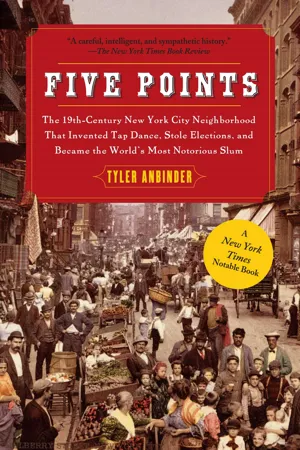
The very letters of the two words seem, as they are written, to redden with the blood-stains of unavenged crime. There is Murder in every syllable, and Want, Misery and Pestilence take startling form and crowd upon the imagination as the pen traces the words." So wrote a reporter about Five Points, the most infamous neighborhood in nineteenth-century America, the place where "slumming" was invented.All but forgotten today, Five Points was once renowned the world over. Its handful of streets in lower Manhattan featured America's most wretched poverty, shared by Irish, Jewish, German, Italian, Chinese, and African Americans. It was the scene of more riots, scams, saloons, brothels, and drunkenness than any other neighborhood in the new world. Yet it was also a font of creative energy, crammed full of cheap theaters and dance halls, prizefighters and machine politicians, and meeting halls for the political clubs that would come to dominate not just the city but an entire era in American politics. From Jacob Riis to Abraham Lincoln, Davy Crockett to Charles Dickens, Five Points both horrified and inspired everyone who saw it. The story that Anbinder tells is the classic tale of America's immigrant past, as successive waves of new arrivals fought for survival in a land that was as exciting as it was dangerous, as riotous as it was culturally rich. Tyler Anbinder offers the first-ever history of this now forgotten neighborhood, drawing on a wealth of research among letters and diaries, newspapers and bank records, police reports and archaeological digs. Beginning with the Irish potato-famine influx in the 1840s, and ending with the rise of Chinatown in the early twentieth century, he weaves unforgettable individual stories into a tapestry of tenements, work crews, leisure pursuits both licit and otherwise, and riots and political brawls that never seemed to let up. Although the intimate stories that fill Anbinder's narrative are heart-wrenching, they are perhaps not so shocking as they first appear. Almost all of us trace our roots to once humble stock. Five Points is, in short, a microcosm of America.
Frequently asked questions

Yes, you can cancel anytime from the Subscription tab in your account settings on the Perlego website. Your subscription will stay active until the end of your current billing period. Learn how to cancel your subscription.
At the moment all of our mobile-responsive ePub books are available to download via the app. Most of our PDFs are also available to download and we're working on making the final remaining ones downloadable now. Learn more here.
Perlego offers two plans: Essential and Complete
  • Essential is ideal for learners and professionals who enjoy exploring a wide range of subjects. Access the Essential Library with 800,000+ trusted titles and best-sellers across business, personal growth, and the humanities. Includes unlimited reading time and Standard Read Aloud voice.
  • Complete: Perfect for advanced learners and researchers needing full, unrestricted access. Unlock 1.4M+ books across hundreds of subjects, including academic and specialized titles. The Complete Plan also includes advanced features like Premium Read Aloud and Research Assistant.
Both plans are available with monthly, semester, or annual billing cycles.
We are an online textbook subscription service, where you can get access to an entire online library for less than the price of a single book per month. With over 1 million books across 1000+ topics, we’ve got you covered! Learn more here.
Look out for the read-aloud symbol on your next book to see if you can listen to it. The read-aloud tool reads text aloud for you, highlighting the text as it is being read. You can pause it, speed it up and slow it down. Learn more here.
Yes! You can use the Perlego app on both iOS or Android devices to read anytime, anywhere — even offline. Perfect for commutes or when you’re on the go.
Please note we cannot support devices running on iOS 13 and Android 7 or earlier. Learn more about using the app.
Yes, you can access Five Points by Tyler Anbinder in PDF and/or ePUB format, as well as other popular books in History & North American History. We have over one million books available in our catalogue for you to explore.

Information

1

diagram

PROLOGUE

THE FIVE POINTS RACE RIOT OF 1834
ON HIS WAY into the Laight Street Presbyterian Church on June 12, 1834, silk importer Lewis Tappan noticed a lone black man standing nervously outside the house of worship. Dozens of white parishioners stood by the doorway, chatting amiably among themselves, but casting suspicious glances at the man and then whispering to their friends. Incensed at the insensitivity of his fellow congregants, Tappan approached the man and recognized him as the Rev. Samuel E. Cornish, whom Tappan knew because both were active in the abolition movement. Cornish, who a few years earlier had co-edited the first African-American newspaper, had no congregation of his own. He had appeared at the door of the Laight Street Church that morning seeking a place for Sunday worship. Ignoring the looks of horror on the faces of the other parishioners, Tappan invited Cornish inside to attend the service and insisted that he sit in Tappan’s own pew toward the front of the church.
Tappan’s gesture was bound to create an uproar in 1830s New York, even within his relatively liberal congregation. Once inside, a number of parishioners complained loudly to Tappan and demanded that he never so embarrass them again. Observing the commotion, the church’s own minister, Samuel H. Cox, decided to make it the subject of his sermon that day. Condemning the intolerance of his parishioners, Cox told them that the peoples of the Holy Land were dark-skinned and would be considered “colored” by American standards. Jesus himself, Cox asserted, was therefore probably dark-skinned as well. Americans should thus have sympathy for all people of color.
In the press the next day, Tappan’s enemies seized upon Cox’s sermon as a means to discredit the entire anti-slavery movement. Reporting that Cox claimed Christ was black, anti-abolitionists wrote that such radical ravings proved that the abolitionists were “amalgamationists,” seeking intermarriage and social integration of blacks and whites. Two conservative journals, the Commercial Advertiser and the Courier and Enquirer, were especially vicious in their attacks, advocating violence to suppress abolitionism and the threat it posed to national unity.1
diagram
Coverage of the anti-abolition riot from the New York Transcript, July 14, 1834. Collection of the New-York Historical Society.
The incident at the Laight Street Church might not have had significant repercussions had not anti-abolitionists in general, and the Commercial Advertiser and the Courier and Enquirer in particular, been engaged in a long-running feud with Tappan and his brother and business partner Arthur, also an active abolitionist. The bad blood between the Tappans and the city’s conservative press dated back to 1832, when the brothers leased the Chatham Theater, located just south of Chatham Square at the fringe of the Five Points neighborhood, and converted it into a chapel for the famed evangelist Charles G. Finney. According to Finney, the Tappans had selected the location because it was “in the heart of the most irreligious population of New York. It was not far from the ‘five points,’ and was a place of resort highly discreditable to the city.” Although designated by its founders the Second Free Presbyterian Church because it charged no pew rent (in hopes of attracting the poor into the evangelical movement), the house of worship became universally known as the Chatham Street Chapel. Under the leadership of Finney and the Tappans, the chapel became a popular venue for abolitionist meetings.2
The movement to abolish slavery was still considered quite radical in 1830s New York. Most of those willing to admit that slavery was an evil did not support its immediate abolition, but instead promoted the colonization movement, which sought to send voluntarily emancipated slaves to Africa. The Tappans had once been active in the colonization movement, but around 1830 converted to the abolition cause. In order to discredit colonization, Lewis Tappan in May 1834 conducted a public interrogation of a man recently returned from Liberia, the African nation set up by American colonizationists. The man painted a picture of licentiousness, drunkenness, and sexual debauchery in the new African state. Embarrassed colonization advocates (especially the editors of the Commercial Advertiser and the Courier and Enquirer) responded with scathing attacks on the Tappans. But the Tappans remained determined to expose colonization as a subterfuge by which those who really hoped to protect slavery diverted attention and money from abolitionism.
The tensions between New York abolitionists and their adversaries had smoldered throughout early 1834. By early July, just a few weeks after Tappan had invited Samuel Cornish inside his church, they ignited into violence. And because both the Chatham Street Chapel and one of the city’s largest concentrations of blacks were located in or near Five Points, the neighborhood became the focus of much of the bloodshed. On Independence Day, an angry mob disrupted an abolitionist lecture at the Chatham Street Chapel. Outnumbered and intimidated, the opponents of slavery canceled their meeting. According to the Sun, the rioters then proceeded to City Hall Park “to act out their patriotism in knocking down the blacks . . . [and] commanding every man of color they met to leave the Park. . . . On seeing this Alderman [James] Ferris interfered, and the rioters knocked him down also.” Police eventually dispersed the mob and arrested six rioters.3
Three days later, violence erupted again as a group of African Americans gathered at the Chatham Street Chapel to celebrate the anniversary of the abolition of slavery in New York. When some members of the New York Sacred Music Society arrived for practice, not knowing that it had been canceled, they brusquely ordered the assembled blacks to leave. An argument flared, and the ensuing scuffle degenerated into a brawl that was “waged with considerable violence on both sides, and resulted in the usual number of broken heads and benches.”4
When the Courier and Enquirer announced inaccurately on Wednesday, the ninth, that another anti-slavery meeting would take place at the chapel that evening, anti-abolitionists mobbed it once again. Finding the church closed, they broke in and held a meeting of their own. Led by George “Legs” Williamson (“a most desperate character [who] would cut and shoot when in a tight place”), the crowd then stormed Lewis Tappan’s house at 40 Rose Street. Tappan and his family had gone to Harlem to escape the summer heat, so were not hurt by the flying glass when the rioters smashed some windows. The rioters’ next target was Five Points’ Bowery Theater, where the rioters forced the cast to abort a benefit performance for the playhouse’s English-born stage manager, who had supposedly made anti-American remarks. Still burning with resentment, the mob returned to Tappan’s house, broke in, smashed the crockery, tore down the blinds, and removed and burned all the furniture. Future Vice President Schuyler Colfax, then a boy of twelve, visited the scene the next day and later said that his disgust at the wanton destruction helped convince him to support the anti-slavery cause.5
On the following evening, Thursday, July 10, mobs seemed to be everywhere—at Tappan’s house again, at his store on Pearl Street, at Reverend Cox’s house, and at the Bowery Theater, among other places. And on the evening of the eleventh, the rioting degenerated into a full-scale racial pogrom, as crowds attacked African-American homes, businesses, and churches throughout the Five Points area. This time, the violence began at the Tappan store, where a mob of more than one hundred overwhelmed fifteen security guards and broke the shop’s windows. The rioters moved up Pearl Street to Five Points, where they attacked two or three houses on Mulberry Street just north of Chatham Square. Word soon spread throughout the neighborhood that the rioters wanted Five Points whites “to exhibit lights in the windows,” so the mob would know which houses not to attack. Meanwhile, most of the rioters moved northwest to the block of Orange Street just north of the Five Points intersection, where many Five Points blacks lived. There the mob attacked the African-American Mutual Relief Hall at 42 Orange Street, breaking all the windows and tearing down the sign. Around the corner at African-American John Rolloson’s porterhouse at 157 Leonard Street, “the mob rushed in, tore down his bar, threw his kegs of liquor into the streets, and carried them off, broke all the decanters and glasses, and carried off a clock and what money was in the drawer.” Rioters went upstairs and took almost two hundred dollars “in silver, 4 valuable watches, a set of silver spoons and jewelry to the amount of $100,—then destroyed the furniture in the basement,” until they were driven away by the “watch.” Still not satisfied, the mob crossed the street and burned all the furniture at 156 Leonard Street, including that of African-American Maria Willis, who “was robbed of everything she had in all the world.” The poor woman, who had four children and was pregnant with a fifth, had been widowed just two weeks earlier.6
Back on Orange Street, still other rioters were smashing doors and windows near the Five Points intersection. According to the account in the New York Transcript, “they were about to pull down the Arcade,” a saloon at 33 Orange, and the Swimming Bath bawdy house at 40 Orange, when a street inspector named McGrath “addressed them, and assured them that every negro should be out . . . by twelve o’clock the next day; they then gave three cheers, shook hands with the officer, and left . . . without disturbing a plank.” Moving north, the rioters attacked 56 and 561/2 Orange, where they “broke all the windows [and] furniture, abused the inmates, and carried off property to the amount of $100.” Next, they stormed Thomas Mooney’s barbershop at 87 Orange. But Mooney, armed in preparation for the onslaught, fired three times at the mob, injuring one person and convincing the rest to spare his business. The rioters then moved westward. They attacked St. Philip’s African Episcopal Church on Centre Street around 11:00 p.m. “and demolished it almost entirely, including a fine organ.” Up and down Centre Street the crowd attacked the homes of African Americans, smashing windowpanes and wrecking furniture. From some residences the mob even “took the clothes of gentlemen, which the colored people had taken in to wash.” Finally, the mob arrived at Anthony Street and broke the windows of the African Baptist church and a few other buildings, including those of the porterhouse operated by African-American Robert Williams. In anticipation of the violence, Williams had closed his saloon that afternoon and moved his valuables, “as did several other black families whose dwellings were attacked.” Only after venting their rage at virtually every manifestation of African-American life in the neighborhood did the rioters disperse.7
In terms of wanton destructiveness, the Five Points anti-abolition riot was the most devastating in New York history to that point. “In thirty years’ acquaintance with the city,” insisted the Post, “nothing has ever happened to compare with it.” Surveying the damage in the riot’s aftermath, the Sun remarked that it appeared “as if the angel of destruction had swept his bosom over the land.” Many black Five Pointers were “seriously wounded,” and the casualty list would have been longer had many more not fled the city altogether. The riot left the Five Points African-American community devastated, both physically and emotionally. “It is enough to sicken the heart of every one not destitute of humanity,” commented the Sun, “to see weeping fathers and mothers sobbing over the ruins of all they possessed, the effects of years of toil, with their little children around them crying for bread.”8
What had motivated this tremendous outpouring of hatred? On one level, the mob undoubtedly sought to emphasize its opposition to the abolition movement and its implied message that blacks were the equals of whites. Yet the breadth and intensity of the attack against black Five Pointers indicate that members of the crowd, either consciously or unconsciously, harbored some deeper resentments. Signs of African-American economic independence clearly galled them, for while the black-occupied hovels of a particularly decrepit alley known as “Cow Bay” were left untouched, the few black-owned businesses in the neighborhood were devastated. Finally, by literally tearing the roofs off black-occupied buildings, the mob sent perhaps its most emphatic and unmistakable message. The rioters sought not merely to injure black-owned or -occupied property, but to make their homes and businesses permanently uninhabitable.9
The Five Points anti-abolition riots were not isolated incidents of violence in an otherwise peaceful community. In 1834 and 1835 alone, two other significant riots would rock the neighborhood. The scope, ferocity, and deadliness of these three episodes of unrest were unprecedented, not merely for Five Points but for the entire city. They revealed racial, ethnic, and religious fault lines that New Yorkers had previously recognized but preferred to ignore. Over the next sixty-five years, Five Pointers would often find themselves at the epicenter of these struggles—ones that would help shape modern New York.

CHAPTER ONE

The Making of Five Points
diagram
FIVE POINTS, the lower Manhattan neighborhood named for the five-cornered intersection of Anthony, Orange, and Cross Streets, was originally verdant and bucolic, like everything else in America. A five-acre lake known as “the Collect” was its defining landmark. Just northeast of the Collect, Bunker Hill rose more than a hundred feet, providing picnickers with breathtaking views of both the wildlife that gathered at the Collect’s shores and the expanding city to the south. But as New York spread northward, the Collect area became a favorite site for the city’s most noisome industries. Slaughterhouses, banned from inhabited areas, clustered just east of the lake on what is now Bayard Street. By the mid-1700s, it was the only place in the city where one could lawfully kill livestock. Here meatpackers could butcher their ...

Table of contents

  1. Cover
  2. Description
  3. About Tyler Anbinder
  4. Title Page
  5. Dedication
  6. Copyright Page
  7. Contents
  8. Introduction
  9. Prologue 1: The Five Points Race Riot of 1834
  10. Chapter One: The Making of Five Points
  11. Prologue 2: Nelly Holland Comes to Five Points
  12. Chapter Two: Why They Came
  13. Prologue 3: “The Wickedest House on the Wickedest Street That Ever Existed”
  14. Chapter Three: How They Lived
  15. Prologue 4: The Saga of Johnny Morrow, The Street Peddler
  16. Chapter Four: How They Worked
  17. Prologue 5: “We Will Dirk Every Mother’s Son of You!”
  18. Chapter Five: Politics
  19. Prologue 6: “This Phenomenon, ‘Juba’”
  20. Chapter Six: Play
  21. Prologue 7: The Bare-Knuckle Prizefight Between Yankee Sullivan and Tom Hyer
  22. Chapter Seven: Vice and Crime
  23. Prologue 8: “I Shall Never Forget This as Long as I Live”: Abraham Lincoln Visits Five Points
  24. Chapter Eight: Religion and Reform
  25. Prologue 9: “HE NEVER KNEW WHEN HE WAS BEATEN”
  26. Chapter Nine: Riot
  27. Prologue 10: “The Boy Who Commands That Pretty Lot Recruited Them for the Seceshes”
  28. Chapter Ten: The Civil War and the End of an Era
  29. Prologue 11: “So It Was Settled That I Should go to America”
  30. Chapter Eleven: The Remaking of a Slum
  31. Prologue 12: “These ‘Slaves of the Harp’”
  32. Chapter Twelve: Italians
  33. Prologue 13: “The Chinese Devil Man”
  34. Chapter Thirteen: Chinatown
  35. Chapter 14: The End of Five Points
  36. Notes
  37. Select Bibliography
  38. Acknowledgments
  39. Index
  40. Endnotes