- 272 pages
- English
- ePUB (mobile friendly)
- Available on iOS & Android
eBook - ePub
Information
Topic
Personal DevelopmentSubtopic
Business CommunicationMANAGEMENT PRINCIPLES AND PRACTICES
On Running a Business to Win
Being a boss is one thing, and managing your career another. But business cannot move forward without certain principles and practices in place.
Right—but which ones? That’s the general question that the answers in this chapter grapple with. Grapple, because certain principles, such as candor and differentiation, and certain practices, such as strategy, budgeting, and HR, are controversial, to say the least. Take candor. We haven’t visited a country (including the United States) where people haven’t challenged its “appropriateness,” not to mention its practicality. But every aspect of management, as the following pages show, can be open to debate. And they should be; that’s how companies get better.
23
GETTING THE BEST PEOPLE
In your experience, what are the three most critical factors to put in place to turn a company into a “preferred employer” on a sustained basis? And what’s a realistic time frame for getting there?
—CHICAGO, ILLINOIS
You ask for three factors—but you really need twice that many “gold stars” to earn the grand prize of being a preferred employer. And it is a grand prize, because when you build a company where people really want to work, you’ve got your hands on one of the most powerful competitive advantages in the game, the ability to hire and field the best team.
But before we give you our six ways to arrive at that fortunate place, a reply to your question about how long the preferred employer process takes.
The answer is easily years, and it can be decades or more. That’s just the way it is with corporate reputations—they’re built annual report by annual report, career story by career story, crisis by crisis (because every company has one or two of them), and recovery by recovery. It probably took IBM about thirty years to earn its gold-standard reputation in the ’70s, less than a decade to lose it when the company stumbled, and then about a decade more to rebuild it to where it is today.
In today’s media-saturated world, however, there is a major exception to the generally slow pace of reputation building. Companies can become preferred employers virtually overnight thanks to a “buzz factor,” which is as potent as it is fast acting. In a technology-based company, buzz usually comes with an exciting breakthrough or otherwise paradigm-altering new product or service. Google, eBay, and Apple are perfect examples. Buzz, however, can also come from having a glamorous or prestigious brand, like Chanel or Ferrari.
But the buzz factor is as rare as it is precarious. Apple had it with the Mac, lost it when other PC manufacturers leapfrogged them, then recaptured it (plus some) with the iPod. This entirely common story explains why most companies have to become a preferred employer the old-fashioned way, grinding it out over time.
Here’s a checklist to assess your company’s progress.
First, preferred employers demonstrate a real commitment to continuous learning. No lip service. These companies invest in the development of their people with classes, training programs, and off-site experiences, all sending the message that the organization is eager to facilitate a steady path to personal growth.
Second, preferred employers are meritocracies. Pay and promotions are tightly linked to performance, and rigorous appraisal systems consistently let people know where they stand. As at every company, whom you know and where you went to school might help get you in the door at a meritocracy. But after that, it’s all about results. Now, why does all this make a company a preferred employer? Very simply, because people with brains, self-confidence, and competitive spirit are always attracted to such environments.
Third, preferred employers not only allow people to take risks, they celebrate those who do, and don’t shoot those who fail trying. As with meritocracies, a culture of risk taking attracts exactly the kind of creative and bold individuals that companies want and need in a global marketplace where innovation is the single best defense against unrelenting cost competition.
Next, preferred employers understand that what is good for society is also good for business. Gender, race, and nationality are never limitations; everyone’s ideas matter. Preferred employers are diverse and global in their outlook and environmentally sensitive in their practices. They offer flexibility in work schedules to those who earn it with performance. In a word, preferred companies are enlightened.
Fifth, preferred employers keep their hiring standards tight. They make candidates work hard, requiring an arduous interview process and strict criteria around intelligence and previous experience. Admittedly, this factor is somewhat of a catch-22, as it is difficult to be picky before you become an employer of choice! But it’s worth the effort, as talent has an uncanny way of attracting, well, talent.
Sixth and finally, preferred companies are profitable and growing. A rising stock price is a real hiring magnet. Beyond that, though, only thriving companies can promise you a future, with career mobility and the potential of increased financial reward. Indeed, one of the most intoxicating things a company can say to a potential employee is, “Join us for the ride of your life.”
As we said at the outset, the best thing about being a preferred employer is that it gets you good people—and that launches a virtuous cycle. The best team attracts the best team, and winning often leads to more winning.
That’s a ride that you and your employees will never want to get off.
24
THE FIGHT AGAINST PHONINESS
Even though my company is in a very competitive industry and we need to move fast and decisively, I’ve noticed that people rarely say what they mean to each other—particularly in meetings. There’s just so much beating around the bush and general phoniness. I’m just a middle manager. What can I do?
—PHOENIX, ARIZONA
What you describe is one of the most common and destructive problems in business, and in society, for that matter—the lack of candor. No matter where we travel, we hear about organizations that are slowed down and gummed up by the very human tendency to soften hard, urgent messages with false kindness or phony optimism. This tendency is particularly prevalent when it comes to communicating about poor performance. Very often, bosses don’t come right out and tell underperformers how badly they are doing until, in a burst of frustration, they fire them. That’s terribly unfair to the person at the receiving end and often very disruptive to the business itself.
But lack of candor doesn’t just pervade performance evaluations. It cripples lots of conversations, many about how and when and where to spend scarce company resources. Yes, these kinds of conversations can be sensitive, politically loaded, or complex, or all of the above. But they’ll simply be better if they’re candid.
So, what can you do? The only option we know of is having the guts to start using candor yourself, even if you have limited power in the organization. When people use double-talk, push back with questions that cut through the nonsense and probe for reality. Ask, “What are you really trying to tell us?” or say, “What I hear you saying is…” and deliver the straight message yourself for confirmation.
Introducing candor to an organization, of course, is not without risk. In fact, it can be a total shock to the system, and being the first one to use it can get you killed, that is, marginalized or thrown out. But should you decide to get candid anyway, go slow and use humor when possible. In the best-case scenario, your candor will eventually be rewarded with candor in return—and sometimes the change is faster than you would imagine. As soon as many people experience candor, they can’t understand how they ever did business without it.
25
THE LIMITS OF CANDOR—OR NOT
I’m a recent MBA who was just made a manager. I believe in using candor, but I’m afraid to, since most of my direct reports are twice my age.
—HUNTSVILLE, ALABAMA
You may feel squeamish using candor with people who look like your parents, but rest assured that “old people” hate jargon, ambiguity, and double-talk just as much as you do. In fact, having suffered through it at work for decades, they will most likely applaud your efforts to be straight, especially after the shock wears off.
Shock—because without doubt, there will be a rough period of adjustment once you start talking directly and honestly about performance and results. Most people—no matter what their age—just aren’t accustomed to it.
Use it anyway. In the end, candor always works, and it always makes work better. Once you dispense with mixed messages and phony performance reviews, a team never fails to become faster, more creative, and more energetic.
And frankly, candor is your job. In fact, once you become a manager, it’s your obligation to let everyone who works for you know exactly where they stand. That’s how you build the best team—and win.
Your question, by the way, is by no means unusual. We’ve heard every possible excuse for avoiding candor—it goes against politeness in Japan, for instance, and egalitarianism in Sweden. But by far, the age issue you raise is the most common reason for discomfort.
Let go of it. Some “old folks” might object at first, but the good ones have been waiting longer than you think for straight talk to arrive.
26
THE CASE FOR DIFFERENTIATION…EVEN IN SWEDEN
You have long advocated a management approach called “differentiation”—promoting the top 20 percent of performers in a company, developing the middle 70, and letting go of the bottom 10. But how can your method be applied in Sweden, where it is not really possible to fire someone who is underachieving?
—GÖTEBORG, SWEDEN
You ask about Sweden, but we’ve heard this question in dozens of countries, from Germany to Japan to Mexico. We’ve even heard it in the United States, with its relatively flexible labor laws. There, people ask the variation, “How can I apply differentiation in my company? We never fire anyone—we can’t.”
It’s just not true. Differentiation can be applied anywhere—if it’s done right. Yes, there are always people who claim at the outset that the system won’t work in their culture, but over time, they come to see how differentiation not only helps employees improve their lives, it changes the competitive game. And they come to understand how differentiation isn’t at odds with any particular national character or set of labor laws. In fact, quite the contrary.
Look, differentiation raises hackles, as you mention, because of its firing component. The irony is, once the system is in place, it hardly ever ends up with managers terminating anyone. That’s because differentiation forces companies to implement regular, candid performance appraisals so that a 20-70-10 curve can be established. When people are told during these appraisals that they are in the bottom 10 percent, they usually move along of their own accord, more often than not finding jobs that fit them better. Almost no one wants to stay where they are at the bottom of the barrel.
Meanwhile, the rest of differentiation does its powerf...
Table of contents
- Cover
- Title Page
- CONTENTS
- INTRODUCTION
- GLOBAL COMPETITION
- LEADERSHIP
- MANAGEMENT PRINCIPLES AND PRACTICES
- CAREERS
- PRIVATELY HELD
- WINNING AND LOSING
- About the Authors
- Credits
- Books by Jack & Suzy Welch
- Copyright
Trusted by 375,005 students
Access to over 1.5 million titles for a fair monthly price.
Study more efficiently using our study tools.
Frequently asked questions
Yes, you can cancel anytime from the Subscription tab in your account settings on the Perlego website. Your subscription will stay active until the end of your current billing period. Learn how to cancel your subscription
No, books cannot be downloaded as external files, such as PDFs, for use outside of Perlego. However, you can download books within the Perlego app for offline reading on mobile or tablet. Learn how to download books offline
Perlego offers two plans: Essential and Complete
- Essential is ideal for learners and professionals who enjoy exploring a wide range of subjects. Access the Essential Library with 800,000+ trusted titles and best-sellers across business, personal growth, and the humanities. Includes unlimited reading time and Standard Read Aloud voice.
- Complete: Perfect for advanced learners and researchers needing full, unrestricted access. Unlock 1.5M+ books across hundreds of subjects, including academic and specialized titles. The Complete Plan also includes advanced features like Premium Read Aloud and Research Assistant.
We are an online textbook subscription service, where you can get access to an entire online library for less than the price of a single book per month. With over 1.5 million books across 990+ topics, we’ve got you covered! Learn about our mission
Look out for the read-aloud symbol on your next book to see if you can listen to it. The read-aloud tool reads text aloud for you, highlighting the text as it is being read. You can pause it, speed it up and slow it down. Learn more about Read Aloud
Yes! You can use the Perlego app on both iOS and Android devices to read anytime, anywhere — even offline. Perfect for commutes or when you’re on the go.
Please note we cannot support devices running on iOS 13 and Android 7 or earlier. Learn more about using the app
Please note we cannot support devices running on iOS 13 and Android 7 or earlier. Learn more about using the app
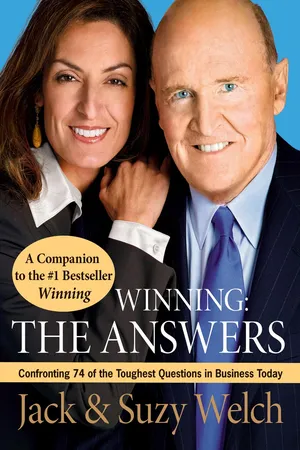
Yes, you can access Winning: The Answers by Jack Welch,Suzy Welch in PDF and/or ePUB format, as well as other popular books in Personal Development & Business Communication. We have over 1.5 million books available in our catalogue for you to explore.