The national bestselling author of
Never Play It Safe shows you how to forge your own success and fulfillment through the power of creativity.
Creativity is a force inside every person that, when unleashed, transforms our lives and infuses everything we do with vitality. In fact, as Chase Jarvis demonstrates here, stablishing a creative practice is as important to our well-being as exercise or nutrition.
A renowned artist, author, and CreativeLive founder, Jarvis reminds us that creativity isn't a skill—it's a habit available to everyone: beginners and lifelong creators, entrepreneurs to executives, astronauts to zookeepers, and everyone in between. Through small, daily actions we can supercharge our innate creativity and rediscover our personal power.
Whether your ambition is a creative career, completing a creative project, or simply cultivating a creative mindset,
Creative Calling will help unlock your potential via Jarvis's memorable "IDEA" system:
· Imagine your big dream, whatever you want to create—or become—in this world.
· Design a daily practice that supports that dream—and a life of expression and transformation.
· Execute on your ambitious plans and make your vision real.
· Amplify your impact through a supportive community you'll learn to grow and nurture.
** A
Wall Street Journal, Los Angeles Times and Publishers Weekly Bestseller **
eBook - ePub
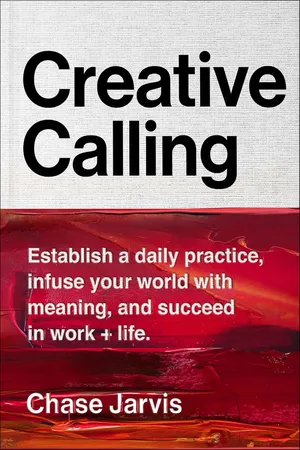
Creative Calling
Establish a Daily Practice, Infuse Your World with Meaning, and Succeed in Work + Life
- 304 pages
- English
- ePUB (mobile friendly)
- Available on iOS & Android
eBook - ePub
Creative Calling
Establish a Daily Practice, Infuse Your World with Meaning, and Succeed in Work + Life
About this book
Information
Topic
Crescita personaleSubtopic
Cultura aziendaleStep II
Design
Design a strategy to make your dream a new reality.
4
Develop Your Systems
Our goals can only be reached through a vehicle of a plan, in which we must fervently believe, and upon which we must vigorously act. There’s no other route to success.
—PABLO PICASSO
If creativity is connecting unlikely ideas in novel ways, following a structured approach to it can feel contradictory or even counterproductive. You can’t put borders around spontaneity! Making an actual plan for how you’re going to be creative can feel just plain wrong. But by developing basic strategies, systems, and frameworks to support your output, you’ll relieve yourself of the burden of waiting around for lightning to strike. In the process, you’ll become much more effective. Trust me—I wish I’d learned this sooner.
Throughout my childhood I had more guidelines than I could handle on what to do and how to do it. Nothing unreasonable by itself, but I always had a curfew, a slew of daily chores, and a laundry list of rules to follow around the house: keep the heat at 62 degrees even in the dead of winter, put dirty dishes in the dishwasher a particular way, set the table just so—you get the picture. My parents are lovely, and they are fastidious.
The same held true with the team sports I played. Football and soccer each came with plenty of rules. So did academia, of course, all the way through graduate school. Though I appreciated the consistency those boundaries provided, many of the rules struck me as arbitrary, unnecessary, or designed solely in the interests of someone else’s convenience. I rarely saw them as providing any value for me. Ultimately, I began to see all rules, rituals, and systems as little more than disguised mechanisms of control and oppression.
Fast-forward a few years, and—naturally—this disdain for structure and frameworks hindered my early creative career. You can’t program creativity, I thought. It should be spontaneous; I’d work only when I felt inspired by magical forces from above and do whatever I wanted with the rest of my time. Creativity wasn’t about discipline—it was about freedom, right?
Looking back at that undeveloped view of creativity, it’s obvious to me that my beliefs were informed by the dominant cultural narrative around artists as wild mystics, people who go off into the woods or a loft in Soho or some other sacred place and return with a finished masterpiece—somehow. In reality, this romantic myth has next to nothing in common with the true working methods of professionals in any field, especially the creative ones.
Today I know what gets results: establishing a consistent creative practice and sticking to it. Building even a basic framework for creative work will save you a lot of disappointment and put you on the fast track to the success you seek.
The Power of Consistent Action
After flunking out of college in Georgia, Brandon Stanton moved to Chicago, where a friend in finance helped him land a job as a bond trader. Finance wasn’t an area of passion for Stanton, but he was thrilled to be making real money in a respectable position—it felt good to be able to show friends and family that he was making something of himself. So good, in fact, that he became obsessed with the job. He grew emotionally dependent on the identity it gave him and the lifestyle it made possible. He started working nonstop, spending every waking minute thinking about the markets.
Though his day job took up most of his time and all of his attention, Stanton occasionally took a few minutes to photograph urban landscapes or capture portraits of strangers while riding Chicago public transit. It was a form of pressure relief, an opportunity to spend a moment of his day not thinking about money. But he told himself not to get distracted by the pretty pictures. Photography might have been more interesting to him than fixed-income securities, but his own security came first. If everything went according to plan, he’d make a fortune trading bonds. Once he’d signaled his success to the world—and insulated himself from financial peril—he’d be free to pursue his real passion.
That belief kept him going for two years. Then he was fired. Leaving the building that day and returning to the streets of Chicago, he had an epiphany. After two years spent obsessing over money, a subject of no personal interest whatsoever, his mind was suddenly empty. He could fill it with anything he wanted. Likewise his time—he could go wherever and do whatever he wanted. The sense of freedom that inspired in him was intoxicating. He never wanted it to end.
It was then that Stanton made a bold decision, but one that would eventually create value for millions of people around the world. He made it his goal from that moment forward to spend his time doing what brought him joy. He was tired of promising himself that he would get to be creative and live the life he wanted to live “one day,” once he’d built a financial buffer. Instead, he’d begin living the life he wanted then and there, fresh out of a job and with no buffer at all.
He struck on the idea of a photo project: taking street portraits of ten thousand New Yorkers. To fund the trip, he sold landscape photos to his friends. Upon arrival in New York City, he slept on a mattress on the floor of a sublet apartment in Bedford-Stuyvesant, Brooklyn. Comfort and security took a back seat. He had work to do.
If you’re familiar with the photo blog Humans of New York, you’ll barely recognize the first images on the site. There were no likes and no comments. The photos didn’t even have captions. After spending a couple of months posting portraits every day, all for a following numbering well under a thousand, something crucial happened. Feeling stymied with only one lackluster portrait in the queue for that day, Stanton remembered something the subject, a woman wearing green, had said to him: “I used to go through different stages. But then I found that I was happiest when I was green, so I’ve been green for 15 years.” He decided to post that caption with the photo. It became the most engaged-with photo he’d ever posted. Following his intuition this way, Stanton stumbled on the missing piece of the formula: the story. He’d already lost any fear about approaching strangers after months of daily practice, so he simply started talking to his subjects about their lives and condensing what he learned into a caption below each image.
Early social media traction led to interest from a literary agent and a book deal. Today, Stanton has more than 20 million followers, multiple best-selling books, and a video series on Facebook Watch. Beyond achieving more wealth than he’d ever hoped for as a bond trader, Stanton has also raised millions of dollars for charities around the world. Through the structure of a daily practice, a willingness to embrace hard work and risk, and a readiness to follow his intuition, he has become one of the best-known and most prolific living photographers.
How did he start? First, he decided to believe that he could change his own situation through creativity. Next, he identified as a photographer, a creator. Finally, he took regular, consistent action toward his goal. The simple but intentional act of heading out in the morning with his camera created all his staggering momentum. Small daily actions, outsized results.
Accept These Truths
This chapter kicks off the Design section of the book. These three chapters will help you develop a creative mindset and establish a set of habits to shape your work and your life. Before we get into specific tactics, however, I’d ask you to consider the following principles.
Your Mindset Matters Most
As the philosopher and Roman emperor Marcus Aurelius said, “The happiness of your life depends on the quality of your thoughts.” As true today as in Roman times. The state of your mind, body, and spirit is the direct result of all the decisions you’ve made in your life up until this moment. Physical health, cognitive performance, happiness, and well-being—these are driven almost entirely by our beliefs and behaviors. Day after day, choosing to exercise or watch Netflix, pull an all-nighter or get some sleep, eat clean or binge on mint chocolate-chip ice cream—all these decisions create our days, and our days create our lives as a whole. Each of us faces unique physical and mental challenges, but no matter what hand you’ve been dealt, your mindset makes a massive difference.
To achieve a new mindset and transform your life, you have to believe two things: Your situation—whatever it is—is changeable for the better; and you are capable of making that change happen.
What needs to change? How can you design your best life? To help you figure that out, I’ll share a few key ideas and some proven practices. You can experiment with these to find out what works best for you and then design an approach according to your ideal mode of being and doing.
The Benefits of Quitting
If the elation and joy we experience when we’re doing what we love feed us, it only follows that being out of alignment with our authenticity drains the vital energy required to make and share creative work.
Once upon a time, trying to be something I wasn’t took a major toll on me. A professor from my philosophy PhD program once called me an “armchair sociologist”—the kind of insult you hear only in grad school—simply because I wanted to engage with ideas in the living world around us, not just parse Aristotle and Plato all day.
My feelings weren’t hurt. He was only telling me what I already knew deep inside: that I was just going to school because I was afraid to chase my real dreams and that I didn’t care enough about grad school to do work that was anything more than superficial. I left the university not long after. Little did I know at the time that I was developing a rare but powerful tool: quitting stuff I wasn’t meant to do. This is a tool you must wield to create the life you want.
Though deciding to quit was a difficult decision, quitting itself felt good. I soon realized that grad school had taught me as valuable a set of lessons as any I’d learned in Europe. Through just a few pivotal experiences, I’d been given a master class in What Works for Chase. Designing my life from that point forward became much easier. By analyzing my unsuccessful experiences to identify what had drained me and held me back, I was able to make decisions that would steer me clear of those pitfalls moving forward.
Joy Is the Way
I know what you’re thinking. “Hey, Chase. Thanks for the nice stories, but I can’t quit grad school or move to a ski town, let alone fly off to Europe to teach myself photography.”
Not my intention. No vision quest necessary. What this is really about is listening to your gut and understanding the consequences of not following your intuition. The path is different for everybody. The important thing is to figure out what works for you and what doesn’t. Then do more of the good stuff and less of what turns you off. How very hedonistic, you might say. To that, I’d respond that far too many people these days die with the regret of not having done what they wanted for a career, let alone having lived the life of their dreams. Don’t let this happen to you.
Doing more of what you love doesn’t have to mean dashing off to Paris. You can have a lovely experience at the local museum or by paging through a coffee-table art book you purchased to provide a few moments of quiet inspiration now and then. If you once felt completely empowered in the peace and quiet of a spiritual retreat, try integrating some natural solitude into your day with a walk through a nearby park on the way to work. The goal is to cultivate activities that will resonate with you and bring you joy. By constructing a practical blueprint for what nourishes you—pursuing creative paths that brought you joy as a kid or writing in a journal before others in your household wake up, for example—you’ll give yourself the chance to see your life and your personal agency in new and powerful ways.
Your job is to figure out which behaviors feed your soul and which leave you running on empty. By the end of this chapter, you’ll have a set of habits and routines to fan your creative spark and accelerate your progress toward becoming the creator and human you want to be.
Building a Creative Mindset
In the previous chapter, we looked at creating a healthy relationship with risk by developing the distinction between real risk (losing your house when you quit your job without a plan) versus perceived risk (sharing your work on Instagram). Only by learning to overcome irrational risks—that don’t threaten anything but your ego—can you become your authentic self and begin to stand out as a creator.
A creative mindset is not only about managing downside risk; it’s also critical to use your mind to go on the offensive. How can you keep your mind open, happy, and positive? Because, let’s face it, the quality of your life is determined by what you think and feel.
Science tells us that positive thoughts are healthier—they makes us feel better and are tightly correlated with flow states and improved performance. We simply cannot ignore the role that mindset plays in creating everything we want for ourselves—whether a gorgeous illustration, a sonata, a thriving business, or the life we envision. I like to think of mindset as the ground floor, the bedrock. The wrong foundation crumbles quickly when loaded with challenges, and we become trapped in the rubble. The right foundation can support a rocket launch. The core principles of a stable creative mindset are:
You are a creative person.
The world is abundant and full of possibilities.
Your situation can always be changed.
You can use your creativity to create the change you seek.
Creativity is natural and healthy but requires practice.
Creativity is ultimate personal power.
Unfortunately, you can’t adopt a creative mindset just by reading this book. Repetition of corresponding actions is necessary to develop it. Changing ...
Table of contents
- Cover
- Title Page
- Dedication
- Contents
- Read This First!
- Introduction
- Step I: Imagine
- Step II: Design
- Step III: Execute
- Step IV: Amplify
- Read This Last
- Acknowledgments
- About the Author
- Praise
- Also by Chase Jarvis
- Copyright
- About the Publisher
Trusted by 375,005 students
Access to over 1.5 million titles for a fair monthly price.
Study more efficiently using our study tools.
Frequently asked questions
Yes, you can cancel anytime from the Subscription tab in your account settings on the Perlego website. Your subscription will stay active until the end of your current billing period. Learn how to cancel your subscription
No, books cannot be downloaded as external files, such as PDFs, for use outside of Perlego. However, you can download books within the Perlego app for offline reading on mobile or tablet. Learn how to download books offline
Perlego offers two plans: Essential and Complete
- Essential is ideal for learners and professionals who enjoy exploring a wide range of subjects. Access the Essential Library with 800,000+ trusted titles and best-sellers across business, personal growth, and the humanities. Includes unlimited reading time and Standard Read Aloud voice.
- Complete: Perfect for advanced learners and researchers needing full, unrestricted access. Unlock 1.5M+ books across hundreds of subjects, including academic and specialized titles. The Complete Plan also includes advanced features like Premium Read Aloud and Research Assistant.
We are an online textbook subscription service, where you can get access to an entire online library for less than the price of a single book per month. With over 1.5 million books across 990+ topics, we’ve got you covered! Learn about our mission
Look out for the read-aloud symbol on your next book to see if you can listen to it. The read-aloud tool reads text aloud for you, highlighting the text as it is being read. You can pause it, speed it up and slow it down. Learn more about Read Aloud
Yes! You can use the Perlego app on both iOS and Android devices to read anytime, anywhere — even offline. Perfect for commutes or when you’re on the go.
Please note we cannot support devices running on iOS 13 and Android 7 or earlier. Learn more about using the app
Please note we cannot support devices running on iOS 13 and Android 7 or earlier. Learn more about using the app
Yes, you can access Creative Calling by Chase Jarvis in PDF and/or ePUB format, as well as other popular books in Crescita personale & Cultura aziendale. We have over 1.5 million books available in our catalogue for you to explore.