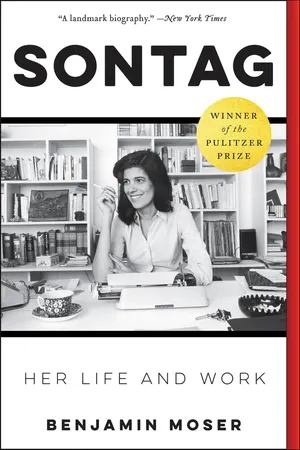
The Pulitzer Prize-winning "landmark biography" of the towering 20th century intellectual, exploring the hidden struggles behind the formidable public face (
The New York Times).
Named one of the Best Books of the Year by O Magazine
, Milwaukee Journal Sentinel
, and Seattle Times
Finalist for the Lambda Literary Award and PEN/Jacqueline Bograd Weld Award for Biography
No writer is as emblematic of the American twentieth century as Susan Sontag. Mythologized and misunderstood, lauded and loathed, a girl from the suburbs who became a proud symbol of cosmopolitanism, Sontag left a legacy of writing on art and politics, feminism and homosexuality, celebrity and style, medicine and drugs, radicalism and Fascism and Freudianism and Communism and Americanism, that forms an indispensable key to modern culture. She was there when the Cuban Revolution began and when the Berlin Wall came down; in Vietnam under American bombardment, in wartime Israel, in besieged Sarajevo. She was in New York when artists tried to resist the tug of money—and when many gave in. No writer negotiated as many worlds; no serious writer had as many glamorous lovers.
Sontag tells these stories and examines the work upon which her reputation was based. It explores the agonizing insecurity behind the public face: the broken relationships and struggles with her sexuality that animated—and undermined—her writing. And it shows her attempts to respond to the cruelties and absurdities of a country that had lost its way, and her conviction that fidelity to high culture was an activism of its own.
Utilizing hundreds of interviews conducted from Maui to Stockholm and from London to Sarajevo—and featuring nearly one hundred images—
Sontag is the first book based on the writer's restricted archives, and on access to many people who have never before spoken about Sontag, including Annie Leibovitz. It is a definitive portrait—a great American novel in the form of a biography.
"[Sontag] was avid, ardent, driven, generous, narcissistic, Olympian, obtuse, maddening, sometimes loveable but not very likeable. Moser has had the confidence and erudition to bring all these contradictory aspects together." —
The Times Literary Supplement
- 832 pages
- English
- ePUB (mobile friendly)
- Available on iOS & Android
eBook - ePub
About this book
Information
Part I

Susan in cheongsam dress. Susan Sontag Papers (Collection 612). Library Special Collections, Charles E. Young Research Library, UCLA.
Chapter 1
The Queen of Denial
Until she died, Susan Sontag kept two home movies that were made with such ancient technology that she never was able to view them. She cherished these talismans because they contained the only moving images of her parents together: when they were young, embarking on adventurous lives.1
The shaky footage shows Peking, as the Chinese capital was then known: pagodas and shops, rickshaws and camels, bicycles and trams. It briefly shows a group of Westerners standing on the opposite side of a barbed-wire fence from a gathering of curious Chinese. And then, for a couple of seconds, Mildred Rosenblatt appears, looking so much like her daughter that it is no surprise that they were later mistaken for sisters. Her handsome husband, Jack, turns up for a couple of seconds, so badly lit that it is hard to see more of him than to note the contrast he forms—tall, white, in foreign clothes—with the Chinese onlookers.
The film was made around 1926, when Mildred was twenty. The second was made around five years later. It begins on a train in Europe, and then moves to the upper deck of a ship. There, a group of passengers—Jack and Mildred and another couple—is tossing a ring over a net, laughing. Mildred is wearing a summery white dress and a beret, smiling broadly and talking to whoever is behind the camera. A game of shuffleboard begins, and about halfway through the film, thin, gangly Jack appears in a three-piece suit and a beret of his own. He and the other man vigorously compete, and then their friends start making faces and horsing around as Mildred leans on a doorway, nearly breathless from laughter. Together, the films are less than six minutes long.
* * *
Mildred Jacobson was born in Newark on March 25, 1906. Though her parents, Sarah Leah and Charles Jacobson, were born in Russian-occupied Poland, both reached the United States as children: Sarah Leah in 1894, at seven, and Charles the year before, at nine. Unusually for Jews in that age of mass immigration, Mildred’s parents both spoke unaccented English. And—ironically for the most Europeanized American writer of her generation—their granddaughter was perhaps the only major Jewish writer of that generation with no personal connection to Europe, no experience of the immigrant background that defined so many of her fellow writers.
Though born in New Jersey, Mildred grew up on the other side of the continent, in California. When the Jacobsons moved to Boyle Heights, a Jewish neighborhood east of downtown, Los Angeles was a town on the cusp of becoming a big city. The first Hollywood film was made in 1911, around the time the Jacobsons arrived. Eight years later, when Mildred and Sarah Leah appeared in Auction of Souls, the city was already home to a large-scale industry. The nascent film colony attracted sleaze: Mildred loved to tell people that she had gone to school with the notorious gangster Mickey Cohen, one of the early kingpins of Prohibition-era Las Vegas.2 And it attracted, and exuded, glamour: Mildred would always strike people as beautiful, vain, and sophisticated in a Hollywood way. Susan once likened her to Joan Crawford; others would compare Susan to the same diva.3
“She was always made up,” said Paul Brown, who knew Mildred in Honolulu. In that city of hippies and surfers, where she spent the last part of her life, she stood out. “Her hair was always done. Always. Like a New York Jewish princess who wears Chanel suits and was too thin.” She retained her Hollywood mannerisms all her life. She answered the phone with a throaty “Yeeeeees?” and forbade her daughters to cross the living room rug until expressly summoned by a manicured hand.4 Mildred “had this better-than-thou attitude, like royals,” said Paul Brown, who saw her difficulty in dealing with the real world. “Like somebody who didn’t know how to find the light switch.”5
* * *
When she sailed off to China, beautiful Mildred seemed headed for a dazzling destiny. Her shipboard companion was Jack Rosenblatt, whom she had met while working as a nanny at Grossinger’s. This was one of the giant summer resorts of the Catskills, the “Jewish Alps.” For a middle-class girl like Mildred, Grossinger’s was a summer job. For someone like Jack, Grossinger’s was a step up.
Like thousands of poor immigrants, Jack’s parents, Samuel and Gussie, had squeezed into the Lower East Side of Manhattan, then perhaps the most notorious slum in America. Born in Krzywcza, in Galicia, a part of Poland under Austrian rule, the Rosenblatts were markedly more plebeian than the “middle-class and suburban” Jacobsons, who were “nothing at all like first-generation Jews,” Susan once told an interviewer.6 In private, she said that her father’s family was “horribly vulgar.”7
Perhaps Samuel and Gussie’s disregard for learning made their granddaughter look down on them. Born in New York on February 1, 1905, Jack had a fourth-grade education. He dropped out of school at ten, and headed to work as a delivery boy in the fur district, on the West Side of Manhattan, where his energy and intelligence were soon noted. He had a flawless photographic memory: his daughter’s memory would likewise be exceptional.8 Elevating him from the mailroom, his superiors shipped him off to China when he was just sixteen. There, he braved the Gobi Desert on camelback, bought furs from Mongolian nomads,9 and eventually set up his own business, the Kung Chen Fur Corporation, with offices in New York and Tientsin. It was the beginning of a busy life: in the eight years they were married, Jack and Mildred built a prosperous international business, went to China several times, traveled to Bermuda, Cuba, Hawaii, and Europe, moved house at least three times, and paused to have two children.
When Susan Lee Rosenblatt came into the world on January 16, 1933, the couple was living in a smart new building on West Eighty-Sixth Street, in Manhattan. That summer, the family moved to Huntington, Long Island; and around the time Judith was born, in 1936, they were installed in a suburban idyll in Great Neck. This was the town immortalized as West Egg in The Great Gatsby, and Jack Rosenblatt’s arrival there was a testament to the success of a slum dropout. In class terms, Great Neck was as far from the sweatshops and the tenements of the Lower East Side as it was from China. It was the kind of ascension that might have cost a lifetime of hard work. Jack Rosenblatt achieved it by the time he was twenty-five.
* * *
A rise that rapid could only have been accomplished by a driven man; and Jack knew he had to hurry. When he was eighteen, two years after his first journey to China, he had his first attack of tuberculosis. In literary terms, as Susan later wrote, this was “a disease apt to strike the hypersensitive, the talented, the passionate.”10 In nonliterary terms, it would fill his lungs with fluid and drown him.
To all appearances, the man Mildred met at Grossinger’s was vigorous and athletic, rich and about to get richer. But the spots on his lungs gave her pause; his mother had brought him to Grossinger’s, in fact, in the hopes that the country air might bring relief.11 Mildred realized that their life together might not be long. Perhaps she reasoned that his infection might not blossom into full-fledged tuberculosis: the bacillus could linger harmlessly for years. But there was, as yet, no treatment. (Penicillin, discovered in 1928, would not be widely available until after World War II.) But Mildred was passionately in love with Jack. In 1930, they married and headed to China, setting up shop in Tientsin.
The major port closest to Beijing, Tientsin, now usually written Tianjin, was one of the “treaty ports” forced upon China after its defeat in the Opium Wars. There, foreign traders could operate outside of the constraints of Chinese law; for them, Susan wrote, this meant “villas, hotels, country clubs, polo grounds, churches, hospitals, and protecting military garrison.” For the Chinese, it meant “a closed space, bounded by barbed wire; all who live there must show a pass to enter and leave, and the only Chinese are domestic servants.”12
These servants were always chief among Mildred’s memories of China. As the land was being devoured by Japanese invasion and civil war, the newlywed Rosenblatts were enjoying a golden age. “She loved the lifestyle,” her friend Paul Brown remembered. “The servants. Having someone cook and serve. Just living like that in the beautiful clothes and the beautiful things, the embassy parties.”13 For the rest of her life, Mildred would distribute Chinese knickknacks to favored friends. “She had some things that were just amazing,” Brown said. “Beautiful Chinese stuff made with little Chinese hands.” But her romantic memories were not to everyone’s taste: “Even as a child,” her daughter Judith wrote, “I was disgusted at her stories of all the people who waited on her for this and that in China.”14
It is unclear how long the Rosenblatts were actually in China. They could not have lived there full-time. Tientsin is so far from New York that when Jack came back in 1924, the crossing from Shanghai to Seattle took sixteen days; the entire trip, nearly a month. Customs records find them entering New York nearly every year of their marriage, sometimes from beach destinations where they were presumably on vacation.15 It would have been difficult to travel to China even once a year. It was an exhausting trip, even for people in good health: hard on Jack, with his weak lungs; hard on Mildred, who purportedly made it twice while pregnant.
But it was China that forever occupied Mildred’s imagination. The house in Great Neck, where Susan spent her earliest infancy, was stuffed with Chinese memorabilia. “In China the colonialists came to prefer Chinese culture to their own,” she wrote. “Their houses became little museums of Chinese art.”16 This interior decoration became another ambiguous heritage. “China was always everywhere in the house,” Judith wrote. “Mother’s way of putting down the present, reminders of her ‘glorious’ past.”17
* * *
Jack’s energy manifested itself in another area as well. Susan remembered a mistress,18 and Judith described him as “a playboy.”19 Perhaps this, too, reflected his tortured awareness that his time was short: determined, as his daughter Susan would be, to make the most of it. Did Mildred know? It is hard to imagine the girls could have learned from any other source. Did she mind? Sex, as her later career demonstrated, was not among her interests. Like many people who lose their parents in childhood, Mildred wanted to be taken care of; it is not a coincidence that the servants were what she remembered most fondly from China. And Jack Rosenblatt took good care of her.
She was less interested in—or less capable of—taking care of others. Along with her elegant furniture, she imported from China parenting precepts that reinforced her natural inclination to keep children out of sight. “In China, children don’t break things,” she would say, approvingly. “In China, children don’t talk.”20 Chinese or not, these ideas reflected the mind-set of a woman who was by no account maternal, one who was not eager to exchange her adventurous life with her husband for the drudgery of child-rearing. “Our mother,” Judith said, “never really knew how to be a mother.”21
When parenting became a chore, Mildred could simply sail away. “Somehow the myth has gotten out that it was relatives” who took care of the girls, Judith said, when Jack and Mildred were abroad. But “the relatives all had their own troubles.” And so, from a v...
Table of contents
- Cover
- End Papers
- Title Page
- Dedication
- Epigraph
- Contents
- Introduction: Auction of Souls
- Part I
- Part II
- Part III
- Part IV
- Acknowledgments
- Bibliography
- Notes
- Index
- Photo Section
- About the Author
- Also by Benjamin Moser
- Copyright
- About the Publisher
Trusted by 375,005 students
Access to over 1.5 million titles for a fair monthly price.
Study more efficiently using our study tools.
Frequently asked questions
Yes, you can cancel anytime from the Subscription tab in your account settings on the Perlego website. Your subscription will stay active until the end of your current billing period. Learn how to cancel your subscription
No, books cannot be downloaded as external files, such as PDFs, for use outside of Perlego. However, you can download books within the Perlego app for offline reading on mobile or tablet. Learn how to download books offline
Perlego offers two plans: Essential and Complete
- Essential is ideal for learners and professionals who enjoy exploring a wide range of subjects. Access the Essential Library with 800,000+ trusted titles and best-sellers across business, personal growth, and the humanities. Includes unlimited reading time and Standard Read Aloud voice.
- Complete: Perfect for advanced learners and researchers needing full, unrestricted access. Unlock 1.5M+ books across hundreds of subjects, including academic and specialized titles. The Complete Plan also includes advanced features like Premium Read Aloud and Research Assistant.
We are an online textbook subscription service, where you can get access to an entire online library for less than the price of a single book per month. With over 1.5 million books across 990+ topics, we’ve got you covered! Learn about our mission
Look out for the read-aloud symbol on your next book to see if you can listen to it. The read-aloud tool reads text aloud for you, highlighting the text as it is being read. You can pause it, speed it up and slow it down. Learn more about Read Aloud
Yes! You can use the Perlego app on both iOS and Android devices to read anytime, anywhere — even offline. Perfect for commutes or when you’re on the go.
Please note we cannot support devices running on iOS 13 and Android 7 or earlier. Learn more about using the app
Please note we cannot support devices running on iOS 13 and Android 7 or earlier. Learn more about using the app
Yes, you can access Sontag by Benjamin Moser in PDF and/or ePUB format, as well as other popular books in Literature & Literary Biographies. We have over 1.5 million books available in our catalogue for you to explore.