New York Times–Bestselling Author: "Brings Dave Barry-style humor to an illuminating book on what is wrong with American democracy—and how to put it right." —
The Washington Post
The democracy you live in today is different—completely different—from the democracy you were born into. You probably don't realize just how radically your republic has been altered during your lifetime. Yet more than any policy issue, political trend, or even Donald Trump himself, our redesigned system of government is responsible for the peril America faces today.
What explains the gap between what We, the People want and what our elected leaders do? How can we fix our politics before it's too late? And how can we truly understand the state of our democracy without wanting to crawl under a rock? That's what former Obama speechwriter David Litt set out to answer. Poking into forgotten corners of history, translating political science into plain English, and traveling the country to meet experts and activists, Litt explains how the world's greatest experiment in democracy went awry.
(He also tries to crash a party at Mitch McConnell's former frat house. It goes poorly.)
The result is something you might not have thought possible: an unexpectedly funny page-turner about the political process. You'll meet the Supreme Court justice charged with murder, learn how James Madison's college roommate broke the Senate, encounter a citrus thief who embodies what's wrong with our elections, and join Belle the bill as she tries to become a law (a quest far more harrowing than the one in
Schoolhouse Rock!).
Yet despite his clear-eyed assessment of the dangers we face, Litt remains audaciously optimistic. He offers a to-do list of bold yet achievable changes—a blueprint for restoring the balance of power in America.
"In the book's strongest contribution, Litt shows how radically our democracy has been altered in recent decades . . . [making] the case that nearly all of these negative trends are occurring by design."
—The Washington Post
"Wry, quickly readable, yet informed." —
The Atlantic
"Equal parts how-to, historical, and hilarious." —Keegan-Michael Key
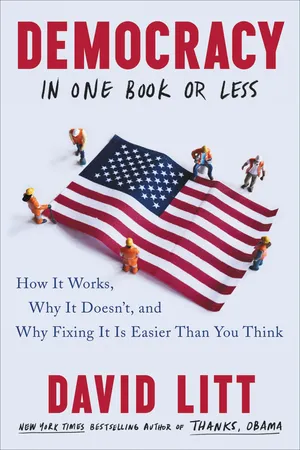
eBook - ePub
Democracy in One Book or Less
How It Works, Why It Doesn't, and Why Fixing It Is Easier Than You Think
- 320 pages
- English
- ePUB (mobile friendly)
- Available on iOS & Android
eBook - ePub
Democracy in One Book or Less
How It Works, Why It Doesn't, and Why Fixing It Is Easier Than You Think
About this book
Part I
Who Gets to Vote?
1
The Drawing of Lots
The Non-Voters
Three years ago in Virginia, a doofus cast a vote. Arriving at a polling place in Newport News, a small city on the mouth of the James River, this person was handed a paper ballot containing very simple instructions: To record your preference, fill in the oval beside a candidate’s name. In the governor’s race, our mystery voter carefully filled the bubble for Republican Ed Gillespie. Then he drew an “X” through it.
To our doofus’s credit, he managed to get through the next few sections of his ballot without incident. But then he reached the race for State House of Delegates and the wheels came off the bus. Below the words “VOTE FOR ONLY ONE” were three names. Our illustrious Virginian chose two of them. Remarkably, he not only voted for the wrong number of candidates; he also voted for them incorrectly. While Republican David Yancey received a properly filled-in oval, Democrat Shelly Simonds, like Ed Gillespie before her, received both a filled-in oval and a slash.
Lord knows I have no right to lecture anyone about following directions. The last time I tried assembling a purchase from IKEA, I learned it’s possible to flip a dresser inside out. Still, an adult human being, failing in three separate ways to fill in an oval with a pen? What a goober.
Six weeks later, that goober held the fate of 8.5 million Virginians in his hands.
Here’s what happened. When the votes from the 2017 election were first counted and recounted, the ballot with the extra ovals and slashes was not among them. In election jargon, it had been “spoiled,” like milk someone forgot to put back in the fridge. Meanwhile, the tally of unspoiled ballots revealed a seismic result. For the first time in twenty-two years, Democrats had won all three branches of Virginia government. In the first two of these, the races for governor and control of the state senate, their victories had been decisive.
But the race for the third branch, the Virginia House of Delegates, could not have been closer. Democrats had flipped the chamber by just one seat. One of those seats was in Newport News, home to our spoiled ballot. And there, Shelly Simonds had been elected by a winning margin of exactly one vote. Republicans grumbled at their bad luck. Democrats breathed a sigh of relief and prepared to make some major changes to Virginia’s laws.
But back in Newport News, a middle school civics teacher named Kenneth Mallory, who had volunteered as an election observer for Shelly Simonds’s opponent, was having second thoughts. Remembering a certain spoiled ballot, one pockmarked with unforced errors, guilt apparently crept in. After all, didn’t every voter, even an outrageously careless one, deserve a chance to be heard?
That’s how Virginia was treated to a Solomonic tussle over an answer sheet that would have been bounced from the SATs. Three judges were summoned from the state’s Circuit Court. The Newport News doofus’s ballot was placed before them. The room was locked. Deliberations began.
What happened over the next several hours remains a secret. We will never know what discussions took place, which theories were proffered, exactly how the three wise men attempted to read a voter’s mind. But we do know that the judges reached a verdict. The person who cast the spoiled ballot, they ruled, had in fact intended to vote for Republican David Yancey. Shelly Simonds was no longer the winner by a single vote. The race was tied—which meant Democrats no longer controlled the House of Delegates. Their agenda was suddenly on ice.
Almost exactly one year later, in December 2018, I meet Shelly Simonds at a biker bar turned seafood restaurant called Harpoon Larry’s. Unlike some politicians, she doesn’t have a wax museum polish. Before she ran for office she was a mom and an elementary school Spanish teacher, and she still looks like both those things.
As we settle into a booth, the only difference between Shelly and the rest of Harpoon Larry’s clientele is that her earrings and sweater are aggressively Christmas-themed. She’s just come from taking a family photo that would double as a mailer for her next campaign, a rematch with David Yancey.
“I have a neighbor who’s Republican who said, ‘I’m going to vote for you next time,’” Shelly tells me proudly. I spear a bit of broiled crab cake onto a piece of lettuce and raise an eyebrow.
“Were you like, ‘Where were you twelve months ago?’”
“No, no,” Shelly assures me. But I am unconvinced.
“What about those two?” I ask, pointing to a white-haired gentleman and a much younger brunette casting bedroom glances across a shellfish platter. “Don’t you look at them and wonder, ‘Okay, which of you didn’t vote?’”
Shelly shook her head. “You have to love everybody and accept everybody,” she said. Then she shrugged. “Maybe it’s maturity and yoga.”
I am not especially mature, however, and I don’t do yoga, so I frequently return to Shelly’s 2017 campaign. Not the moment when a winner was finally decided—although we’ll get there—but to the hours of deliberation that preceded it. The judges studying inky splotches. The spoiled ballot placed solemnly upon a table in a locked and windowless room.
It was a scene from a parable, the kind of story that demands a moral, and a moral soon emerged. “Every Vote Counts: 1 More Ballot Ties Up Virginia,” read the headline on CNN. “It’s proof that every vote counts,” declared David Yancey, Shelly’s opponent. “If you ever wonder whether every vote counts, talk to Shelly,” said Tom Perez, the chair of the Democratic National Committee.
This idea—that all of us should vote because any of us might single-handedly decide an election—is inspiring and patriotic. It is also untrue. We might as well say “every plane crashes” or “every lotto ticket wins.” Sure, Shelly’s race was a reminder that your ballot could theoretically prove decisive. But the probability of that actually happening is so small as to be virtually nonexistent. If you participate in every election for which you’re eligible, odds are it will take centuries before one of them is decided by a single vote. And that’s just for small local races like Shelly’s. To personally tip a statewide contest, one for governor or senator, you’d likely have to wait eons.
Which is why when I think about the moral of Shelly Simonds’s tied race, I don’t imagine my vote deciding an election. Instead, I imagine what would have happened had the Newport News doofus not voted at all. If he had chosen zero candidates, rather than two, no wise men would have retreated to a locked room to determine his intentions. No reporters would have descended on his hometown. If he hadn’t filled out his ballot, no one would have given him any thought at all.
But he did fill out a ballot. And whether you agree or disagree with the judges’ final verdict, there’s no denying this: Three of Virginia’s most influential citizens spent their day pondering the inner life of a person you wouldn’t trust to order a pizza on your behalf. All because he chose to vote.
The moral of Shelly’s story, then, is not that every vote counts. The true moral, at once completely obvious and chronically overlooked, is this: in a democracy, people who vote are important in a way people who don’t vote are not.
* * *
Benjamin Franklin understood the importance of voting—or, rather, the unimportance of not voting—before there was even an America to vote in. “They who have no voice nor vote in the electing of representatives,” he wrote in 1774, “do not enjoy liberty; but are absolutely enslaved to those who have votes.”
A lot has changed in the past 246 years, yet Franklin’s warning still rings true. America today is made up of two separate and totally unequal countries. The first country, while far from perfect, is a republic. The people select their leaders. The people can reject those leaders when they fall short.
But here’s the important thing: the people of the first country select the leaders of the second country as well. Citizens of that latter nation pay the same taxes, celebrate the same holidays, live in the same neighborhoods, send their children to fight and die in the same wars. Yet the decisions that shape their lives are made by representatives they never choose.
Because I am a creative professional who makes my living deploying clever turns of phrase, I will call the first country “Country Number One” and the second country “Country Number Two.” As you’ve probably surmised, what determines which country you belong to is whether or not you vote.
Taken together, the inhabitants of Country Number One are more commonly known as “the electorate.” The combined inhabitants of both countries make up “the population.” But what do we call those living in Country Number Two? The only phrase we have to describe a group of non-voters is “a group of non-voters.” In the last presidential election, 185 million Americans, including 44 percent of adults, didn’t cast a ballot. And yet despite its enormous size, this gigantic slice of our country is chronically overlooked.
The goal of this chapter, and of the section of this book that follows, is to give what I’ll call “the unelectorate” the attention it deserves. Who are America’s non-voters? Why aren’t they voting? And what does their lack of participation mean for the rest of us? If we want to understand our democracy, these are questions we must ask.
These questions are particularly urgent in America, because we have more non-voters, both in sheer numbers and as a percentage of the population, than nearly every developed democracy on earth.
We don’t just trail countries like Australia and Belgium, where voting is mandatory. If our 2016 turnout rate had equaled France’s, our electorate would have grown by 30 million people. New Zealand-level participation would have added a whopping 49 million to the rolls—a number larger than the voting-age populations of Florida, Pennsylvania, Wisconsin, Michigan, and Ohio, combined. When it comes to turnout, the United States also lags Sweden, South Korea, the Netherlands, Italy, Mexico, Austria, Denmark, Israel, Finland, Norway, Germany, Greece, the Czech Republic, the United Kingdom, Canada, Portugal, Spain, Slovakia, Ireland, and Estonia.
(We’re slightly ahead of Latvia. So that’s nice.)
And these rankings are based solely on America’s performance in presidential election years. In midterm elections, the biannual affairs where we choose one-third of our senators, more than two-thirds of our governors, and every single member of the House of Representatives, the electorate shrinks further. Consider what happened in 2018. Campaigns spent billions of dollars on ads, hundreds of thousands of volunteers knocked on doors, the president of the United States invented a terrorist-filled caravan to motivate his base. Thanks to all these efforts, midterm voter turnout soared to a new record high . . . of 53 percent. “The voters” and “the people” are not the same at all.
If the electorate were an exact replica of the population, only smaller, our low turnout might not matter. After all, the real purpose of elections—and the reason we’ll spend so much time on them in the coming pages—is not just to win. Done right, elections make real the most basic promise of representative democracy: that the people have a say in what their leaders do. If the voters are demographically identical to the people, our representatives should pursue policies the public supports, regardless of turnout. We’ll have leaders we trust. And if we stop trusting them, or they pursue some other agenda, they’ll get fired.
As it happens, however, the electorate and unelectorate are not demographically identical at all. Voters, on average, have higher incomes than non-voters do. They are vastly more likely to possess a graduate degree or golf shoes. They are vastly less likely to have personal experience with food stamps, community college, or payday loans. As with most things in America, when it comes to voting, there is also a racial gap: historically, white people have turned out at the highest rates, followed by Black people, followed by other nonwhite groups. Perhaps most stark is the age gap. Millennials are now the largest generation in America. But when the dust settles on the 2020 presidential election, Baby Boomers will almost certainly cast the most votes.
Here’s an easy way to think about it: along nearly every dimension, the average voter looks more like Donald Trump than the average American does.
Consider what happened in 2016. As Americans went to the polls, the United States was, thanks to changing demographics, more diverse than it had ever been. But that diversity wasn’t reflected in the electorate. White voters cast 73 percent of the ballots, exactly the same percentage as four years earlier. Meanwhile, in that same four-year span, the African-American population grew by 1.7 million. But the number of African-American voters actually declined by nearly 800,000. It was as though the entire Black population of Detroit vanished into thin air.
Perhaps unsurprisingly, Shelly Simonds puts it best. “The most important thing isn’t who people decide to vote for,” she explains. “It’s who decides to vote.” We’re walking along the banks of the James River, and she says that for months after her election ended in a tie, non-voters would approach her to beg forgiveness. I looked out over the water, the November sun glancing off the river and bathing the air in wintry glow, and tried to think, really think, about what she had just told me.
“Don’t you want to slap them?” I asked.
* * *
Perhaps my initial attitude toward the unelectorate was, as my highly diplomatic editor put it, “overly harsh.” But in my defense, I wasn’t alone. Just think about the language we typically use to describe the behavior of non-voters: “Staying home.” “Sitting out the election.” “Not showing up.” These phrases drip with judgment.
Even on the Upper West Side of Manhattan, the Emerald City of well-meaning liberalism where I was born and raised, the idea that someone might have a good reason for failing to cast a ballot was never seriously considered. No adults I knew growing up would have suggested that those without jobs or homes were lazy. But non-voters were a different story. “People who don’t vote have no right to complain” was a phrase so well worn it could have been embroidered on a throw pillow. Just a few years ago, I returned home for the Jewish high holidays weeks before an election. During the service, one of my rabbis lifted his hands and pointed his gaze skyward.
“How is it,” he beseeched the heavens, “that anyone in America could not vote?”
I don’t know if he ever received a divine answer, but let’s run through some earthly possibilities. One explanation, volunteered by the late columnist Charles Krauthammer, is that Americans vote at lower rates than people from other countries because America is better than other countries. “Low voter turnout is a leading indicator of contentment,” he wrote in a 1990 essay for Time magazine. Arguing that government was mercifully unimportant to Americans’ day-to-day lives, he added that “it seems entirely proper that Americans should in large numbers register a preference against politics by staying home on Election Day.”
One person who quite liked this argument was Mitch McConnell. He quoted Krauthammer’s piece in an op-ed about voting the following year. But just in case readers didn’t agree that low voter turnout is a sign of contentment, he offered a second theory: non-voters are lazy. “Political couch potatoes,” he called them, a phrase he later repeated to the Washington Post.
In retrospect, it’s remarkable how readily the rest of the country adopted McConnell’s framing. “Half the Electorate, Perhaps Satisfied or Bored, Sat Out Voting,” read a New York Times headline in 1996. The Times is painstakingly careful to avoid taking sides, often to the point of ridiculousness. Yet when it came to the motivations of the unelectorate, Kentucky’s leading Republican was in perfect harmony with Manhattan liberals, right-wing authors, and the paper of record. Some Americans, they all concluded, either don’t care who ...
Table of contents
- Cover
- Title Page
- Dedication
- Contents
- A Note Regarding Facts (on the theory that they still exist)
- Introduction: Brother Mitch
- Part I: Who Gets to Vote?
- Part II: Whose Votes Matter?
- Part III: Which Ideas Become a Law?
- Epilogue: Unity Place
- Acknowledgments
- Suggested Reading
- Index
- About the Author
- Also by David Litt
- Copyright
- About the Publisher
Trusted by 375,005 students
Access to over 1.5 million titles for a fair monthly price.
Study more efficiently using our study tools.
Frequently asked questions
Yes, you can cancel anytime from the Subscription tab in your account settings on the Perlego website. Your subscription will stay active until the end of your current billing period. Learn how to cancel your subscription
No, books cannot be downloaded as external files, such as PDFs, for use outside of Perlego. However, you can download books within the Perlego app for offline reading on mobile or tablet. Learn how to download books offline
Perlego offers two plans: Essential and Complete
- Essential is ideal for learners and professionals who enjoy exploring a wide range of subjects. Access the Essential Library with 800,000+ trusted titles and best-sellers across business, personal growth, and the humanities. Includes unlimited reading time and Standard Read Aloud voice.
- Complete: Perfect for advanced learners and researchers needing full, unrestricted access. Unlock 1.5M+ books across hundreds of subjects, including academic and specialized titles. The Complete Plan also includes advanced features like Premium Read Aloud and Research Assistant.
We are an online textbook subscription service, where you can get access to an entire online library for less than the price of a single book per month. With over 1.5 million books across 990+ topics, we’ve got you covered! Learn about our mission
Look out for the read-aloud symbol on your next book to see if you can listen to it. The read-aloud tool reads text aloud for you, highlighting the text as it is being read. You can pause it, speed it up and slow it down. Learn more about Read Aloud
Yes! You can use the Perlego app on both iOS and Android devices to read anytime, anywhere — even offline. Perfect for commutes or when you’re on the go.
Please note we cannot support devices running on iOS 13 and Android 7 or earlier. Learn more about using the app
Please note we cannot support devices running on iOS 13 and Android 7 or earlier. Learn more about using the app
Yes, you can access Democracy in One Book or Less by David Litt in PDF and/or ePUB format. We have over 1.5 million books available in our catalogue for you to explore.