![]()
CHAPTER 1
The Four Behavioral Styles
Behavioral Styles in the Business World
People are different, and those differences, while greatly enriching the never-ending process of personal interaction, also create friction.
Our capabilities and, particularly, how we apply them to deal with different tasks vary greatly from person to person and so do the expectations we have about how others deal (or fail to deal) with such tasks. This is apparent just by looking at daily work routine as it happens in the corporate environment; someone may be at the office and feel frustrated that the person at the other side of the table is just not understanding why a particular thing (a project, a process, a calculation) has to be done in a particular way. Managers may not understand why team members cannot complete an assigned task in the way they need them to, even when the reasons for it have already been explained. Or certain team members may be left scratching their heads and feeling frustrated, not understanding the instructions, so clear to some and confusing to others, that managers are delivering. Outside of work, day-to-day life is a parade of efforts in dealing with behavior types that are different to oneself. How often we get enraged because the person who is lining up in front of us is having trouble operating an ATM or is holding up the queue in the airplane aisle by trying to fit his or her luggage in a way that is obviously nonsensical . . . to us.
The truth of the matter is that, by living in society, people are destined to come across others who do not conform to the way they see things and the way they do things. And in a professional context, where performance is measured by communicational, relationship, and leadership abilities, the key to success may just be how to best broaden our own understanding of others rather than trying to change their behavior so it fits our expectations.
In fact, this is such an essential skill that it comes up immediately upon joining the professional world. In a job, any job, the initial step is always to be thrown in the midst of a group of strangers; we are not consulted about who we prefer to work with but are paired with coworkers based on skill or role, not personal compatibility. How we behave under such conditions reflects our temperament and affects, in turn, the attitude of those around toward us. Different types of people meshed together can work in harmony and turn out to have complementary behaviors, while others can become antagonistic and affect performance.
Even if we have no intention of changing the way we act, understanding what are the characteristics of our conduct, and what are its strengths and weakness, will help us develop more effective relationships (and it should be noted that “effectiveness” here is not used only in its purely utilitarian or mercantile sense; getting to know and establishing a meaningful personal friendship with a new acquaintance is as much a valid result of an effective relationship as closing a multimillion-dollar sales deal). In turn, knowing which type of behavior we can expect from those around us will remove unpredictability from our social interactions, increasing their positive effects and helping us lessen negative ones.
Such understanding is, in short, a key professional competence that allows us to work, communicate, and lead people of different characters who exhibit different behaviors, and it comes via two fundamental points of awareness:
- We need to recognize what our behavioral style is.
- We need to learn how to recognize the behavioral style of others.
The Legacy of Behavior Classification
The behavioral classification used in this book is based on the model developed by American psychologist William Moulton Marston (1893–1947). In a book published in 1928, Emotions of Normal People, Marston, a fascinating scholar who also developed the polygraph lie detector machine and created the comic book character “Wonder Woman,” explained how people’s emotions and behavior can be classified into four types depending on their predominant trait:
- Dominance (D), when there is a superiority of self over some sort of antagonist.
- Inducement (I), when there is a process of persuading someone, in a friendly way, to perform an act suggested by the subject.
- Submission (S), when there is a voluntary obedience to the commands of the person in authority.
- Compliance (C), when the subject is moving himself or herself at the dictates of a superior force.
This model had come to be known as the DISC classification and still influences research on human psychology to this day.
The book’s curious title uses the word “normal” because Marston made clear that his intention was to classify people’s standard behavior, that is, the type of actions they expressed when not under stress:
I do not regard you as a “normal person”, emotionally, when you are suffering from fear, rage, pain, shock, desire to deceive, or any other emotional state whatsoever containing turmoil and conflict. Your emotional responses are “normal” when they produce pleasantness and harmony. And this book is devoted to description of normal emotions which are so commonplace and fundamental in the every-day lives of all of us that they have escaped, hitherto, the attention of the academician and the psychologist.
Despite the inherent complexity of the human psyche, Marston was not the first who looked into classifying people’s behaviors into a model or chart that could be simultaneously simple and comprehensive. The Greek physician Hippocrates (c. 460–c. 370 BC) developed the idea that there exist four temperaments, each related to a natural element, in the rational mind, and that establish many types of archetypical personalities:
- Sanguine (air-like): Active, outgoing, and charismatic.
- Choleric (fire-like): Decisive and goal oriented.
- Melancholic (earth-like): Thoughtful, self-reliant, and analytical.
- Phlegmatic (water-like): Sympathetic, relaxed, and easygoing.
Hippocrates noted that those positive traits could be taken to their extreme and develop into negative behavioral patterns, which accounted for social and interpersonal frictions. The sanguine become risk-taking, the choleric become dictatorial, the melancholic become reclusive, and the phlegmatic become pusillanimous. As per the classical conception of physiology, displaying one or another behavior was ultimately attributed to varied humors of fluids present in the human body, which, in different combinations, determined a personality type. Hippocrates understood, however, that the human character is not always so easily explained and that there existed mixtures between the different types so that individuals could present at the same time characteristics of two or more of them.
The Swiss psychiatrist and psychoanalyst Carl Jung (1875–1961) also looked at the different personality trends present in each human being and how they “determine and limit a person’s judgment.” In his 1921 book Psychological Types, he identified two attitudes for the control of consciousness, introversion and extraversion, and four basic psychological functions:
- Thinking, the intellectual comprehension of things.
- Feeling, the judgment of the value of things based in a sentimental function.
- Sensing, the sensorial perception of the world.
- Intuiting, the adding of meaning through a deeper perception process.
Later, Katharine Cook Briggs and her daughter Isabel Briggs Myers developed the “Myers–Briggs Type Indicator,” based on Jung’s approach. Still widely used today, the indicator takes the form of a personal questionnaire where, by answering different questions, the participant profile is aligned with one of 16 different personality types that organize Jung’s principles into a list ranging from the ISTJ (Introversion + sensing + thinking + judging) group to the ENTP (Extraversion + intuition + thinking + perceiving).
When looking at the lessons that result from applying martial arts fighting mentality to business and business-related interactions, this book divides individual behavioral patterns into one of the four following groups, derived from Marston’s original classification. Each name looks to represent a behavioral type that can be intuitively recognized in a professional environment:
- The Controller
- The Analyst
- The Promoter
- The Supporter
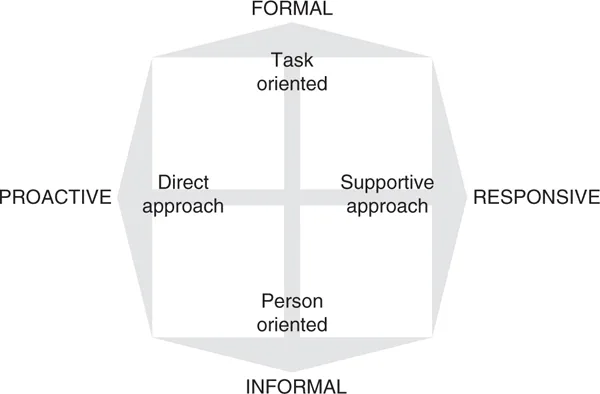
These four basic behavioral patterns are initially defined according to where they sit in a graph that defines human behavior as points articulated along two basic parameters or axes:
- Formal/informal behaviors: Refers to the degree to which a person is task-oriented and likes to work under clearly stated rules, or is people-oriented and prefers a more fluid, unstructured environment.
- Proactive/responsive behaviors: Refers to the degree to which a person uses a direct, take-charge type of approach or an indirect, more supporting one.
Understanding these two axes is the first step in learning what the individual behavioral patterns are.
The Vertical Axis: Formal/Informal Behaviors
In 2017, a conference took place in San Francisco hosted by the technology and media company Facebook. Following the informal and loose Silicon Valley style, the organizers chose an unusual venue, the Palace of Fine Arts, where a large warehouse had been conditioned with sofas, Wi-Fi service, chairs, barista coffee counters, and meeting rooms. There were two stages, one at each end of the large location; the first one, wider, was dedicated to business and sales presentations, while the second stage, narrower, was there for the engineering and technical discussions.
Over the course of 2 days, a pattern showing differences not just between the programs in both areas but about their style quickly emerged. The speakers on the sales stage were smartly dressed, used slides with a simple, evocative sentence, and pitched their ideas in an emotional, passionate manner. They talked about “partnership collaboration” and “synergy” and “market impact.” The speakers on the technical stage were mostly engineers, dressed in comfortable, casual outfits; their slides had an abundance of detail, and although many of them seemed not very used to public speaking, their presentations were structured and logical.
It would be simplistic to say that each type of presentation style that day was exclusive to a certain work role; not all businesspeople were fast-talking salespersons, nor were all engineers social recluses who spoke in incomprehensible technical lingo. But it is true that an alignment of behavior with job roles could be felt: the business area was informal and people-oriented; the engineering one was formal and task-oriented. It certainly stands to reason: salesmanship requires a degree of gregariousness because results will be determined by the ability a person has to engage with clients and prospects. Similarly, technical jobs need, by definition, accuracy and attention to detail if a new program or machine is to work properly and without hitches.
In the classification of behavioral styles, these two broad types correspond to the gradating axis line, which goes from formal to informal:
- The formal behavior style is task-focused and refers to people who follow a disciplined and structured working style. They are precise in their communication and present ideas in a less emotional way, staying close to facts and figures to support their arguments. In some cases, such formality can come across as obdurate.
- The informal behavior style is relationship-oriented and refers to people who follow a less organized but more intuitive working style. Their communication style is less organized but more approachable, showing emotion that appeals to the listener’s gut feeling rather than the intellect. In some cases, this informality can come across as fickle.
The Horizontal Axis: Proactive/Responsive Behaviors
In the 1938 comedy Bringing up Baby, Cary Grant plays David Huxley, a ...