![]()
Section III
Picture Quiz, MCQs, with Applied Medicine
Q-1. This 52-year-old male with a BMI of 26 and chronic smoker developed increasing cough with mild hemoptysis since one week. There is no history of fever or chest pain. On examination, he had early clubbing of the fingers and recently developed this rash in the axilla. What important investigations are required in this setting?
MCQ-1. In relation to the appearance of the arm pit in this patient, give true or false to each of the following statements.
- It may be seen in almost half of the grossly obese patients.
- It may be seen in up to 20 percent of the diabetics.
- It may be related to Cushing’s syndrome.
- It may be related to lymphoma.
- Insulin resistance is present in about 90 percent of the patients.
Ans-1. A non-obese smoker with hemoptysis and clubbing should be worked up for bronchogenic carcinoma. Although, hemoptysis in COPD may be due to infection, pulmonary hypertension, pulmonary embolism, or tuberculosis infection, especially in endemic areas. The axillary rash is characteristic of acanthosis nigricans, which further supports an underlying malignancy. CBC may show anemia and high ESR. Imaging may be done by X-ray chest, CT scan, or MRI. PET scan is more useful to detect metastasis and the extent of disease. Diagnosis may be reached by sputum cytology and culture followed by bronchoscopic washings or biopsy (usually CT-guided), if required. A full work of the extent of disease is important to stage the disease and offer the best therapeutic intervention.
Ans. to MCQ
- True
- True
- False
- True
- True
Applied medicine. Acanthosis nigricans. (Also see bronchogenic carcinoma Volume I, page 89.)
- It is most commonly seen with obesity and diabetes and rarely associated with malignancies such as and bronchogenic carcinoma and gastric adenocarcinoma, drugs like glucocorticoids, oral contraceptives, and insulin. Diseases like Type 2 diabetes, acromegaly, polycystic ovarian syndrome, or Cushing’s syndrome may also be associated with acanthosis.
- It appears as dry, rough, or dirty-looking skin that may be thick brown-gray hyperpigmented with velvety appearance.
- Classical sites include the axilla, neck, intertriginous areas, and rarely, also non-intertriginous sites.
- It can be seen before or after the detection of the malignancy or may rarely precede the malignancy by years.
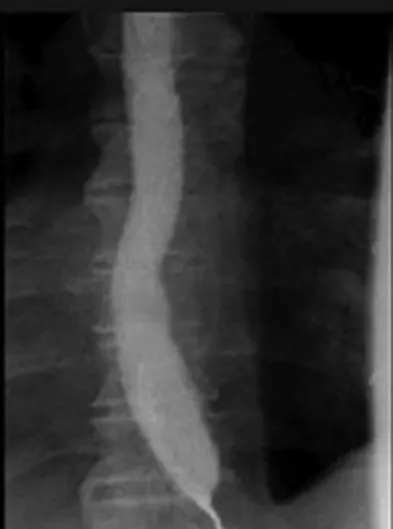
Q-2. This 46-year-old non-smoker male was admitted due to recurrent chest infections requiring hospitalization and IV antibiotics on several occasions in the last one year. He complained of off and on dysphagia to both solids and liquids over the last 18 months. He is otherwise healthy with no history of COPD or weight loss. A barium swallow was done. What underlying cause is most likely for his recurrent problem?
MCQ-2. In relation to this disease, give true or false for each of the following statements.
- There is failure of relaxation of smooth muscle at the lower esophageal sphincter.
- It carries a high for the development of adenocarcinoma.
- Treatment is pneumatic dilatation or surgery.
- Chest pain may be a feature.
Ans-2. Achalasia is seen with classical rat tail appearance of the lower esophagus. This is due to the degeneration of ganglion cells in the myenteric plexus in the esophageal wall with failure to relax the lower esophageal sphincter. These patients have recurrent vomiting and high chance of recurrent aspiration and pneumonia.
Differential diagnosis includes malignancy or external compression of the lower esophagus, eosinophilic esophagitis, and Chagas disease.
Ans. to MCQ
- True
- False (risk for squamous cell carcinoma is increased)
- True
- True
Applied medicine. Achalasia. (Also see Volume I, aspiration pneumonia page 139.)
- Achalasia results from progressive degeneration of ganglion cells in the myenteric plexus in the esophageal wall, leading to failure of relaxation of the lower esophageal sphincter, accompanied by a loss of peristalsis in the distal esophagus.
- The disease can occur at any age, but onset before adolescence is rare. Achalasia is usually diagnosed in patients between the ages of 25 and 60 years.
- Patients present with dysphagia, regurgitation, and heart burn. Chest pain and weight loss may be...