Chapter 1
Leadership System
If leaders expect staff to meet and exceed the expectations of their customers, those same leaders must respond to concerns and exceed expectations on behalf of their staff.
—Joseph A. Michelli,
The Starbucks Experience
Traditional Management
We are provided leadership skills through life experiences both at home and at work. In addition, certain personality styles lend themselves to qualities of leadership that assist in your leadership journey. In this chapter, you will learn a leadership system used by successful entrepreneurs that can assist you advance your skill set. I can remember as a child telling myself that I would never say to my children some of the things my father said to me. However, when I became a father I heard some of the same phrases coming out of my mouth! You may have similar experiences.
Just as we are shaped by our parents, we are shaped by supervisors and managers who guide us as we begin our professional careers. That is why it is important to think of leadership as a system of behaviors that can be learned and applied in everyday situations at work and at home. The good news is that there may be certain behaviors to master in today’s world of work but we have learned many of them along the way. We need to focus only on a critical few in order to have the total skill set required for pulling everyone together and moving your organizations into the future.
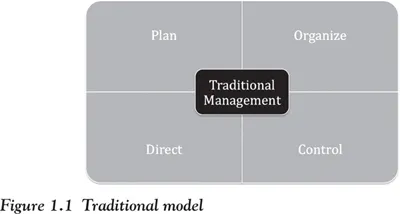
The traditional leadership system was created from a military tradition. For decades, organizations have experienced success using the system shown in Figure 1.1.
Within this system, managers are taught to plan and organize work for their employees and operations. They learn to execute plans by directing and following up with each person in their sphere of control to ensure that work is performed accurately and on time. Employees are expected to be good listeners and perform as directed.
21st-Century Leadership
In today’s environment of diverse cultures represented by multiple generations, a new form of management system is required. Entrepreneurs are being challenged to create a culture of pluralism that is collaborative and innovative to compete in today’s marketplace.
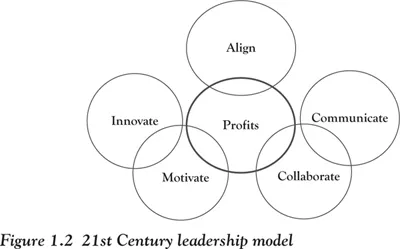
The manner in which behaviors are organized into a system of leadership develops a common culture when used organization wide. That system consists of the five circles shown in Figure 1.2, illustrating Alignment, Communication, Collaboration, Motivation, and Innovation. This book will review each element of the system and accompanying behaviors integral for your organization becoming the best in your marketplace. Figure 1.2 illustrates how you can lead your organization to think out of the box.
System for Succeeding as an Entrepreneur and a Leader
Alignment means the personnel in your organization know the direction of the company, its goals, teams’ goals, and how each supports the other. It means having data and scorecards that inform all staff of the progress toward goal achievement and making improvements. It means everyone in the organization can recite the vision, mission, and principles of your organization. The leadership behaviors that contribute to alignment include developing and sharing vision and strategy, planning and organizing around strategy, and linking associates with customers and strategy.
Communication means having the information needed to perform each person’s duties and accomplish their goals. It includes regularly scheduled meetings in which scorecards and plans are updated and everyone shares their activities and what they have learned. It also includes the use of technology to instantly update persons and teams with information to help them optimize their talents and accomplish their tasks and goals. Communication involves the leadership behaviors of listening before speaking, meeting regularly with staff, building trust, and modeling ethical behavior.
Collaboration means that the organization is organized into a team system in which each team’s members meet regularly to discuss ideas for solving problems and improvement in the way work is performed, products and services are enhanced, and new products and services are designed. Customer requirements are part of any discussion regarding work improvements as well as product and service enhancements and new product design. The team’s ideas are utilized, thus creating an innovative workplace. Collaboration relies on leadership behaviors of driving out fear, facilitating, encouraging new ideas, and delegating.
Motivation means there are both short and long-term rewards and recognition for accomplishments. They are contingent on improvements in organizational scorecards and goal attainment and can range from short-term incentives such as time off to long-term stock ownership plans. It means the culture has four times more positive feedback than corrective feedback. Leadership behaviors required for motivating the workforce include understanding human behavior, celebrating improvements and goal attainment, positive thinking, calmly correcting behavior, and being flexible in leadership styles with associates.
Innovation means the organization has created a culture in which people feel free to express themselves and are encouraged to think out of the box and create ways to reduce costs, improve productivity, quality, product performance, new products and services and organizational designs for future growth. The culture is created using behaviors defined earlier and aligned within the five circles. In addition, the following behaviors are used when creating a new product or service: Follow Principles of Innovation, Create Project Team, Encourage Purposeful Play, and Maintain Confidences.
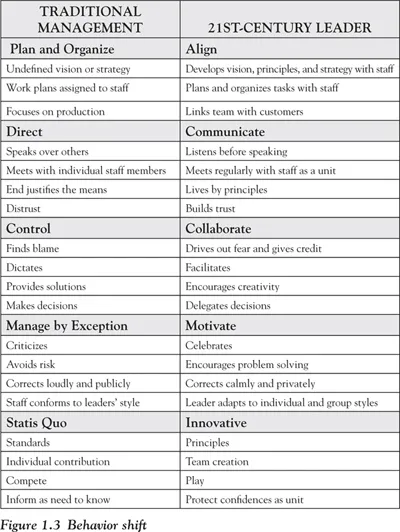
Figure 1.3 illustrates behavior changes required to shift from a traditional culture to a collaborative and innovative culture.
First, have a definite, clear practical ideal; a goal, an objective. Second, have the necessary means to achieve your ends; wisdom, money, materials, and methods. Third, adjust all your means to that end.
The beginning of my journey turning around the non-profit I was hired to lead involved beginning with the end in mind. Planning and aligning the people in the organization.
The ability to align the people in your operation with the goals of the enterprise is a critical part of leadership. Alignment includes the behaviors of a leader who facilitates the development of a vision and principles with a balanced strategy and goals with the team, develops a balanced scorecard to track progress, and organizes staff and tasks to best accomplish goals. A critical element of innovation involves inclusion of customers and other stakeholders with your team members when developing your strategy. The purpose is to ensure team members are completely aligned with their customers and your organization’s plan. At the very least, stakeholders to invite to the planning session should include key customers and suppliers.
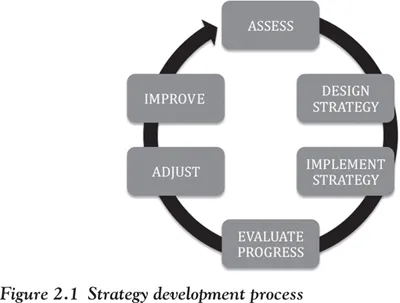
A paper manufacturing operation went through a two-day process to identify their vision and mission with supporting principles. Their work was posted just inside the main entrance of headquarters. The executives found that many potential clients converted to new clients after visiting and learning how this supplier aligned with their values. The process for creating a living strategy aligned with your workforce is shown in Figure 2.1.
Our vision is to lead our industry. Our mission is to continually innovate through a process of Discovery, Designing Solutions, Implementing Solutions, Evaluating Results, and Continually Improving.
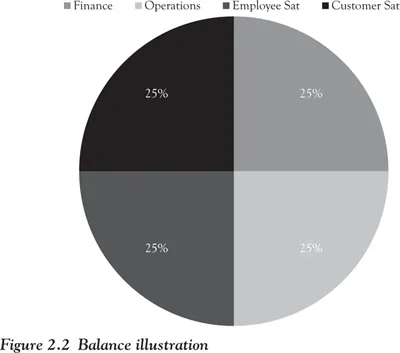
The key elements of strategic goal development involve consideration of the four pillars of an organization including Financials, Operations, Customers, and Employees (Figure 2.2).
Organizations focusing solely on their financials find the result to be discontented employees and inefficient operations. They may reduce costs but typically lose market share in the process.
Just as misdirected is the organization focusing solely on customers. It may experience market gains but be unable to remain competitive because of poorly maintained operations and low margins. It takes focus on core components of the organization (its four pillars) in order to increase innovation and competitiveness in today’s marketplace.