CHAPTER 1
Starting and Planning the Global Project
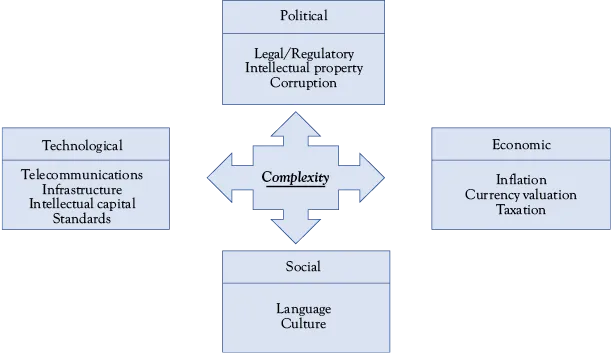
What is so special about projects that are planned and executed within the global environment? Why should project managers concern themselves with examining global projects as something distinct from projects that are purely local, regional, or national in scope? This question may be answered in a single word—complexity. Global projects include significantly more variables to manage including the macroenvironment. The global macroenvironment is vast and includes the political, economic, social, and technological factors in which a global project is executed. Further, project managers encounter language and cultural barriers that often involve fundamentally different approaches to management itself. To make an analogy, when project managers face such factors, it is rather like attempting to drive a car from one location to another while wearing a blindfold. The environment faced by the project manager may be quite alien, thereby leading to confusion, miscommunication, conflict, and stress. On the other hand, when project managers take the time to understand the global project management environment and become more comfortable with the added complexity, it is not uncommon to find global project management to be a successful and rewarding experience (Figure 1.1).
Figure 1.1 The global project management environments
Whether a project manager desires to lead a global project or not, projects today are increasingly global in scope. Often an apparently purely local project will include some components, subsystems, software, technology, or labor sourced from outside of the home country. As a result, even local project managers may be required to communicate with or travel to suppliers who are outside of the home country. These requirements present little problem since modern technology has made it possible to communicate in real time anywhere on the globe. Further, jet travel makes it possible to travel from any major city in the world to any other major city in less time than it was required to travel between the original Greek city states in antiquity. The world is effectively smaller—but since the world is round and it is not physically smaller, the apparent smallness enables global projects but leaves the additional stresses, strains, and complexities in place. Jumping into a global project without serious consideration of the many facets of the global macroenvironment is much like planning a project that includes a significant component of scope that is hidden and not revealed until later in the project. There is more at stake, more at risk, and more for the project manager to do in a global project than any project that is carried out on a purely local scale.
Complexity = Risk
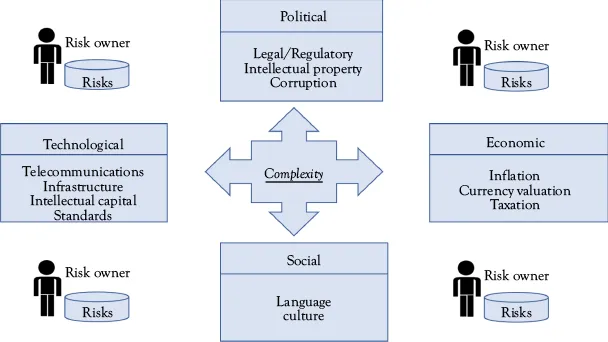
The many additional factors that a global project manager must consider effectively increases the overall project risk. Like any project risk uncovered by the project team, the risks associated with the global environment may be identified, analyzed, ranked, and linked to appropriate risk responses. Given the special nature of the global macroenvironment, a separate and distinct “global risk register” may be created to track and keep an ongoing appraisal of global risks. Further, in large-scale projects—which global projects often are—it is recommended to have a project team member assigned to “own” and lead the project team in managing these risks (Figure 1.2).
Figure 1.2 Global risk and risk owners
One reason for approaching global project risks in this manner is that the logistics of implementing risk responses is likely to be far more complex than that involved in purely localized risk responses. It is simpler to call a meeting with local suppliers to resolve an issue, but addressing problems with suppliers and contractors in Eastern Europe, India, and Asia—at the same time—presents unique difficulties. The scale of global risks that materialize into issues are likely to reach the scope of a major subproject. It is for this reason that in-depth global project risk identification, risk analysis, and risk response scenario planning is assigned to and carried out by the owner of the global project risk register.
Start with “SWOT the PEST”
The Guide to the Project Management Body of Knowledge (PMBOK) includes knowledge areas associated with each discipline required for carrying out each of the process groups. There is no single process group associated with managing a project within the global environment—but perhaps there should be. At minimum, a project team could create, as is required in most kno...