Key Texts for Latin American Sociology is the first book to curate and translate into English key texts from the Latin American Sociological canon. By bringing together texts from leading sociologists in Argentina, Brazil, Peru, Chile, Costa Rica, Mexico, Bolivia, and Uruguay, the book provides comprehensive coverage of a wide range of issues in Latin American Sociology; drawing attention to embedded issues such as inequalities, identities, development, oppression and representation.
This volume is the result of five years of collaboration between colleagues from 15 Latin American Countries, coordinated by Fernanda Beigel (CONICET, UNCuyo, Mendoza-Argentina) with the collaboration of the ?Key Texts Scientific Committee?, the Committee consists of the following members: Nadya Araujo Guimaraes (PPGS-USP, Brazil), Manuel Antonio Garretón (Universidad de Chile), Raquel Sosa Elizaga (CELA-UNAM, México), Jorge Rovira Mas (Universidad de Costa Rica), Breno Bringel (IESP-UERJ, Brazil), Joao Ehlert Maia (FGV, Brazil), Hebe Vessuri (IVIC, Venezuela), André Bothelo (UFRJ, Brazil), Carlos Ruiz Encina (Universidad de Chile), Eloisa Martin (UFRJ, Brazil), Sergio Miceli (PPGS- USP, Brazil), Alejandro Moreano (UCE, Ecuador), Elizabeth Jelin (CONICET-IDES, Argentina), Patricia Funes (UBA-CONICET, Argentina), Claudio Pinheiro (FGV, Brazil), Pablo de Marinis (UBA, CONICET, Argentina), Diego Pereyra (UBA, CONICET, Argentina), José Gandarilla Salgado (CIICH-UNAM, México), Juan Piovani (UNLP-CONICET, Argentina).
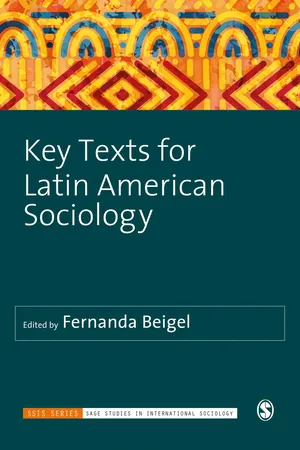
eBook - ePub
Key Texts for Latin American Sociology
- 456 pages
- English
- ePUB (mobile friendly)
- Available on iOS & Android
eBook - ePub
Key Texts for Latin American Sociology
About this book
Information
Publisher
SAGE Publications LtdYear
2019Print ISBN
9781526490254
9781526490261
Edition
1eBook ISBN
9781526492661
Part One Founding Problems Introduction To Part One
1 Founding Problems and Institutionalization of Sociology in Latin America1
How did the institutionalization of sociology as a social science discipline in Latin America come about? What relation does this process have with the founding problems of Latin American sociology? This presentation seeks to offer some answers to these questions, while relating to the key texts presented in this section.
Sociology appeared in Europe in a historical and social setting marked by transformations such as those brought about by industrial capitalism, a rapidly growing proletariat and social and political struggles, including socialist ideals. This was the period of the birth and establishment of bourgeois society. In the United States (US), this context had its own variants: the process of urbanization experienced at the end of the nineteenth and beginning of the twentieth century, social problems derived from inequality in the cities, racism and criminality; these issues stimulated social concern and the formation of the first entities devoted to this practice in the US.
As an intellectual practice that conceives itself within the social sciences in a rigorous sense, Sociology is a fruit of modern Eurocentric reasoning. The founding fathers of the first and most eminent sociological schools of thought – Marx, Durkheim and Weber – emerged in the second half of nineteenth-century Europe. The recognition of the discipline and the gradual expansion of its institutionalization in departments at universities came later: in Europe and the US, in the first half of the twentieth century, with a few prior exceptions.
The development of sociology in Latin America began in a historical period with a very different economic, political, cultural and institutional framework. At the end of the nineteenth and beginning of the twentieth century several academic activities preceded sociology’s institutionalization. One of these was the presence of courses dedicated to sociology in the faculties of philosophy and law, mostly of a theoretical and speculative nature. The elaboration of studies and institutional diagnostics were carried out by State functionaries – but it was not a usual procedure. More significantly, writers, essayists and philosophers conducted studies on Latin American reality becoming a widespread practice (Solari, Franco and Jutkowitz, 1981; De Sierra, Garretón, Murmis and Trindade, 2007).
In a strict sense, the institutionalization of Sociology as a social science in Latin America, begins in the 1930s and 40s, in countries such as Brazil and Mexico, and finishes only by the mid-1970s, in Central America. Some of the emblematic institutions of this period are: in São Paolo, the Free School of Sociology and Politics (1933) and the journal Sociología (1939) (Trindade, 2007); and the Institute of Social Research (1930 and 1939) and the Revista Mexicana de Sociología (1939), both in the National Autonomous University of Mexico (UNAM) (Reyna, 2007). Later on came the Central American Program of Social Sciences and the journal Estudios Sociales Centroamericanos (founded in 1971–72 by the public universities in the sub-region), and the launch of the Central American Sociology School (1973) at the University of Costa Rica, with a broader regional scope (Rovira Mas, 2007: 68).
The institutionalization of sociology picked up speed after the 1950s, but observed regionally, its development was and continues to be an unequal process in terms of professionalization, quality and temporality. After the Second World War and the creation of the United Nations (UN) in 1945, new topics emerged in the international agenda. One of great relevance, was that of the development of the nations. In 1948, the Economic Commission for Latin America and the Caribbean (ECLAC) was created within the UN, with headquarters in Santiago, Chile, led by the prestigious Argentinian economist Raúl Prebisch (1901–1986). His influence was decisive in the generation of an original approach, enriched by Latin American experiences: ECLAC structuralism and its concept of center–periphery as the main dynamic of international economy. With this focus, explanations were sought regarding the factors which influenced the underdevelopment of the region and to promote structural changes in these economies. The influence of this perspective on the economy and economic policies committed to development lasted at least three decades. Both governmental officials and social science practitioners shared this project throughout Latin America.
In political terms, in the context of the Cold War, Latin American countries oscillated between representative democracies and dictatorships. Mexico was one of the intermediate cases. Meanwhile, cultural and educational institutions – universities included – began to grow quantitatively, with massive student access and a diversification of their curriculum, due in part to the demographic explosion in Latin America. At the beginning their infrastructure was weak and the professionalization of teachers and researchers was incipient, for the aim of the first ‘sociologists’ was the founding of an academic discipline differentiated from other activities in the social sciences and humanities, led by a group of scholars who would form and settle in the emerging specialized institutions. Fundamental to this process was the new concept of sociological practice which began to gain ground throughout the 1950s: a new appropriation of cognitive resources was required in sociological theory as well as training in systematic procedures to cultivate empirical research – and techniques, including statistics. All of these elements were joined methodologically to generate new knowledge on the local social reality and problems. The disciplinary references were the United States and France, countries considered to be at the vanguard of global scientific developments.
A first conflict generated in this process occurred between the carriers of this modern concept of the discipline on the one hand, and those who defended a practice in which theory was overvalued and research techniques were undervalued or used with poor and outdated skills, on the other hand. The generation of methodologically controlled data collection was disparaged by the latter, where the essay was prevalent in the communication of sociological analysis. In the context of this dispute – with a high profile or diffuse presence depending on the country – the first group was identified as the bearers and representatives of scientific sociology and the second as chair sociology (Franco, 1979). This conflict was manifest throughout the decade in forums of importance such as the congresses of the Latin American Association of Sociology (ALAS), the first sociological entity of regional scope worldwide, founded in 1950 (Blanco, 2005).
The pledge for scientific objectivity became the organizing principle of those seeking to institute a modern scientific approach to research and teaching. Along with this, the practice of social science became a clear and conscious discipline independent from political inclinations or preferences. This did not entail the scientist quitting, as a citizen, from political participation in society (Franco, 1979: 239–241).
Among the important figures of this scientific sociology is the Spaniard José Medina Echavarría (1903–1977), who emigrated to Mexico after the Spanish Civil War, where he performed an outstanding labor of institutionalizing sociology. At the beginning of the 1950s, at the invitation of Prebisch, he moved to Chile to work at ECLAC. He was the first Director (1958–1959) of the Latin American School of Sociology (ELAS) within the Latin American Faculty of Social Sciences (FLACSO) (Franco, 2007), a regional institution, founded in 1957 with support from the Chilean State, along with the United Nations Education, Science and Culture Organization (UNESCO). Apart from contributing to a modern concept of sociology, Medina brought a sociological focus to the issue of development, which enriched ECLAC and brought more complexity to its vision.
A second relevant scholar identified with scientific sociology and certainly emblematic to this day, is the Italian-Argentine Gino Germani (1911–1979). His work, The Social Structure of Argentina (1955), is exemplary of the possibilities for the modern practice of sociology and exerted a powerful influence on the new generations, shoring up the new perspective. He was very influential in the design of the School of Sociology established in 1957 at the University of Buenos Aires, and the renovation of the previously existing Institute of Sociology (1940), which he directed in the 1960s and now bears his name. Germani made use of the sociological theory of modernization, of US origin, to guide his theoretical reflection and empirical research on Argentina and Latin America.
Two prominent Brazilian sociologists during this foundational period were Florestan Fernandes (1920–1995) and Alberto Guerreiro Ramos (1915–1982). The first was influential in the 1950s as a mentor in the group that became known as the Paulista School of Sociology – in which Fernando H. Cardoso and Octavio Ianni were formed, among others. Guerreiro Ramos, while sharing the modernizing ideals of the discipline, raised the need for a style of knowledge production that would reveal the cultural and historical conditions from which sociological practice was to be implemented. This should be rooted in a critical perspective, according to him, on the specific and more pressing problems in Brazilian society.
Another outstanding figure of this period was Orlando Fals Borda (1925–2008), a Colombian, trained at the University of Florida (USA), where he earned his PhD in Sociology in 1955. He was the founder of the Department of Sociology at the National University of Colombia in 1959 and an active part of a generation that renewed and modernized sociology with an approach that recognized the value of empirical research. However, in the prevailing political climate in his society, of full-fledged poverty, inequality and violence, his research in rural areas of Colombia drove him in the course of the next decade to an approach of sociology explicitly committed to the disadvantaged sectors of society. He further postulated a methodological approach different to the canon prevailing since the 1950s: Participatory Action Research (PAR), one of the key texts included in this volume.
Chile managed to attract a significant number of international institutions of the social sciences that proliferated with the support of the UN, achieving an outstanding institutional presence. The establishment of the ECLAC in Chile – a prominent magnet – and FLACSO has already been highlighted. Others were the Latin American and Caribbean Demographic Center (CELADE, established in 1957), the Latin American Institute for Economic and Social Planning (ILPES, created in 1962), and the regional office for Latin America of UNESCO, among many others. Beigel and her team (Beigel et al., 2010) have studied the dynamics by which a regional academic circuit in the social sciences was generated with some degree of autonomy in the Southern Cone, with its axis in Chile. This autonomy can be larger or smaller depending on the historical and structural context, i.e., determining the elasticity of the autonomy of the academic fields. Some features of this process explain the next period of Sociology, ranging from the 1960s up to the early 1970s. The first such feature was a favorable political climate for university education and research, as well as scientific and intellectual debate, in contrast to the process in Argentina and Brazil. A second factor was advances in the formation of educational institutions – mainly universities – led by the elites with State support, seeking to diversify social sciences. These elites were very proactive in bringing international organizations to Santiago, invigorating the conditions of institutionalization of these disciplines, especially sociology and economics. Among the Chilean universities that played a key role during these years, each with international support from other academic networks, were the University of Chile (public) and the Catholic University of Chile (private). Both of these generated nu...
Table of contents
- Cover
- Half Title
- Acknowledgements
- Title Page
- Copyright Page
- Contents
- About the Editor
- About the Contributors
- Acknowledgments
- Introductory Study Latin American Sociology: A Centennial Regional Tradition
- Part One Founding Problems Introduction To Part One
- 1 Founding Problems and Institutionalization of Sociology in Latin America1
- 2 A Critical Introduction to Brazilian Sociology: Canned Sociology versus Dynamic Sociology1
- 3 Theoretical–Practical Experiences: General Working Guidelines on Participatory Action Research (PAR)1
- 4 Of Don Quixote and Windmills in Latin America1
- 5 On the Pessimism in the Social Sciences1
- 6 The Foundations of a New Issue: Gender, Human Rights and Memory1
- Part Two Historical and Contemporary Debates Introduction To Part Two
- 7 Understanding Historical and Contemporary Debate in Latin American Sociology: Enlightening Paths
- 8 Building Theory1
- 9 The Struggle for Surplus1
- 10 Development (Again) in Question: Trends in Critical Debates on Capitalism, Development and Modernity in Latin America1
- 11 The ‘American’ Modernity (Keys to Its Understanding)1
- Part Three Social Structure and Inequalities Introduction To Part Three
- 12 Inequality, Inequalities
- 13 The Problem of Race: Approaching the Issue1
- 14 The Weight of the Past1
- 15 The Dynamics of Inter-ethnic Relations: Classes, Colonialism and Acculturation1
- 16 Marginality and Social Exclusion (Fragments)1
- 17 Households, Families and Social Inequalities in Latin America1
- Part Four Identities, Actors and Social Movements Introduction To Part Four
- 18 Latin American Perspectives on Social Movements Research
- 19 Ch’ixinakax utxiwa: A Reflection on the Practices and Discourses of Decolonization1
- 20 New Players Came on Stage – São Paulo Workers’ Experiences, Language, and Struggles (1970–1980)1
- 21 Latin American Feminisms and Their Transition to the New Millennium (A Personal Political Reading)1
- 22 Trade Union Models in Latin America, Before and After1
- Part Five State, Society and Politics Introduction To Part Five
- 23 Politics, State and Society in Latin American Sociology: A Partial Introduction
- 24 The Secular Roots of a Difficult Nation-building1
- 25 The Populist Turn and the Center-Left in Latin America1
- 26 On Certain Aspects of the Crisis of the State1
- 27 Political Activism in the Era of the Internet1
- Index
Trusted by 375,005 students
Access to over 1.5 million titles for a fair monthly price.
Study more efficiently using our study tools.
Frequently asked questions
Yes, you can cancel anytime from the Subscription tab in your account settings on the Perlego website. Your subscription will stay active until the end of your current billing period. Learn how to cancel your subscription
No, books cannot be downloaded as external files, such as PDFs, for use outside of Perlego. However, you can download books within the Perlego app for offline reading on mobile or tablet. Learn how to download books offline
Perlego offers two plans: Essential and Complete
- Essential is ideal for learners and professionals who enjoy exploring a wide range of subjects. Access the Essential Library with 800,000+ trusted titles and best-sellers across business, personal growth, and the humanities. Includes unlimited reading time and Standard Read Aloud voice.
- Complete: Perfect for advanced learners and researchers needing full, unrestricted access. Unlock 1.5M+ books across hundreds of subjects, including academic and specialized titles. The Complete Plan also includes advanced features like Premium Read Aloud and Research Assistant.
We are an online textbook subscription service, where you can get access to an entire online library for less than the price of a single book per month. With over 1.5 million books across 990+ topics, we’ve got you covered! Learn about our mission
Look out for the read-aloud symbol on your next book to see if you can listen to it. The read-aloud tool reads text aloud for you, highlighting the text as it is being read. You can pause it, speed it up and slow it down. Learn more about Read Aloud
Yes! You can use the Perlego app on both iOS and Android devices to read anytime, anywhere — even offline. Perfect for commutes or when you’re on the go.
Please note we cannot support devices running on iOS 13 and Android 7 or earlier. Learn more about using the app
Please note we cannot support devices running on iOS 13 and Android 7 or earlier. Learn more about using the app
Yes, you can access Key Texts for Latin American Sociology by Fernanda Beigel, Fernanda Beigel,SAGE Publications Ltd in PDF and/or ePUB format, as well as other popular books in Social Sciences & Sociology. We have over 1.5 million books available in our catalogue for you to explore.