Stepping Out Into University As A Nursing Or Midwifery Student
So you’ve gone and done it! You’ve consciously taken that first step through the university doors to start your nursing or midwifery programme. Excited, scared or a bit of both? You’ve thought about this a great deal and you’ve prepared as best you can, and the way you see it this day has been a long time coming and you can’t wait to get started. There’s a great buzz around the university – meeting new people, where’s the lecture hall, oh, there’s the library, grab a quick coffee, check out the computing hub – and it seems like everybody’s in the same boat. Or are they? Sure your goal is the same – pass everything, get a good degree and land that job, but...
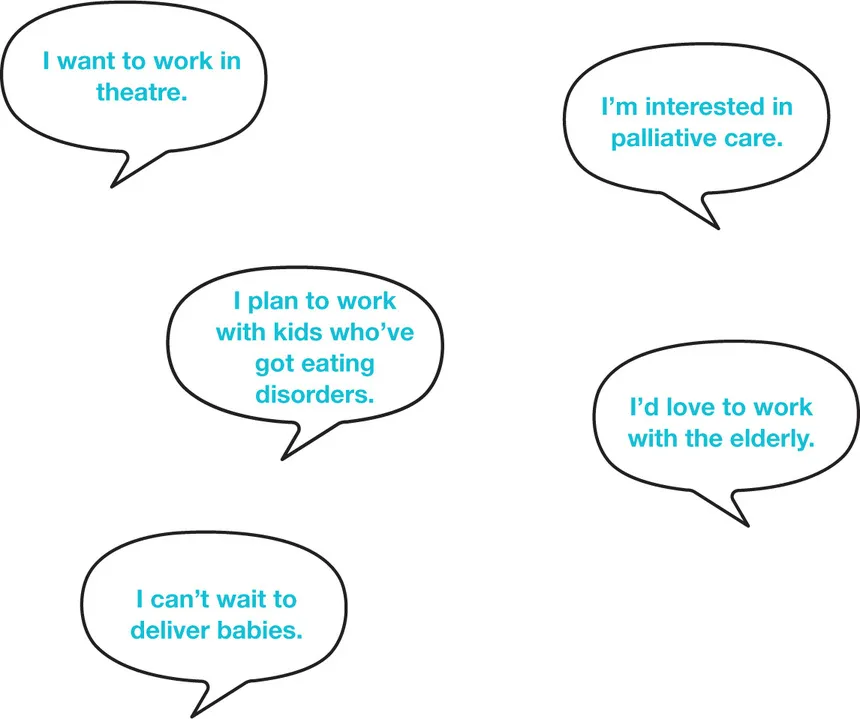
Great! You’ve all an idea of what you want to do then. So first things first – what brought you here? What key qualities can you offer to this profession and how can you use them in your studies and practice learning placement?
Activity 1.1 Professional Domains, Personal Qualities – Advertise Yourself
Go on tell me – advertise yourself, promote your uniqueness, but please, keep it real!
Figure 1.1 Professional domains, personal qualities – advertise yourself
So that’s you! Now this is us and what we can offer – and yes, we’ll keep it real too. Nursing and midwifery are great professions – personally satisfying and extremely rewarding. But step out into this programme and your life will change forever. It’s extremely demanding and is a programme unlike any other at university; 50 per cent learning the theory at university and 50 per cent putting what you’ve learned into practice on clinical placement over your three to four year programme. In your practice learning placements, you’ll work day shifts, night shifts, weekends too, while trying to keep up with university assignments and juggling everything else in your life. Early starts, late finishes, long days! So are you ready for all this?
Okay here it is – evidence-based learning, case-based learning, problem-based learning, inter-professional education, lectures, tutorials, seminars, workshops, clinical skills simulated environments, online learning materials and resources, practice placement learning. Oh, and don’t forget the self-directed learning. Then there’s the assessment of all that – timed written exams, short answer questions, online modules, drug calculations, multiple choice questions, reflective journals, ongoing achievement records, case studies, learning logs, oral presentations, objective structured clinical assessments (OSCAs), objective structured clinical examinations (OSCEs), essays, reports, blogs, wikis, posters, a dissertation.
And so back to you – there’s your self-directed study (O’Shea 2003), matching up the reality of what happens in practice with what you’ve learned in the classroom, adding new knowledge to what you already know, learning new skills like critical thinking, critiquing, reflection, academic writing, note-taking, referencing, researching, communication, dealing with emotions, advocacy, infection control, oh, and avoiding plagiarism. Then there’s the NMC Code (2015a) and their Standards for Competence (2014) to uphold, and there’s also understanding professionalism – what you can and can’t say or do, how to deal with difficult situations, how to report unprofessional behaviours, and how to keep yourself safe as a professional. Add to that - learning who’s who and what they do in your university, sorting out your support needs, accessing what you need exactly when you need it. Phew! It reads like an encyclopaedia, I know, but just think of the end result – supported studies, personal support, your career taking shape, entry to a lifelong profession, worldwide and endless opportunities, a rewarding life.
Well, is it everything you expected when you signed up to the nursing or midwifery profession? Are you ready to take it all on board? You are! Then it’s over to you now. You’ve stepped out into university; we’ll give you the tools to manage it all. Take responsibility, keep your finger on the pulse and you’ll surely stay ‘on course’!
Nursing And Midwifery Council Standards And Competencies And Professional Code
Rules, regulations, professional expectations – we can’t avoid them. All institutions have them and all professional bodies are enshrined in them, and the NMC is no exception. So what exactly is the NMC?
Well, it’s a professional body whose main aim is to protect both patients and the public by monitoring the personal and professional activity of nurses and midwives working in the United Kingdom (UK), whether in the National Health Service (NHS) or private settings. It also protects nurses and midwives by setting standards and providing guidance on all aspects of practice. So how about some key NMC facts:
- It’s directly accountable to the UK Parliament.
- It’s governed by an independent council.
- It maintains a register of all registered nurses and midwives who’ve completed their initial training, met and continued to uphold the registration standards, and so are eligible to practise.
- It sets out a code of conduct, which all nurses and midwives must adhere to throughout their professional career, regardless of the setting – NHS or private healthcare, hospitals, the community, prisons, social care, education.
- It sets standards for pre-registration nursing and midwifery education, and supports learning and assessment of students in practice.
- It investigates and acts upon any concerns about a nurse’s or midwife’s conduct or actions.
So what does this mean for you – the student nurse or midwife? After all, it’s your professional body too!
Well, as soon as you sign up for a student nursing or midwifery programme, you’re automatically bound by the NMC Code (2015a) and its standards. From your first student placement, you’ll be in the privileged position of caring for people from all walks of life, cultural backgrounds and ages, and so you’re expected to act professionally, with honesty, integrity, respect and confidentiality at all times. A tall order, we know! But to manage all this, you’re given guidelines that support and protect you, your patients and the staff you’re working with. So what are these guidelines?
The Code (NMC 2015a) sets out four key domains (Figure 1.2), within which all nurses and midwives need to achieve the following outcomes:
Figure 1.2 NMC four domains
Within these four key domains, you’ll find knowledge, skills and values that all nurses and midwives need to meet to achieve specific levels of competence. As a student nurse or midwife, you too are expected to achieve specific competencies in practice from day one of your programme of study.
Well, it’s a way of demonstrating that you’ve achieved a specific level of knowledge and understanding that enables you to practise safely as a nurse or midwife. Exactly that! Without this, you can’t be registered to practise. So reflect – how can you place this principle at the heart of your professional values, not only in your formative years in nursing or midwifery but in your professional role as a clinical practitioner? Have you considered too how all this might affect your personal life and how different things will be from now on?