Critically examining the fears that commonly surround young children?s play involving digital technologies, this book seeks to address each of the negatives and present the positive possibilities of technology when it comes to early childhood. Using observations of children in play and cutting-edge research, this book will empower students and build their confidence so that they are able to challenge perceptions and think creatively about how they can use technology. Each chapter includes case studies, research spotlights, activities and annotated further reading to help students develop their critical thinking, deepen their research and connect theory with practice.
Digital play in the everyday life of young children
A 3-year-old girl and her 18-month-old brother are playing games through the ‘Sarah and Duck’ app on their mother’s phone while she tidies up around them. ‘Sarah and Duck’ is a programme, produced by the BBC, that they love to watch on television, and they are excited about interacting with the characters from the show through the app on the phone. The app involves a sequence of games: from playing virtual snap, to ‘tidying up’ Sarah’s toys on screen by dragging them to the right place, and brushing the characters’ teeth through the movement of the finger on the screen. The 3 year old is concentrating and perseveres with each game, even though she is relatively inexperienced with the touch screen and finds the ‘drag and drop’ motion quite difficult. She is frowning and hunched over, looking at the screen with intensity and not engaging with those around her. Her younger brother is excited about seeing the characters, especially ‘Duck’. He points at the phone repeatedly, smiling widely and making eye contact with his mother, and says ‘duck’ and ‘quack’ many times. Sometimes he jabs at the phone and his sister gets frustrated that he is getting in the way and ‘ruining the game’.
Asking open questions about digital play
Even though this observation is simple – just a few minutes’ worth of observation of a common form of everyday digital play – there is a lot going on here. An observation like this stimulates many questions about young children’s learning, development, social interaction, imagination, physical activity, creativity and so much more. We can see an observation like this in different ways. We might feel concern about the 3 year old’s experience; we might read her furrowed brow and the way she pushes her younger brother away from the screen as evidence of an unhealthy fixation on the screen – a fixation that hinders her social development. On the other hand, we might see this activity as a fundamental part of the children’s developing interests and passions, enabling them to apply their knowledge about the world; after all, the 18 month old seems to be mostly experiencing excitement about his recognition of the duck character on screen. Through his pointing and facial expressions he is using the digital play as a way of connecting with others. We might see the mother’s apparent lack of involvement (though the app is on her phone) as an opportunity for independent learning, or we might feel that it is a missed opportunity to mediate the digital play experience for one or both of the children.
A few minutes of observing digital play can lead to lots of questions, and it is often the case that these questions will come loaded with judgements rather than being genuinely open questions. This is because the issue of children’s digital play tends to be a forum for intensive and often harsh judgement and typically one in which children’s lives are deemed to be ‘problematic’. When you read the observation above, what impressions and judgements do you form immediately? If some of your evaluation of the situation was negative (e.g. the children are too passive, they should not be left alone, the screen will damage their eyes, the screen is getting in the way of meaningful interaction, ‘this is not real play’), then this is not that surprising given the popular media discourses that surround children’s digital play. Most media headlines relate to this judgement: children are losing out, for all sorts of reasons, through their digital play. You can see this for yourself now if you search online for recent news stories about children’s digital engagement; you will probably find that of the top five headlines, the majority of these relate to a sense of concern and the idea that contemporary children’s engagement in digital play constitutes a ‘problem’.
These concerns are of course important. We need to address the potentially negative issues that surround digital play, and this book aims to do this. But it also aims to organise itself around more open questions about children’s digital play that are less overwhelmed by judgement. By asking open questions, we can respond to the concerns that surround digital play but also explore the opportunities that emerge through children’s digital play. This book aims to model a genuine spirit of open inquiry around the timely issue of digital play in early childhood. The book is also an invitation to explore together through research and theory, but also through our personal and professional observations, reflections and experiences.
This introductory chapter will first explain who I am and my motivations for writing this book; it will then suggest why you might read this book and offer some guidance about how to get the most from the experience. Finally, you will find some brief chapter overviews so that if you are interested in particular aspects of digital play (e.g. imagination, social interaction, physical activity or more), then you will know where to find what is most relevant to you.
A bit about me
I currently teach as a Senior Lecturer at Middlesex University in London on two undergraduate degree programmes: Education Studies and Early Childhood Studies. In this role, I lead two optional modules – one about children’s play, and the other about children’s creativity. A key aspect of these modules stems from how children’s digital engagement is changing the way that children play and enact their creativity. Over the years, I have seen my students trying to make sense of what happens to play and creativity when digital technologies become a fundamental part of children’s everyday experiences. I have seen my students struggle with the questions ‘Does digital play count as real play?’ and ‘Can children be as creative when they are engaging in digital environments?’. I have also seen the extent to which popular media headlines about children’s digital engagement have influenced how my students see these issues. When we look at digital play, or children’s creativity in digital environments, I have been surprised that most of my students have an underlying assumption that digital technologies must be bad for children. They believe this even though they themselves are constantly engaging with their own digital technologies – most often their smartphone. I try to help my students to see that we need to see children’s digital play through a more open-minded lens, and that we need to ask genuine questions about what is going on rather than jumping to conclusions about the worth (or lack of worth) of digital play in children’s lives. In that respect, this book is a continuation of my teaching.
As well as teaching about digital play, my research over the last 8 years has focused on understanding more about what is going on when children engage in digital play. I have conducted research in nurseries, schools and homes, observing children as they engage with digital technologies. I have analysed these observations looking for different aspects of behaviour and interaction including 1) the emotional dynamics of a situation and how they are influenced by the flow of digital play, 2) opportunities for creativity and collaborative creativity within different digital play environments and 3) how the activity of play moves between different spaces – between the digital environment but also around different elements of the physical environment. Overall, these research projects, alongside a growing body of research conducted by an international range of researchers, have demonstrated that while digital play has some distinct properties, children can essentially still be playful and creative in the context of digital environments. What the research suggests in no way corresponds to the panic and anxiety that is conveyed through media headlines about children’s digital engagement. So as researchers, students and practitioners in early childhood, we have a duty to take a step back from the popular discourses that surround children’s digital play and look afresh at what is going on and what it means for children’s learning and wellbeing.
A final thing I would like to mention here is that I am also a mother to two small children. On the most personal level, I am involved in the debates around children’s digital play. I often wonder about which digital technologies to have in the house, which to make available to the children, when to make them available, and how to mediate and monitor what is going on in their digital engagement. You might have guessed that the observation at the start of this chapter actually relates to my own two children. The phone they are playing with in the observation is my phone. All the many questions that arise around the observation are my questions as a mother too: Should the children be playing with this app? Is there something better they could be doing with their time? How should I manage the interaction between the children as they are playing on the app, particularly when they are each engaging with the app in such a distinct way? Should the app just be for the 3 year old, even though the 18 month old seems to be enjoying it so much? Was I right to leave them to play with the app, or should I have been more involved? Did they end up playing with the app for too long, or for not long enough? What did they learn through their engagement with the app? What if they did not learn anything, and just found it fun – is this still a meaningful experience? These are just some of the questions that I have around this kind of experience.
Given that you are probably a student or practitioner in early childhood, and/or perhaps you are a parent yourself, I am sure that the issues around digital play that this book discusses are personal to you too. I am not asking you to leave your own experiences, observations and reflections at the door. As explained more in the following sections, your own personal take on what is going on is an essential part of the dialogue around children’s digital play. Your thoughts and opinions, coupled with critical questioning, are a fundamental part of the project represented by this book.
My motivations for writing this book
As evident in the section above, my motivations for writing this book relate to both my professional and personal involvement in early childhood education and care. In both spheres of experience, the last 10 years have seen a whirlwind of excitement and controversy – fuelled by popular media – about children’s digital engagement and the significance of their digital play as part of their everyday lives. For most of the students and practitioners who I work with, the response to this whirlwind has predominantly been one of confusion. They are unsure how to respond. Should they embrace the growth of digital play as a core part of children’s lives, and build in more time for this when being with young children, or should they impose some kind of ‘digital detox’ in order to safeguard children from the excesses of contemporary culture?
Often when I see practitioners and students engaging with the issues, they take up one extreme position or the other so that either they are ‘in favour’ of digital play or they are ‘against’ digital play. But positioning the debate in terms of these two extreme positions is perhaps not so helpful and might be adding to our confusion about what to do as part of our everyday lives. I am convinced that a more helpful position to adopt is one great big step back! Rather than trying to find one definitive answer to the ‘problem’, perhaps we need instead to be prepared to watch and listen intently and ponder what is going on when children engage in digital play. Only then can we become more aware of the myriad opportunities and concerns that are folded into their experiences of digital play.
As individuals working in the early childhood education sector, we are normally experts in observation. Watching, listening and feeling intently is what we are good at, and that is what we can contribute when it comes to making sense of digital play. I wanted to write a book that represents and models this approach in action – prioritising observation and reflection over judgement. At the same time, I did not want to skirt around the issues that concern people the most. It is important to recognise that so many adults in our society do see digital play as a problem, and for all different sorts of reasons, and we need to engage with these popular perceptions and discourses rather than dismissing them. This explains the book’s subtitle: ‘What’s the problem?’ The book engages with the different ‘problems’ that are presented in relation to digital play in early childhood. In fact, each chapter centres on a particular type of ‘problem’ that digital play in early childhood is often taken to constitute, whether this is physical activity/inactivity, or declining rates of outdoor play and the blame that has been heaped on digital play in relation to this decline. However, each chapter then goes on to unpick the evidence and theoretical perspectives that help us to consider that ‘problem’ perspective with more criticality and apply a spirit of curiosity and possibility thinking in relation to the future.
Most excitingly, children’s digital play is not something that is static and set. The nature of digital play and what it involves is still under construction. We might think that others are responsible for its construction, such as digital games designers and producers, but this is not the case. The digital play industry responds to the needs and opportunities that practitioners and parents vocalise. By creating a stronger vision around children’s digital play, we can make a radical contribution to the future of digital play. I often hear my students saying something like ‘children are so lazy now in terms of their imagination; digital technologies just imagine everything for them so that they don’t have to’. However, a statement like this suggests that digital play is just what it is and cannot be designed in such a way as to encourage a more imaginative approach among children. Are we so sure that there aren’t particular digital play experiences that are deeply imaginative? And even if there are not any currently, would it be so impossible to design a digital play experience that is deeply imaginative? In this respect, we need to be more open, more optimistic and more curious about the future of digital play. As we come to articulate what it is that we want children to experience through their play – including through their digital play – we can have a vital influence on the development of digital play experiences designed for children. So this book is also an experience of brainstorming the future of digital play, so that we can work towards a future of digital play that is truly inspiring.
Good reasons for reading this book
Readers of this book will be bringing different levels and types of experience. You might be a student of early childhood, you might be a practitioner in an early years setting, or you might see yourself first and foremost as a carer wanting to take a more critical perspective on your children’s digital engagement. Regardless of your particular role in relation to young children, you will have picked up this book because you want to make sense of the rise in children’s digital play and what it means in relation to play, learning and wellbeing. I hope that you will already have developed some criticality in relation to the common voices you hear in the popular media, and that you are interested in engaging with research, theory, reflections and observations in order to think about digital play more deeply. This book will help you to ask open questions about digital play and engage critically with different forms of evidence and insights that have been generated about children’s experiences of digital play. You will probably find by the end of reading the book that you are actually asking more questions about digital play than you did previously. This is excellent – open questions about digital play in a spirit of genuine inquiry are exactly what is needed, and are a great indicator that you are developing academically and even have the potential to carry out research in this field.
How to get the most out of your reading
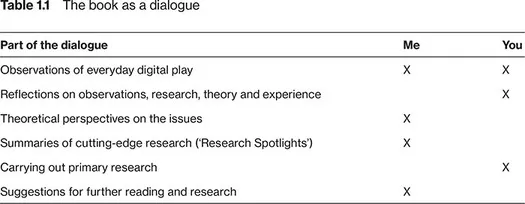
This book is not just about ‘reading’, or at least not as you might think about ‘reading’ at the moment. It is about actively engaging in a complex dialogue between different forms of knowledge: observations, reflections, cutting-edge research studies, distinct theoretical perspectives and your own primary research findings. Some of the parts of the dialogue will come from the book, but many will come from you. In Table 1.1, you can see how the contributions are divided up between me and you:
Table 1.1
You will see from Table 1.1, that there is a back and forth dialogue between the book and you. The more you bring to your part of the dialogue, the more you will get from the book. For example, in a typical chapter you will find that there are observations of everyday experiences among children that help you to see issues applied in a naturalistic context, but as well as the observations that are shared by me, there will also be multiple invitations to you to conduct your own observations. You will find ‘Reflection Activities’ at various points throughout each chapter; these questions are designed to encourage you to actively respond to what you have read and to apply the ideas to the particular context that you find yourself in. ‘Research Spotlight’ sections in each chapter summarise cutting-edge research around digital play in relation to the topic of the chapter, but you will also find ‘Research Activities’ at the end of each chapter with ideas for primary research that you could do yourself around the issue.
Beyond the questions and the activities that are explicitly asked of you, practise bringing your criticality to every single part of what you r...
Table of contents
Cover
Half Title
Publisher Note
Title Page
Copyright Page
Contents
About the Author
Acknowledgements
1 Introduction
2 Digital Technologies and Social Interaction
3 Physical Engagement and Sensory Experience in Digital Play
4 Digital Technologies and Outdoor Play
5 Imagination and Creativity in Digital Environments
6 Digital Play and Media Literacy
7 Managing Attention in Digital Environments
8 Digital Play and a Child’s Sense of Self
9 Digital Play in Context
10 Conclusion
References
Index
Trusted by 375,005 students
Access to over 1.5 million titles for a fair monthly price.
Study more efficiently using our study tools.
Frequently asked questions
Yes, you can cancel anytime from the Subscription tab in your account settings on the Perlego website. Your subscription will stay active until the end of your current billing period. Learn how to cancel your subscription
No, books cannot be downloaded as external files, such as PDFs, for use outside of Perlego. However, you can download books within the Perlego app for offline reading on mobile or tablet. Learn how to download books offline
Perlego offers two plans: Essential and Complete
Essential is ideal for learners and professionals who enjoy exploring a wide range of subjects. Access the Essential Library with 800,000+ trusted titles and best-sellers across business, personal growth, and the humanities. Includes unlimited reading time and Standard Read Aloud voice.
Complete: Perfect for advanced learners and researchers needing full, unrestricted access. Unlock 1.5M+ books across hundreds of subjects, including academic and specialized titles. The Complete Plan also includes advanced features like Premium Read Aloud and Research Assistant.
Both plans are available with monthly, semester, or annual billing cycles.
We are an online textbook subscription service, where you can get access to an entire online library for less than the price of a single book per month. With over 1.5 million books across 990+ topics, we’ve got you covered! Learn about our mission
Look out for the read-aloud symbol on your next book to see if you can listen to it. The read-aloud tool reads text aloud for you, highlighting the text as it is being read. You can pause it, speed it up and slow it down. Learn more about Read Aloud
Yes! You can use the Perlego app on both iOS and Android devices to read anytime, anywhere — even offline. Perfect for commutes or when you’re on the go. Please note we cannot support devices running on iOS 13 and Android 7 or earlier. Learn more about using the app
Yes, you can access Digital Play in Early Childhood by Mona Sakr,Author in PDF and/or ePUB format, as well as other popular books in Education & Education General. We have over 1.5 million books available in our catalogue for you to explore.