Just Teach! in FE is a straightforward, helpful, engaging and reliable read for all beginning teachers. It focuses on the needs of the teacher and the learner and outlines this people-centered approach. This focus on the principles of good teaching, and the theory behind them, frees the reader from ever-changing structures and provides truly practical strategies to use from their first lesson.
The text supports beginning teachers to Be organised; Be resourceful; Be resilient and to Just keep teaching. It is an engaging exploration of real teaching in FE and of the pressures and challenges that FE teachers face.
- 144 pages
- English
- ePUB (mobile friendly)
- Available on iOS & Android
eBook - ePub
About this book
Information
Part 1
Introducing people centred teaching and learning
Chapter 1
Introducing people-centred teaching for connected professionals

The context and nature of the FE sector
Explaining ‘people-centred teaching’ and ‘acts of connection’
Working towards becoming a ‘connected professional’
We are all human – which characteristics are addressed by people-centred teaching?
The context and nature of the FE sector
Since the eighteenth century ‘Further Education’ has existed in the UK in a form which has some resemblance to that taking place today. The early work took the form of literary and philosophical societies, the first of which was founded in Manchester in 1781. The Anderson Institute, founded in 1796, was ‘the first in the world to provide evening classes in science and the first to admit women on the same terms as men’ (Walker, 2012: 32). Mechanics Institutes were established in 1823 to provide training in areas that were relevant to industry. Walker (2012: 32) argues that Mechanics Institutes provided ‘a firm foundation on which technical and vocational education was established by the beginning of the twentieth century and has continued to date’. Fisher and Simmons (2010: 7) chart a ‘burst of activity that encouraged growth of technical and commercial post school education’ during the twentieth century. The arrival of the 1944 Education Act placed a statutory responsibility on local authorities to ‘provide adequate facilities’ for what was for the first time named ‘Further Education‘ (Butler Act, 1944). The pace of change accelerated from the 1960s, and more activity across a wider range of subjects and learners, the creation of more sub-sectors and regular changes of sector titles became part of the ongoing context within which teaching took place. By 2015, the somewhat surreal situation had been arrived at where, ‘in the three decades up to the 2015 election there had been 61 Secretaries of State responsible for skills policy in Britain’, and there had been ‘13 major acts of parliament’. As if that isn’t enough, the responsibility for skills policy had changed government department or been shared ‘on ten different occasions’ (Orr, 2016: 19). The Lingfield report (DBIS, 2012) recommended the withdrawal of a requirement for teachers in FE to gain a teaching qualification, only 12 years after it was introduced. At the time of writing another major piece of education legislation, the ‘Technical and Further Education Act, 2017’ has been passed, and this institutes another range of significant changes for the sector. Overall, it is not an exaggeration to argue that FE stands at the centre of a change and policy vortex.
If you work in Primary Education, Secondary or Higher Education, most people outside the sector will have a reasonably clear idea of where that fits in the overall education sector. If you mention ‘primary’ or ‘secondary’ in a conversation, people’s eyes show recognition. Even here though, it has become harder to pinpoint what exactly a primary school or secondary school is called. Within the overall terms ‘primary’ and ‘secondary’ there are now many different types of school, but they are still called ‘primary’ and ‘secondary’ education. Higher Education, although it takes place in places other than universities, also retains a consistent title in its various contexts and locations.
Naming the sector
Naming this sector, which we are calling Further Education in this book, is however a different matter. Other parts of the education sector do not seem to have such an identity crisis. In the last 20 years, FE has had several different titles including Post Compulsory Education and Training, Post Compulsory Education, Lifelong Learning, Learning and Skills, Further Education and Training and currently Further Education and Skills. These are only some of the more ‘official’ definitions (i.e. those favoured or created by governments). There have been many others suggested by writers, organisations and professional groupings, including ‘Further, Adult and Vocational Education’ (FAVE) to name just one. When you are in a conversation with someone who does not work in the FE sector, and you mention ‘Further Education’ or ‘Post Compulsory Education’ people’s eyes become glazed, as they genuinely don’t quite know what you are talking about. This is not a good starting position for the sector.
Defining FE
Despite the regularly changing name, and an underlying difficulty describing just which educational activities are included in FE, it is possible to define what the sector does, if not necessarily what it is called. The best way of defining ‘Further Education’ is by including its component parts. This does not necessarily give you a clear brand of education, but it does at least make clear what is involved. What follows is an inclusive definition, which I created in Crawley (2010) and which will be meaningful to readers, as they will be able to identify their own position in the sector from this definition. For this book, the Further Education sector includes teaching and learning activity in
further education colleges, adult and community learning and development centres, workplace learning organisations, 14–19 college provision, sixth form colleges, public services or armed forces training or offender learning, none of which is delivered by school teachers.
(Adapted from Crawley, 2010: 14)
The size and scale of FE
It is also important to remind ourselves that FE works with a very large number of people.
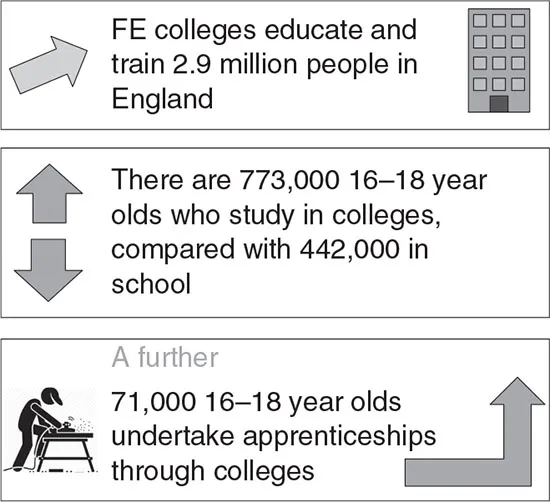
Complex, varied and difficult to name it may be, but the FE sector still educates a very significant number of people each year.
Explaining ‘people-centred teaching’ and ‘acts of connection’

People-centred teaching – Dewey and Freire
There is no shortage of leading thinkers, old and new, who believe that education is and should be centred on people. John Dewey (1859–1952) argued that learning is not just about outcomes or bodies of knowledge but that it is focused on the lifelong growth of the learner as a person with feelings, interests, needs and preoccupations. Dewey insisted that education is the heart of a democratic society, and that members of an educated society would be able to critically engage with each other through their experiences to create a better world. Dewey’s vision was based more on reflecting on the ideas of others than empirical research, but his views remain extremely influential over 100 years later.
Paulo Freire (1973) reinforced this philosophy of education as offering many possibilities to improve the world, and emphasised how it can help people act together for change. His work helping oppressed minorities in South America to become literate contributed to the development of his vision of education as a liberating and empowering process. He argued that learning helps people to increase their understanding of their own situation and, as a result, their own confidence in their ability to do something about it. This growth in confidence and self-awareness can empower individuals and groups to become involved in action together, with the express intent of improving their life situation. These actions then contribute to reducing and ultimately removing the oppression people face and changing their world for the better.
Recent people-centred teaching approaches – Illeris and Jarvis
People-centred approaches to teaching and learning are not however a relic from the past and only found in the works of thinkers who are no longer with us. As the editor of a 2010 book on current educational thought by current educational thinkers, Knud Illeris, who is a professor of lifelong learning at the Danish University of Education (and is still very much alive), exemplifies how current thinking also embraces a people-centred approach to teaching and learning. Illeris firstly acknowledges how education has become ‘a crucial parameter of competition in the present globalised market and knowledge society’. He then powerfully reminds us that education is much more than that, when he insists that it ‘is, however, important to emphasise that the competitive functions of learning are merely a secondary, late-modern addition to the much more fundamental primary function of learning as one of the most basic abilities and manifestations of human life’(Illeris, 2010: 1). He further asserts that this ‘far-reaching type of learning’ can lead to ‘changes in the organisation of the self’ which can result in ‘both profound and extensive transformative learning’ (ibid: 14). In contrast to that greater purpose for education, he suggests that ‘in schools, in education, at workplaces and in many other situations, very often people do not learn what they could learn or what they are supposed to learn’ (ibid: 15).
Peter Jarvis, one of the best-known living figures in the field of adult learning, argues that ‘fundamentally, it is the person who learns and it is the changed person who is the outcome of the learning’. The individual as a social being is also ‘crucial to our understanding of learning’ as is ‘the fact that the person is both mind and body’ (Jarvis, 2010: 25). Jarvis continues that individuals, as they change, ‘cannot make this meaning alone; we are social human beings’ and that ‘as we change and others change as they learn, the social world is always changing’ (Jarvis, 2010: 26).
Is our current education system people-centred?
As will become clear through the different sections of this book, the belief that learning is people-centred is strongly supported by a wide range of thinkers, many of whom have carried out extensive research which has led to this conclusion. When comparing this evidence with the existing education systems across the UK however, there is less evidence that it is as people-centred as we would hope for. There is a strong emphasis on learner outputs, learning outcomes and impact measures, an over-reliance on data and a growing culture of ongoing monitoring and inspection in all education, and particularly in FE. It appears that, for governments, education is too important to set it free. This emphasis on counting and measuring, albeit in the name of accountability and quality improvement, has created a situation which Biesta has called ‘valuing what we measure’ rather than ‘measuring what we value’ (2010: 13). I have spent 40 years as a teacher and I have seen control by organisations and governments over teachers grow to the point where education is moving along a path towards sterility and a lack of humanity. This is desperately unfair on students, and on those trying to teach them, and is not leading to a better, more equal society.
If we can work together to draw the human features back into the centre of how we organise education, we may just be able to rescue learning before it is too late. I strongly believe that using people-centred approaches in teaching and learning is a logical, evidence-based way of or...
Table of contents
- Cover Page
- Halftitle
- Advertisement
- Title
- Copyright
- Dedication
- Contents
- About the Authors
- Acknowledgements
- Glossary
- Introduction
- Part 1 Introducing People Centred Teaching and Learning
- Part 2 Just Teach
- Part 3 Just Keep Teaching
- References
- Index
Trusted by 375,005 students
Access to over 1.5 million titles for a fair monthly price.
Study more efficiently using our study tools.
Frequently asked questions
Yes, you can cancel anytime from the Subscription tab in your account settings on the Perlego website. Your subscription will stay active until the end of your current billing period. Learn how to cancel your subscription
No, books cannot be downloaded as external files, such as PDFs, for use outside of Perlego. However, you can download books within the Perlego app for offline reading on mobile or tablet. Learn how to download books offline
We are an online textbook subscription service, where you can get access to an entire online library for less than the price of a single book per month. With over 1.5 million books across 990+ topics, we’ve got you covered! Learn about our mission
Look out for the read-aloud symbol on your next book to see if you can listen to it. The read-aloud tool reads text aloud for you, highlighting the text as it is being read. You can pause it, speed it up and slow it down. Learn more about Read Aloud
Yes! You can use the Perlego app on both iOS and Android devices to read anytime, anywhere — even offline. Perfect for commutes or when you’re on the go.
Please note we cannot support devices running on iOS 13 and Android 7 or earlier. Learn more about using the app
Please note we cannot support devices running on iOS 13 and Android 7 or earlier. Learn more about using the app
Yes, you can access Just Teach! in FE by Jim Crawley,Author in PDF and/or ePUB format, as well as other popular books in Education & Adult Education. We have over 1.5 million books available in our catalogue for you to explore.