This is a guide to the teaching of computing and coding in primary schools, and an exploration of how children develop their computational thinking. It covers all areas of the National Curriculum for primary computing and offers insight into effective teaching.
The text considers three strands of computer science, digital literacy and information technology. The teaching of coding is especially challenging for primary teachers, so it highlights learning on this, giving practical examples of how this can be taught. For all areas of the computing curriculum the text also provides guidance on planning age-appropriate activities with step-by-step guides and details of educationally appropriate software and hardware.
This book helps you to connect what you need to teach with how it can be taught, and opens up opportunities in the new curriculum for creative and imaginative teaching. It also includes the full National Curriculum Programme of Study for Computing, key stages 1 and 2 as a useful reference for trainee teachers.
eBook - ePub
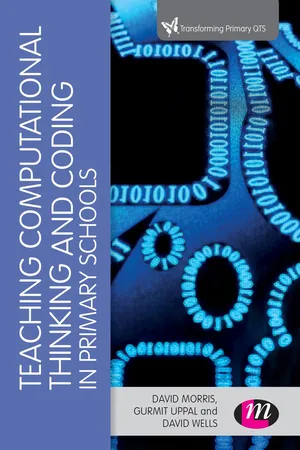
Teaching Computational Thinking and Coding in Primary Schools
- 216 pages
- English
- ePUB (mobile friendly)
- Available on iOS & Android
eBook - ePub
Teaching Computational Thinking and Coding in Primary Schools
About this book
Information
1 An Introduction to the Computing Curriculum
Learning outcomes
By the end of this chapter you will have:
• developed an introductory understanding of the computing curriculum;
• considered the Information and Communications Technology (ICT) to computing curriculum shift.
Teachers’ Standards
A teacher must:
3. Demonstrate good subject and curriculum knowledge:
• demonstrate a critical understanding of developments in the subject and curriculum areas, and promote the value of scholarship.
Part Two. Personal and professional conduct:
• teachers must have an understanding of, and always act within, the statutory frameworks which set out their professional duties and responsibilities.
(DfE, 2011)
Introduction
This chapter will introduce you to computing in the English primary phase curriculum. It will summarise the historical input of Information Technology (IT) and Information and Communications Technology (ICT), and position computing as a highly important subject in any school’s academic provision. The book you are now beginning to read will offer guidance, support, ideas and tools for implementing, delivering and assessing a successful computing curriculum at Key Stages 1 and 2. Although the computing programmes of study (PoS) are non-statutory in the Early Years Foundation Stage (EYFS), guidance is given to those teaching this age phase.
September 2014 saw the introduction of the ‘new’ national curriculum in England, including computing (DfE, 2013a). Not all schools, however, are obliged to follow the programmes of study as detailed in this national curriculum. Independent schools, academies and free schools are exempt, although they are expected to provide a broad and balanced curriculum for their pupils. Academies and free schools, for example, must offer English, maths, science, religious education and sex and relationships education. If they have Reception and pre-school pupils, then the Statutory Framework for the Early Years Foundation stage is to be followed (DfE, 2014). All national tests such as Key Stage 2 Standard Attainment Tests (SATs) must also be adhered to. In practice, most of these schools deliver the majority of the national curriculum subjects as set out in the 2014 documentation.
Computing is a new compulsory subject in this latest national curriculum iteration, taught at all phases from Key Stage 1 to Key Stage 4 (ages 5 through to 16). Previously Information and Communications Technology (ICT) was taught in UK primary and secondary schools. This ICT curriculum had been under considerable review prior to 2014, with many industry leaders and academics calling for change. September 2012 saw the ICT programmes of study, attainment targets and associated statutory assessment expectations ‘disapplied’ from the then national curriculum. This removed a programme and subject that the Secretary of State for Education at the time described as too off-putting, too de-motivating, too dull (Gove, 2012). ICT still had to be studied in our schools but teachers were given the freedom to decide their own taught content and not be tied to the national curriculum programme. Computing and computer science are, at the time of writing, the options perceived as the route forward for appropriate academic and vocational engagement in the subject area (DfE, 2015).
What is computing?
The computing curriculum has been ‘disaggregated’ into three clearly defined areas (Morris, 2012) and as a discipline, is made up of the following subject strands: Digital Literacy, Information Technology and computer science (Royal Society, 2012). Digital literacy can be referred to as the knowledge, competence and skills needed to access and use a range of technological devices. Information Technology is the use of computer systems to create, store, process, manipulate and share digital information and data. computer science is the study of the theory behind the technology we now use. It is concerned with how computers, digital equipment and their software work, are implemented, and are designed. It involves the science of programming and computational thinking and as such goes beyond the comparatively simple use and exchange of electronic information that IT and Digital Literacy facilitate. This ‘shift’ represents considerable challenge for many primary teachers, and it is hoped this book will help alleviate some of this challenge for you entering the profession, and demystify computer science as a perceived (too) complex subject to engage with. The purpose of this book is not, therefore, to discuss the Digital Literacy and IT elements of the computing curriculum. Instead, the following chapters will focus on the teaching of computer science and its computational thinking foundations.
A brief history of IT, ICT and CS in our schools
Information Technology and ICT had been an established national curriculum subject for over 20 years, before the introduction and transference to computing took place. The final version of the ICT national curriculum programme of study (PoS), published in 2007, detailed the following skills and processes as required to be learned:
• Finding Information – concerned with solving problems and the ability to collect and search for data and information while judging its value, accuracy, validity, reliability and bias;
• Developing Ideas – creating models and IT systems that make things happen by planning, testing and modifying a sequence of instructions, recognising where a group of instructions needs repeating, and automating frequently-used processes by constructing efficient procedures that are fit for purpose;
• Communicating Information – presenting, exchanging and communicating information safely and responsibly;
• Evaluating – reflecting critically by reviewing, modifying and evaluating work as it is being completed.
(The Qualifications and Curriculum Authority, 2007)
An interesting observation when considering this ‘old’ ICT programme of study, is that it should dispel any myths you might have that ICT was simply about using application software such as word processing and desktop publishing. This is how the curriculum was often interpreted by schools. With this in mind, recent ICT education had arguably focused on the training of office skills (Livingstone and Hope, 2011). However, this was not what the curriculum was designed to do in progressing our pupils’ IT competence and capability.
It can therefore be contended that the previous ICT curriculum was not working for all pupils in maintaining the challenge and progress needed for the twenty-first century (Wells, 2012). Vocational ICT qualifications (in particular) achieved significant outcomes and success at the end of Key Stage 4 for countless pupils. However, many schools were interpreting their ICT curriculum from its lowest level of need (Royal Society, 2012), and using non-specialist teachers to deliver it, meaning appropriate challenge and engagement was not always experienced by our pupils. ‘A’ Level and undergraduate take-up of computer science courses had also declined dramatically in recent years, indicating difficulty in the UK’s ability to sustain its rich heritage as leaders and innovators in the fields of technology and computing. With all this in mind, it would seem relevant and appropriate, therefore, that computing has been introduced as a replacement for what ICT had become in many schools: both to reinvigorate the challenge and rationale of studying within the field (particularly in our more able pupils perhaps) and to meet the growing needs of industry. Clearly, this has more significant implications for secondary school teachers of computing. However, if we are to produce the next generation of programmers and game designers (for example), and encourage a greater take-up of the subject at this level, then there is a clear sense to starting this process with very young children during their primary phase education. It is also worth noting that the science of computational thinking is an excellent cross-curricular and life ‘skill’ for pupils to engage with, as you will hopefully see as you delve further into this book.
The ‘new’ and transformed (2014) computing curriculum aims to ensure all pupils:
• can understand and apply the fundamental principles and concepts of computer science, including abstraction, logic, algorithms and data representation;
• can analyse problems in computational terms, and have repeated practical experience of writing computer programs in order to solve such problems;
• can evaluate and apply information technology, including new or unfamiliar technologies, analytically to solve problems;
• are responsible, competent, confident and creative users of information and communication technology.
(DfE, 2013a)
This is broken down into distinct learning expectations and outcomes for each key stage (that will be explored further in subsequent chapters of this book). Computing, although incorporating elements of ICT in its Digital Literacy and IT strands, is therefore a very different subject to what ICT was often interpreted as in schools. Computer science is a more complex area of study than ICT, and as such needs time and effort in developing the skillset to teach these lessons successfully and effectively. The traditional curriculum model of teaching pupils to be users of technology is now at conflict with the need for improved subject and pedagogical knowledge required to teach our children to become creators of computing innovations (Goode et al., 2012). However, this is not something you should fear and we hope this book will help you to see the relevance of the subject and also that it need not be as complicated as you might think! computer science is not this mythical, complex beast many believe it to be – at least it need not be in Key Stages 1 and 2.
Research focus: shut down or restart
The way forward for computing in UK schools?
Launched in January 2012, this report, by the British Computing Society (published by The Royal Society), details the arguments for either shutting ICT down as a curriculum subject, or rebooting it as something different and arguably more relevant for our pupils and the UK economy. The report suggested the terminology reform from ICT to the more distinctive three strands of Digital Literacy, IT and computer science. It also makes further recommendations for how to overhaul the ICT curriculum and why this change was needed. As a starting point for considering the curriculum shift that has been taking place since September 2012, it is highly recommended that you engage with this influential report.
Activity: reflection point
In your opinion:
Where do you position yourself in this curriculum shift from ICT to computing? Was it necessary? Can primary school colleagues meet the demands of the new curriculum for computing? Will schools engage with the computer science strand of the curriculum or err on Digital Literacy and IT?
The need for pedagogic shift and change?
The introduction of computer science as a discipline within computing has caused considerable issues and anxieties for many teachers. Inevitably change often breeds fear and reluctance in people to embrace that change. They are concerned about being able to successfully make the transition from the familiar (ICT) to the new (computer science). They are concerned about the impact on their role and inevitable employment. They struggle to see the arguments and reasons presented for the change because the change is unfamiliar to them. However, the change has happened, and schools and colleagues teaching in them are in a position where they must implement change. With reference to Kurt Lewin’s 1951 change management model, teachers must unfreeze and, with the appropriate driving forces (which this book will hopefully contribute to), teachers will be able to transition successfully and confidently into this ‘unknown’.
As a beginning primary teacher, you are in a position to act as an ‘agent of change’ (and therefore a driving force) in supporting this successful transition in your training schools. The expertise to deliver computing-focused lessons may not exist with many of your primary school colleagues and this will inevitably impact on the school’s ability to provide creative and imaginative computer science lessons. You can help support this and bridge computing ‘capability gaps’ by sharing your own knowledge and expertise, as well as suggesting pedagogy that might be used for successful learning within computing to support the required ‘pedagogic shift’ within this subject.
Research focus: change agents
Stevenson (2008) suggests that a change agent is about identity, understanding people, being self-motivational, patient and living for the future. To complement this, Lu and Ortlieb (2009) suggest change agents are innovators, initiators, creators, convincers and involvers. An agent of change will have a vision that they see as possible to enact. They will be somebody who is empowered to influence others in both purpose and focus (Price and Valli, 2005). Change agents will want to make a difference and are able to inspire transformation (Dunne and Zandstra, 2011). They are origin...
Table of contents
- Cover Page
- Advertisement
- Halftitle
- Title
- Copyright
- Dedication
- Contents
- Acknowledgements
- About the Authors and Series Editor
- Glossary
- 1 An Introduction to the Computing Curriculum
- 2 Developing Computational Thinking in the Early Years Foundation Stage (EYFS), KS1 and KS2
- 3 Programming with Floor Robots
- 4 Developing Programming through Age-Appropriate Software: KS1 Curriculum and Pedagogy
- 5 Developing Programming through Age-Appropriate Software: KS2 Curriculum and Pedagogy
- 6 Coding with HTML and Web Design
- 7 Using Computational Thinking and Coding to Create: App Building
- 8 Using Computational Thinking and Coding in Gaming
- 9 Computational Thinking Across the Curriculum
- 10 Planning for Computational Thinking and Coding
- 11 Assessing Pupil Progress in Computational Thinking and Coding
- 12 Transition Issues: Bridging the Computing Gap between KS2 and KS3
- References
- Index
Trusted by 375,005 students
Access to over 1.5 million titles for a fair monthly price.
Study more efficiently using our study tools.
Frequently asked questions
Yes, you can cancel anytime from the Subscription tab in your account settings on the Perlego website. Your subscription will stay active until the end of your current billing period. Learn how to cancel your subscription
No, books cannot be downloaded as external files, such as PDFs, for use outside of Perlego. However, you can download books within the Perlego app for offline reading on mobile or tablet. Learn how to download books offline
Perlego offers two plans: Essential and Complete
- Essential is ideal for learners and professionals who enjoy exploring a wide range of subjects. Access the Essential Library with 800,000+ trusted titles and best-sellers across business, personal growth, and the humanities. Includes unlimited reading time and Standard Read Aloud voice.
- Complete: Perfect for advanced learners and researchers needing full, unrestricted access. Unlock 1.5M+ books across hundreds of subjects, including academic and specialized titles. The Complete Plan also includes advanced features like Premium Read Aloud and Research Assistant.
We are an online textbook subscription service, where you can get access to an entire online library for less than the price of a single book per month. With over 1.5 million books across 990+ topics, we’ve got you covered! Learn about our mission
Look out for the read-aloud symbol on your next book to see if you can listen to it. The read-aloud tool reads text aloud for you, highlighting the text as it is being read. You can pause it, speed it up and slow it down. Learn more about Read Aloud
Yes! You can use the Perlego app on both iOS and Android devices to read anytime, anywhere — even offline. Perfect for commutes or when you’re on the go.
Please note we cannot support devices running on iOS 13 and Android 7 or earlier. Learn more about using the app
Please note we cannot support devices running on iOS 13 and Android 7 or earlier. Learn more about using the app
Yes, you can access Teaching Computational Thinking and Coding in Primary Schools by David Morris,Gurmit Uppal,David Wells,Author in PDF and/or ePUB format, as well as other popular books in Education & Education Technology. We have over 1.5 million books available in our catalogue for you to explore.