eBook - ePub
Professional Practice in Counselling and Psychotherapy
Ethics and the Law
- 240 pages
- English
- ePUB (mobile friendly)
- Available on iOS & Android
eBook - ePub
About this book
Developing and maintaining a secure framework for professional practice is a core part of any counselling and psychotherapy training, as all therapists need to understand the key values, ethics and laws that underpin the profession today. But what does being a member of a ?profession' actually mean, and what does being a 'professional' actually involve?
Structured around the BACP Core Curriculum, and with the help of exercises, case studies and tips for further reading, this book covers everything from the requirements of the BACP Ethical Framework to broader perspectives on good professional practice.Â
It includes:
- Practising as a therapist in different roles and organizational contexts.
- Working with key issues, including difference, vulnerable clients and risk.
- Understanding the law and relevant legal frameworks for practice.
- Working ethically, including contrasting models and approaches to ethics.
Â
Frequently asked questions
Yes, you can cancel anytime from the Subscription tab in your account settings on the Perlego website. Your subscription will stay active until the end of your current billing period. Learn how to cancel your subscription.
At the moment all of our mobile-responsive ePub books are available to download via the app. Most of our PDFs are also available to download and we're working on making the final remaining ones downloadable now. Learn more here.
Perlego offers two plans: Essential and Complete
- Essential is ideal for learners and professionals who enjoy exploring a wide range of subjects. Access the Essential Library with 800,000+ trusted titles and best-sellers across business, personal growth, and the humanities. Includes unlimited reading time and Standard Read Aloud voice.
- Complete: Perfect for advanced learners and researchers needing full, unrestricted access. Unlock 1.4M+ books across hundreds of subjects, including academic and specialized titles. The Complete Plan also includes advanced features like Premium Read Aloud and Research Assistant.
We are an online textbook subscription service, where you can get access to an entire online library for less than the price of a single book per month. With over 1 million books across 1000+ topics, weâve got you covered! Learn more here.
Look out for the read-aloud symbol on your next book to see if you can listen to it. The read-aloud tool reads text aloud for you, highlighting the text as it is being read. You can pause it, speed it up and slow it down. Learn more here.
Yes! You can use the Perlego app on both iOS or Android devices to read anytime, anywhere â even offline. Perfect for commutes or when youâre on the go.
Please note we cannot support devices running on iOS 13 and Android 7 or earlier. Learn more about using the app.
Yes, you can access Professional Practice in Counselling and Psychotherapy by Peter Jenkins,Author in PDF and/or ePUB format, as well as other popular books in Psychology & History & Theory in Psychology. We have over one million books available in our catalogue for you to explore.
Information
1 Becoming a member of a new profession
Introduction
This chapter looks at what it means to join counselling and psychotherapy as a profession and what is involved in the process of becoming a âprofessionalâ counsellor. It covers the following topics:
- understanding counselling and psychotherapy as a new profession;
- exploring the statutory regulation of counselling and psychotherapy;
- developing critical perspectives on the role of counselling in society;
- exploring the relationship of counselling and psychotherapy to other professions;
- becoming a professional counsellor and psychotherapist.
Learning context
The BACP Core Curriculum (2009) briefly sets out the requirement for students to develop knowledge and understanding of the history and culture of counselling in order to join and fully become a part of the wider community of therapists. The BACP Ethical Framework for the Counselling Professions (2016) provides a core part of what is required from students and practitioners in becoming a professional, by working to meet the appropriate standards of practice and behaviour. Extracts from both documents are included below for reference.
BACP Core Curriculum (2009)
9.1.A The professional role and responsibility of the therapist.7. Understanding the values underpinning the profession, as exemplified in the Ethical Framework. (2009: 17)9.1.D. The social, professional and organisational context for therapy:The practitioner will have relevant knowledge to inform his or her ability to:
- Take an active role as a member of a professional community.
- Show a critical awareness of the history of ideas, the cultural context and social and political theories that inform and influence the practice of counselling and psychotherapy. (2009: 18)
BACP Ethical Framework for the Counselling Professions (2016)
Working to professional standards:
13. We must be competent to deliver the services being offered to at least fundamental professional standards or better.14. We will keep skills and knowledge up to date by:
- reading professional journals, books and/or reliable electronic resources
- keeping ourselves informed of any relevant research and evidence-based guidance
- discussions with colleagues working on similar issues
- reviewing our knowledge and skills in supervision or discussion with experienced practitioners
- regular continuing professional development to update knowledge and skills
- keeping up to date with the law, regulations and any other requirements, including guidance from this Association, relevant to our work
15. We will keep accurate records that are appropriate to the service being provided.16. We will collaborate with colleagues over our work with specific clients where this is consistent with client consent and will enhance services to the client.17. We will work collaboratively with colleagues to improve services and offer mutual support.18. We will maintain our own physical and psychological health at a level that enables us to work effectively with clients.19. We will be covered by adequate insurance when providing services directly or indirectly to the public.20. We will fulfil the ethical principles and values set out in this Ethical Framework regardless or whether working online, face to face or using any other methods of communication. The technical and practical knowledge may vary according to how services are delivered but all our services will be delivered to at least fundamental professional standards or better. (2016: 6)
Understanding counselling and psychotherapy as a new profession
So, what exactly is this new profession that you have decided to join, or which you are in the process of joining? Counselling and psychotherapy are hugely worthwhile occupations, with great job satisfaction and a strongly developing evidence base for their effectiveness in relieving human distress. However, whether they can confidently be called âprofessionsâ in the more widely accepted sense of the word is still subject to dispute, at least in some circles. This chapter will look at some of the main features of what it is to be a member of a profession, or to act in a professional manner, which may not hold quite the same meaning.
Definition of a profession
The notion of a checklist, or list of key characteristics required of recognised professions, is a well-established format for guiding discussion on this topic. This is known as the trait model of professionalisation, which has been hugely influential in framing discussions on this topic. However, it has also been subject to increasing criticism for neglecting significant issues, such as power and gender. The checklist approach is, in part, a developmental model, holding out the possibility that different occupational groups, such as teachers and social workers, can work towards achieving full status as a profession by gradually achieving each of the required criteria. Becoming a profession involves a degree of legal recognition, when either the title (e.g. as a psychotherapist) or the activity of a particular group (e.g. counselling) becomes protected by law. This has important implications. A legally protected title (e.g. as a chartered psychologist) means that anyone claiming this status without being properly registered with a professional body (e.g. the British Psychological Society) or with a regulating body, such as the Health and Care Professions Council (HCPC), can be prevented from doing so. In addition, if a practitioner is subject to a successful complaint or a disciplinary procedure against them by their professional association (such as the British Psychological Society), or by their regulatory body (such as the Health and Care Professions Council), they can be removed from the register. They are thus legally prevented from practising in that role.
The trait model has been a standard feature of sociological discussions of the process of professionalisation over the last century. It still retains influence as a working approach to deciding whether occupational groups, such as art therapists, dance therapists and social workers, fully qualify as professions. The Health and Care Professions Council used this approach in deciding applications from new and emerging professions up to 2011. It has had, therefore, real application in the recent past in deciding on the value of competing claims to professional status, even if it is no longer used for this purpose. The list of criteria follows a classic trait or a âchecklistâ model, despite the growing academic criticism of this approach. Aspiring professions needed to demonstrate the criteria set out in Box 1.1.
Box 1.1 HCPC criteria for considering applications by new professions for regulation
- Cover a discrete area of activity displaying some homogeneity
- Apply a defined body of knowledge
- Practice based on evidence of efficacy
- Have at least one established professional body which accounts for a significant proportion of that occupational group
- Operate a voluntary register
- Have defined routes of entry to the profession
- Have independently assessed entry qualifications
- Have standards in relation to conduct, performance and ethics
- Have Fitness to Practise procedures to enforce those standards
- Be committed to continuous professional development (CPD)
Health and Care Professions Council (HCPC) (2001) New professions process, www.hpc-uk.org/aboutregistration/aspirantgroups/newprofessionsprocess/
Exercise Exploring HCPC criteria for a new profession
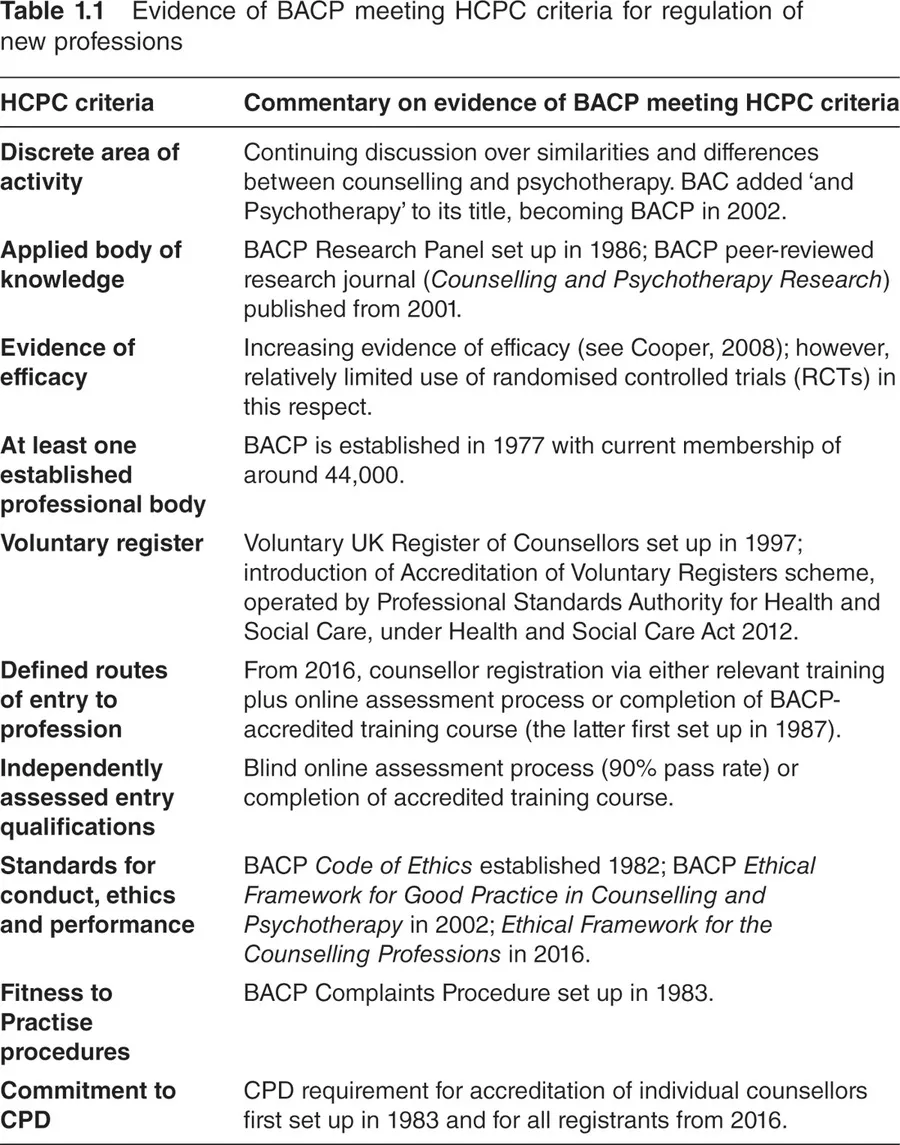
Consider the HCPC list of criteria in Box 1.1 and tick those you feel are met for counselling. Discuss and compare your answers with those of someone else, and then compare with the answers below in Table 1.1 (examples relate primarily to the BACP as the leading body for counselling in the field, but similar responses could be supplied for the British Psychological Society (BPS,) United Kingdom Council for Psychotherapy (UKCP), British Association for Behavioural and Cognitive Psychotherapy (BABCP), etc.).

The evidence outlined in Table 1.1 seems to suggest that BACP has already met, or is in the process of meeting, all of the criteria required by the HCPC for professional status and regulation. So, why is it still not subject to statutory regulation? This is a crucial question which will be discussed below.
Exploring the statutory regulation of counselling and psychotherapy
Counselling began to emerge as a distinct occupational group during the 1960s and 1970s, with the British Association for Counselling being established in 1977. This took a âbroad churchâ approach to membership, including as members those who used counselling skills as part of another profession, such as teachers. The issue of statutory regulation was first raised in 1971, with the publication of the Foster Report into the Church of Scientology (Foster, 1971), which was highly critical of the quasi-psychological methods used by Scientology to recruit, retain and control its members. It also raised the wider issue of regulating counselling and psychotherapy. However, it is telling that the Report struggled, then as now, to distinguish between the various different types of psychological practice. Hence ââpsychiatryâ was seen as dealing with emotional or mental problems, âpsychologyâ mainly with problems of the intellect. âCounsellingâ was widely practised, as was âpsychotherapy without a feeââ (Foster, 1971: 176). The Report concluded that âIt is high time that the practice of psychotherapy for reward should be restricted to members of a profession properly qualified in its techniques and trained...â (1971: 179).
The mantle was then taken up in the form of the Seighart Report (Seighart, 1978). This similarly struggled with resolving problems of definition:
we have serious doubts about whether psychotherapy as a function could be defined precisely enough by statutory language to prevent evasion, without at the same time casting the net so wide as to catch many people who are outside the mischief which the statute is designed to meet. We have in mind here professions as diverse as general medical practitioners, applied psychologists, clergymen, counsellors and educators who do not present themselves as specialised psychotherapists, but many of whom use interpersonal techniques in the course of their ordinary work... (Seighart, 1978: 6)
The strategy proposed was to regulate the use of the title of âpsychotherapistâ, given that it was not feasible to regulate a broad social grouping, with such loosely defined boundaries to its practice and membership. Yet this first major attempt to introduce statutory regulation ultimately failed because of the continuing high levels of disagreement within the wider profession. In particular, concerns were raised by the behavioural psychotherapists. This group insisted on evidence of therapeutic effectiveness â and not simply of completion of a period of training â as a crucial precondition for the regulation of the profession (Jenkins, 2007a: 189).
Barriers to achieving statutory regulation
Disunity between the various therapistsâ organisations effectively ended this first attempt at achieving statutory regulation. The second major attempt developed after the failure of a Private Memberâs Bill in Parliament to regulate psychotherapy (but explicitly not counselling) in 1981. This led to a sustained round of lobbying by all the main therapistsâ organisations, the BACP, UKCP and others, during the 1980s, 1990s and beyond the turn of the century. Once again, this ran into substantial difficulties in trying to distinguish between counselling and psychotherapy for regulatory and legislative purposes. Another major cause of dissent among therapists was that the proposed regulatory body was to be the Health Professions Council (now the Health and Care Professions Council). This seemed to offer statutory regulation, but on a very medicalised model. Critics argued that this model was not suitable for the psychological or âtalkingâ therapies. Movement towards even this relatively unsatisfactory form of regulation ended with the change of government in 2010. The new Coalition government announced that the way forward would now be via the implementation of voluntary registers of therapists, rather than through statutory regulation. This decision ended the second attempt to achieve statutory regulation for counselling and psychotherapy. Almost 40 years of slow progress towards achieving the goal of statutory regulation was thus halted overnight.
This account suggests that the reasons why counselling and psychotherapy still do not have statutory regulation are quite complex. Progre...
Table of contents
- Cover
- Half Title
- Publisher Note
- Title Page
- Copyright Page
- Contents
- Illustration List
- Table List
- Sidebar List
- Sidebar List
- About the author
- Acknowledgements
- Introduction
- 1 Becoming a member of a new profession
- 2 Working in different organisational contexts as a counsellor or psychotherapist
- 3 Working with key client issues in therapeutic practice
- 4 Working with key professional issues in therapeutic practice
- 5 Understanding the legal context of professional practice
- 6 Working ethically as a counsellor or psychotherapist
- 7 Surviving and thriving as a counsellor or psychotherapist
- 8 Developing new roles in counselling and psychotherapy
- References
- Index