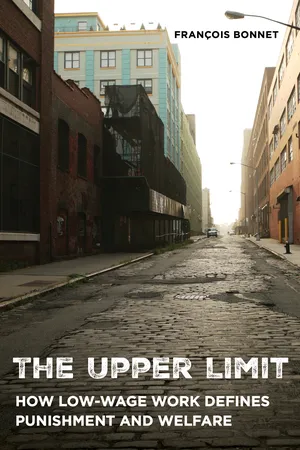
Since 1993, crime in the United States has fallen to historic lows, seeming to legitimize the country’s mix of welfare reform and mass incarceration. The Upper Limit explains how this unusual mix came about, examining how, beginning in the 1970s, declining living standards for the poor have defined social and penal policy in the United States, making welfare more restrictive and punishment harsher. François Bonnet shows how low-wage work sets the upper limit of social and penal policy, where welfare must be less attractive than low-wage work and criminal life must be less attractive than welfare. In essence, the living standards of the lowest class of workers in a society determine the upper limit for the generosity of welfare and for the humanity of punishment in that society. The Upper Limit explores the local consequences of this punitive adjustment in East New York, a Brooklyn neighborhood where crime fell in the 1990s. Bonnet argues that no meaningful penal reform can happen unless living standards and the minimum wage rise again. Enlightening and provocative, The Upper Limit provides a comprehensive theory of the evolution of social and penal policy.
- 200 pages
- English
- ePUB (mobile friendly)
- Available on iOS & Android
eBook - ePub
About this book
Information
1
The Upper Limit
But in no part of Europe except England has it been thought fit that the provision, whether compulsory or voluntary, should be applied to more than the relief of indigence, the state of a person unable to labour, or unable to obtain, in return for his labour, the means of subsistence. It has never been deemed expedient that the provision should extend to the relief of poverty; that is, the state of one, who, in order to obtain a mere subsistence, is forced to have recourse to labour.
— POOR LAW COMMISSIONERS’ REPORT OF 1834
The major function of criminal law in a capitalist society is to prevent people from bypassing the system of voluntary, compensated exchange—the “market.” . . . When transaction costs are low, the market is, virtually by definition, the most efficient method of allocating resources. Attempts to bypass the market will therefore be discouraged by a legal system bent on promoting efficiency. . . . The market transaction that he [the offender] bypasses is the exchange of his labor for money in a lawful occupation. . . . Criminal law is designed primarily for the nonaffluent; the affluent are kept in line, for the most part, by tort law.
— RICHARD A. POSNER, AN ECONOMIC THEORY OF THE CRIMINAL LAW
In the sweat of thy face shalt thou eat bread, till thou return unto the ground.
— GENESIS 3:19
Welfare and punishment vary widely in time and space. Equally prosperous countries have markedly different social and penal policies. What determines a given society’s mix of welfare and punishment? Comparative studies have led to typological efforts, with countries labeled as inclusive or exclusionary; neoliberal, corporatist, or social democratic; coordinated or liberal.1 As the saying goes, any typology is better than none, but typologies are not explanations. Others have compared Nordic countries with Anglophone ones in a search for explanations of the latter’s “penal excess” and have proposed explanations based on cultural differences.2 The core problem of cultural explanations is their difficulty in accounting for the fact that in the mid-twentieth century, from the New Deal to the Great Society, the United States was a world leader in both penal reform and social policy, ahead of its Western European counterparts, before becoming the world leader of mass incarceration. Consider two alternative accounts.
The first one is a story of institutions. Legal scholar Nicola Lacey and economist David Soskice have explained American patterns of punishment and welfare using the structure of electoral competition. Decentralization and small voting units make for median voters “who are reluctant to vote for costly public goods whose benefits are not so restricted.”3 The argument draws on Joachim Savelsberg’s work on certain specifically American institutions that make criminal justice more responsive to popular emotions: the popular election of prosecutors and judges, and the involvement of popular juries at all levels of sentencing.4 Lacey and Soskice offer an explanation for American welfare and punishment that is grounded on the concrete institutional mechanisms through which policies are produced—but which does not account for changing patterns of welfare and punishment over the twentieth century.
The second explanation is more structural. Sociologist Loïc Wacquant observes that punishment and welfare are inversely related and that countries where neoliberalism is hegemonic experience a downgrade of their welfare state and an expansion of the carceral state.5 He therefore proposes a theory of the neoliberal state. Wacquant’s neoliberal state implements workfare and mass incarceration to discipline the poor and force them into labor markets. The plight of the poor, and of Durkheimian deviants such as sex offenders, serves to soothe the status anxiety of the economically declining middle classes, who vote in support of less welfare and more punishment. It is an explanation that seeks to reconcile instrumental approaches to punishment (the link to the labor market) and Durkheimian approaches (the making of solidarity at the expense of deviants).
In this chapter I present my theory of the relationship of welfare, punishment, and labor markets. This is a theory of social order based on the principle of less eligibility.
The principle of less eligibility exists in two versions. One says that poor relief cannot be more generous than low-wage work (otherwise, the poor will tend to choose welfare over work). The second version says that punishment should make crime less desirable than low-wage work (otherwise, the poor will commit more crime). I argue that we can combine both ideas: that is, for society to be basically functional, punishment has to make crime less attractive than welfare, and welfare has to be less attractive than low-wage work. In other words, the living standards offered by low-wage work determine the upper limit of both social and penal policy.6 High living standards for the poor means that Scandinavian countries can afford generous welfare and humane punishment. Lower living standards means that Brazil has meager relief and death squads.
To make my case, I will begin by presenting the historical context of the formulation of the first principle of less eligibility—that welfare has to be less desirable than work. I go back in time because poverty has threatened the quality of life enjoyed by more affluent classes for centuries. Misery has consistently thrust the poor into begging, prostitution, vagrancy, and crime.7 The problem has remained much the same. On one hand, the poor provide low-wage labor and are thus essential to the economy (they can’t all be killed); on the other hand, they make for social problems, which require costly interventions in terms of welfare and punishment. I am interested in the various mixes of welfare and punishment that societies have implemented throughout history to engineer a measure of social order.
LESS ELIGIBILITY AND ENGLAND’S NEW POOR LAW OF 1834
Medieval society in Europe was not complex enough to require organized relief systems. There was not enough stratification for a concept of poverty to make sense, and most economic life revolved around quasi-autonomous rural parishes. The Black Death (1346–53) introduced a breakdown. It disrupted feudal economic relations, discredited established authorities, and favored the bargaining power of workers. Political authorities across Europe responded by prohibiting wage increases. In the decades that followed the Black Death, population grew rapidly, resulting in underemployment, rising food prices, and urban growth.8 Mendicancy and vagrancy appeared on a large scale. In the rural country of Picardy (now northern France), 13 percent of the population begged for a living.9 Food shortages and starvation became common events. Throughout the Late Middle Ages (1300–1500), relief was residual and loosely distributed by the church or private institutions. Economic transformations prompted elites to take measures.
Medieval authorities did not want a labor market where wages could increase and expressly forbade their poor to look for better opportunities elsewhere, but they did not know what to do about the excess population. Many vagrants were executed for the mere crime of being on the road.10 Spanish scholar Juan Luis Vives (1493–1540) thus theorized in De Subventione Pauperum (1526) that it was better to extend poor relief, provided that the poor work. Vives’s ideas proved influential across Europe. Cities promulgated interdictions against begging and not working, and they proceeded to regulate early forms of poor relief. In Ypres (modern day Belgium) there was a special provision in the law for professional panhandlers and for people pretending to be poor.11 During unemployment and starvation crises in the sixteenth century, the poor were rounded up and coerced to work so as to prevent them from begging and fomenting protest.
De Subventione Pauperum’s focus on labor markets shaped poor law in England.12 In a first step, the Statute of Artificers of 1562 forbade English workers to look for better jobs elsewhere or to bargain for better wages. Attempts to leave one’s job were met with a fine, corporal punishment, and a return to work. Organizing workers toward better conditions was a crime.13 In a second step, Elizabeth I authorized in 1572 compulsory taxation to provide poor relief and promulgated in 1597–1601 the Elizabethan Poor Law. The (Old) Poor Law’s principles were simple:
In general, begging was forbidden. Employable poor were to be put to work in manufacturing projects organized by overseers of the poor. The able-bodied refusing to work were to be sent to houses of correction. Rogues, vagabonds, and vagrants were to be punished. Poor children were to be put to work or apprenticed. Relatives were made responsible for the maintenance of their destitute kinsmen. Only those who had settlement in a community were entitled to its aid, and what constituted settlement and the methods of its acquisition were carefully circumscribed. Paupers and potential paupers without settlement were to be excluded or expelled from the community.14
The Old Poor Law retained all the criminal control over labor that previously existed, including the fixity, but it established a system of relief (and punishment) that “helped break the historical link between harvest failure and mortality.”15 The relief offered was meager but enough to keep the workers alive and, all in all, economically rational.16 Farmers paid for poor relief between harvests to maintain a supply of workers when needed.17 Relief was conditional on nonthreatening behavior: “accepting charity meant abstaining from illegal survival strategies and accepting forms of social control. To deserve help, one had to behave deferentially and ‘decently,’ could not migrate, nor openly resort to begging, prostitution, crime, or looting.”18 The system worked for two hundred years and is credited with enabling England’s early economic development.19
After 1750, English elites began to think that the Elizabethan Poor Law was becoming expensive.20 In the first decades of the Industrial Revolution (late eighteenth to early nineteenth century), the Poor Law went into crisis. Real wages fell across Europe. The situation was aggravated by the Napoleonic Wars and bad harvests. The English system of poor relief was inadequate for the extent of poverty that had arisen. Relief spending continued to grow, increasing from £2 million in 1784 to £7 million in 1832. Relief benefited 10 percent of the English population and in the winter of 1832–33 was equivalent for a family to 93 percent of the winter wage.21 The growth of relief spending forced Victorian elites to rethink social policy.22 They were guided by a few core ideas: Malthus’s concern for unchecked population growth, Bentham’s utilitarianism, and Ricardos iron law of wages. The commissioners of the time concluded that relief had to be made less desirable than work. It was called the “principle of less eligibility”:
A compulsory provision for the relief of the indigent can be generally administered on a sound and well-defined principle; and that under the operation of this principle, the assurance that no one need perish from want may be rendered more complete than at present, and the mendicant and vagrant repressed by disarming them of their weapon,—the plea of impending starvation. . . . The first and most essential of all conditions, a principle which we find universally admitted, even by those whose practice is at variance with it, is, that his situation on the whole shall not be made really or apparently so eligible as the situation of the independent labourer of the lowest class.23
The New Poor Law was passed in 1834, and within a few years, social spending fell from 2.5 percent of the national income to below 1 percent.24 Real relief benefits per capita dropped 50 percent between 1833 and 1838.25 The earnings of the working class were reduced by two percentage points.26 The New Poor Law removed the fixity of labor, thus enabling the creation of a proper labor market, but criminal sanctions backing labor contracts lasted until 1875.27
Under this law, relief was organized in terms of the workhouse, where the destitute were to ...
Table of contents
- Title
- Copyright
- Dedication
- Epigraph
- Contents
- Illustrations
- Introduction
- 1. The Upper Limit
- 2. The Great Adjustment
- 3. The Crime Drop and the East New York Renaissance
- 4. The Necessity of Harsh Policing
- 5. Prisoner Reentry in Public Housing
- 6. Nonprofits: Welfare of the Cheap
- 7. Reengineering Less Eligibility: The New York Homeless Shelter Industry
- Conclusion
- Notes
- Acknowledgments
- References
- Index
Trusted by 375,005 students
Access to over 1.5 million titles for a fair monthly price.
Study more efficiently using our study tools.
Frequently asked questions
Yes, you can cancel anytime from the Subscription tab in your account settings on the Perlego website. Your subscription will stay active until the end of your current billing period. Learn how to cancel your subscription
No, books cannot be downloaded as external files, such as PDFs, for use outside of Perlego. However, you can download books within the Perlego app for offline reading on mobile or tablet. Learn how to download books offline
Perlego offers two plans: Essential and Complete
- Essential is ideal for learners and professionals who enjoy exploring a wide range of subjects. Access the Essential Library with 800,000+ trusted titles and best-sellers across business, personal growth, and the humanities. Includes unlimited reading time and Standard Read Aloud voice.
- Complete: Perfect for advanced learners and researchers needing full, unrestricted access. Unlock 1.5M+ books across hundreds of subjects, including academic and specialized titles. The Complete Plan also includes advanced features like Premium Read Aloud and Research Assistant.
We are an online textbook subscription service, where you can get access to an entire online library for less than the price of a single book per month. With over 1.5 million books across 990+ topics, we’ve got you covered! Learn about our mission
Look out for the read-aloud symbol on your next book to see if you can listen to it. The read-aloud tool reads text aloud for you, highlighting the text as it is being read. You can pause it, speed it up and slow it down. Learn more about Read Aloud
Yes! You can use the Perlego app on both iOS and Android devices to read anytime, anywhere — even offline. Perfect for commutes or when you’re on the go.
Please note we cannot support devices running on iOS 13 and Android 7 or earlier. Learn more about using the app
Please note we cannot support devices running on iOS 13 and Android 7 or earlier. Learn more about using the app
Yes, you can access The Upper Limit by François Bonnet in PDF and/or ePUB format, as well as other popular books in Scienze sociali & Criminologia. We have over 1.5 million books available in our catalogue for you to explore.