How is it possible for six men to take a Liberian-flagged oil tanker hostage and negotiate a huge pay out for the return of its crew and 2.2 million barrels of crude oil? In his gripping new book, Jatin Dua answers this question by exploring the unprecedented upsurge in maritime piracy off the coast of Somalia in the twenty-first century. Taking the reader inside pirate communities in Somalia, onboard multinational container ships, and within insurance offices in London, Dua connects modern day pirates to longer histories of trade and disputes over protection. In our increasingly technological world, maritime piracy represents not only an interruption, but an attempt to insert oneself within the world of oceanic trade. Captured at Sea moves beyond the binaries of legal and illegal to illustrate how the seas continue to be key sites of global regulation, connectivity, and commerce today.
- 264 pages
- English
- ePUB (mobile friendly)
- Available on iOS & Android
eBook - ePub
About this book
Information
Publisher
University of California PressYear
2019Print ISBN
9780520305199
Edition
1eBook ISBN
9780520973299
ONE
Protectors of the Sea
THE RISE OF MARITIME PIRACY OFF THE COAST OF SOMALIA
BERBERA WAS MY FIRST INTRODUCTION to the Somali coast. As I waited for a visa and security guarantee to travel to Puntland, the autonomous region in northern Somalia and home to most pirates, I decided to begin my research in the relatively safe confines of secessionist Somaliland. I arrived in the capital, Hargeisa, in the winter of 2010, armed with contacts obtained from boat captains, Somali wholesalers, and traders in Sharjah and Mombasa. In Hargeisa, people constantly informed me that I was in the wrong place looking for pirates. “We have honest fishermen, and law and order in Somaliland,” remarked Admiral Ahmed during our weekly chats in the small Somaliland Coastguard Office. Visibly bored after imparting yet another history lesson on Somaliland and the Somaliland Coastguard’s problems of underfunding, the admiral suggested a trip to Berbera: “You won’t find pirates—but you’ll learn about fishing, and you must meet Musa, the director of the Somaliland Fishing Association (SOMAFISH) who will explain everything.” With the admiral’s invitation letter in hand, a couple of days later I was in a Land Cruiser racing towards the Badda cas (Red Sea) and the port city of Berbera.
Located a hundred or so miles before the Red Sea empties into the western Indian Ocean, Berbera is the main trade port for Somaliland. Unlike the mythical Indian Ocean port cities with their labyrinthine coral buildings that echo long histories of trade and mobility, Berbera is by every measure architecturally unremarkable. Drab concrete buildings, shops, and warehouses line the dusty, rough road connecting Berbera to the capital, with the relentless and harsh sun a constant reminder of why the Saaxil (coast) remains relatively peripheral and often inaccessible in northern Somaliland/Somalia. But this initial impression of inaccessibility belies a rich world of trade and exchange.
In the nineteenth century, traders and merchants from far and wide annually transformed this dusty speck on the Red Sea into a hub of activity during Berbera’s annual trade fair. In his travelogue, Lieutenant C. J. Cruttenden of the British Indian Navy described arriving in Berbera at the height of the trade fair in 1848 as anchoring into a “perfect Babel, in confusion as in languages” amidst the chaos of “small crafts from the ports of Yemen; the valuably freighted Bagalas from Bahrein [Bahrain], Bussorah [Basra, Iraq] . . . and the clumsy Kotias of the fat and wealthy Banian traders from Porebunder, Mandavie, and Bombay” (Cruttenden 1849, 54). Gazing from his ship, Cruttenden noted a constant dust cloud on the horizon as rows and rows of livestock marched through the harsh Somali interior in order to be loaded onto waiting boats ready to transport them across the Red Sea.
While few physical reminders exist of this vibrant nineteenth-century trading port, the cycle of commerce continues with dhows, and increasingly container ships, arriving in this heavily import-dependent economy laden with goods from dentist chairs to rice. In addition to this long history of trade, Berbera is also littered with remains of other, more recent and more violent histories. On the road between Hargeisa and Berbera, I occasionally encountered shelled-out and bullet-pocked buildings and abandoned and rusted tanks—reminders of the civil war that pitted the inhabitants of Somaliland against the dictatorial regime of Siyad Barre (1969–91). Adjacent to the port, half-sunken ships from aerial bombing campaigns testify to the twilight years of the Barre regime when all dissent was viciously quelled.
Legacies of the Cold War, when Somalia oscillated between the Soviet Union and the United States, also linger in the shadows of the city. The seemingly endless airport runway constructed by the Soviet Union and used by NASA as an emergency space shuttle landing site is perhaps the most visible reminder of Berbera’s former strategic importance. But there are also smaller imprints of the Cold War and Somalia’s recent history. Health clinics, fishery cooperatives, and schools, built with Soviet assistance, dot the coastline and are now reduced to rubble due to shelling or simple neglect. New construction, the result of investment by the Somali diaspora, occurs closer to the market area away from the sea. One of these buildings along the coastline, a former Cuban health clinic, now hosted the office of SOMAFISH.
After a week of back-and-forth phone calls and text messages, Musa, the director of SOMAFISH, agreed to meet with me right after the afternoon prayers. To get to his office I passed a veritable graveyard of fiber fishing skiffs, the preferred vessels of local fishermen as well as the pirates who roamed farther out in the Gulf of Aden. Sitting behind a desk littered with papers and a triptych formed by a Somaliland flag, a shark jaw with teeth intact, and a replica of an anchor, Musa recounted his personal biography, which intersected with the story of Somali fisheries—from the heyday of industrialized fishing in the Barre regime to the calamities of war and the tentative reemergence of this industry in Somaliland, in the shadow of piracy and foreign interlopers.
Born in Berbera, Musa, like many of his generation, went to university in Mogadishu. “I studied business administration at university. In those days, the Soviet Union was heavily involved in funding development projects. So, after finishing my degree I got a job in one of these projects, a fish factory in Las Qoray.” Pausing, he asked me if I knew where Las Qoray was. I nodded. “In Sanaag, between here and Puntland,” I replied, and told him I was planning a trip there to see the fish factory. “Oh, you won’t see anything of the old factory anymore. I worked at the factory until the war began [1991] . . . it was all destroyed during the war.” Leaning further back into his chair, he started telling me about the end of the Barre regime: “During the war, after the government ended, most people started to return to their clan homelands. So, we moved from Las Qoray and ended up here in Berbera because my father is from Somaliland. Those were hard days. People were leaving, going everywhere they could, but many of us who stayed, we built Somaliland.” After a long chat about the successes of Somaliland, Musa returned to the fish factory in Las Qoray. “One morning people came in and took everything at the fish factory: the machines, roofing material, anything that could be taken was taken from the factory and sold. I hear they’ve rebuilt the factory and it sells fish to China and even Australia.” I asked Musa if he ever wanted to go back to work in Las Qoray. “No, no,” he responded somewhat angrily, “that factory is controlled by Puntland.” I had inadvertently stumbled into the thorny issue of conflict between Somaliland and Puntland.1
Trying to change the subject, I asked instead about plans for the Berbera factory. Musa detailed his ambitious vision to create a fishing store and export house in Berbera. “But to do all that we need air-conditioning. Fish need ice.” Sitting in his decidedly not air-conditioned office, we were discussing plans to find ice and air conditioning when Musa suddenly remembered another meeting. We walked outside into the humid evening and back through the graveyard of skiffs. Pointing to these vessels, even more eerie in the dim light, he remarked that these were the lifeblood of SOMAFISH. “We need more boats; we need to be able to repair these boats. Without the skiff we cannot profit from the sea.” He walked closer to the skiffs and continued, “Without fuel, the fishermen cannot compete with the Yemeni fishermen or the trawlers.” Seemingly to underscore his point, Musa jumped into one of the skiffs: “If they [the fishermen] can’t fish, they might become pirates. You know the pirates in Puntland, many of them were fishermen, before they started catching different fish.” As he stepped out of the skiff, he remarked, “Now they call themselves badaadinta badah [protectors of the sea].” Nodding in agreement, I offered to take Musa to the seafood restaurant after his meeting, a place favored by the occasional UN official visiting Berbera, as a gesture of appreciation. Musa politely declined, explaining that he was a “true pastoralist” and found the idea of eating fish “repulsive.” As he emphasized, he had no plans on being afkalluun (a fish mouth).
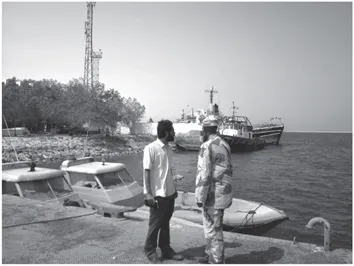
FIGURE 2. Author with Somaliland coastguard in Berbera Port, 2011. Photo by Hassan Ibrahim.
Musa’s story, his reliance upon and revulsion of fish, and the physical landscape of Berbera bring into view geographies of commerce, conflict, and community that have shaped this region’s past and present. From his work at a fish factory in Las Qoray to his return to Somaliland, Musa’s career trajectory reflects both the fantasies of the developmentalist state and the disruptions of internecine conflict. Similarly, the terrain of Berbera underlines a port city whose fortunes depend on both land and sea, ebb and flow, alongside political, social, and economic shifts. These histories of rubble,2 these visible and invisible legacies of trade, war, and geostrategic rivalry, all serve to remind us of Berbera’s role in a wider world. These connections, reflections of a simultaneous interplay of marginality and strategic importance, continue to shape the Somali coast’s relationship to a wider oceanic world. As Admiral Ahmed had rightfully predicted, I did not meet pirates in Berbera on that trip. But what was made visible in Berbera—the movement between land and sea, the longer political and economic histories, and the ambiguous status of fish and fisheries (and pirates)—is key to understanding maritime piracy in the western Indian Ocean.
From 2007, the dramatic upsurge in maritime piracy off the coast of Somalia drew global attention to fishing, specifically to the problem of illegal fishing in the western Indian Ocean. While reports emphasizing the prevalence of illegal, unreported, and unregulated (IUU) fishing vessels in Somali waters date back to the early 1990s, when large-scale foreign trawling first made its appearance in the western Indian Ocean, this renewed emphasis on IUU fishing in popular and academic scholarship can be directly linked to the rise in incidents of maritime piracy and international efforts to curb this practice. Whether writing about the connections to the Sicilian mafia or the exploitation of these waters by foreign trawlers,3 these works have been crucial in critiquing a simplistic narrative of piracy as criminality. They remind us that in global coverage only certain actions are labeled as piratical: “piracy” and “legality” are loaded and polemical terms that legitimize certain actions while condemning others. But while importantly contextualizing the rise (and fall) of maritime predation in the western Indian Ocean, these works still narrate a story of failure—of governance, of states, and of other international institutions.
A focus on failures of governance has been central in explaining not only the rise of maritime piracy, but also contemporary understandings of global commons regimes more generally. From land appropriations across sub-Saharan Africa to toxic dumping in the world’s oceans, we are in an era of renewed global dispossession, one seemingly aided by failures of governance. Drawing on Karl Marx (1867) and Rosa Luxembourg ([1913] 2003), scholars like David Harvey (2005) have emphasized an ongoing primitive accumulation characterized by new and increased forms of enclosure and expropriation. This primitive accumulation produces geographies of toxicity in its wake, a toxicity that is felt unevenly along lines of race, class, and gender. This scholarly focus on dispossession, toxicity, and ruination is a powerful diagnostic of the current moment and has given rise to new, emergent scholarship in anthropology and beyond that chronicles the (im)possibilities of life “at the end of the world” (Tsing 2015).
While remaining attentive to dispossession and exploitation, this chapter tells a different story. Locating Somali piracy within longer histories that emerge from places like Berbera, I highlight commons (such as oceanic spaces) that emerge through the interrelationship and interdependence of land and sea, of capture and redistribution. The transformation to what Musa referred to as catching a different kind of fish requires us to focus simultaneously on the making and unmaking of relationships, including property relations—a process that occurs across scale and time. The rise of piracy, then, is not just a story of failure or absence—even though that absence profoundly shapes what happens off the coast of Somalia—but also of the development of a modality of governance (and extraction), built on the intimacy of capture and redistribution, through which one could claim to be a protector of the sea.
This chapter unfolds along two interrelated lines. At one level, what follows is the story of the emergence of maritime piracy that captivated global attention from 2007 to 2012—a period in which over one hundred fifty ships and three thousand crew members were held hostage off the Somali coast. Through this story of piracy, one shaped by local and global regulatory shifts, I reflect on the broader making and unmaking of the commons and focus on what piracy tells us about possession and dispossession on land and sea.
I begin on the Somali coast and explore the role of fish and fishing within a pastoral world. Moving between ethnography, history, the archive, and theories of property, the first part of the chapter builds what I term a pastoral commons that emphasizes mobility, capture, and redistribution. This mode of property-making is central to understanding how claims are made upon objects at sea, claims that shape the encounters between pirate skiffs, oil tankers, and other vessels in the Indian Ocean. The focus then shifts to the heyday of the Somali state and the period of Scientific Socialism (1969–75). The argument here tracks the transition from a “sea of fish” (Dua 2013), a world of artisanal fishing, to a sea of licenses from the 1970s onwards: the sea as a natural resource belonging to the state that could be harnessed and exploited by the Somali government and other private actors through licensing (Dua 2017a). The government’s extraction of profits through this form of licensing was crucial to the establishment of fisheries and constituted more generally a central logic of statecraft in Somalia. In this sense, the contemporary upsurge in maritime piracy off the coast of Somalia can be understood not as a moment of rupture resulting from the absence of a centralized government but rather as an extension of the licensing regime, now pursued by nonstate actors in the guise of piracy.
LAND AND SEA
What does it mean to make property at sea? In the classical world, Roman jurists divided the universe into things over which humans had patrimony and things that were seen to lie outside this system (res extra nostrum patrimonium). Land could be fenced in and enclosed, and so was fair game for conquest and control. Things outside the threshold of human patrimony and ownership included those which belonged to the gods and those over which no single being, divine or human, could lay claim. This latter realm of law included the air, flowing water, and the sea. This elemental distin...
Table of contents
- Title
- Copyright
- Contents
- List of Illustrations
- Acknowledgments
- A Note on Language
- List of Abbreviations
- Introduction: An Anthropology of Protection
- 1 • Protectors of the Sea: The Rise of Maritime Piracy off the Coast of Somalia
- 2 • Anchoring Pirates: Grounding a Protection Economy
- 3 • Regulating the Ocean: The Governance of Counter-Piracy
- 4 • Markets of Negotiation: The Making of a Ransom
- 5 • Captivity at Sea: Pirates on Dhows
- Epilogue: The Gifts of the Sea
- Notes
- References
- Index
Trusted by 375,005 students
Access to over 1.5 million titles for a fair monthly price.
Study more efficiently using our study tools.
Frequently asked questions
Yes, you can cancel anytime from the Subscription tab in your account settings on the Perlego website. Your subscription will stay active until the end of your current billing period. Learn how to cancel your subscription
No, books cannot be downloaded as external files, such as PDFs, for use outside of Perlego. However, you can download books within the Perlego app for offline reading on mobile or tablet. Learn how to download books offline
Perlego offers two plans: Essential and Complete
- Essential is ideal for learners and professionals who enjoy exploring a wide range of subjects. Access the Essential Library with 800,000+ trusted titles and best-sellers across business, personal growth, and the humanities. Includes unlimited reading time and Standard Read Aloud voice.
- Complete: Perfect for advanced learners and researchers needing full, unrestricted access. Unlock 1.5M+ books across hundreds of subjects, including academic and specialized titles. The Complete Plan also includes advanced features like Premium Read Aloud and Research Assistant.
We are an online textbook subscription service, where you can get access to an entire online library for less than the price of a single book per month. With over 1.5 million books across 990+ topics, we’ve got you covered! Learn about our mission
Look out for the read-aloud symbol on your next book to see if you can listen to it. The read-aloud tool reads text aloud for you, highlighting the text as it is being read. You can pause it, speed it up and slow it down. Learn more about Read Aloud
Yes! You can use the Perlego app on both iOS and Android devices to read anytime, anywhere — even offline. Perfect for commutes or when you’re on the go.
Please note we cannot support devices running on iOS 13 and Android 7 or earlier. Learn more about using the app
Please note we cannot support devices running on iOS 13 and Android 7 or earlier. Learn more about using the app
Yes, you can access Captured at Sea by Jatin Dua in PDF and/or ePUB format, as well as other popular books in Social Sciences & Cultural & Social Anthropology. We have over 1.5 million books available in our catalogue for you to explore.