- 320 pages
- English
- ePUB (mobile friendly)
- Available on iOS & Android
eBook - ePub
About this book
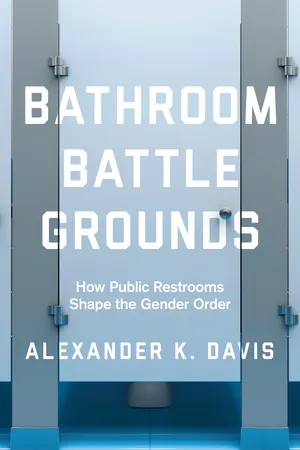
Today's debates about transgender inclusion and public restrooms may seem unmistakably contemporary, but they have a surprisingly long and storied history in the United States—one that concerns more than mere "potty politics." Alexander K. Davis takes readers behind the scenes of two hundred years' worth of conflicts over the existence, separation, and equity of gendered public restrooms, documenting at each step how bathrooms have been entangled with bigger cultural matters: the importance of the public good, the reach of institutional inclusion, the nature of gender difference, and, above all, the myriad privileges of social status. Chronicling the debut of nineteenth-century "comfort stations," twentieth-century mandates requiring equal-but-separate men's and women's rooms, and twenty-first-century uproar over laws like North Carolina's "bathroom bill," Davis reveals how public restrooms are far from marginal or unimportant social spaces. Instead, they are—and always have been—consequential sites in which ideology, institutions, and inequality collide.
Information
Publisher
University of California PressYear
2020Print ISBN
9780520300149
Edition
1eBook ISBN
9780520971660
1
Politicizing the Potty
An eminent sanitarian has said that “the relations between sociology and hygiene are extremely intimate”—a fact which seems not sufficiently appreciated by the students of either subject.
Marion Talbot, “Sanitation and Sociology,” American Journal of Sociology, July 1896
In the spring of 1970, Harvard University and Radcliffe College embarked on a bold experiment: an exchange in which 150 Radcliffe students and 150 Harvard students would swap housing arrangements, live in coeducational dormitories, and share residential bathrooms for a single semester. Following “unanimous approval of the faculty,” the two institutions became the most recent schools in the United States to adopt a mixed-gender living scheme that one Wall Street Journal article described as “the biggest thing in college dormitories since the hotplate.”1 In part, Harvard faculty and administrators approved coeducational housing as a response to similar, increasingly unavoidable pressures from other institutions. Elsewhere in the Ivy League, more and more previously all-male institutions were admitting their first-ever pool of female applicants, and Harvard and Radcliffe were themselves enmeshed in negotiations about when and how to merge into a single coeducational university in the coming years. The success or failure of coeducational housing was thus understood “to have a significant bearing on plans for a full, permanent merger.”2
But the national trend toward coeducation was not the only rationale motivating the Harvard faculty’s approval of a mixed-gender housing program. Much more mundane considerations, such as enabling undergraduate men and women to mingle with one another serendipitously—but without amorous trappings—also precipitated administrative interest in the new venture. As the head of one of Harvard’s merger committees reported, the new housing exchange would allow “Harvard men who would just like to talk to a Radcliffe woman in a common room or [while] taking a walk along the Charles” to do so without having to use “the only apparatus” currently available to him: asking her out on a date. After all, he added, “The date carries with it subtle but clearly palpable expectations as to how one should behave,” and those expectations would undoubtedly “interfere with the originally quite simple expectation”3 of cultivating a friendship across gendered lines.
Harvard and Radcliffe students also welcomed shared dormitory arrangements for equally platonic reasons, though clear gender differences abounded in the details of each group’s appreciation for their newly shared spaces. Harvard’s male students were particularly taken with the many improvements to their residence life that women offered, praising the “improved housekeeping” in their halls and their newfound proximity to “excellent sources of classroom notes at all hours.” Radcliffe’s female students, on the other hand, welcomed the opportunity to convince the Harvard men to rethink such tired gender stereotypes and to see them as worthy colleagues rather than “supermachines.” 4 For them, coeducational dormitories represented an opportunity to overcome a long-standing impediment to their learning and academic growth: the physical isolation of the Radcliffe dorms. No longer restricted by such “socially undesirable” circumstances, female students now found themselves able to tap into “the intellectual advantages of the Harvard house system”5—and thus into the possibility of achieving true educational equity with their male counterparts.
Those differences aside, Harvard men and Radcliffe women were united in finding the new dorms to be much more “natural,” “normal,” and “like home” than conventional gender-segregated housing arrangements. And they were not alone. Outside of Cambridge, students at the many other institutions of higher education throughout the United States experimenting with coeducational spaces in the early 1970s described their new housemates in similarly familial terms. One female student at Wilmington College found that her foray into coed living was analogous to living with “a whole bunch of brothers,” and a male student likewise noted that mixed-gender living helped him with “perpetuating relationships” with women—“not sexually,” he carefully added, “but as friends, brothers and sisters.” Although many parents worried that such appeals to family values were a thin veneer beneath which the “panty-raids and Saturday afternoon open-houses” that they experienced in their own college days were now omnipresent, students and university staff alike stressed that sexual activity was genuinely no more or less rampant than before gender integration. Indeed, as one publicist from Brown University put it in his public rejoinder intended to quell such fears: “There wasn’t any more or any less fooling around than there used to be.” 6
Shared bathrooms, however, were met with much less enthusiasm. One critical dimension of ensuring that the faculty would favor the Harvard-Radcliffe housing exchange was an administrative condition that newly co-residing students would continue to have their most private residential spaces separated by gender. For the first round of coeducational housing, female Radcliffe students “could easily be placed anywhere in the three houses” that Harvard offered, because Harvard housing was “arranged in self-contained suites, each with its own bathroom.” In contrast, because “such suites” did “not exist at Radcliffe,” the Harvard men had to be assigned to living quarters “in separate corridors in the South, North and East houses.”7 At other universities, too, mixed-gender bathrooms remained largely off the table even as coed dorms multiplied dramatically. One staff member at Indiana University’s Office of Residence Life determined that “70% of some 315 colleges had some type of coed dorm by 1971, compared to 51% of 376 institutions in 1967,” but “shared bathrooms” had only “come to 15% of the campuses.” Plus, in that first survey from 1967, researchers “didn’t even consider” counting shared bathrooms, because of their rarity.8 So, while students at Harvard, Radcliffe, and beyond were enjoying the opportunity to challenge some long-standing residential gender boundaries, common bathrooms remained comparatively verboten.
In fact, even when Harvard and Radcliffe incorporated mixed-gender bathrooms into coeducational dorms the very next semester, students bristled at the loss of separation. Although some recounted that managing shared bathroom space was as simple as “holler[ing] before you go into the shower,” 9 many others were nonplussed at the substantial “inconveniences” that resulted. One Harvard student quipped that he could not “leave his razor in the bathroom overnight,” because he found it “dulled by female bathroom mates using it to shave their legs.” And because shared facilities were largely relabeled without being renovated, Radcliffe women found themselves inventing new roles for the “exotic” plumbing fixtures “built originally for men”—by, for instance, creatively repurposing urinals into racks “for hanging your laundry over” so that their male housemates would cease using them as intended. The net effect, according to one dean, was that once the novelty of shared space had worn off, students began to have “second thoughts about sharing bathrooms.” “It was a cool thing at first to have shared bathrooms as an experiment,” she offered, but in looking ahead to the next year, “the students wanted the dorm restructured in separate suites, to allow separate bathrooms.” But perhaps most telling of all was the onslaught of complaints about shared restrooms to the college psychiatrist, who candidly quipped to the Wall Street Journal reporter covering coed housing: “You know, these kids are not as cool as you think they are.” 10
• • • • •
Throughout the 1960s and 1970s, a torrent of restroom-related news was surging into the popular press from American colleges—and not just because journalists were in a tizzy over the “intimate revolution”11 yielding open dormitories and coed bathrooms across the country. Many institutions of higher education found their names featured prominently in the mass media for another reason: their engineering, natural science, and social science faculty were publishing the results of rigorous, peer-reviewed studies about all things toilet. One article in the Washington Post, for instance, celebrated the most recent issue of the American Chemical Society’s journal Environmental Science for thinking beyond the “flush toilet”—because such familiar forms of sanitary technology were “a technological mistake” prone to depleting “the diminishing supply of fresh water.”12 Another piece, in Life magazine, labeled the week of May 15, 1966, as a watershed moment for “the U.S. bathroom, that worldwide symbol of cleanliness, luxury, and civilization.” As it reported, Cornell architecture professor Alexander Kira had just released a study finding that “hygiene-happy Americans are not as clean as they think they are.” The culprit, according to his team of researchers? Inadequate bathroom fixtures and toileting technologies—which, Kira argued, were surprisingly serious problems in need of equally serious solutions. In fact, while he reported that several of his “distinguished senior colleagues” thought his choice to study bathrooms “was irresponsibly funny,” his research participants—and the journalist assigned to write about his forthcoming book, The Bathroom—“seemed wonderfully relieved that the whole bathroom question was out in the open at last.”13
Since then, social-scientific research on restrooms has proliferated. Over the last four decades, demographers and public health scholars have documented the necessity of clean, safe, and accessible public bathrooms for individual and community-wide wellness.14 Historians of the body and urban historians have frequently addressed public toilets in tandem with their accounts of eighteenth- and nineteenth-century public life in the United States, whether their archival excavations have foregrounded shifting norms of bodily cleanliness or the constant churn of political support for publicly funded urban infrastructure.15 Microsociologists and social psychologists interested in the dynamics of “backstage” social practices and social interactions—that is, those actions that people undertake when they are largely out of the view of others—have highlighted public restrooms as revelatory sites of inquiry, largely owing to their status as private spaces in the midst of public life.16 And as I briefly described in this book’s introduction, researchers studying inequalities of race, class, ability, and sexuality across disciplinary boundaries have illustrated that public restrooms in the United States are critical sites for the production (and reproduction) of various forms of social and political exclusion. But because the persistent taboo associated with bathrooms has never fully disintegrated, the academic study of all things toilet-related has never fully moved from the margins of intellectual inquiry to the mainstream. Instead, such contributions have unfolded more as disconnected odds and ends of academic fabric rather than as a cohesive intellectual project.
In response, this chapter stitches together many of those social-scientific fat quarters into an interdisciplinary quilt of existing scholarship on American public restrooms. But rather than doing so with the conventional, thematic organization used in most social-scientific literature reviews, I structure this chapter in a way that also crafts a synthetic history of gendered “potty politics” in the United States. This allows me to accomplish two interrelated ends. The first is, as before, to remedy the disconnected character of so much existing restroom-related research by producing a cohesive narrative of how gender has shaped public restrooms over the last two hundred years. But my second aim is to establish the topical motivation for my intellectual work in Bathroom Battlegrounds—in complement to the theoretical motivation I outlined in the introduction. Specifically, by documenting what scholars already know about gender and public restrooms and, relatedly, what they do not know, I use this chapter to lay the groundwork for the empirical analysis I pursue in the five chapters that follow—work that will track how various kinds of formal organizations choose to gender their restrooms and, moreover, reveal how bureaucratic talk of toilets diverges, and often notably so, from the more public conversations summarized here.
FROM THE PRIVATE BATH TO THE (QUASI-) PUBLIC TOILET: 1800–1905
Of the many revolutionary changes to American culture that occurred over the course of the nineteenth century, one of the most transformative of everyday life was the rise of personal cleanliness as a normative, everyday aspiration for the majority of the population. Although the body’s evacuative processes had been a site of cultural concern since well before the nation’s founding, owing largely to the emphasis placed on such matters in European and North American medical thinking, maintaining a properly clean and orderly body became a ubiquitous social practice to an unprecedented degree. In part, such shifts were driven by uniquely American beliefs about the individualistic pursuit of upward mobility. As guidebooks outlining the necessities of respectable living began to celebrate the boons associated with regular washing, bathing and toileting practices understood to enhance personal hygiene began to trickle down from the most affluent social circles in the United States to the growing middle class. Moral reformers extended that diffusion even further as they peddled the myth of meritocracy to less affluent groups. As they collectively argued, regular bathing was an easy way for working-class individuals to find acceptance within middle- and upper-class society and for immigrants to demonstrate that they had fully assimilated to native-born culture. Cleanliness thus became a matter of personal self-development for most Americans—and was especially requisite for any citizen interested in climbing (or maintaining their current position on) the social ladder.17
But in part, the new value placed on the clean body was driven by beliefs about what it meant to participate in the collective project of American democracy. Stemming from eighteenth-century beliefs in American exceptionalism, two of the central projects of nineteenth-century American politics were defining the character of the United States as a nation and demonstrating the success of that character over its European counterparts. By the middle of the century, a tight connection between an individual’s quest for personal development and the nation’s quest for showcasing the unique strengths of American democracy had emerged. Publicly showcasing signals of one’s moral stature subsequently came to function as a way for individuals to convey their commitment to themselves and their country in simultaneity, allowing regular bathing and “clean” toileting practices to proliferate in popularity for men and women alike. That popularity, however, followed gendered tropes. For men, hygiene was a symbol of masculinity that was thought to protect the state from the numerous perils associated with a weak or effeminate citizenry, while for women, hygienic knowledge was an important dimension of effectively maintaining the health and moral character of one’s household. Hygiene thus served a dual function throughout the first few decades of the nineteenth century: it could not only uplift the masses, offering an opportunity for individuals to shed moral filth alongside physical dirt and pursue the American Dream, but it could also uplift the nation as a whole.18
That revolution in American hygiene was given several additional boosts by infrastructural and institutional developments leading up to the Progressive Era. One was a series of technological advancements that enabled public water systems to begin delivering water to private homes. By the middle of the nineteenth century, middle-class Americans had largely adopted the view that cleanliness was of personal and collective value; however, most cities did not have fully functioning municipal water systems until the 1870s and 1880s. The emergence of such systems therefore allowed more Americans than ever before to have technologies like running water and indoor water closets in their homes. In the wake of such emergent technologies, advertising as an institutional field also began to emerge. Manufacturers of soap, bathroom fixtures, and other such wares harnessed the new moral standard of cleanliness in the service of marketing bathing products to consumers interested in appearing as healthy and as respectable as possible: marketing messages upheld “to...
Table of contents
- Subvention
- Title
- Copyright
- Dedication
- Contents
- List of Illustrations
- Acknowledgments
- Introduction
- 1. Politicizing the Potty
- 2. Professionalizing Plumbing
- 3. Regulating Restrooms
- 4. Working against the Washroom
- 5. Leveraging the Loo
- 6. Transforming the Toilet
- Conclusion
- Appendix: Data and Methodology
- Notes
- Bibliography
- Index
Trusted by 375,005 students
Access to over 1.5 million titles for a fair monthly price.
Study more efficiently using our study tools.
Frequently asked questions
Yes, you can cancel anytime from the Subscription tab in your account settings on the Perlego website. Your subscription will stay active until the end of your current billing period. Learn how to cancel your subscription
No, books cannot be downloaded as external files, such as PDFs, for use outside of Perlego. However, you can download books within the Perlego app for offline reading on mobile or tablet. Learn how to download books offline
We are an online textbook subscription service, where you can get access to an entire online library for less than the price of a single book per month. With over 1.5 million books across 990+ topics, we’ve got you covered! Learn about our mission
Look out for the read-aloud symbol on your next book to see if you can listen to it. The read-aloud tool reads text aloud for you, highlighting the text as it is being read. You can pause it, speed it up and slow it down. Learn more about Read Aloud
Yes! You can use the Perlego app on both iOS and Android devices to read anytime, anywhere — even offline. Perfect for commutes or when you’re on the go.
Please note we cannot support devices running on iOS 13 and Android 7 or earlier. Learn more about using the app
Please note we cannot support devices running on iOS 13 and Android 7 or earlier. Learn more about using the app
Yes, you can access Bathroom Battlegrounds by Alexander K. Davis in PDF and/or ePUB format, as well as other popular books in Social Sciences & Discrimination & Race Relations. We have over 1.5 million books available in our catalogue for you to explore.