What is the role of the ambulance in the American city? The prevailing narrative provides a rather simple answer: saving and transporting the critically ill and injured. This is not an incorrect description, but it is incomplete.
Drawing on field observations, medical records, and his own experience as a novice emergency medical technician, sociologist Josh Seim reimagines paramedicine as a frontline institution for governing urban suffering. Bandage, Sort, and Hustle argues that the ambulance is part of a fragmented regime that is focused more on neutralizing hardships (which are disproportionately carried by poor people and people of color) than on eradicating the root causes of agony. Whether by compressing lifeless chests on the streets or by transporting the publicly intoxicated into the hospital, ambulance crews tend to handle suffering bodies near the bottom of the polarized metropolis.
Seim illustrates how this work puts crews in recurrent, and sometimes tense, contact with the emergency department nurses and police officers who share their clientele. These street-level relations, however, cannot be understood without considering the bureaucratic and capitalistic forces that control and coordinate ambulance labor from above. Beyond the ambulance, this book motivates a labor-centric model for understanding the frontline governance of down-and-out populations.
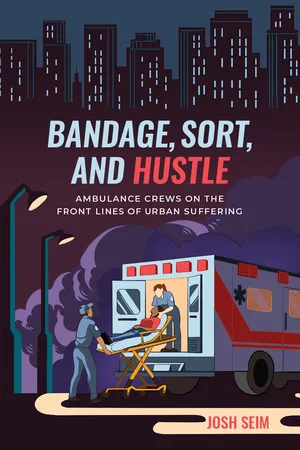
eBook - ePub
Bandage, Sort, and Hustle
Ambulance Crews on the Front Lines of Urban Suffering
- 272 pages
- English
- ePUB (mobile friendly)
- Available on iOS & Android
eBook - ePub
About this book
Information
PART I
Bandaging Bodies
INSIDE THE AMBULANCE
This first set of chapters jumps into the ambulance. I cover the manual, mental, and emotional aspects of ambulance labor and detail some of the subtle and not-so-subtle distinctions ambulance crews use to make sense of their work. The point is not to simply demystify what happens within this mobile structure that frequents poor and nonwhite neighborhoods. That’s one of my objectives for sure, but I’m also interested in laying the foundation for the horizontal and vertical analyses that follow (parts 2 and 3 respectively).
Life inside the ambulance can be first and foremost summarized as a site of “people work.” This work involves a physical regulation of spaces in bodies (e.g., clinical interventions into flesh and bone) and bodies in spaces (e.g., moving people from streets and homes into the hospital). However, ambulance work cannot be reduced to just a manual execution of treatment and transport. This material engagement with the world is interlocked with symbolic transformations, like the basic assemblage of a medical case. Workers’ written and verbal articulations of vital signs, diagnostic categories, and other formal classifications are essential to understanding how crews process people into ambulance patients. Yet, there are more informal classifications at play too. Workers’ shared distinctions in different kinds of people (e.g., racialized and gendered subjects) shape, and are shaped by, the labor they perform.
Such biases are significant, but I argue that another axis of preference is also at play: the taken-for-granted distinction in “legit” and “bullshit” cases. More pure types on a continuum than binary categories, these folk terms tend to map onto variability in spaces in bodies (more legit work) and bodies in spaces (more bullshit work). Understanding the fuzzy moral order in legit and bullshit cases requires an understanding of ambulance work as a vocation. While a number of workers, especially the more veteran ones, describe themselves as “jaded” and “burnt out,” the overwhelming majority of people I met at MRT articulate some generally strong commitments to the craft of paramedicine. They want to “truly help” people by doing what they are primarily trained and equipped to do: salvage bodies in crisis through relatively deep and technical interventions into human flesh. However, to their frustration, much of their day-to-day labor involves not a regulation of spaces in bodies, but the inverse. They’re often moving forgettable cases from homes and streets into the hospital for “nonemergency problems” like mild chronic illness exacerbations and empty prescription bottles.
Among other things, this legit-bullshit continuum is intertwined with crews’ mechanisms for coping with the particular challenges of ambulance-based people work. I argue that two opposing sets of dispositions are especially important: “being a dick” (apathetic, hostile, and cold) and “having heart” (sympathetic, hospitable, and warm). There are plenty of factors that engender someone’s disposition at work, many of which probably extend well beyond the workplace. I don’t deny this or intend to suggest that some one-dimensional spectrum between being a dick and having heart captures the entirety of worker temperament. However, the emotional thread I detail helps clarify the pathways through which the immediate conditions of labor influence the interactions between crews and patients. The lows of bullshit work tend to motivate a cold handling of patients and the highs of legit work tend to encourage a warm handling. I link crew-patient struggle to the former and crew-patient solidarity to the latter.
This layering of the physical, mental, and emotional aspects of people work inside the ambulance is no doubt complicated, but it’s important. It helps us piece together the practical component of a labor process. Recall that the practical component refers to a transformation or regulation of the world by the hands and minds of workers utilizing the instruments of production. While the effects are often micro and momentary, ambulance workers nevertheless change and maintain the world. They identify and correct abnormalities within people and move those deemed ill and injured into places they’re better fit for.
We must not forget that these transformations are unevenly spread across the urban landscape. Neither legit nor bullshit calls are limited to poor or racially oppressed populations, but both call types—and essentially everything in the gray area between—concentrate downward. Morbidity and mortality risks are higher near the floor of the urban hierarchy, and so too are the risks of being excluded from the yolks of medicine, housing, and social security more generally. Crises, the “urgent” or the “nonurgent,” the “medical” or the “nonmedical,” accumulate in poorer and less white territories. The men and women who labor the ambulance are some of the few people the state dispatches to handle crises and this means much of their work brings them toward the bottom of the polarized city.
In several respects, ambulance labor amounts to bandaging bodies. Crews generally offer superficial responses to complex problems. This can be seen not only in the application of gauze and pressure to a bloody gash but also in the movement of a body from the cold concrete into the relatively warm hospital bed. It can be seen in the fentanyl, albuterol, and other medications that crews throw at the chronically ill, just as it can be seen during the forced restraint and transport of drunk or otherwise disordered subjects. Ambulance crews ultimately constitute a reactionary force for stabilizing, but not fundamentally solving, many of the crises that disproportionately plague destitute and stigmatized populations in the American metropolis.1 This fact isn’t lost on crews either. As many put it, much of their job means applying “bandage solutions” to a variety of hardships.
We can learn a lot about the regulation of urban suffering by looking in the back of an ambulance. Representative of the state’s quick and temporary responses to crises, the ambulance is a suitable analogy for a number of interventions that mitigate social suffering but rarely target its root causes: emergency housing, short-term cash assistance, expedited food stamps, and so on. We may live in an era of “retrenched” or “disciplinary” welfare, but we also live in an era of ambulance welfare.2 Many of the fragmented programs and policies that disadvantaged populations depend on are not just stingy; they’re also superficial.
1
People Work
A STRANGE SHOP FLOOR
Paramedics and EMTs work on people. The primary material that’s labored by ambulance crews are human beings—their organs, their categorizations, their locations, and so on. Consider five seemingly disparate cases.
Stabbing at a Bar
Paramedic Edward and EMT Morgan arrived at a bar. Police and firefighters were already on scene and directed the crew to John, a white male in his late twenties who works as the bar’s bouncer. He was lying in the parking lot. Someone stabbed him multiple times. John’s inner left arm was sliced just below the elbow and there was a laceration on the back of his head. There were also deep punctures to his gut, flank, and lower back.
With the help of some firefighters, Edward and Morgan covered John’s oozing wounds, loaded him into the ambulance, and gave him some fluid through an intravenous (IV) line. As Morgan drove to the hospital, John screamed through the non-rebreather oxygen mask that Morgan attached to his face. “Fuck,” he shouted from the gurney, “Don’t let me die! You need to get me to a doctor!” “We’re going there right now,” responded Edward as he spiked another IV bag. A firefighter also rode in the ambulance and helped Edward control the patient’s bleeding. Midway through the transport, John’s screams faded to moans before he began to nod off. Edward shook his patient to keep him awake. “Stay with me! Stay with me!” he shouted. It wasn’t long until Morgan parked the rig. A trail of blood then connected the ambulance to the emergency department.
After transferring care to a team of trauma specialists inside the hospital, Morgan hosed blood off the gurney as Edward documented details regarding the call in his laptop. In addition to logging John’s demographics (e.g., age and gender), Edward noted his “primary impression” of the patient (i.e., his field diagnosis) and listed the interventions he and Morgan performed (e.g., bleeding control, oxygen therapy via a non-rebreather mask, and fluid via IV). Edward uploaded this medical record known as a patient care report to a secure server and printed a copy for hospital staff.
Living Room Death
Paramedic Stacey and EMT Jeremy, along with the assistance of local firefighters and a paramedic supervisor, responded to a “code” (i.e., a cardiac arrest). The victim was a seventy-or-so-year-old black man who lay on the floor of his apartment living room. He was “PEA,” meaning the monitor connected to his body via some sticky electrodes indicated “pulseless electrical activity.” The man’s body was hooked up to a Lucas CPR device, a special machine that delivers automatic sternum compressions.
Firefighters shoved nearby furniture toward the walls to make room for the “pit crew,” the resuscitation team of five or so first-responders led by Stacey. While one firefighter paramedic intubated the patient by carefully guiding a plastic tube down the airway, Stacey drilled a hole into the old man’s shin to initiate intraosseous infusion (IO). Once an IO was established, Stacey’s team periodically administered medications like epinephrine directly into the bone marrow. They paused regularly to shock the patient with a defibrillator. For over thirty minutes, the pit crew attempted to revive the patient through a mixture of compression, ventilation, electrical shock, and drugs.
They eventually “called him” (i.e., determined death) before Stacey even had a chance to learn the patient’s name. The paramedic and EMT returned to their ambulance without a body, where Stacey documented some intricate details of the case in her laptop before they responded to another 911 call. Among other things, she had to carefully report the timing of the pit crew’s many interventions.
Septic at the Sniff
Paramedic Derrick and EMT Martin responded to a skilled nursing facility or what is colloquially referred to as a “sniff.” They were greeted by a certified nursing assistant (CNA), a nurse, and someone from the sniff’s management team. Firefighters were also on scene and introduced Derrick and Martin to their patient: Barbara, a seventy-five-or-so-year-old white woman, who lay in bed and mumbled. The firefighters had already collected some baseline vitals indicating a rapid heart rate and low oxygen saturation. The CNA and nurse also informed the crew that Barbra has type-2 diabetes, osteoporosis, and a pressure ulcer (i.e., a bedsore). They also stated that Barbara seemed to experience discomfort upon recent urination.
Derrick placed his gloved hand on Barbara’s forehead and noted that she was warm to touch before he checked her blood sugar levels using a glucometer. Derrick also directed Martin to run an electrocardiogram (EKG) while Barbara was still in her sniff bed. In following through with the paramedic’s wishes, Martin struggled at first to stick the EKG electrodes to Barbara’s skin. It was covered in some sort of lotion. This may have helped thwart new bedsores, but Derrick suspected it was worsening Barbra’s fever. After an unremarkable EKG, Derrick and Martin started to transport Barbara to the hospital, suspecting the early stages of sepsis, and Derrick gave her some low-flow oxygen on the way.
During the transport, Derrick typed away on his laptop and periodically checked on Barbara and the monitor that summarized her heart rate, oxygen saturation, and blood pressure. He used paperwork provided to him by the sniff staff to log Barbara’s date of birth, medical history, current medications, insurance policy number, and other information.
Drunk and Drowsy in Downtown
Paramedic Rob and EMT Logan were summoned to a downtown sidewalk to aid Darrell, a “frequent flyer” known to both ambulance workers by name. It was unclear how this fifty-five-year-old black man got there or why he was leaning against the side of a building with his eyes closed. However, it was clear who called 911: a security guard who roams these business-hugging sidewalks. He was unable to convince Darrell to leave the area on his own, so he reported the seemingly intoxicated person to dispatchers who in turn sent Rob and Logan.
After kicking the bottom of Darrell’s shoes and struggling to converse with the slurring man, Rob determined that he was too drunk to leave. So, the crew loaded their patient, who carried a strong smell of alcohol and vomit, into the ambulance, where they then hooked him up to a monitor to collect a baseline set of vitals: blood pressure, heart rate, and blood oxygen saturation. Logan sat on a chair next to the gurney and began a patient care report on the laptop while Rob asked Darrell about his medical history. The workers also ran an EKG before they determined Darrell to be a low-priority case. The man mumbled the name of a hospital across the county, but Rob refused to take him there. Instead, Rob let Darrell chose one of the three closest hospitals. The patient then said the name of a large public hospital a few miles away.
Logan left the back of the ambulance and took the driver’s seat. Rob stayed in the back with Darrell. During the transport, Rob continued the medical record started by Logan. The computer program soon forced him to enter a primary impression. He was given some closed-ended options and selected the category that seemed to best summarize his patient’s state: “ETOH,” an acronym for...
Table of contents
- Title
- Copyright
- Contents
- List of Illustrations
- Preface
- Author’s Note
- Acknowledgments
- Introduction
- Part I Bandaging Bodies: Inside the Ambulance
- Part II Sorting Bodies: The Ambulance Between Hospitals and Squad Cars
- Part III Hustling Bodies: The Ambulance Underneath Bureaucracy and Capital
- Conclusion
- Appendix: Notes on Data and Methods
- Notes
- Reference List
- Index
Trusted by 375,005 students
Access to over 1.5 million titles for a fair monthly price.
Study more efficiently using our study tools.
Frequently asked questions
Yes, you can cancel anytime from the Subscription tab in your account settings on the Perlego website. Your subscription will stay active until the end of your current billing period. Learn how to cancel your subscription
No, books cannot be downloaded as external files, such as PDFs, for use outside of Perlego. However, you can download books within the Perlego app for offline reading on mobile or tablet. Learn how to download books offline
Perlego offers two plans: Essential and Complete
- Essential is ideal for learners and professionals who enjoy exploring a wide range of subjects. Access the Essential Library with 800,000+ trusted titles and best-sellers across business, personal growth, and the humanities. Includes unlimited reading time and Standard Read Aloud voice.
- Complete: Perfect for advanced learners and researchers needing full, unrestricted access. Unlock 1.5M+ books across hundreds of subjects, including academic and specialized titles. The Complete Plan also includes advanced features like Premium Read Aloud and Research Assistant.
We are an online textbook subscription service, where you can get access to an entire online library for less than the price of a single book per month. With over 1.5 million books across 990+ topics, we’ve got you covered! Learn about our mission
Look out for the read-aloud symbol on your next book to see if you can listen to it. The read-aloud tool reads text aloud for you, highlighting the text as it is being read. You can pause it, speed it up and slow it down. Learn more about Read Aloud
Yes! You can use the Perlego app on both iOS and Android devices to read anytime, anywhere — even offline. Perfect for commutes or when you’re on the go.
Please note we cannot support devices running on iOS 13 and Android 7 or earlier. Learn more about using the app
Please note we cannot support devices running on iOS 13 and Android 7 or earlier. Learn more about using the app
Yes, you can access Bandage, Sort, and Hustle by Josh Seim in PDF and/or ePUB format, as well as other popular books in Ciencias sociales & Antropología cultural y social. We have over 1.5 million books available in our catalogue for you to explore.