Axiom Business Book Awards 2020 Gold Medalist in Philanthropy / Nonprofit / Sustainability
The Time to Impact the Future Is Now
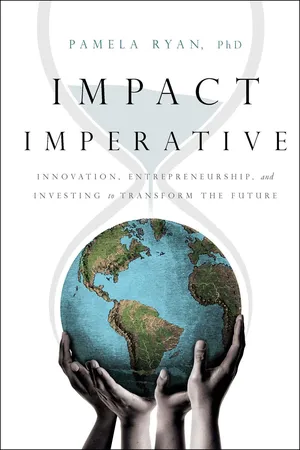
?Impact Imperative author Pamela Ryan explores the likely realities facing our planet and humanity for the next few decades. We are, as she tells us, at a pivotal moment in history. Individuals, organizations, and investors are doing immense good, but extraordinary challenges are enveloping the planet, threatening life and humanity itself: escalating extreme weather events, shifting global population and power balances, widening socioeconomic disparities, and rising tensions among extremists and mainstream populations.
Impact Imperative stems from consultations with over 130 professionals in the burgeoning impact innovation, entrepreneurship, and investment space. As Dr. Ryan shares insights from these impact innovators about how we can meet these challenges in the next few decades and beyond, she encourages readers to think about how our own consequential actions in the present can propel us—individually and collectively—toward more optimal futures. Or increasingly destructive futures.
eBook - ePub
Impact Imperative
Innovation, Entrepreneurship, and Investing to Transform the Future
- 392 pages
- English
- ePUB (mobile friendly)
- Available on iOS & Android
eBook - ePub
Impact Imperative
Innovation, Entrepreneurship, and Investing to Transform the Future
About this book
Information
PART ONE:
Toward Clarity: Impact, Doing Good, Minimizing Harm
Considering impact, enacting impact, and investing in impact are on the rise. Impact thinking and doing is increasingly influencing the organizational, socioeconomic, and political environments in which we live, work, and play. But what do we mean by “impact”? How do we know we are impacting? What if our impact is not what we intended? What if our “doing good” inadvertently causes harm?
Part 1 of Impact Imperative illuminates the multifaceted and inherently paradoxical nature of impact for the 2020s and beyond. We move from a focus on impact as a noun (a static “end”) toward a more nuanced understanding of impact as a verb, as a dynamic process. The chapters ahead explore impact in all of its dualities—noun and verb, positive and negative, intended and unintended, micro and macro, immediate and long term. We hope our reflections trigger your reflections about the assumptions, language, and actions you and your organizations bring to impact.
We hope that in considering the dualities of impact, future acts of doing good will not contribute to or exacerbate inequities or distress in the very communities we seek to assist. We therefore invite everyone intent on doing good to constantly monitor and adjust their assumptions, frames, language, and actions—to do no harm.
We argue in the pages ahead that any contemplation of enacting impact must inherently consider both the negative and the positive, and how we ourselves contribute to the negative. The “do no harm” imperative is a necessary and equal partner to the impact imperative. This do-no-harm thread runs throughout the book.
CHAPTER 1
Impact? What Impact?
“If you asked me what the world looked like in twenty-five years, I guarantee you that companies, all companies, will be reporting not just financial metrics, but also impact metrics . . . Those things will be driving part of their investment portfolios, and that will effectively get companies to pay for negative externalities.”
—Nick O’Donohoe, Big Society Capital
Metrics, measurement, evaluation. These terms have become familiar, almost ubiquitous and inescapable in the social enterprise world, although they can elicit trepidation and exasperation in equal measure. Yet there is nothing unfamiliar about the expectation that an organization, any organization, answers the fundamental question: Is the organization delivering what it aims and claims to deliver? The tricky part is how we can know the organization achieves its aims and unequivocally demonstrates its claims.
In the impact arena, exasperation derives from how specifically to measure the impact of enterprises whose positive impact missions are ahead of or equal to their financial missions. The social metrics that Nick O’Donohoe—who was appointed by the UK government as the first leader of Big Society Capital (BSC), the world’s first institution established to facilitate a countrywide, even global, impact investment sector—sees as normal and universal in a decade or two are the source of debate and struggle as we enter the 2020s.
O’Donohoe noted how far the impact arena has come in just one decade. The G8 process raised the impact investing conversation to whole new levels, reflecting justifiable concerns and hype about reality. When leaders of the G8 (the “Group of Eight” of most industrialized countries—the United States, Britain, France, Germany, Canada, Italy, and Japan; Russia was temporarily suspended for its invasion of Ukraine)1 gathered in Northern Ireland in June 2013 for their annual summit on global issues, then-UK prime minister David Cameron (president of the 2013 summit) convened a pioneering task force on social impact investment. A vocal champion of impact investing, Cameron backed his vision with political and other resources, including committing his Cabinet Office to be the task force secretariat for two years. This G8 task force was mandated with catalyzing a global market in impact investment to improve society, by facilitating global dialogue and action in the G20 and beyond. Initial members included all of the G8 countries, plus Australia and the European Union, both invited to join with observer status. Since then, O’Donohoe has witnessed seismic shifts, like the emergence of a critical mass of investors wanting to positively impact our world. More and more high-net-worth individuals and foundations are asking their banks about positive impact investments. Millennials are investing with their positive impact values and Baby Boomers are seeking alternative meaning and purpose to the financial drivers that may have dominated their lives so far. People are caring about both the positive and negative impacts of their own and organizational actions. They are increasingly paying attention to how they can contribute positively, not negatively.
Such client interest is nudging mainstream financial institutions into the impact space. O’Donohoe sees a significant majority of citizens wanting to do more and asking their banks how they can engage. Corporations, managers, CEOs, and boards of directors are seeking opportunities for impact investment—one of the fastest-growing investment strategies—and proactively embedding impact into their organization’s culture and activities. Others are accessing this burgeoning source of financial and human capital, as individuals, family offices, philanthropic organizations, governments, institutional investors, and corporations embrace investing for positive purposes. In impact innovators’ positive visions of global futures in the late 2020s, these positive impact values dominate entrepreneurial initiatives, investments, and consumer decisions. In the minds of today’s impact changemakers, by 2030, these values are a normal part of operating an organization, of life.
What is “Impact”?: Impact as noun and verb, product and process
Conceptions of impact in the first two decades of the twenty-first century have mostly used the word as the end result of action. As a noun. The focus has been on measuring impact as the conclusion of a sequential set of organizational activities—a linear chain starting with an organization’s mission and goals regarding social challenges and ending with impact. As a noun, impact belongs to the family of words that includes effect, influence, consequences, results, and conclusions. However, this dominant use of impact as a noun conceals elements of impact that are about force: impact as a collision or the striking of one thing against another. Impact as a verb.2
Most impact measures in the second decade of the twenty-first century focus on impact as a noun, only examining outputs and outcomes, the effects of an organization’s activities. However, if only the products of an organization are examined, we miss a fundamental set of impacts. We focus on a finite end instead of ongoing evolution. We see only a problem to be solved within a specific time frame instead of a set of circumstances to be managed over time.
As a verb, impact is associated with words connoting “to affect”—the act of influencing, transforming, moving, shaping—but also, in some usages, the act of colliding with or slamming into. As Professor Karl Weick might say: If all incarnations from affect to effect, from influence to collision, have a tinge of impact to them, then determining what impact is and what it isn’t, let alone measuring it, becomes exceedingly hard. But doable.
When our usage of impact comes to encompass its complexity—as both noun and verb, as product and process—we get close to articulating how impact and impacting, the doing impact and the measuring of impact, will evolve over the next decade or two.
Impact innovators we consulted foresee a 2030 in which common use of the word impact reflects its full meaning as noun and verb. This reflects the inherent intricacy of the extended and interconnected web of potential impacts (intended and unintended) of any organization. In 2030 the linear chain dominating pre-2020 impact thinking should be replaced by a collective understanding of the mosaic of relationship threads, and the multiplicities of relations among activities, processes, outputs, outcomes, and impacts—replete with feedback loops and circular cause-and-effect ramifications.
UNDERSTANDINGS OF “IMPACT” ARE EVOLVING
If contemplating all of these words feels like we are treading our way through a field studded with land mines, wariness is well warranted.
As the 2020s begin, battles still rage around the planet between shareholders and stakeholders, but the tide is turning toward a future where profit is not the only measurement of a company’s well-being. The surge in demand for awareness and action toward net positive impact is being felt in the boardrooms of even the most profit-oriented corporations. Just ask the embattled CEOs of United Airlines or the Weinstein Company about the billion-dollar beating their financial bottom lines endured after public exposure of bad behavior (including delayed responses or cover-ups) that valued profits over people.
Leading thinkers and doers in the impact innovation arena, like Nick O’Donohoe and Stanford Social Innovation Review editor Johanna Mair, believe that by 2030 technology-driven transparency and accountability will ensure that individuals and organizations enacting negatively impactful activities will be routinely called out, held to account, publicly shamed. So, by 2030, individuals and organizations will have no choice but to ensure net positive impact of what they do. By 2030, the debacles like Facebook’s or Wells Fargo’s public displays of disregard for customers’ rights will be so last decade.
Despite the challenges of the 2010s, many impact thought leaders generally believe in a positive trajectory for impact from the 2010s’ struggle to sift through all possible definitions and measures to consolidated understandings and clarity. When it came to impact measurement, our interviewees cohered around consistently salient themes. Impact innovators see impact metrics in the late 2020s reflecting a world where impact is the way, not a “third sector” or “fourth way.” They see definitions of impact and measurement characterized by clarity and intent, transparency and accountability, forcing everyone into measurement. They see a 2030 in which conceptions of impact success are multistoried and customized, measures of impact are multistoried and customized, and definitions and measures of scale are multistoried and customized, with measures occurring at multiple levels. They see definitions and measures of impact reflecting evaluations of relationships and collaborations, processes and products. They see locals driving the impact measurement process with reference to global, sector, or other stakeholder measures, and impact definitions and measures simultaneously encompassing the short term and the long term.
For the remainder of this chapter, we examine the status of impact measurement in the 2010s, and then explore the challenges for measuring impact into the 2020s.
MEASURING IMPACT
How do we know when net positive impact has occurred? How do we measure impact? Designers, entrepreneurs, investors, and other stakeholders may have very different objectives and priorities. Some types of impact—for example, the number of farmers who use solar drying systems to preserve their produce, or the number of children with diabetes who use Jerry, the educational teddy bear, to learn how to monitor and care for their own disease—may be easier to define and measure than others. For example, how specifically the recipients of these initiatives were impacted, or how the entrepreneurs’ lobbying efforts helped change public policy to enable government subsidies to farmers, or educational teddy bears being reimbursable on health insurance.
Forms of impact measurement that may capture more nuanced impacts—especially the gold standard, randomized control research designs—take time and specialized intellectual and research knowledge and skills. But a more nuanced approach to understanding impact is the key to unlocking proper measurement of it.
While virtually every impact changemaker envisages a future where impact measurement dilemmas have been solved by 2030, few have solved the measurement puzzle that might enable standardized comparable measures of impact across organizations, industries, and sectors. They were certain that by 2030, understandings of how impact manifests would be predicated on data. On evidence-based decision-making. They were certain that understandings of the nature, size, and rippling effects of impacts (both positive and negative) are much more advanced by 2030, facilitated by technology-enabled, real-time access to meaningful data. But measuring traditional returns or financial return on investment (ROI) is relatively simple and straightforward: Compare monetary income streams against monetary outlay streams, calculate the profits (or losses) and the consequent financial ROI, and explain in the annual report. Can social and environmental returns on investment, which are often social changes or quality-of-life improvements, really be measured in numbers? For enterprises intent on positive impact—whose missions dictate that their companies make a positive difference to societal challenges—the task of evaluating whether or not they have reached their impact goals is much more complex than a single or even triple bottom line of numbers.
Accurately capturing the multiplicity of impacts of an enterprise is often an illusive endeavor. Illusive because, as an Economist editorial asserted, defining what constit...
Table of contents
- Cover
- Title Page
- Copyright
- Contents
- Introduction
- Part One: Toward Clarity: Impact, Doing Good, Minimizing Harm
- Part Two: Changemakers Inherent in Entrepreneurial Ecosystems
- Part Three: Toward 2030: Which Future?
- Forthward: Everywhere, Everywhen
- Acknowledgments
- Appendix: Forms of Capital for Innovation, Entrepreneurship, and Impact
- Notes
- Index
- About the Author
- About the Contributors
Trusted by 375,005 students
Access to over 1.5 million titles for a fair monthly price.
Study more efficiently using our study tools.
Frequently asked questions
Yes, you can cancel anytime from the Subscription tab in your account settings on the Perlego website. Your subscription will stay active until the end of your current billing period. Learn how to cancel your subscription
No, books cannot be downloaded as external files, such as PDFs, for use outside of Perlego. However, you can download books within the Perlego app for offline reading on mobile or tablet. Learn how to download books offline
Perlego offers two plans: Essential and Complete
- Essential is ideal for learners and professionals who enjoy exploring a wide range of subjects. Access the Essential Library with 800,000+ trusted titles and best-sellers across business, personal growth, and the humanities. Includes unlimited reading time and Standard Read Aloud voice.
- Complete: Perfect for advanced learners and researchers needing full, unrestricted access. Unlock 1.5M+ books across hundreds of subjects, including academic and specialized titles. The Complete Plan also includes advanced features like Premium Read Aloud and Research Assistant.
We are an online textbook subscription service, where you can get access to an entire online library for less than the price of a single book per month. With over 1.5 million books across 990+ topics, we’ve got you covered! Learn about our mission
Look out for the read-aloud symbol on your next book to see if you can listen to it. The read-aloud tool reads text aloud for you, highlighting the text as it is being read. You can pause it, speed it up and slow it down. Learn more about Read Aloud
Yes! You can use the Perlego app on both iOS and Android devices to read anytime, anywhere — even offline. Perfect for commutes or when you’re on the go.
Please note we cannot support devices running on iOS 13 and Android 7 or earlier. Learn more about using the app
Please note we cannot support devices running on iOS 13 and Android 7 or earlier. Learn more about using the app
Yes, you can access Impact Imperative by Pamela Ryan PhD in PDF and/or ePUB format, as well as other popular books in Economics & Sustainable Development. We have over 1.5 million books available in our catalogue for you to explore.