![]()
CHAPTER 1
Hard Work in Newark
Tough lessons from my ancestors and the Not So Great Depression.
Timing is everything, especially when it comes to making money. Let’s just say the timing was off for much of my family history. My grandfather and namesake, Pherris Robins, was a promising artist who emigrated from Lithuania in the 1880s to escape Czarist persecution of the Jewish people. (What had probably been “Rabinovich” in Russia became “Robins” in America.) He settled in Newark, New Jersey, where he and his cousin opened a furniture store. My grandfather died before the shop became profitable, and I’m sorry I never knew him. The cousin moved the furniture company to Millburn, New Jersey, and it became a local success, but my grandmother never received a dime from it. She and her three boys and two girls had to make their own way.
My maternal grandparents had equally bad luck. My grandfather died in an accident, leaving behind his wife and three daughters, who moved from Massachusetts to the Lower East Side of New York City to try to make a living. Grandma Markowitz often told the story of the day the Labor Department came to vet the conditions of a clothing factory where Esther (who would become my mother) and her two sisters worked. At the time, they were well underage, and they hid in a big sewing machine to avoid being seen by the labor inspectors.
By the 1920s, though, New York and New Jersey were booming, and the Robins boys had big hopes and dreams. Lewis and his two older brothers, William and Jack, became interested in real estate and started buying land in the Bronx, where many Russian Jewish immigrants were settling. They made some money, and when Lewis Robins married Esther Markowitz, it seemed like prosperity was unshakable.
My older sister, Irene, came along in 1926. Newark Airport opened two years later and quickly became the world’s busiest commercial hub, attracting more business to the area. (That airport would spark my interest in learning to fly as well as my passion for travel.) Also in 1928, construction began on the Chrysler Building, that glittering symbol of Art Deco prosperity across the Hudson (and just a few blocks from where I would practice medicine for nearly half a century).
The stock market crash of October 1929 changed everything, and the country plunged into the Great Depression. I made my entrance into the world just eight months later, on June 14, 1930. My timing was not good.
During the Depression years, my father and uncles struggled to pay the taxes on the land they owned and eventually lost it all. That was disheartening for my father, who lost a lot of his drive because of it. I think it took the wind out of his sails. He later ran a gasoline station on Bloomfield Avenue in Montclair, but times were tough and my parents didn’t have much money.
THE NICKNAME GAME
While my given name is “Pherris,” after my paternal grandfather, it never stuck, and I soon became known as “Perry.” When my mother first registered me for school in Newark, the principal suggested she officially change my name, as Pherris was unusual and he thought the children would make fun of it (and, no doubt, bully me for it). To this day, my diplomas and passports say either Perry Pherris Robins or Pherris Perry Robins.
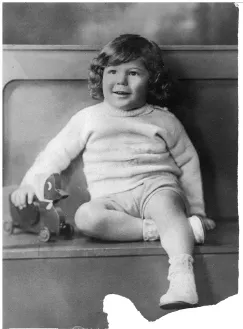
My other nickname was triggered by my hair. When I was a toddler, I’m told, I had gorgeous golden-blond curls. People would comment on my hair so often, my mother was reluctant to cut it. As a result, my uncles insisted on calling me “Patricia” until I got a haircut. After I finally received a haircut, they shortened the name to “Pat.” It stuck, and for many years my nickname was Pat. One day while in college, my roommate went to fetch the mail. He laughed when he handed me a postcard addressed to “Dear Pat.” In fact, I recently received an email from a distant relative that began with “Dear Pat.” Some habits die hard. The grand irony, of course, is that not only did my hair darken as I grew up, but I also lost most of it far earlier than I would have liked. But as I often say, it doesn’t matter, as grass doesn’t grow on a busy street!
My mother was a very caring and kind person, warm and affectionate, and she made do with what she had. Not only did she look after her own immediate family, but she also tended to my father’s two brothers and two sisters who moved in with us. She cooked, kept a tight control on the household chores and worked in a bakery to earn extra money. She worked extremely hard. I learned later that to save money on our food budget, she often just ate the free cake at the bakery and skimped on the healthier foods during meals at home to leave more for the rest of us. That certainly contributed to her developing type 2 diabetes.
My father, who was younger than my mother, was a good-looking hunk with a golden voice. He adored music and loved to sing. He was a great storyteller and could expertly mimic people. When he talked, everyone listened. I realized from a pretty young age, though, that my parents were completely mismatched. I don’t want to say my father was lazy. He was conscientious and did his job. He did the best he could, but he didn’t have the joie de vivre or the spirit that my mother had. She was full of energy and loved to travel and entertain. He was a homebody, happy just to nap on the couch. As the Depression slogged on, I imagine that many of my mother’s dreams were dashed, too. My parents argued all the time. They should have gotten divorced, unequivocally. But in those days you didn’t get divorced. You couldn’t afford to.
I knew there were troubles at home, but I don’t recall that it affected me that much. Still, when I was in about the third grade, the principal at my school became concerned. I was tall for my age, and so super skinny that my ribs stuck out. I wasn’t applying myself in class, and I was not motivated in my lessons. I remember that the principal called my parents and wanted to know if we had enough money and enough to eat. My parents said they were fine. He also wanted to know if there were arguments or family problems at home. My parents said no. Let’s face it: The Depression was not a time when people aired their dirty laundry in public. Nor did parents often ask about their kids’ well-being. They had bigger problems to worry about.
It’s true that I wasn’t a good student and didn’t really care about learning until quite a bit later, but I also had dyslexia. I eventually learned how to work with it, but I have trouble even today. I cannot read a long speech as I tend to stumble a bit. Luckily, I learned to think on my feet and became pretty adept at public speaking anyway.
A LESSON IN ENTREPRENEURSHIP
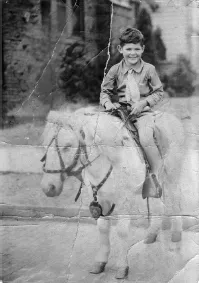
This photo triggers one of my earliest memories. When I was 5 or 6, walking home from school, I saw a man with a pony not far from our house. Of course, I was enchanted by it. The man asked if I’d like to sit on the pony. I said, “Gee, that sounds like fun. I’d like to!” He helped me up into the saddle, then he took some photographs and asked where I lived. I pointed to our house on the corner. A few days later he was knocking at the door of our home, asking my parents if they wanted to purchase the photographs he’d taken of me. They were furious with me and reluctant to buy the photos because of limited funds, but they purchased a couple of the pictures anyway. I think I got a spanking for it. Today anyone would be wary of a stranger trying to lure a child. But I think it might have been an early lesson for me in the power of entrepreneurship!
While times were tough during the Depression, I remember many good things about my childhood. For one, my dog, Queenie, was always there for me. When I was a baby, the owner of the bakery where my mother worked gave her a beautiful German shepherd puppy (after the bakery owner’s 3-year-old left the puppy in the refrigerator on a hot day “because it was perspiring”). The puppy survived the ordeal, became completely protective of me and wouldn’t let anyone near me in my baby carriage. Once when my aunt tried to pick me up, Queenie bit her on the arm. Still, everyone loved that dog, who was with us for many years. I’ve been lucky to have quite a few great dogs in my life.
We lived in a house in Newark, a few blocks from Weequahic Park, and on the weekends my Uncle Jack would take me for walks around the lake. My other uncle, Bill, was self-educated, an avid reader and very intelligent. He taught me a lot as I was growing up and, in some ways, became more of a father to me than my father himself.
I was close with my aunts and uncles, and with my sister, Irene (although we’d fight sometimes, like when I’d steal a piece of cake and blame it on her). There were lots of kids in the neighborhood to play with, although most of them were not Jewish, and a few bad apples occasionally taunted me about it, or tried to beat me up. It seemed so unfair, too, because even though my parents were both raised in religious Jewish families, we never belonged to a synagogue or temple.
Yes, we observed some traditions, especially while my maternal grandmother was still alive. Friends and relatives would come on Friday nights for a big dinner, and we would lock the doors as a symbol of the security of being together and keeping out intrusions. I loved those evenings, and one of my fondest early memories was that on Friday nights, my grandmother would bake a special small challah bread, just for me.
We would use the special dishes for Passover, too, but when my grandmother died, that stopped. We’d still get together with all the family for Rosh Hashanah and Yom Kippur. We didn’t go to synagogue, but my mother would say, “You’re not supposed to eat,” so we’d fast for half a day—although it’s supposed to be the whole day.
I remember how thrilling it was the first time I was told that I didn’t have to go to school because it was a Jewish holiday. I was so excited I went out and told the other kids in the neighborhood they didn’t have to go to school, either. A few tried it and got caught. When their parents found out I was their cause for unsanctioned truancy (as most of the neighborhood kids were not Jewish), I’m pretty sure I got a spanking.
As for my bar mitzvah, it was uninspiring. I never went to Hebrew school, so about a month before I turned 13 my parents decided I should do something. They hired a rabbi who taught me to pronounce the words phonetically, and I read it the best I could off a sheet of paper. That was my entire Jewish education.
The one thing I did throw myself into wholeheartedly in those years was hard work—and from an early age. When I was 8 or 9, I’d go to the gas station with my dad and uncle on Saturdays and help change and fix tires. If I was a good boy and did well, I got to sit in the rumble seat of the Ford and we’d drive down to an ice cream parlor in Newark called Sloppy Dave’s for a maple walnut sundae. To motivate me, my father or uncle would say, “Perry, if you’re not going to work, you’re not going to get your sundae.” So I would work! I guess that kick-started the work ethic I learned from my mother as well as my lifelong love affair with good food—especially ice cream.
My parents often said, “The harder you work, the luckier you’ll be.” I definitely wanted to make them proud. I also had a bicycle route delivering copies of Ladies’ Home Journal and Liberty magazine, with its tagline “A Weekly for Everybody.” Yes, those publications were heavy, but when I was in grammar school, I was taller and stronger than most kids. As a result, I was also assigned the humiliating task of having to carry a neighbor girl’s accordion to school and back, because it was too big and heavy for her. Can you picture that? Let’s just say I wasn’t cool. And I hated having to wait for her, as she was seldom on time. I’d say, “Come on! Come on! We’re going to be late for school! I’ll be in detention.” While I wasn’t a good student then, at least I was obedient and did my best to follow the rules.
When I was about 11, I started working as a busboy at Preakness Hills Country Club. That was my first glimpse of true luxury. It looked like The Great Gatsby come to life. I wondered if I would ever be wealthy enough to join a country club. (Now I belong to three.) That job was not easy. I was lugging food and dishes back and forth, always hearing, “Hurry up! Clean the table! Here! Get the mop! Wipe up the floor!” I couldn’t move fast enough.
My work didn’t stop in the summers. It just changed. When the school year ended, my parents sent me to my aunt’s farm up in Montville, New Jersey, where I spent the days as free labor, picking corn, peppers and tomatoes. I liked being in the country, though, especially when I could end the day by jumping into the local swimming hole. And I have such vivid memories of the hotel kochalein (translated from Yiddish as “cook for yourself”) during those years. This was a tradition going back to the turn of the 20th century, in which Jewish farmers rented rooms to Jewish immigrants who wanted to get out of the city in the summer. My aunt rented out six or seven bedrooms, and all the families had kids. There was an army of kids, which was fun for me. The huge garage, which usually stored tractors and hay machines, would be fixed up for kitchens, with a stove, icebox and table where the families would eat their meals. The iceman would make deliveries each day.
I remember one guy, short and fat, who worked for the city of New York, was funny and loved to tell jokes. I remember another family who were devout Communists, and they’d sit around in the evening and try to brainwash me. “Russia’s going to defeat the Germans and help the world,” they’d say. My aunt would get angry and say, “If you dare mention one more word about Russia to my nephew, I’m going to ask you people to leave.” Back then I didn’t even know where Russia was.
I had no idea we’d move to that rural area of northern New Jersey when I was 14, and my life would change in so many ways. But in those years I’d return to Newark before school started.
Besides working in the bakery, my mother had formed a partnership with a caterer called Clinton Manor. They rented a restaurant in the Mosque Theater, which was the opera house of Newark. (Today it’s called Newark Symphony Hall.) The restaurant also catered the concessions, so when the opera performances were on, my father and I would help out and sell lemonade at intermission. When everyone went back to their seats, I got to sit in the back row for the rest of the performance. My father loved classical music, and this was my first chance to experience it live. I don’t think we even had a record player in those days. I was squirmy at first but learned to love listening to the music. I remember one of my favorite singers was Lily Pons. I worry that kids today don’t have any exposure to classical music and that it’s a dying art in this country.
At home, my father liked to listen to classical music on the big radio in the living room. And I couldn’t wait to hear my favorite radio shows, too, like Tom Mix and The Lone Ranger. I’ll never forget the excitement of lying on the floor and hearing those introductory words that included, “Return with us now to those thrilling days of yesteryear,” and ended ...