![]()
Chapter One
GET READY TO PAINT . . . ON LOCATION!
Your indoor painting spot or studio can be anything from a corner of the kitchen table to an elaborate, specially designed studio building, with every feature and comfort an artist could wish for. Your outdoor “studio” can also run the gamut from minimal to elaborate. The big difference is that it must be mobile—you have to be able to take it to the painting location!
What equipment does one need to be able to go out and paint successfully at the site? As with so many other choices in life, it all depends.
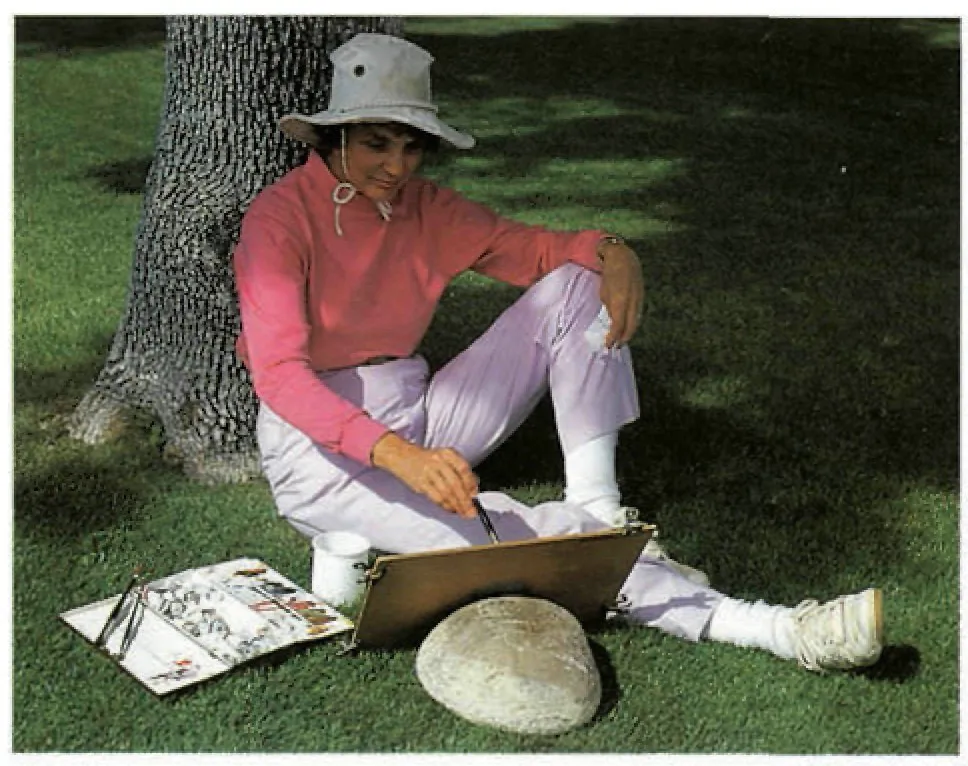
At the very least, you could have a small watercolor pan set (like you had back in grade school), a little watercolor paper tablet, a brush and a small bottle of water. It’s possible it could all fit into your jacket pocket or your purse! It’s also possible that travelling this lightly, you might have to sit on the ground and hold your painting in your lap. A good painting result is still obtainable, even with this small amount of painting equipment.
At the other end of the scale, you might have a large truck, van or trailer, wherein you could carry nearly as many painting amenities as you’d have in a home studio, and could paint while inside this vehicle, away from bugs, weather, onlookers, etc. Most of us, I suspect, will want a mobile “studio” somewhere between these two extremes.
In general, your on-location setups will depend on your way of working, where your painting spot is located, and how much time and resources you have available.
A WORD ABOUT MATERIALS
This book is concerned with painting directly from the subject—how to manage this type of painting and succeed at it—and does not delve too deeply into watercolor painting techniques. There are many fine books devoted to techniques, so there is no need to cover that subject here. However, I do want to talk about the materials that I use most often, especially for on-location watercolor painting.
WATERCOLOR PAINT
I prefer moist tube colors to the harder ones in block or pan form. I find them easier to load on the brush, easier to control. My choice of hues is related to the solar spectrum—the colors you see in a rainbow: red, orange, yellow, green, blue and violet. As artists’ colors don’t quite match the solar ones, I get as close as I can, with a “cool” and “warm” version of each.
•Reds: Scarlet Lake (warm), Alizarin Crimson, Permanent Rose (cool).
•Oranges: mixed from yellows and reds, Burnt Sienna (grayed red-orange).
•Yellows: Lemon or Hansa (cool), New Gamboge (warm), Raw Sienna (grayed middle).
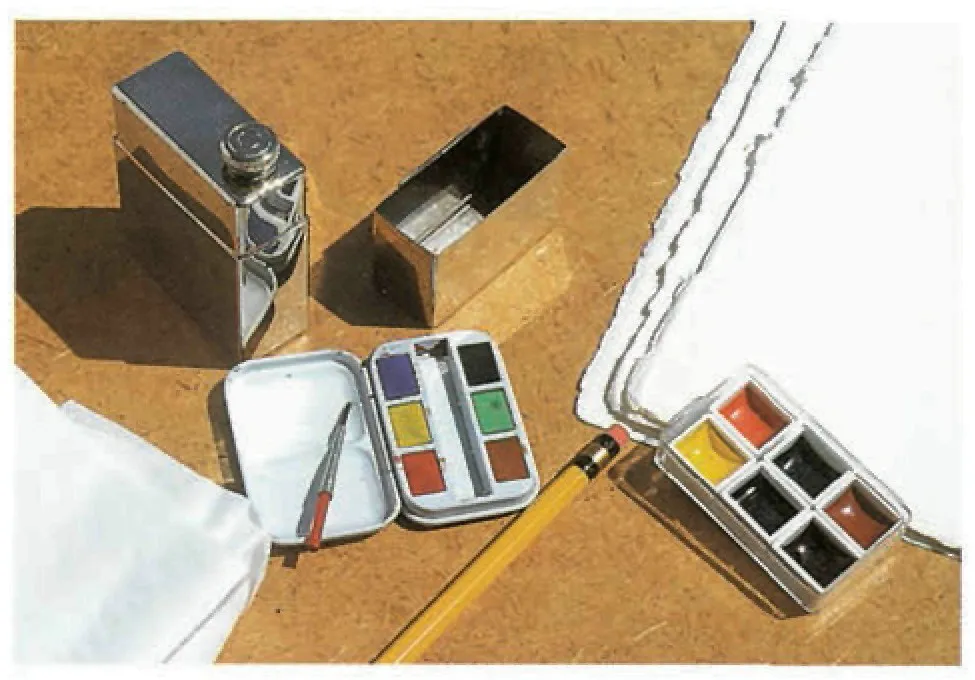
The two photos above show how very small watercolor essentials can be! The ordinary pencil gives an idea of scale. Several manufacturers make these little pan watercolor sets. In a situation where all your equipment must be kept small, painting “out of your pocket” might be the answer.
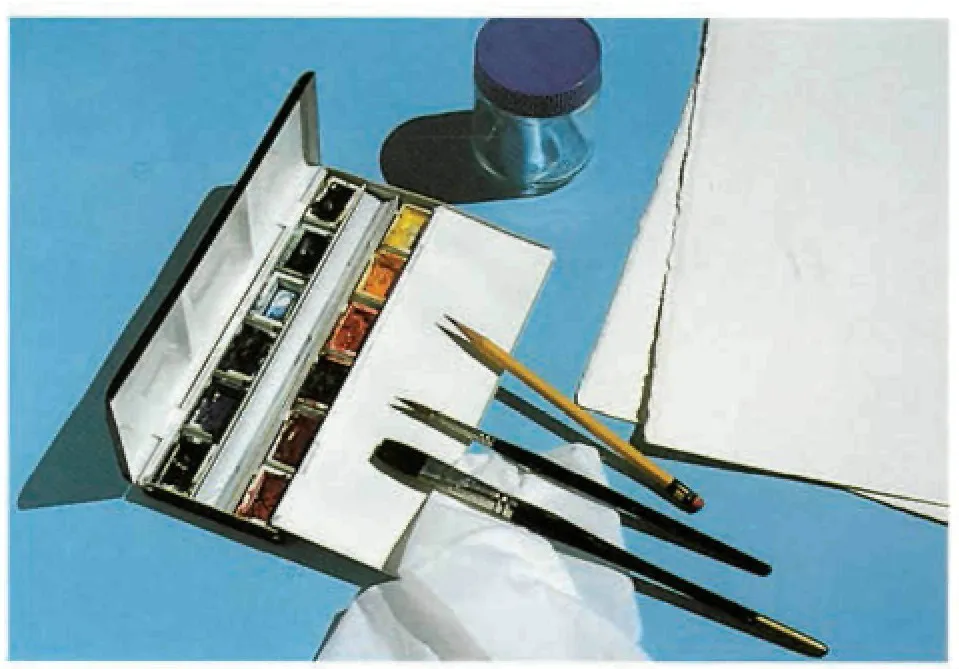
Here you can see a slightly larger paint box, allowing for larger brushes and paper, and the more versatile moist tube colors—but you’ll have to find a place to sit and something to prop your watercolor paper against!
•Greens: Mixed from yellows and blues, also Winsor or Thalo (cool).
•Blues: Ultramarine (warm), Cobalt (close to a true blue), Winsor or Thalo, Manganese or Cerulean (all cool).
•Violets: Mixed from reds and blues.
Most of my painting is done with only five or six of the above hues, occasionally more.
BRUSHES
I don’t use a lot of brushes when I paint in watercolor, preferring to do most of the work with only two or three. I’ll have a 1½-inch, 1-inch and
-inch oxhair or synthetic hair flat brush, plus a couple of sable hair round watercolor brushes, maybe a no. 10 or a no. 8, plus a no. 6. These are more expensive than oxhair or synthetic, but perform beautifully if properly cleaned and cared for. I might also use a no. 6 rigger or script brush for linear strokes. Sometimes I’ll use a ½-inch oil painting bristle brush (called a “bright”) for scrubbing out or lightening previously painted areas.
PAPER
I’ve found it best to use the handmade or mould-made papers, rather than the machine-made ones. One of my favorites is Arches, a French mould-made paper that comes in different surface textures and weights. I also like Lanaquarelle, Fabriano, Winsor & Newton, etc. I often use a 140-lb. cold-press (medium texture) paper, but I also enjoy painting on the other common surface textures of hot-press (smoother texture) and rough.
Most often, with 140-lb. paper, I’ll stretch the sheet prior to painting on it. I do this by soaking the paper in clean water long enough that it expands slightly. While it’s still damp, I staple or gum-tape the sheet around the edges to my watercolor board. When it’s dry it becomes taut and easier to paint on, because it resists buckling and wrinkling.
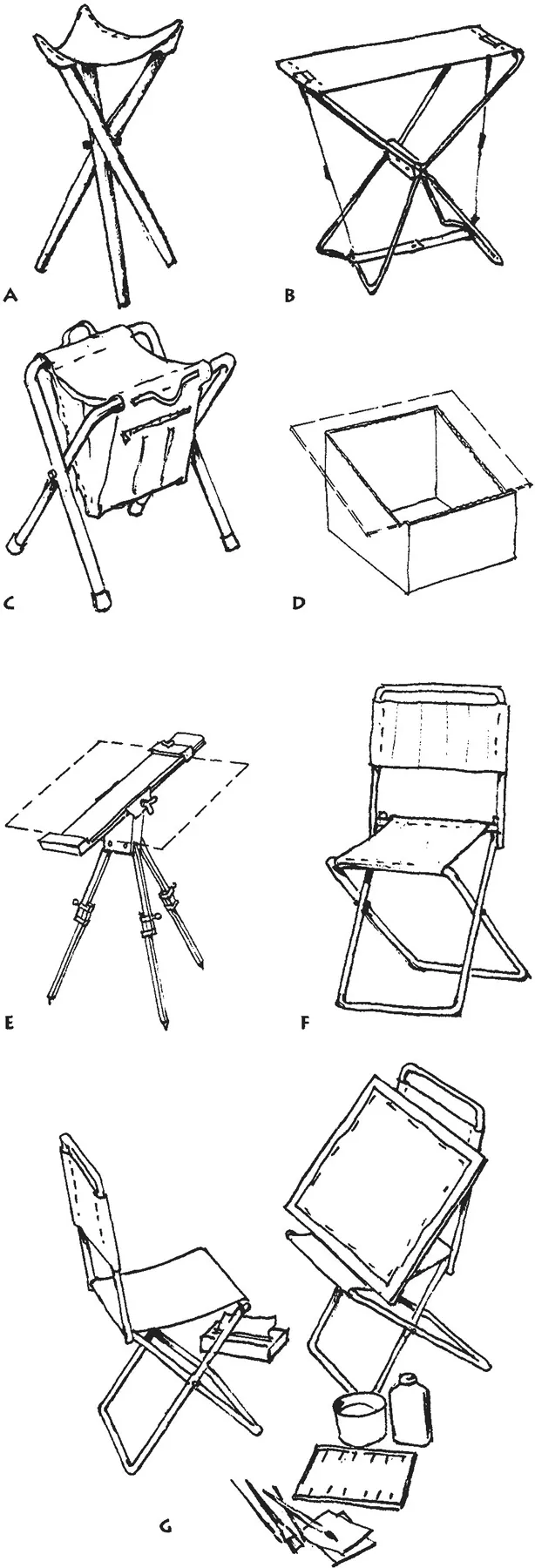
Please be seated—or would you prefer to stand? I do both, depending on the situation. Here are a few suggestions—all are lightweight and portable:
AThree-legged stool that folds and has a “saddle” seat.
BLittle “web” seat that folds to a very small size.
CReliable camp stool—this one has a canvas pouch under its seat.
DA sturdy cardboard carton, the top cut at an angle, with a notch, holds watercolor board and carries gear too! You must sit on the ground, or put the box on a table.
EA folding, adjustable wooden easel. For years I’ve had one of these; there’s an aluminum version, too.
FLightweight, folding camp chair.
GTwo folding chairs and your painting gear: an easy way to get started.
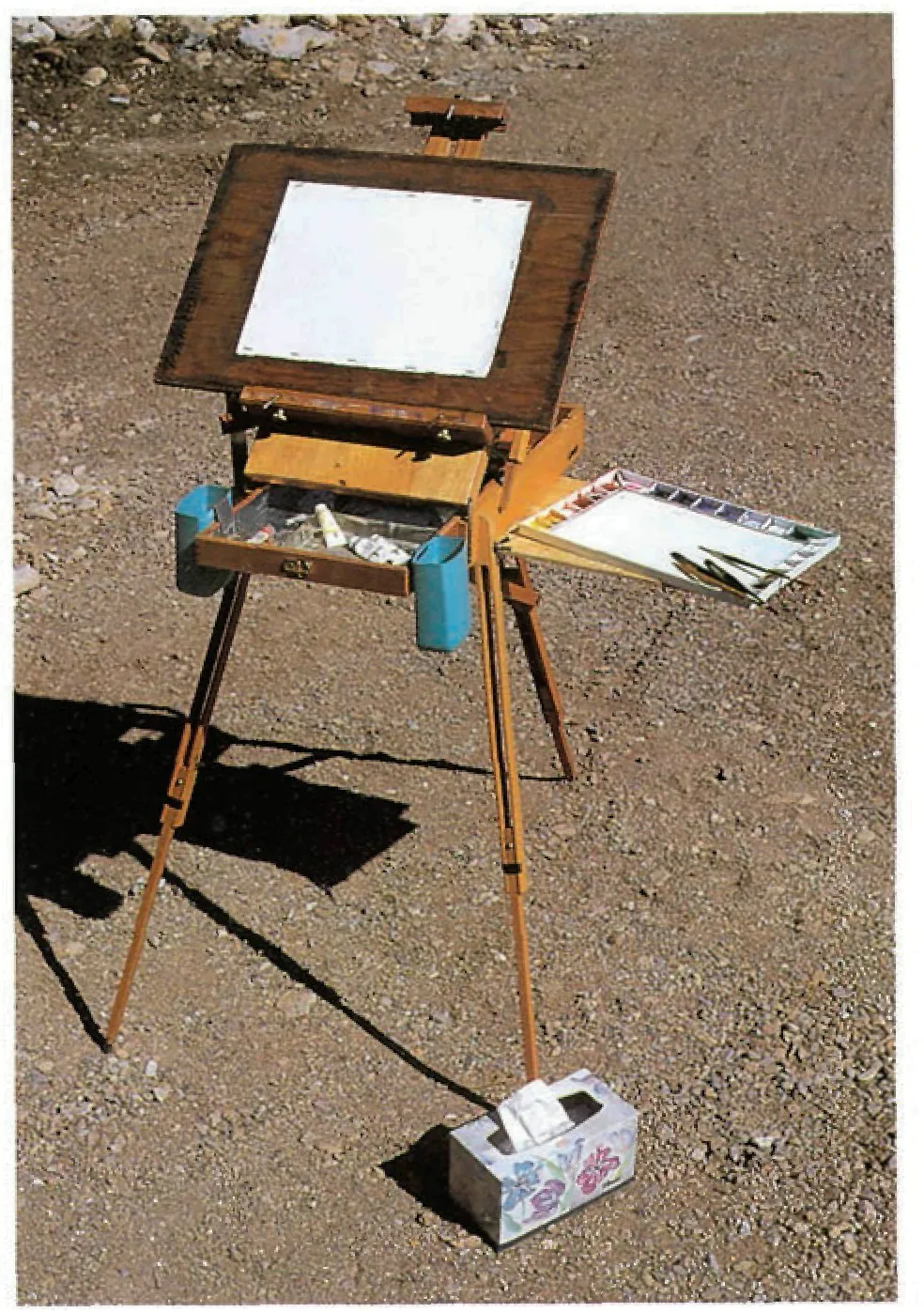
“French” easels are made for oil painters who hold their palette. This one was modified with cleats underneath, so a plywood tray could be slid in to hold the watercolor palette level.
OTHER ITEMS
I like to use two water containers when painting—one for clean, the other for dirty water....