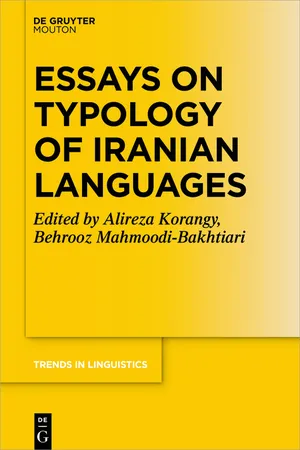
The Iranian languages are one of the world's major language families. With an estimated 150 to 200 million native speakers, these languages constitute the western group of the larger Indo-Iranian family, which represents a major eastern branch of the Indo-European languages. Geographically, the Iranian Languages are spoken from Central Turkey, Syria and Iraq in the West to Pakistan and western edged of Xinjiang Uygur Autonomous Region of China in the east. Iranian languages have long been among the major interests of the philologists and general linguists, and European scholars have made tremendous contributions to the study of this language family. In light of such efforts, now we know that the Iranian languages can be historically divided into three phases, that are old, middle and new Iranian languages, and the new Iranian languages may be generally grouped as Eastern and Western. In recent years, the orientation towards typology has led to the appearance of somewhat more ponderance on the subject but the work has not included description of some of the very important languages of the Caspian, and or of the religious minorities (such as those of the Zoroastrians or the Jewish community), of the four-fold Central Plateau dial.
eBook - ePub
Essays on Typology of Iranian Languages
- 190 pages
- English
- ePUB (mobile friendly)
- Available on iOS & Android
eBook - ePub
Essays on Typology of Iranian Languages
About this book
Information
Loss vs. expansion of gender in Tatic languages: Kafteji (Kabatei) and Kelāsi
Donald Stilo
Note: I wish to express my gratitude to the Swedish Collegium for Advanced Study, Uppsala, for its one-year invitation to join them as a fellow and for its generous support in the writing of the first draft of this chapter. I also would like to express my thanks to Geoff Haig for his feedback and comments on this chapter.
1 Introduction
In this chapter, I document a case in which two neighboring, closely related dialects, even though mostly mutually intelligible and in regular socioeconomic contact and interdependence, can still diverge from each other in striking ways. While areal phenomena and contact are important in such situations leading to convergence, divergence may also be taking place at the same time due to reasons internal to the specific dialects as well as to external factors that cause them to drift apart, e.g., areal phenomena with different isoglottic patternings encompassing one dialect but not the other; the retention of archaic features in one of these dialects as a factor of a more peripheral location; sociolinguistic attitudes; intermarriage patterns; and language shift, to name a few.
Below I will present an extreme and somewhat unique case of just such divergence on one issue: gender marking. Kafteji and Kelāsi1 are two neighboring Tatic2 dialects of the Central Tati group (Stilo 1981) that have taken the original two-term masculine/feminine gender distinction of Tatic languages – still quite robust in many members of the group but totally lost to about 40% of the Tati languages and all Talyshi and Tatoid dialects – and have each pushed the pattern in completely opposite extremes. That is, Kafteji has expanded the marking of gender beyond the grammatical domains where gender agreement is usually encoded in thes...
Table of contents
- Title Page
- Copyright
- Contents
- Acknowledgments
- Iranian languages and linguistic typology
- Ergativity in New West Iranian
- Aspect in Iranian two systems: Persian and Pashto
- Loss vs. expansion of gender in Tatic languages: Kafteji (Kabatei) and Kelāsi
- Mazandarani: A typological survey
- Referential Null Subjects (RNS) in colloquial spoken Persian: Does speaker familiarity have an impact?
- A typological study of (in)definiteness in the Iranian languages
- The quotative marker in Gilaki
- Plural marking in the New West Iranian languages and dialects: a historical and typological approach
- A typological sketch of the Jewish Iranian dialects
- Epilogue
- Index
Trusted by 375,005 students
Access to over 1.5 million titles for a fair monthly price.
Study more efficiently using our study tools.
Frequently asked questions
Yes, you can cancel anytime from the Subscription tab in your account settings on the Perlego website. Your subscription will stay active until the end of your current billing period. Learn how to cancel your subscription
No, books cannot be downloaded as external files, such as PDFs, for use outside of Perlego. However, you can download books within the Perlego app for offline reading on mobile or tablet. Learn how to download books offline
Perlego offers two plans: Essential and Complete
- Essential is ideal for learners and professionals who enjoy exploring a wide range of subjects. Access the Essential Library with 800,000+ trusted titles and best-sellers across business, personal growth, and the humanities. Includes unlimited reading time and Standard Read Aloud voice.
- Complete: Perfect for advanced learners and researchers needing full, unrestricted access. Unlock 1.5M+ books across hundreds of subjects, including academic and specialized titles. The Complete Plan also includes advanced features like Premium Read Aloud and Research Assistant.
We are an online textbook subscription service, where you can get access to an entire online library for less than the price of a single book per month. With over 1.5 million books across 990+ topics, we’ve got you covered! Learn about our mission
Look out for the read-aloud symbol on your next book to see if you can listen to it. The read-aloud tool reads text aloud for you, highlighting the text as it is being read. You can pause it, speed it up and slow it down. Learn more about Read Aloud
Yes! You can use the Perlego app on both iOS and Android devices to read anytime, anywhere — even offline. Perfect for commutes or when you’re on the go.
Please note we cannot support devices running on iOS 13 and Android 7 or earlier. Learn more about using the app
Please note we cannot support devices running on iOS 13 and Android 7 or earlier. Learn more about using the app
Yes, you can access Essays on Typology of Iranian Languages by Alireza Korangy, Behrooz Mahmoodi-Bakhtiari, Alireza Korangy,Behrooz Mahmoodi-Bakhtiari in PDF and/or ePUB format, as well as other popular books in Languages & Linguistics & Middle Eastern Literary. We have over 1.5 million books available in our catalogue for you to explore.